MCViewPoint

Opinion from a Libertarian ViewPoint

Posts Tagged ‘military intervention’

Do Not Let the ‘Lesson of 1938’ Overshadow the ‘Lesson of 1914’

Posted by M. C. on March 23, 2022

Four years of preventable and utterly pointless bloodshed ensued. Thanks to calls to oppose aggression and defend allies, what should have been a regional war in the Balkans became a major Europe-wide war. Even worse, with the Treaty of Versailles and the inclusion of the absurd “War Guilt” clause against Germany, the war set the stage for the far more destructive Second World War.

https://libertarianinstitute.org/articles/do-not-let-the-lesson-of-1938-overshadow-the-lesson-of-1914/

by Ryan McMaken

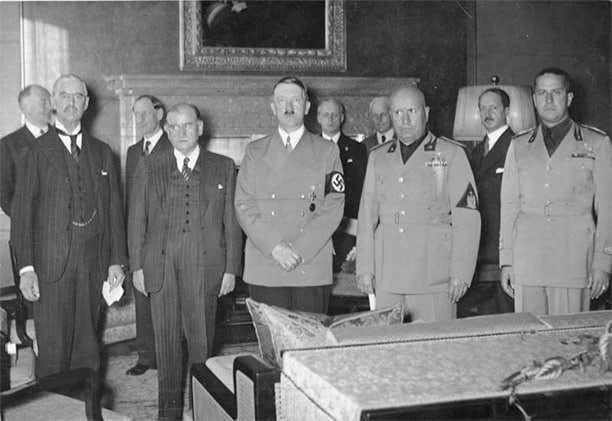
munich

With proponents of military intervention and war, it’s always 1938, and every attempt to substitute diplomacy for escalation and war is “appeasement.”

Last week, for example, Ukrainian legislator Lesia Vasylenko accused Western leaders of appeasement over Moscow’s invasion of Ukraine, stating “This is the same as 1938 when also the world and the United States in particular were averting their eyes from what was being done by Hitler and his Nazi Party.” The week before that, Estonian legislator Marko Mihkelson declared “I hope I’m wrong but I smell ‘Munich’ here. ”

These, of course, are references to the notorious Munich conference of 1938 when UK PM Neville Chamberlain (and others) agreed to allow Hitler’s Germany to annex the Sudetenland in Czechoslovakia as a means to avoid a general war in Europe. The “appeasement,” of course, failed to prevent war because Hitler’s regime actually planned to annex much more than that.

Ever since, the “Lesson of Munich” for advocates of military intervention is that it’s always best to escalate international conflicts and meet all perceived aggressors with immediate military force rather than embrace compromise or non-intervention.

Americans have made similar references with pundits from Larry Elder to Peter Singer peppering their musings on the Ukraine War with the Munich analogy. One need only enter “Munich” and “1938” into a Twitter search to receive an apparently endless number of tweets from newly minted American foreign policy experts about how anything less than World War III is Munich all over again. Historically, countless American politicians have used the analogy as well. 1980s Cold Warriors denounced Ronald Reagan’s efforts to limit nuclear weapons as Munich-style appeasement. Republicans routinely claimed Obama’s Iran diplomacy was the same.

But it is not, in fact, the case that every act of diplomacy or compromise designed to avoid war is appeasement. Moreover, we can find countless examples in which non-intervention and a refusal to escalate a situation was—or would have been—the better choice.

In other words, it’s not always 1938. Rather than fixating on the “Lesson of 1938” the better lesson to learn is often the “Lesson or 1914” or perhaps even the lessons of 1853, 1956, or 1968. In all these cases, military escalation was—or would have been—the wrong response. Moreover, in the age of nuclear weapons—something that did not exist in 1938—the world is a different place and confrontation with a nuclear power could potentially bring about the end of human civilization. Casually bandying about demands for a “no fly zone”—which would mean war with Russia—is both irresponsible and the sort of rhetoric fit for a non-nuclear world that ceased to exist many decades ago.

The Foundations of the “Lessons of Munich”

The supposed Lesson of Munich is based on two basic pillars. The first is the assumption that any act of military aggression will lead to many more acts of military aggression if not forcefully countered. It is basically a variation on the domino theory: if one nation submits to conquest by an aggressive neighbor, other nations will soon be forced to submit as well. This assumes every allegedly aggressive state has the same motivations as Nazi Germany and can plausibly seek a large, region-wide chain of military conquests across numerous states.

The second pillar of the Lesson of Munich is that, since every aggressive military act is likely to lead to many more, the only realistic option is to meet aggression with escalation, and a no-compromise response.

This is precisely why Western advocates of military adventurism repeatedly equate Hitler with every foreign leader Western elites don’t like. Or, as noted at The Conversation:

This kind of parallelism is not new; it is used every time there is a new enemy the public opinion should focus on. In recent years, according to Western rhetoric, Adolf Hitler has already been apparently reincarnated several times – as Saddam Hussein, Mohammad Qaddafi, Mahmoud Ahmadinejad, and more besides.

In 2022, Putin is the new Hitler, which necessarily means to some that any failure to respond to the Russian invasion with a full-blown military response from the West is a Munich-style appeasement.

The fact that the events of 1938 are so well known by so many has helped considerably in pushing the narrative that compromise or non-intervention is appeasement. For most Americans, it’s likely the only event in the history of diplomacy they actually know anything about. Never mind the fact that the Lesson of Munich has often been proven quite inapplicable to the modern world. As noted by Robert Kelly at the hardly non-interventionist publication 1945:

This frightening image of falling dominoes is not actually historically common though, thankfully. It was in the 1930s, but it was not, for example, in the Cold War. Aggressors do not always read one victory in place to mean they can automatically push on other ‘dominoes.’ Deterrence is structured by local and historical factors; some commitments are much more credible than others. So even though the US lost in Vietnam, North Korea or East Germany did not attack South Korea or West Germany, just as the US did not attack Cuba or Nicaragua after the Soviet defeat in Afghanistan.

In Ukraine that means that Western reticence to fight directly against the Russians in Ukraine does not automatically mean that Putin will test NATO’s collective security commitment or that China will attack Taiwan.

But none of this matters when the public believes what its told by politicians and the media about how every rogue state is the equivalent of Nazi Germany. There is no foreign-policy lesson to learn except that of opposing each new “Hitler.”

The Lesson of 1914 

Yet, there are other competing lessons to be learned. Lessons can be found, say, with the lead up to the Crimean War in 1853 or the July Crisis of 1914. (Ask the average American about either of these and you will probably receive a blank stare.)

In both of these cases, regimes claimed they were countering aggression by foreign states and protecting either “allies” or oppressed minorities in the lands being subjected to conquest.

The lead up the First World War provides an especially cautionary tale in which the major powers rushed to intervene in the name of supporting allies. The Austrian regime issued an ultimatum to the Serbians, and the Russians—with the support of France, Europe’s biggest democracy—mobilized in support of traditional ally Serbia. The Germans then mobilized in support of Austria-Hungary. Later, the regimes in the United Kingdom and the United States employed propaganda about alleged German war crimes in Belgium to ensure their respective countries entered the war. British politicians also claimed they must intervene to assist Britain’s Entente allies in resisting aggression. Four years of preventable and utterly pointless bloodshed ensued. Thanks to calls to oppose aggression and defend allies, what should have been a regional war in the Balkans became a major Europe-wide war. Even worse, with the Treaty of Versailles and the inclusion of the absurd “War Guilt” clause against Germany, the war set the stage for the far more destructive Second World War.

Yet, the war was a result of regimes doing—from their own perspectives—what the “Lesson of Munich” dictates: rush to war and immediately escalate and confront “enemies” with military force in the name of countering aggression.

The Lesson of 1914 is certainly instructive today. Escalation is extraordinarily unwise, especially if there is the potential of turning limited wars into mega-scale disasters. Moreover, in the case of the United States, the complexity of the war’s causes meant there was no justifiable reason at all for the United States to enter. There was no “good guy” in the war and American participation only further extended the bloodshed.

Fortunately, in spite of its pretensions of being the global guarantor of freedom always and everywhere, the United States has, at least twice, behaved as if it has learned the Lesson of 1914. The first was in 1956 when Soviet tanks rolled into Hungary when the  Hungarian regime—an ostensibly sovereign state—became too uppity to suit Moscow. So, Soviet military might moved in to ensure Hungary remained sufficiently under Moscow’s control. Thousands of Hungarians were killed. Did NATO mobilize against this aggression? Did Eisenhower ready America’s bombers? No.

Then, in Prague in 1968, Czechoslovakian resistance to Moscow led to an invasion of 200,000 foreign troops and 2,500 tanks from the pro-Soviet regimes of the Warsaw Pact. Again, the United States took no action.

This, of course, was the right decision on the part of the U.S. and NATO. Heeding the Lesson of Munich, on the other hand, would have meant direct confrontation between NATO and the Soviet Union—a de facto confrontation between the United States and the USSR. This would have greatly increased the likelihood of global nuclear war.

Naturally, some anti-Soviet activists cried “appeasement!” at the time. Fortunately, they were ignored. A curious difference between 1956 and now, however, is that at the time most of the critics of American inaction were on the anti-Soviet Right. Today, it is the Left where we mostly find those howling about Munich and blithely pushing for a U.S.-Russia war while downplaying the risk of a nuclear apocalypse. But those who are now demanding for World War III are a cautionary example of what happens when we obsess over the Lesson of 1938 and ignore the Lesson of 1914.

This article was originally featured at the Ludwig von Mises Institute

Be seeing you

Posted in Uncategorized | Tagged: , , , , | Leave a Comment »

Kamala Harris Is Basically Obama-Clinton 2.0, but Worse | Mises Institute

Posted by M. C. on August 13, 2020

On foreign policy, for instance, Harris is not significantly different from Hillary Clinton, Barack Obama, Susan Rice, Joseph Biden, or other high-ranking US officials who have been happy to perpetuate endless wars across the globe in recent decades. According to her official campaign site, no region of the globe is off-limits to US intervention so long as the US intervenes multilaterally. It’s just the Clinton-Obama doctrine yet again. In usual Washington doublespeak fashion, she says she is in favor of ending the war in Afghanistan but insists that the US must maintain a presence there to prop up the Afghani regime. She has advocated continued military intervention in Syria. 

Harris is very much an advocate of the conspiracy theory that Russians “hacked” the 2016 election and remain a major threat to US security.

On the environment, she supports a “Green New Deal,” which we would today expect from any Democrat running for the White House. This means immense amounts of new subsidies for “green energy,” paid for with new taxes and a host of new regulations on private businesses. It means global management of carbon emissions in line with international agreements like the Paris accords.

On economic policy, it’s the usual interventionist slate of policies. She wants to “empower” labor unions, more heavily regulate employers, and aggressively prosecute businesses for a variety of “crimes” that run afoul of the intricate labyrinth of federal laws managing the financial sector. Fiscal policy is sure to be what we’ve come to expect from both Republicans and Democrats: endless deficit spending.

Harris has lauded federally imposed mandates like “forced busing,” in which federal courts dictate public schools’ enrollment policies in the name of racially desegregating schools.

https://mises.org/power-market/kamala-harris-basically-obama-clinton-20-worse?utm_source=Mises+Institute+Subscriptions&utm_campaign=dd0d73cb0f-EMAIL_CAMPAIGN_9_21_2018_9_59_COPY_01&utm_medium=email&utm_term=0_8b52b2e1c0-dd0d73cb0f-228343965

Ryan McMaken

Listen to the Radio Rothbard version of this article.

Presidential candidate and former vice president Joseph Biden announced Kamala Harris as his running mate today. Harris is currently a US senator from California and the former attorney general for the state. Biden’s choice brings her back to the fore of the 2020 race after having dropped out as a presidential candidate in early December.

In many ways, Harris dropped out because she had trouble setting herself apart from other candidates such as Biden, representing the mainstream of the Democratic Party. While Elizabeth Warren and Bernie Sanders represented in many respects the far left of the Democratic coalition, Harris was just one of several establishment Democrats in the race, and competed for many of the same fundraising dollars as Biden and Amy Klobuchar.

By picking Harris, Biden—or whoever is making these decisions for Biden—will likely placate the Obama-Clinton power brokers in the party who privately oppose lawmakers like Warren and Alexandria Ocasio-Cortez, who are viewed by establishment Democrats as candidates who often alienate middle-class Middle American voters. At the same time, Harris is likely to satisfy—or at least silence—critics on the party’s left wing, who have long called for a black woman on the presidential ticket.

In 2020, the choice of a vice-presidential candidate is especially high-stakes, because many believe Biden will be either unwilling or unable to run for president in 2024. This sets Harris up as the heir-apparent leader of the party. Because Biden will be the oldest man to ever enter the presidency, and because he is clearly not in excellent health, it is known that Harris has a good chance of succeeding him directly in case he dies or becomes seriously ill.

But although Harris is “demographically correct” for the party’s left wing, she remains basically a social climber who is very well ensconced in the mainstream of the party—although the party’s mainstream has itself moved considerably to the left in recent years.

On foreign policy, for instance, Harris is not significantly different from Hillary Clinton, Barack Obama, Susan Rice, Joseph Biden, or other high-ranking US officials who have been happy to perpetuate endless wars across the globe in recent decades. According to her official campaign site, no region of the globe is off-limits to US intervention so long as the US intervenes multilaterally. It’s just the Clinton-Obama doctrine yet again. In usual Washington doublespeak fashion, she says she is in favor of ending the war in Afghanistan but insists that the US must maintain a presence there to prop up the Afghani regime. She has advocated continued military intervention in Syria.

Harris is very much an advocate of the conspiracy theory that Russians “hacked” the 2016 election and remain a major threat to US security.

On the environment, she supports a “Green New Deal,” which we would today expect from any Democrat running for the White House. This means immense amounts of new subsidies for “green energy,” paid for with new taxes and a host of new regulations on private businesses. It means global management of carbon emissions in line with international agreements like the Paris accords.

On economic policy, it’s the usual interventionist slate of policies. She wants to “empower” labor unions, more heavily regulate employers, and aggressively prosecute businesses for a variety of “crimes” that run afoul of the intricate labyrinth of federal laws managing the financial sector. Fiscal policy is sure to be what we’ve come to expect from both Republicans and Democrats: endless deficit spending.

Harris has lauded federally imposed mandates like “forced busing,” in which federal courts dictate public schools’ enrollment policies in the name of racially desegregating schools.

In all of this, we don’t find very much at all that differs from the eight years of the Obama administration. It’s the usual center-left policy agenda we’ve seen since at least the 2008 election.

What is especially dangerous now, however, is that the political context has changed considerably. Both major US parties have adopted far more interventionist stances in terms of fiscal policy, monetary policy, and in terms of domestic police power. What’s more, the presidency has slowly been moving toward a rule-by-decree model for decades, in which the president essentially rules through executive orders and Congress only intervenes on occasion. The Trump administration has only accelerated this trend.

This is likely music to Kamala Harris’s ears. Harris, after all, as a former prosecutor and as a presidential candidate has never shied away from aggressive use of executive power.

As Tyler Curtis has noted:

Over the course of her campaign, she has repeatedly promised to bypass Congress and take unilateral action on a whole host of intensely divisive issues. On immigration, she has vowed to issue an executive order granting citizenship to “Dreamers” (migrants brought to America illegally by their parents). On the environment, she says she will declare a “state of water emergency” and force the country to re-join the Paris Climate agreement. She also wants to ban the use of fracking.

Many observers have noted how dictatorial these statements sound, and rightly so. To follow through on any one of these proposals would be deeply suspect, but the sheer number of them, coupled with Harris’ brazenly peremptory attitude, must leave no doubt as to her authoritarian ambitions.

For Harris, Congress is at best merely an advisory body. As a kindly gesture, the President may ask Congress for permission to do something, but he or she does not really require their assent.

Harris has even said she would do an end run around Congress on gun control:

upon being elected, I will give the United States Congress 100 days to get their act together and have the courage to pass gun safety laws. And if they fail to do it, then I will take executive action. And specifically what I’ll do is put in place a requirement that for anyone who sells more than five guns a year, they are required to do background checks when they sell those guns.

These are the words of a politician who views the role of the president as an elected dictator. Many presidents, of course—including Donald Trump—have likely viewed things this way, but it’s now easier than ever for a president to carry out these “promises” in which presidents don’t wait for Congress to pass duly enacted laws. That’s the old way of doing things. The new way is to follow Barack Obama’s strategy of using “a pen and a phone” to issue diktats without the inconvenience of involving an elected legislature.

No doubt, many of Harris’s detractors will call her radical or a tool of the far left. The reality is actually far more alarming. Radicals have a tendency to lose political battles, because they often stand on principle. Harris is unlikely to have that problem. She is very much a savvy player who fits in well within the party’s mainstream and who will carry on the center-left political program as we’ve come to expect it from the likes of Hillary Clinton or Barack Obama. There’s not much here that’s new. What has changed, however, is that we live in a country where presidents are ever more rapidly becoming unrestrained in taking unilateral action to do what they want. In ages past it might have been reasonable to assume the Congress might effectively intervene to restrain a president’s less popular and more radical proposals. That vision of the US regime is looking more unrealistic than ever.


Be seeing you


Posted in Uncategorized | Tagged: , , , , | Leave a Comment »