
MCViewPoint

Opinion from a Libertarian ViewPoint

Posts Tagged ‘Military Strength’

America’s Military Is Misdirected, Not Underfunded – Defense One

Posted by M. C. on November 4, 2019

The real problem with current U.S. security strategy is that it is aimed at the wrong targets and employs the wrong tools to deal with the most urgent challenges we face.

https://www.defenseone.com/ideas/2019/11/americas-military-misdirected-not-underfunded/161025/

U.S. strategy should be more focused on preventing conflict with nuclear-armed China than on spinning out elaborate war-fighting scenarios.

The Heritage Foundation released its 500-page index of military strength this week. Unfortunately, what it achieves in length is undermined by its stale and unpersuasive assumptions.

As usual, Heritage gives all of the military services low marks. While there’s always room for improvement, the Heritage methodology seems arbitrary at best, and misleading at worst. The biggest complaint in the index is that America’s military is a “one-war force” that could not win simultaneous wars against Russia and China. But the two-war standard is a convenient myth that has historically had more to do with justifying high Pentagon budgets than it has with any rational assessment of the primary security challenges facing the United States and its allies.

The Center for International Policy’s Sustainable Defense Task Force – a group of ex-White House and Congressional budget experts, ex-military and Pentagon officials, and representatives of think tanks from across the political spectrum – takes a different view of the issue of great power rivalry.

Our European allies spend three times as much on their military forces as Russia does. Given better coordination and a more coherent strategy, they are more than capable of taking the lead in addressing any conceivable military challenge posed by Russia, with a reduced level of direct U.S. support. In any case, the greatest threats posed by the Putin regime – hybrid warfare, nuclear weapons, support for divisive nationalist parties, and cyber-attacks – cannot be dealt with by traditional military means.

Related: The National Defense Strategy Is No Strategy

Related: What’s Great Power Competition? No One Really Knows

Related: Is the Pentagon Truly Committed to the National Defense Strategy?

As for China, its biggest long-term challenge is economic, not military. Beijing’s aggressive global infrastructure initiatives are garnering priority access to key resources, and its steady economic growth could allow it to catch up with the U.S. military within the next two decades. But there is much that can be done to head off that eventuality, and the primary tool for doing so should not be bulking up the U.S. naval presence in the Pacific.

U.S. strategy should be more focused on preventing conflict with China – a war between two nuclear powers that would be a disaster for all concerned – than on spinning out elaborate war-fighting scenarios…

U.S. policy towards Russia and China should seek areas of potential cooperating rather than assuming unending confrontation. Climate change and nuclear arms control are two promising avenues for joint effort. As happened during the Cold War, nuclear arms control can be pursued even during periods of tension between Washington and Moscow. Reversing the Trump administration’s efforts to dismantle the carefully crafted hard-won system of global nuclear arms control – from abandoning the multilateral deal to curb Iran’s nuclear program to walking away from the Intermediate-Range Nuclear Forces treaty – needs to be reversed, and the sooner the better. And there will be no progress on climate change without substantial cooperation between the world’s two largest emitters of greenhouse gases.

The truth is, a policy that takes a more realistic view of great power rivalry; abandons planning for large-scale counterinsurgency and nation building initiatives like those that have been pursued in Iraq and Afghanistan; adopts a deterrence-only nuclear strategy along the lines outlined by the organization Global Zero; and cuts excess bureaucracy could allow for at least a 10 percent reduction in the size of the U.S. military and save $1.2 trillion from current Pentagon plans over the next decade.

In short, when it comes to U.S. military spending and capabilities, the sky is not falling, whatever the new Heritage analysis may allege. In fact, the United States is projected to spend over $1 trillion more during the decade covered by the Budget Control Act than in the prior decade, when the U.S. interventions in Iraq and Afghanistan were at peak levels…

Be seeing you
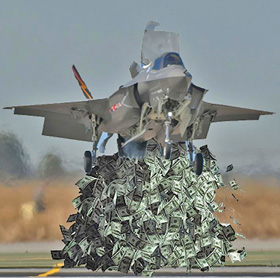
f35-moneydump


Posted in Uncategorized | Tagged: , , , , , | Leave a Comment »

Tomgram: William Astore, Military Strength Is Our National Religion | TomDispatch

Posted by M. C. on August 14, 2019

http://www.tomdispatch.com/post/176596/tomgram%3A_william_astore%2C_military_strength_is_our_national_religion/#more

Posted by William Astore

After almost 18 years of the war (or rather wars) on (or perhaps of) terror, there’s some good news! The Washington Post reports that American troops are finally coming home from Afghanistan! Actually, let me amend that slightly. They will only come home if Taliban and U.S. negotiators complete a deal by September that leads to a countrywide ceasefire (and if the Taliban agrees to certain other conditions as well). In fact, let me amend that one more time: “they” turns out to refer to the withdrawal of just about 5,000 U.S. military personnel, leaving 8,000-9,000 U.S. troops still in place after “peace” breaks out.

For Donald Trump who, years ago, repeatedly demanded that the Afghan War be ended and all American troops brought home, only to agree in mid-2017 to dispatch another 4,000 of them to that land, such a peace pact would just return U.S. troop levels to more or less what they were at that moment two years ago. In the age of Trump, that, I suppose, is the definition of “progress” in America’s never-ending wars. Perhaps you won’t be surprised to also learn that, according to the Post, the U.S. commander in Afghanistan, General Austin Miller, is “open” to such a peace proposal precisely “because he believes it would protect U.S. interests by maintaining a counterterrorism force that can strike the Islamic State and al-Qaeda.” If one were to turn this into a riddle, it might go something like: When is a Trumpian withdrawal hardly a withdrawal at all?

On the other hand, don’t let any of this worry you. The troops may not be coming home, but the wars have been on their way here for a long time. That should have been obvious at least since, in 2014, local police, using equipment off America’s distant battlefields, made such a public splash in responding to protests in Ferguson, Missouri. From thousands of troops sent to the U.S.-Mexican border to the Pentagon spy drones that have long flown over parts of the U.S., further examples of the growing militarization of this country abound. Perhaps the most recent, as reported by the Guardian, is the news that the military is now “conducting wide-area surveillance tests across six Midwest states using experimental high-altitude balloons… Travelling in the stratosphere at altitudes of up to 65,000 feet, the balloons are intended to ‘provide a persistent surveillance system to locate and deter narcotic trafficking and homeland security threats,’ according to a filing made on behalf of the Sierra Nevada Corporation, an aerospace and defense company. The balloons are carrying hi-tech radars designed to simultaneously track many individual vehicles day or night, through any kind of weather.”

As it happens, almost unnoticed, America’s twenty-first-century wars have been coming home in another way as well: in the increasingly worshipful attitudes of so many Americans (especially those in the seats of power in Washington, D.C.) toward the Pentagon and the U.S. military, as vividly described today by retired Air Force lieutenant colonel, historian, and TomDispatch regular William Astore. Tom

In Wars and Weapons We Trust
America’s Militarized Profession of Faith
By William J. Astore

When I was a teenager in the 1970s, I looked to the heavens: to God and Christianity (as arbitrated by the Catholic Church) and to the soaring warbirds of the U.S. military, which I believed kept us safe. To my mind then, they were classic manifestations of American technological superiority over the godless Communists.

With all its scandals, especially when it came to priestly sexual abuse, I lost my faith in the Catholic Church. Indeed, I would later learn that there had been a predatory priest in my own parish when I was young, a grim man who made me uneasy at the time, though back then I couldn’t have told you why. As for those warbirds, like so many Americans, I thrilled to their roar at air shows, but never gave any real thought to the bombs they were dropping in Vietnam and elsewhere, to the lives they were ending, to the destruction they were causing. Nor, at that age, did I ever consider their enormous cost in dollars or just how much Americans collectively sacrificed to have “top cover,” whether of the warplane or godly kind.

There were good and devoted priests in my Catholic diocese. There were good and devoted public servants in the U.S. military. Admittedly, I never seriously considered the priesthood, but I did sign up for the Air Force, surprising myself by serving in it for 20 years. Still, both institutions were then, and remain, deeply flawed. Both seek, in a phrase the Air Force has long used, “global reach, global power.” Both remain hierarchies that regularly promote true believers to positions of authority. Both demand ultimate obedience. Both sweep their sins under the rug. Neither can pass an audit. Both are characterized by secrecy. Both seem remarkably immune to serious efforts at reform. And both, above all, know how to preserve their own power, even as they posture and proselytize about serving a higher one…

“Show me your budget and I will tell you what you value” is a telling phrase linked to Joe Biden. And in those same terms, there’s no question what the American government values most: its military, to the tune of almost $1.5 trillion over the next two years (although the real number may well exceed $2 trillion). Republicans and Democrats agree on little these days, except support for spending on that military, its weaponry, its wars to come, and related national security state outlays…

In that context, I’ve been wondering what kind of “profession of faith” we might have to recite, if there were the equivalent of Mass for what has increasingly become our military church…

* We believe in wars…

* We believe in weaponry, the more expensive the better…

* We believe in weapons of mass destruction. We believe in them so strongly that we’re jealous of anyone nibbling at our near monopoly…

* We believe with missionary zeal in our military and seek to establish our “faith” everywhere. Hence, our global network of perhaps 800 overseas military bases…

* We believe in our college of cardinals, otherwise known as America’s generals and admirals…

* We believe that freedom comes through obedience…

* We believe military spending brings wealth and jobs galore, even when it measurably doesn’t…

* We believe, and our most senior leaders profess to believe, that our military represents the very best of us, that we have the “finest” one in human history.

* We believe in planning for a future marked by endless wars, whether against terrorism or “godless” states like China and Russia, which means our military church must be forever strengthened in the cause of winning ultimate victory.

* Finally, we believe our religion is the one true faith…

Be seeing you

Vietnam-Era Zippos Engraved With Soldier's Personalities


Posted in Uncategorized | Tagged: , , , | Leave a Comment »