


This is a very lengthy dissertation on Libertarian philosophy and the hazards of being true to it and ones self.
For the curious inquiring mind.
https://substack.com/home/post/p-162876132
[I would like to personally thank Walter Block and David Friedman, whom I regard as leading and admirable figures in the libertarian community, for their comments on the draft of this article.
I devoted an entire section of this article to responding to Professor Friedman, in an effort to engage with the thoughtful and valid feedback he offered on my draft. I hope that this critique of a critique reflects nothing more than deep intellectual respect. Any disagreement does not—and cannot—diminish the importance of Professor Friedman, his contributions to economic thought, to libertarian theory, and his personal influence on my own thinking.
I chose to write at length on this topic and to include Professor Block in this post as a gesture of appreciation for his tireless courage in standing by his views, even when doing so went against the grain and came at a high personal cost. Nothing deterred him from doing what he believed was intellectually right. For that reason, he deserves an article dedicated to him.]
Introduction
Intellectual ideas, no matter how meticulously conceived, often take on a life of their own once released into the world. Their trajectory depends not only on the precision of their articulation but also on how they are received, interpreted, and applied by others. While some ideas inspire transformative progress, others fall victim to distortion, misinterpretation, and outright misuse. History shows that intellectual legacies are powerful yet vulnerable – ideas evolve over time and are frequently interpreted in ways their originators never intended. The challenge for any intellectual movement is to preserve the integrity of core principles while allowing healthy evolution in response to new contexts.
Walter Block, a renowned libertarian economist, serves as a cautionary tale of how even well-intended ideas can evolve in unintended and troubling directions. Block’s groundbreaking work Defending the Undefendable (1976) provoked readers by defending the economic utility of socially reviled professions within a free-market framework. His nuanced argument emphasized that as long as these controversial actors operated voluntarily and without coercion, they could play a functional role in the economic system. Block sought to challenge moralistic judgments without undermining the ethical foundations of libertarianism – foundations rooted in the non-aggression principle (NAP) and voluntary exchange. Renowned economists like Murray Rothbard and F. A. Hayek praised Block’s approach; Hayek likened it to a “shock therapy” that, though strong medicine, ultimately “disabuses [readers] of many dear prejudices” ( Defending the Undefendable ). In short, Defending the Undefendable was an audacious defense of liberty’s less popular applications, intended to illuminate how even “unsavory” voluntary interactions can uphold free-market principles.
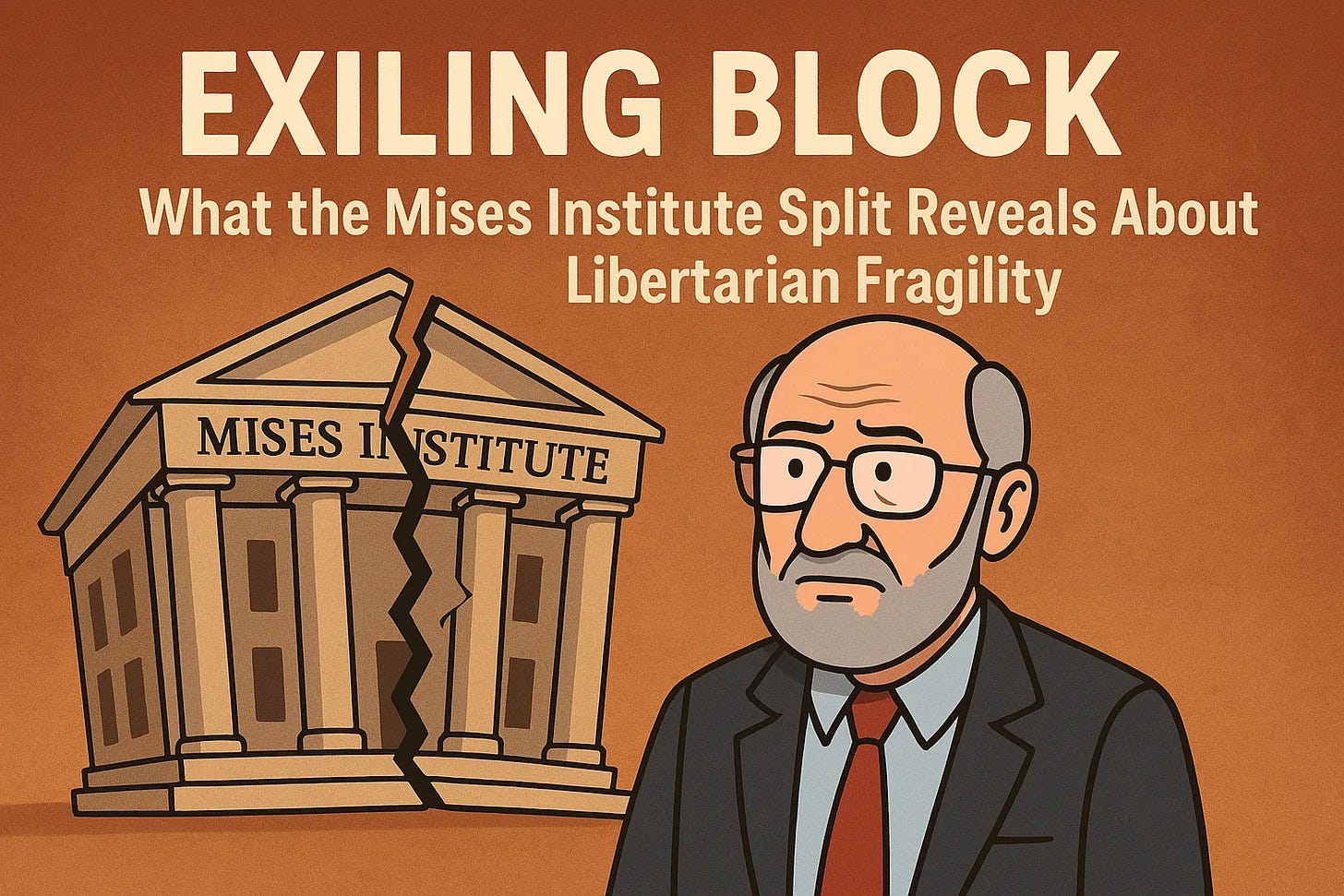
Over time, however, factions within the libertarian movement radically misinterpreted Block’s ideas. Rather than understanding his defense of controversial economic actors as a thought experiment grounded in voluntaryism, these factions adopted a contrarian absolutism that abandoned the very ethics Block championed. They began to argue that libertarians had a moral obligation to defend the most egregious of actors – even violent regimes or terrorists – so long as those actors opposed a state or authority deemed illegitimate. This nihilistic interpretation betrayed the principles of non-aggression and individual rights, effectively excusing coercion and immorality under the guise of “defending liberty.” Ironically, Block himself would become a victim of this distortion. In 2023, Walter Block was expelled from the Mises Institute – an academic institution he helped shape – after he publicly defended Israel’s right to self-defense against Hamas. Block’s stance, grounded in libertarian principles of non-aggression and the protection of innocent life, clashed with factions that had come to equate all state actions with evil. The very followers who claimed to champion his ideas had weaponized a distorted version of his philosophy to ostracize him.
Here, I attempt to examine the evolution of Block’s ideas and their misinterpretation, situating this phenomenon within the broader context of libertarian thought. I will talk about how thinkers like Murray Rothbard and Hans-Hermann Hoppe – towering figures in libertarian philosophy – influenced a strain of anti-statism so radical that it veered into moral paradox. In tracing these dynamics, I try to maintain the main thesis that Block’s foundational ideas from Defending the Undefendable were misinterpreted by radical factions, turning an intellectual exercise into a caricature of its original intent.
I then address comments made by economist David D. Friedman in response to an earlier draft of this article. Friedman offered a friendly but critical review, raising concerns about the argument’s structure, the sufficiency of its evidence, and the interpretation of Walter Block’s intellectual influence. His critique provided a valuable opportunity for me to sharpen the article’s claims and make it clearer. The main point in my rebuttal is to show that the misinterpretation of Block’s ideas is not merely a matter of contrarian posturing or political alignment, but reflects a deeper philosophical error in the form of a reflexive, anti-state bias that excuses violence when committed by non-state actors.
Finally, I will try to explore a secondary theme; that Block’s plight is not unique: many historical thinkers saw their ideas distorted, often to their own detriment. To underscore this, I draw historical parallels with other thinkers whose theories were co-opted or twisted by later followers – from Nietzsche to Marx – illustrating the recurring dangers of ideas removed from their ethical moorings.
Walter Block’s Vision: A Nuanced Defense of Liberty
Walter Block’s Defending the Undefendable stands as one of the most provocative and daring works in modern libertarian thought. In it, Block tackled deeply controversial subjects by defending individuals and professions that society often vilifies – pimps, prostitutes, slumlords, blackmailers, drug dealers, and more. His goal was not to celebrate these people’s choices or morality, but to challenge knee-jerk societal condemnations of their economic roles in a free market. Block argued that these actors, so long as they operate without coercion or fraud, engage in voluntary exchanges that can yield mutual benefit. In a free-market context, even disreputable services have willing customers; by fulfilling a demand through voluntary trade, these “villains” provide value (however unseemly it may appear) and thus play a part in the market’s functioning. For example, a slumlord offers housing that, while low-quality, might be the only affordable option for certain tenants – serving a need that would otherwise go unmet. A loan shark, charging high interest to high-risk borrowers excluded from banks, still provides access to credit that can be life-saving for someone with no alternatives. Block’s point was that outlawing or condemning these voluntary arrangements outright often harms the very people society intends to protect, by driving transactions underground or eliminating options for the poorest. In highlighting the often-ignored economic function of such pariahs, Block forced readers to disentangle economic outcomes from moral approval. One can find an exchange mutually beneficial in a strict market sense without endorsing it morally.
Block’s libertarian philosophy is rooted in two foundational principles: the Non-Aggression Principle (NAP) and respect for voluntary exchange. The NAP holds that it is inherently immoral to initiate force or fraud against another person; violence is only justified in defense against aggression. This principle provides the ethical cornerstone for libertarianism, setting a bright-line rule against coercion. Voluntary exchange, meanwhile, is the lifeblood of the free market: if two parties consent to a trade, and neither uses force, then by definition each expects to be better off from the deal – otherwise they wouldn’t agree to it. Mutual consent implies mutual benefit, as Block emphasizes: “In neither case is force or fraud applied”, he writes of both an ordinary business trade and a prostitute’s contract with a client. Together, NAP and voluntarism delineate the domain of legitimate human action in Rothbardian-libertarian eyes. Block’s innovation was to apply these principles to extreme cases that most people overlook or reject out of hand. He asked uncomfortable questions: If a transaction between a prostitute and a customer is voluntary, why is it fundamentally different from any other service for pay? If no one is forced to live in a slum apartment, can we categorically condemn the landlord for offering cheap (if shabby) housing that people freely accept? By pushing these examples, Block sought to demonstrate a broader point: the morality of a free market cannot be judged by our visceral dislike for the participants. What matters is consent versus coercion, not whether we personally approve of the people or services involved.
It is crucial to note that Block’s defense of the “undefendable” was not moral relativism nor an endorsement of crime. He did not argue that all actions undertaken by, say, a pimp or a blackmailer are good or acceptable. If any of these actors resorted to force, fraud, or the violation of rights, Block would firmly condemn them – consistent with libertarian ethics. His defense was carefully circumscribed: he only defended those actions that remained within the bounds of voluntary interaction. For instance, the pimp who uses threats or violence to control prostitutes is initiating aggression and is not defended; but the pimp who simply connects willing adult sex workers with clients in exchange for a fee is, in Block’s view, providing a voluntary mediation service (one might still find it distasteful, but it’s arguably a mutually agreed arrangement). Likewise, Block would never defend a slumlord’s outright negligence or fraud – only the basic fact that providing low-cost, low-quality housing to a willing tenant is a consensual exchange. In essence, Block was drawing a line: society’s visceral moral outrage often lumps together voluntary vice with actual aggression, but libertarians must be careful to only forbid the latter. As he and many classical liberals see it, “victimless crimes” are not crimes at all in a truly free society ( Defending the Undefendable ). Selling sex, drugs, or charging high interest may be sinful or unsavory to some, but if all parties consent, there is no rights-violation – and using the state’s coercive power to stop it would itself violate the NAP.
Block’s intention was as much educational as polemical. Defending the Undefendable uses shock value to jolt readers into questioning their assumptions. It asks us to apply libertarian principles consistently, even when our emotions or social conventions pull us in the opposite direction. By doing so, Block was testing the robustness of libertarian theory: if the free market and non-aggression principles truly promote human welfare, they should hold up even in “extreme” cases. Indeed, Rothbard lauded Block’s book for demonstrating “the workability and morality of the free market” far better than any dry theoretical tome – by “taking the most extreme examples”, Block illustrates that the principles still apply and thus “vindicates the theory”. In other words, if the theory can justify the hard cases, it reinforces its validity for the ordinary cases too. Block’s work served as a bold reminder that libertarianism isn’t just a fair-weather philosophy to be applied only to socially approved activities; it’s meant to be a principled framework, even when it leads to uncomfortable conclusions. This rigorous consistency is part of what Block (following Mises and Rothbard) saw as the moral strength of libertarian political economy.
However, the very boldness and provocative style of Block’s argument left it vulnerable to misinterpretation, especially by readers inclined to ideological extremism. By defending society’s pariahs in economic terms, Block ran the risk that some would miss the nuance and take his thesis too far. Over the decades after 1976, that risk materialized: factions of self-identified libertarians began to twist Block’s ideas into a blanket apologia for anyone labeled “bad” or “enemy” by mainstream society, regardless of whether those actors upheld libertarian ethics. What Block intended as an intellectual exercise – a nuanced defense of voluntary interactions and a critique of legal moralism – was gradually transformed by others into a much more sweeping and unprincipled stance. Before exploring how this distortion occurred, it is necessary to delve into the intellectual climate fostered by two of Block’s major influences and colleagues: Murray Rothbard and Hans-Hermann Hoppe. Both thinkers made enormous contributions to libertarian theory, but both also cultivated a strain of radical anti-statism that, taken to an extreme, helped lay the groundwork for the very misinterpretations that later ensnared Block’s legacy.
Rothbard and Hoppe’s Influence: Anti-Statism Taken to Extremes
Murray Rothbard and Hans-Hermann Hoppe are towering figures in libertarian thought who profoundly shaped the movement’s trajectory. Rothbard (1926–1995), often called the father of anarcho-capitalism, fused Austrian economics with an uncompromising political philosophy that placed individual liberty above all else. Hoppe, a student of Rothbard’s, carried these ideas forward, extending them into cultural and social realms. Both men staunchly opposed state power in virtually all forms, arguing that the state is inherently a coercive monopolist. Their rhetoric and scholarship galvanized generations of libertarians to question the legitimacy of government authority. However, Rothbard and Hoppe’s unwavering anti-statism sometimes led them to morally problematic positions – including an apparent tolerance for oppressive regimes and violent non-state actors, so long as those actors were enemies of Western governments. At times, their ideology even appeared to condemn acts of self-defense by liberal societies, under the logic that “the state can do no right.” These tendencies created a paradox: in fighting the Leviathan of state power, Rothbard and Hoppe could seem to excuse or even endorse other forms of aggression and illiberalism. Understanding this paradox is key to understanding how Block’s more nuanced libertarian vision became entangled with a much harsher, factional stance.
Murray Rothbard: Blind ‘Absolutism’
Murray Rothbard was, in the mid-20th century, the chief architect of a radical form of libertarianism that called for eliminating the state entirely. In works like Man, Economy, and State (1962) and For a New Liberty (1973), Rothbard argued that all the functions we assign to government could be provided by voluntary arrangements in a free market. He envisioned a society organized around private property, contract, and the NAP, with defense and law supplied by competing private agencies instead of a coercive state. This vision, known as anarcho-capitalism, was revolutionary. It took classical liberalism’s minimal state to its logical endpoint: no state at all. Intellectually, Rothbard buttressed this position with rigorous economic reasoning and natural-rights ethics. He insisted that taxation is theft, war is mass murder, and state regulation is an assault on freedom. To many libertarians, Rothbard’s purity was (and remains) inspiring – a lodestar of principle in a world full of compromises.
Yet Rothbard’s absolutism about state power sometimes led him into troubling territory when applying his ideas to real-world geopolitics and conflicts. His reflexive stance was anti-interventionist to an extreme: he opposed nearly all use of state force, especially by Western democracies, in international affairs. For example, during the Cold War, Rothbard’s hatred of U.S. imperialism led him to downplay or rationalize the crimes of communist and authoritarian regimes that were adversaries of the West. He infamously wrote in the 1970s that the Soviet Union – despite its brutal domestic tyranny – pursued a “far less adventurous” (i.e., more restrained) foreign policy than the United States ([PDF] LIBERTARIANS AGAINST THE AMERICAN WORLD. A CRITICAL …). In other words, Rothbard suggested that, on the global stage, the USSR was less of an aggressor than the U.S., which implicitly casts the American government as the greater evil. Such analysis was in line with his conviction that U.S. interventions (Vietnam, etc.) were unjust – a conviction often justified – but it failed to equally acknowledge the very real aggression and expansionism by the Soviet state (in Hungary 1956, Czechoslovakia 1968, Afghanistan 1979, and so on). Rothbard’s single-minded focus on opposing “the West” sometimes veered into moral relativism. He would criticize Western or democratic governments for any violence, yet exhibit relative silence or even sympathy regarding violence by dictatorships if it could be framed as “resistance” to Western influence. For instance, Rothbard commented positively on revolutionary movements or strongmen who opposed U.S. interests, whether in the Middle East or Latin America, glossing over their authoritarian deeds. In the 1990s, he controversially embraced aspects of the paleoconservative movement and praised politicians like Pat Buchanan – alliances forged largely over shared opposition to global interventionism and liberal internationalism, despite Buchanan’s own authoritarian nationalist streak.
Perhaps most telling was Rothbard’s stance on wars of self-defense. He took an axiomatically pacifist line that “the libertarian opposes war. Period.” (Walter Block Is a Zionist Extremist, Not a Libertarian | The Libertarian Institute). In his view, virtually no war waged by a state could be morally justified, because war inevitably involves aggression against innocents (e.g. civilians caught in the crossfire). While this absolutist anti-war position stemmed from a noble principle, it led Rothbard to draw no distinction between aggression and defense at the state level. By his logic, a government defending its citizens from external attack was just as guilty of “mass murder” as the aggressor, since any warfare would violate the NAP in practice. This radical symmetry – treating all sides in a conflict as equally culpable simply for engaging in war – is highly problematic. It ignores the crucial matter of who initiated force. Libertarian ethics, properly applied, do recognize the difference: initiating violence is criminal; repelling violence is justified. But Rothbard’s blanket condemnation of all state violence failed to account for cases where force is used to protect innocent lives from aggression. His position offered no practical guidance for how a free society should respond to threats short of dismantling its own military. In effect, Rothbard’s pure anti-statism risked undermining the very defense of liberty if taken literally. It is one thing to say the U.S. should not have entangled itself in foreign wars unjustly; it is another to suggest that no state under any circumstance (even invasion or terror attack) may legitimately use force in response. This extreme view would later influence libertarian factions who opposed Walter Block’s support for Israel’s self-defense, as we will see.
Murray Rothbard’s legacy in libertarianism is double-edged. On one hand, he provided the movement with a robust intellectual foundation and an unyielding devotion to principle. On the other hand, his inability (or refusal) to temper principle with situational nuance created a vulnerability. By treating all manifestations of state power as equally evil, Rothbard inadvertently gave cover to some of the worst enemies of freedom, so long as they were anti-Western or anti-liberal. He demonstrated how a philosophy of liberty could be twisted into a mirror image of the thing it despises: excusing or ignoring tyranny and aggression committed by non-liberal forces. This moral blind spot in Rothbardianism – the failure to distinguish defensive force from aggression, and liberal states from illiberal movements – would have a profound effect on segments of the libertarian movement, including the faction that later turned against Walter Block.
Hans-Hermann Hoppe: Reactionism Masquerading as Libertarianism
Be seeing you
 MCViewPoint