MCViewPoint

Opinion from a Libertarian ViewPoint

Posts Tagged ‘Murray Rothbard’

The Power of Self-Ownership | Mises Wire

Posted by M. C. on November 4, 2019

If you don’t own yourself you are not free.

https://mises.org/wire/power-self-ownership?utm_source=Mises+Institute+Subscriptions&utm_campaign=fe55b60ca0-EMAIL_CAMPAIGN_9_21_2018_9_59_COPY_01&utm_medium=email&utm_term=0_8b52b2e1c0-fe55b60ca0-228343965

As every reader of Murray Rothbard knows, the principle of self-ownership stands at the basis of libertarian thought. Each person is the owner of his or her own body. If we add a principle for homesteading land and natural resources, we can without much trouble get to an anarcho-capitalist society. But even on its own, the self-ownership principle rules out the welfare state. You cannot be compelled to labor for someone else, even if the other person “needs” your labor more than you do.

You would expect Marxists to brush aside self-ownership as bourgeois apologetics, and for most part they do. G.A. Cohen, a Marxist who taught political theory at Oxford University, was an exception. In his book Self-Ownership, Freedom, and Equality (Cambridge University Press, 1995), he says that he finds self-ownership intuitively plausible:

In my experience, leftists who disparage [Robert] Nozick’s essentially unargued affirmation of each person’s right over himself lose confidence in their unqualified denial of the thesis of self-ownership when they are asked to consider who has the right to decide what should happen, for example, to their own eyes. They do not immediately agree that, were eye transplants easy to achieve, it would then be acceptable for the state to conscript potential eye donors into a lottery whose losers must yield an eye to beneficiaries who would otherwise not be one-eyed but blind.” (p. 70)

As Cohen rightly notes, your right to your own body outweighs commonly used socialist principles that mandate redistribution. You are entitled to keep your eyes even if the fact that you have two working eyes is a matter of genetic luck and even if a blind person “needs” an eye more than you do. (You could still see with one eye but he cannot see at all.)

Cohen must now confront a dilemma. He finds self-ownership prima facie plausible. But self-ownership rules out the welfare state, and even worse, is a big step toward a fully free market society. What can he do to escape the dilemma?

Two courses of action suggest themselves. He might admit self-ownership, but deny that it leads to free-market capitalism. Alternatively, he might claim that, in spite of its surface plausibility, self-ownership ought to be rejected. It is the latter tactic that he adopts. He readily acknowledges that self-ownership rules out the welfare state.

Cohen says that the force of self-ownership really derives from something else. We have a strong belief that it is wrong to interfere with the integrity of someone’s body, and this, he thinks, is different from self-ownership. He asks us to imagine that everyone is born with empty eye sockets. The state implants two eyes in everyone at birth, using an eye bank it owns. If someone lost both eyes, wouldn’t we oppose an eye lottery to remove forcibly one eye from a sighted person to help the blind person? But in the example the state owns all the eyes. Cohen concludes that our real objection to an eye lottery in the actual world is not that it violates self-ownership but that people have a right to bodily integrity.

The “suggestion arises that our resistance to a lottery for natural eyes shows not belief in self-ownership but hostility to severe interference in someone’s life. For the state need never vest ownership of the eyes in persons.” (p. 244)

A defender of self-ownership can readily acknowledge that it would be wrong to remove someone’s eyes in Cohen’s science-fiction case. All he needs to preserve his principle is the fact that you own your eyes adds to the moral badness of making you enter the eye lottery. Bodily integrity and self-ownership supplement each other: they do not compete for our allegiance, as Cohen seems to think. The fact that Cohen had to resort to a bizarre example to try to escape self-ownership shows its power. Once you think about it, self-ownership is hard to reject.

Be seeing you

706a7-rothbard2bmurray

Murray Rothbard


Posted in Uncategorized | Tagged: , , , | Leave a Comment »

Rothbard and War – LewRockwell

Posted by M. C. on August 26, 2019

First and foremost, war deforms us morally.

War corrupts the culture

War distorts reality itself. 

Be decent. Be human. Do not be deceived by the Joe Bidens, the John McCains, the John Boltons, Hillary Clintons and the whole gang of neocons.

https://www.lewrockwell.com/2019/08/lew-rockwell/rothbard-on-war/

By

This talk was delivered at the Ron Paul Institute’s Conference on Breaking Washington’s Addiction to War.

Murray Rothbard was the creator of the modern libertarian movement and a close friend of both Ron Paul and me. His legacy was a great one, and at the Mises Institute I try every day to live up to his hopes for us.

One issue was the most important to him, of all the many issues that concerned him. This was the issue of war and peace. Because of his support for a peaceful, noninterventionist foreign policy for America, the CIA agent William F. Buckley blacklisted him from National Review and tried, fortunately without success, to silence his voice.

During the 1950’s, Murray worked for the Volker Fund, and in a letter to Ken Templeton in 1959, he complained about the situation:  “I can think of no other magazine which might publish this, though I might fix it up a bit and try one of the leftist-pacifist publications. The thing is that I am getting more and more convinced that the war-peace question is the key to the whole libertarian business, and that we will never get anywhere in this great intellectual counterrevolution (or revolution) unless we can end this . . . cold war-a war for which I believe our tough policy is largely responsible.”

Buckley’s position was that it would be necessary to erect a “totalitarian bureaucracy” within our shores in order to battle communism abroad. The implication was that once the communist menace subsided, this extraordinary effort, domestic and foreign, could likewise diminish.

Since government programs do not have a habit of diminishing but instead seek new justifications when the old ones no longer exist, few of us were surprised when the warfare state, and its right-wing apologists, hummed right along after its initial rationale vanished from history.

As it turns out, by the way, the Soviet threat was grossly exaggerated, as such threats always are. The wickedness of the Soviet regime was never in doubt, but its capabilities and intentions were consistently distorted and overblown.

Despite the dubious foundations on which the hysterical claims behind the alleged “Soviet threat” rested, its existence ossified into one of the unchallengeable orthodoxies of National Review and of the broader conservative movement then being born. When Murray pointed out the silliness of the whole thing, not to mention the counterproductive nature of American military intervention abroad, he quickly became an un-person at National Review, which had published him in its early years.

Well before there was an official “conservative movement,” with its magazines, its crusty orthodoxies, its ineffectual think-tanks (complete with sinecures for ex-politicians) and its craving for respectability, there was a loose, less formal association of writers and intellectuals who opposed Franklin Roosevelt (in both his domestic and foreign policies), a group Murray dubbed the “Old Right.”

There was no party line among these intrepid thinkers because there was nobody to impose one.

Even into the 1950s and the advance of the Cold War, voices of restraint amidst the remnants of the Old Right could still be found. In a 1966 article, Murray points to the right-wing group For America, a political action group whose foreign-policy platform demanded “no conscription” as well as the principle, “Enter no foreign wars unless the safety of the United States is directly threatened.”

Murray likewise pointed to the Jeffersonian novelist Louis Bromfield, who wrote in 1954 that military intervention against the Soviet Union was counterproductive:

One of the great failures of our foreign policy throughout the world arises from the fact that we have permitted ourselves to be identified everywhere with the old, doomed, and rotting colonial-imperialist small European nations which once imposed upon so much of the world the pattern of exploitation and economic and political domination…. None of these rebellious, awakening peoples will…trust us or cooperate in any way so long as we remain identified with the economic colonial system of Europe, which represents, even in its capitalistic pattern, the last remnants of feudalism…. We leave these awakening peoples with no choice but to turn to Russian and communist comfort and promise of Utopia.

Murray likewise made note of a 1953 article by George Morgenstern, editorial writer for the Chicago Tribune, in Human Events (“now become a hack organ for the ‘Conservative Movement,’” Murray lamented in 1966) that deplored the imperialist tradition in American history. Morgenstern ridiculed those who “swoon on very sight of the phrase ‘world leadership,’” and wrote:

An all-pervasive propaganda has established a myth of inevitability in American action: all wars were necessary, all wars were good. The burden of proof rests with those who contend that America is better off, that American security has been enhanced, and that prospects of world peace have been improved by American intervention in four wars in half a century. Intervention began with deceit by McKinley; it ends with deceit by Roosevelt and Truman.

Perhaps we would have a rational foreign policy…if Americans could be brought to realize that the first necessity is the renunciation of the lie as an instrument of foreign policy.

With the advent of National Review, these increasingly isolated voices would be silenced and marginalized. Even the heroic John T. Flynn, whose anti-FDR biography The Roosevelt Myth had reached number two on the New York Times bestseller list, was turned away from National Review when he tried to warn of the dangers of a policy of military interventionism.

Why did Murray oppose war? Here are a few points basic to his thought:…

You will have to see for yourself here…

See through the propaganda. Stop empowering and enriching the state by cheering its wars. Set aside the television talking points. Look at the world anew, without the prejudices of the past, and without favoring your own government’s version of things.

Be decent. Be human. Do not be deceived by the Joe Bidens, the John McCains, the John Boltons, Hillary Clintons and the whole gang of necons. Reject the biggest government program of them all.

Peace builds. War destroys.

Let’s return for a moment to Murray. When he opposed the Vietnam War, he alienated not only National Review, the major right-wing magazine and the most important conservative voice in the country, as well as virtually everyone on the right. He had to write for a small number of newsletter subscribers. By the late 1960s, he told Walter Block there were probably only 25 libertarians in the entire world.

Things are much easier for us today, thanks in large part to Murray’s commitment and Ron Paul’s extraordinary example. There are now millions of people who are resolutely antiwar, and who don’t care which political party the president launching any particular war happens to belong to.

On top of that, it’s encouraging to know that younger people are much less convinced of the need for an interventionist foreign policy. The younger the audience, the less the warmongers’ fact-free exhortations fall on receptive ears.

This in my view is Murray Rothbard’s greatest legacy. It’s up to all of us to help carry it forward.

Be  seeing you

706a7-rothbard2bmurray

Posted in Uncategorized | Tagged: , , , , , , | Leave a Comment »

EconomicPolicyJournal.com: Murray Rothbard on the Truth about the Origins of the Progressive Movement

Posted by M. C. on May 27, 2019

Fast talker, intense, genius.

https://www.economicpolicyjournal.com/2019/05/murray-rothbard-on-truth-about-origins.html

Murray Rothbard on the Truth about the Origins of the Progressive Movement

RW

Posted in Uncategorized | Tagged: , | Leave a Comment »

EconomicPolicyJournal.com: Murray Rothbard vs. Donald Trump on Tariffs

Posted by M. C. on May 11, 2019

https://www.economicpolicyjournal.com/2019/05/murray-rothbard-vs-donald-trump-on.html

Murray Rothbard vs. Donald Trump on Tariffs

Murray Rothbard

From Power & Market: Government and the Economy (1977)by Murray Rothbard:

Tariffs and various forms of import quotas prohibit, partially or totally, geographical competition for various products. Domestic firms are granted a quasi monopoly and, generally, a monopoly price. Tariffs injure the consumers within the “protected” area, who are prevented from purchasing from more efficient competitors at a lower price. They also injure the more efficient foreign firms and the consumers of all areas, who are deprived of the advantages of geographic specialization. In a free market, the best resources will tend to be allocated to their most value-productive locations. Blocking interregional trade will force factors to obtain lower remuneration at less efficient and less value-productive tasks…

The arguments for tariffs have one thing in common: they all attempt to prove that the consumers of the protected area are not exploited by the tariff. These attempts are all in vain. There are many arguments. Typical are worries about the continuance of an “unfavorable balance of trade.” But every individual decides on his purchases and therefore determines whether his balance should be “favorable” or “unfavorable”; “unfavorable” is a misleading term because any purchase is the action most favorable for the individual at the time. The same is therefore true for the consolidated balance of a region or a country. There can be no “unfavorable” balance of trade from a region unless the traders so will it, either by selling their gold reserve, or by borrowing from others (the loans being voluntarily granted by creditors).
The absurdity of the protariff arguments can be seen when we carry the idea of a tariff to its logical conclusion—let us say, the case of two individuals, Jones and Smith. This is a valid use of the reductio ad absurdumbecause the same qualitative effects take place when a tariff is levied on a whole nation as when it is levied on one or two people; the difference is merely one of degree.25 Suppose that Jones has a farm, “Jones’ Acres,” and Smith works for him. Having become steeped in protariff ideas, Jones exhorts Smith to “buy Jones’ Acres.” “Keep the money in Jones’ Acres,” “don’t be exploited by the flood of products from the cheap labor of foreigners outside Jones’ Acres,” and similar maxims become the watchword of the two men. To make sure that their aim is accomplished, Jones levies a 1,000-percent tariff on the imports of all goods and services from “abroad,” i.e., from outside the farm. As a result, Jones and Smith see their leisure, or “problems of unemployment,” disappear as they work from dawn to dusk trying to eke out the production of all the goods they desire. Many they cannot raise at all; others they can, given centuries of effort. It is true that they reap the promise of the protectionists: “self-sufficiency,” although the “sufficiency” is bare subsistence instead of a comfortable standard of living. Money is “kept at home,” and they can pay each other very high nominal wages and prices, but the men find that the real value of their wages, in terms of goods, plummets drastically.
Truly we are now back in the situation of the isolated or barter economies of Crusoe and Friday. And that is effectively what the tariff principle amounts to. This principle is an attack on the market, and its logical goal is the self-sufficiency of individual producers; it is a goal that, if realized, would spell poverty for all, and death for most, of the present world population. It would be a regression from civilization to barbarism.

Posted in Uncategorized | Tagged: , , , | Leave a Comment »

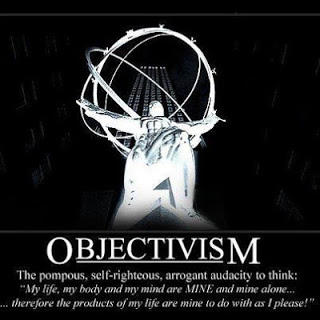
Ayn Rand’s Political Philosophy | Mises Institute

Posted by M. C. on April 25, 2019

Good article if one is of a philsophical bent.

Me…I have to open my Wikipedia before I start.

https://mises.org/power-market/ayn-rands-political-philosophy

David Gordon

Foundations of a Free Society: Reflections on Ayn Rand’s Political Philosophy. Gregory Salmieri and Robert Mayhew, Eds.  University of Pittsburgh Press. Xi + 460 pages.1

This excellent book mirrors in its choice of contributors the odd relationship between Ayn Rand and libertarianism. On the one hand, her own proposals for the political organization of society are a version of minimal state libertarianism, and her novels and essays have had an enormous impact on many libertarians. On the other hand, she not only denied she was a libertarian but denounced libertarianism in characteristically fierce fashion. The anarchist position of Murray Rothbard especially aroused her opposition.

Many of the contributors to the book are members of the “official” Objectivist organization of philosophers, the Ayn Rand Society, but others, including Matt Zwolinski, Peter Boettke, and Michael Huemer, are not Objectivists. The “official” Objectivists are more inclined than was Rand herself to acknowledge the similarity between her political thought and libertarianism, but, like her, they criticize libertarianism and denounce Rothbard’s anarchism.

In what follows, I shall address the criticisms of Rothbard’s anarchism, as these are likely to be of most interest to readers of mises.org. Before turning to this, though, I should like to examine the more general criticism of libertarianism raised by the Objectivists, as this has considerable philosophical value.

Given the manifest similarity between Rand’s political proposals and minimal state libertarianism, why are Objectivists so critical of libertarianism? One is tempted to ask them, “All right, you don’t like anarchism, but why isn’t support for a minimal state that has no power to tax and for laissez-faire capitalism enough for you? What more do you want?” Their answer is that non-Objectivist libertarianism lacks proper philosophical foundations. In the absence of these foundations, libertarians are unable adequately to support their political conclusions.

As an example, Darryl Wright, a philosophy professor at Harvey Mudd College and a rising star among Objectivist philosophers, criticizes Rothbard for not grounding his non-aggression principle in normative ethics. Although Rothbard accepted an ethics of natural law, he also held that political philosophy was autonomous, and this was his fatal error: “The source of the difficulties with Rothbard’s conception of aggression. . .lies in a particular way of understanding self-ownership, which in turn proceeds from Rothbard’s commitment to what I will call the autonomy of political philosophy. By this I mean the view that political philosophy should be independent of normative ethics—that is, independent of any substantive ethical theory applicable to the whole of one’s life.” (p.107). More generally, Wright says, “Since Rand’s approach to philosophy is holistic, a proper understanding of the[non-initiation of force] principle requires us to see how it grows out of her more fundamental positions in ethics and epistemology. . .” (p.16)…

Be seeing you

My Business Travail: My Harrowing Experience in "The Hindu ...

Posted in Uncategorized | Tagged: , , , , , | Leave a Comment »

Is Tax Reform Libertarian? – LewRockwell

Posted by M. C. on December 11, 2017

Shuffling the deck without reducing taxes and employing the necessary reduction in the size of government is worthless.

The implication is there will be winners and losers.

This government we are talking about. I do not expect to come out a winner.

https://www.lewrockwell.com/2017/12/laurence-m-vance/what-makes-tax-reform-libertarian/

And if taxation is organized theft, then, as Rothbard also says: “There can be no such thing as “fairness in taxation” since “the concept of a ‘fair tax’ is therefore every bit as absurd as that of ‘fair theft.’” And as Frank Chodorov adds: “There cannot be a good tax nor a just one; every tax rests its case on compulsion.” Read the rest of this entry »

Posted in Uncategorized | Tagged: , , | 2 Comments »

The Case for Optimism – LewRockwell

Posted by M. C. on September 4, 2017

Some days it is tough but what else are we to do?

https://www.lewrockwell.com/2017/09/gary-north/the-case-for-optimism-3/

Everything meaningful that’s ever happened in the world, any change, any improvement comes about because of optimism. The pessimists don’t get anything done. They’re naysayers.  Read the rest of this entry »

Posted in Uncategorized | Tagged: , , , | Leave a Comment »

The Political Importance of Murray Rothbard | Mises Institute

Posted by M. C. on March 3, 2017

https://mises.org/library/political-importance-murray-rothbard

Read something by him, anything. ‘Conceived In Liberty’ will leave a bitter taste in your mouth about what you never learned in government school about US history.

Posted in Uncategorized | Tagged: | Leave a Comment »

Free Trade versus “Free Trade” | Mises Wire

Posted by M. C. on January 25, 2017

https://mises.org/blog/free-trade-versus-free-trade

To paraphrase a former White House occupant…It depends on what your definition of free trade is. TPP it ain’t.

Posted in Uncategorized | Tagged: , , | Leave a Comment »