
MCViewPoint

Opinion from a Libertarian ViewPoint

Posts Tagged ‘New York State’

It’s Time to Break Up New York State

Posted by M. C. on January 22, 2022

Some might ask what’s the point of an article about a failed proposal aside from it being interesting. The point was not to talk about the success of the movement, but to highlight that there is a hunger for creative and unorthodox solutions in red America. Tens of millions of people feel the tendrils of leftism and authoritarianism tightening around their throat. They are ready to consider solutions they would have scoffed at just a decade ago.

https://mises.org/wire/its-time-break-new-york-state

Nicolas Gregoris

Neil Sedaka said it best – “breaking up is hard to do”. Ask any 16-year-old and they’ll tell you that’s certainly true, but Rep. Marjorie Taylor Greene (R-GA) recently made headlines when she suggested not just a breakup, but a “National Divorce” on social media. Of course, there was the typical incoherent shrieking and pearl clutching from progressives, neoconservatives, and other lizard-people, but there was also general acknowledgement from many regular folks that a “National Divorce” may be the only long-term solution.

We Need to Talk…

It should go without saying that our current political arrangement is not working. 2020 saw not just the Covid-19 insanity, but political violence where people were literally shooting each other in the street. Add to that the disturbing new polling data that revealed 48% of Democrats support “quarantine camps” for those who won’t take the recommended “medical interventions” and it seems like the only solution is to exit this abusive relationship.

But the focus on a national divorce perpetuates the same folly that has plagued libertarians and our allies on the right for years: focusing on the national to the exclusion of the state and local. The title of “county executive” may not be as sexy as “President of the United States”, but if the past 22 months have taught us anything, it is that these local offices matter insofar as they can determine how “normal” and free your day-to-day life is. Rather than talking strictly of a national divorce, we should be advocating small-scale secession as well.

Counties leaving their current states and cities leaving their current counties to join neighboring areas that more closely align with their politics should be a part of popular political discourse. Often the biggest barrier secession movements face is the widely held (albeit ludicrous) belief that our current set of lines on a map are sacred and must be preserved, and anyone who would change these lines in any way just pines for the good ‘ole days when they could own other people as property.

Secession in the Empire State

New York state has always been ripe for secession movements. Extreme political division between Downstate (“the city”) and Upstate (not “the city”) have prompted several movements aiming to split the Empire State in two. The secessionist movement of 1969 saw New Yorkers unhappy that upstate had so much control over their politics at the state level and proposed that New York City become the 51st state. 2003 and 2008 saw similar pushes from downstate citing “paying more than they receive” in taxes.

Talk of separation didn’t stop there. In 2015, the push for breaking up was led by Upstate, rural and red, against Downstate, urban and blue. Upstate has not been represented in state level politics for some time – the S.A.F.E. Act (a slew of draconian gun control laws) passed in 2013, and in 2014 Governor Cuomo banned hydrofracking (an important industry for upstaters).

Upstate New York is also burdened by the absurd regulatory schema implemented and maintained by downstate voters and politicians – case and point, these people are talking about banning gas powered lawn equipment for God’s sake. Many upstaters blame the region’s decaying economy on these regulations.

In other words, upstate New Yorkers are being governed by urban elites – people who not only have completely different values and worldviews but look upon them with disdain and derision.

This should sound familiar to you. The situation in New York is eerily similar to that of the United States as a whole. Comparing the electoral map of the 2020 presidential election and the 2018 New York gubernatorial election (both victories for the ‘Dems) make this abundantly clear – big cities dictate policy to the detriment of everyone else.

Here is the 2020 electoral map (by county):

ng

And here is the 2018 New York gubernatorial race electoral map (by county):
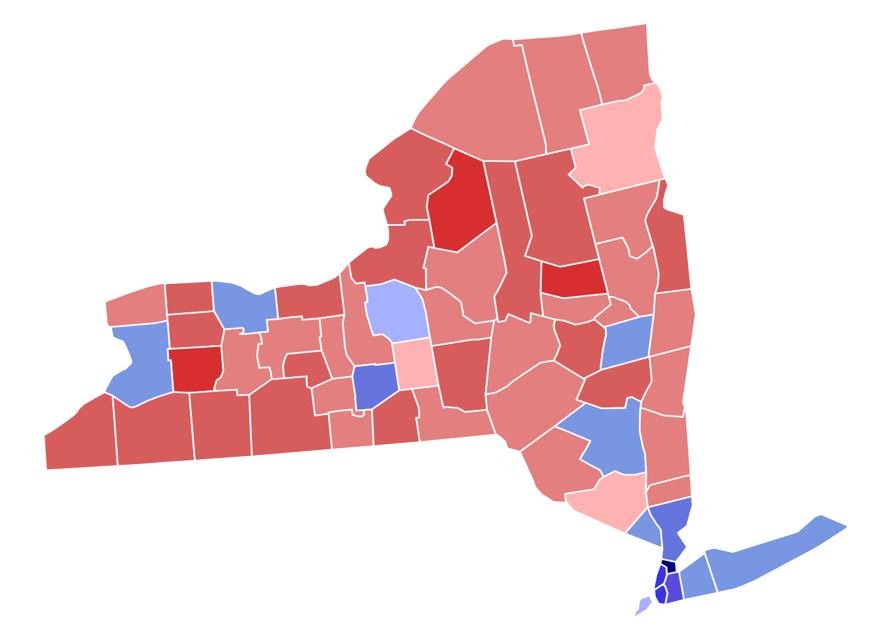
ng

The recent secession movement generated three main proposals: the first was the generic two-state solution; the second involved several counties in the Southern Tier (right above Pennsylvania) becoming part of Pennsylvania. Both ideas ran into an enormous roadblock called the Constitution. Per Article IV Section III, anytime a new state is to be created from an existing state, or parts of one state leave for another state, the approval of both state legislatures and Congress must be obtained. This is a daunting task, to say the least.

The third proposal comes from the Divide NY Caucus and would circumvent the Constitution –in a good way…not a “Commerce Clause” sort of way. There are no constitutional barriers if no new state is being created, so the Divide NY plan would split the state into three autonomous regions – New York (NYC), Montauk (NYC’s immediate suburbs), and New Amsterdam (everything else).

Partition Instead of Secession?

Each region would basically be its own state, responsible for electing its own governor and legislature, as well as dictating its own policies and taxes. But here’s the kicker, “New York State”, as recognized by the federal government, would still exist. The current “governor” would occupy a position akin to that of the Queen of England, but all federal representation would remain the same. There would be no changes to the number of states in the Union or the territory controlled by each state, so Congress is not involved, and since no other state is involved either, the bill would only need to survive one legislature.

Divide NY’s proposal became NY Senate Bill S5416 and dealt with many of the issues commonly associated with secession movements – namely, who would get what. The exhaustive 24-page bill details how the state’s university system, prisons and courts, and roadways would be divided. Sadly, it didn’t make it out of committee, but has been introduced again for the 2022 legislative session.

The proposal isn’t perfect, since it likely means that awful federal representatives like Chuck Schumer and Kirstin Gillibrand would keep their jobs, but virtually all New Yorkers would be better off. Downstate would free themselves from what they perceive as the “free-loading moochers” Upstate, and Upstate would no longer have to answer to the insane hypochondriacs and left-wing ideologues Downstate. But even if it didn’t make everyone better off, man is entitled to self-determination, and that right should be respected and exercised. Period.

Some might ask what’s the point of an article about a failed proposal aside from it being interesting. The point was not to talk about the success of the movement, but to highlight that there is a hunger for creative and unorthodox solutions in red America. Tens of millions of people feel the tendrils of leftism and authoritarianism tightening around their throat. They are ready to consider solutions they would have scoffed at just a decade ago. They are looking for solutions at every level – solutions that the liberty movement had embraced long ago. It might be up to us to spread the message of separation and rebuilding. A message that says, yes, even though mommy and daddy love you very much, they just can’t live together anymore. Author:

Nicolas Gregoris

Be seeing you

Posted in Uncategorized | Tagged: , , , , , , | Leave a Comment »

DNRs, Digital Tattoos, Eliminating The Unfit, Eugenics Redux – It’s 1930’s Europe – Deja Vu all over again

Posted by M. C. on April 23, 2020

The NHS, the go to place for government medicine, has sent mailers out for people to consider DNRs to salvage a system floundering way before COVID.

Bill Gates wants vaccination history, and presumably all medical history, tattooed on us via an implanted chip.

Now New York has now attempted mandatory DNRs for cardiac patients. This is about as obvious as eugenics can get. Eliminating the societal burden of the unfit.

We know who runs the show in New York. The Democratic poster boy for the next presidential election due to his handling of Coronavirus. Andrew Cuomo.

This crisis is tearing the veil off the democratic socialism and it looks a lot like progressive eugenics and national socialism.

New York state rescinds DNR order for cardiac patients amid coronavirus crisis | Fox News

https://www.foxnews.com/us/new-york-state-instructs-paramedics-not-to-revive-cardiac-patients-amid-coronavirus-crisis-report

By Danielle Wallace, Nick Givas

New York state rescinded a blanket do-not-resuscitate order on Wednesday, that instructed first-responders not to revive patients without a pulse, in an effort to preserve resources during the novel coronavirus (COVID-19) outbreak…

Be seeing you

20 Best Memorable Yogi Berra Quotes About Success And Baseball


Posted in Uncategorized | Tagged: , , , , | Leave a Comment »

The IRS’s History of Attacking Political Dissenters and Opponents | Mises Wire

Posted by M. C. on March 6, 2020

As the history of government expansion has shown, government agencies such as the IRS have a nasty way of sneaking into other parts of our lives. What originally started out as an agency solely focused on taxes has morphed into an omnipresent government body that can control political behavior.

Things got even more heated when the New York attorney general decided to investigate the group for “financial improprieties” and threatened to strip the organization of its nonprofit status. None of the investigations have resulted in concrete actions, but the NRA’s interaction with the New York State government illustrates that even the most milquetoast of advocacy groups isn’t safe from the clutches of regulators.

https://mises.org/wire/irss-history-attacking-political-dissenters-and-opponents?utm_source=Mises+Institute+Subscriptions&utm_campaign=74a2cf91bb-EMAIL_CAMPAIGN_2019_12_31_06_15_COPY_01&utm_medium=email&utm_term=0_8b52b2e1c0-74a2cf91bb-228343965

The US purports to be the land of free speech, but you can always expect politicians to carve out exceptions. Just look at how government agencies such as the Internal Revenue Service can slither their way into the political affairs of individuals and organizations.

Americans generally associate the Internal Revenue Service with the hassle of filing income taxes every April. Of course, this is an annual ritual that Americans have been accustomed to for over a century, and it represents one of the numerous ways the federal government violates Americans’ economic freedoms. Income taxation is also one of the main enablers of government growth thanks to its ability to extract hundreds of billions of dollars from hardworking taxpayers annually. In 2019 alone, the IRS collected nearly $3.5 trillion in tax revenue.

The IRS’s misdeeds aren’t just limited to economic activity, though. Most would be surprised to find that the IRS is a violator of free speech rights. When IRS agents aren’t finding ways to squeeze as much revenue as humanly possible from taxpayers, they try to make the lives of America’s most civically engaged miserable.

The IRS as a Political Tool

Former congressman Ron Paul shed light on the IRS’s anti–free speech activity last year in a piece voicing concerns about income tax privacy. In 2019, House Democrats tried to pull every legislative stunt possible to get President Trump to hand over his tax returns. Although these efforts did not materialize into anything substantial, the New York Times published some of Trump’s tax returns from the 1980s and 1990s. The Times’s publication of the returns raised speculation about a potential leaker in the IRS handing this information over to the news outlet.

Right off the bat, Paul understood the bigger picture. As the history of government expansion has shown, government agencies such as the IRS have a nasty way of sneaking into other parts of our lives. What originally started out as an agency solely focused on taxes has morphed into an omnipresent government body that can control political behavior. Paul cited several examples of IRS politicization, including Franklin Roosevelt’s auditing of New Deal opponents, John F. Kennedy’s use of audits against political opponents, and the agency’s investigation of a church hosting an antiwar sermon during the Bush era. One of the more recent cases of IRS harassment of political opponents occurred when it placed Tea Party groups under increased scrutiny when they applied for tax-exempt status.

The IRS’s history shows that its abuses go beyond partisan politics, seeing how the agency has been used as a cudgel to smash opponents from across the political continuum. From a big-picture perspective, political advocacy in America is excessively regulated. Thanks to so-called campaign finance reform, now political organizations have to worry about complying with a whole set of new regulations—as if the IRS breathing down their necks wasn’t enough.

Just a minor slipup could have IRS or other regulatory agents storming an organization’s office. This is typical of the administrative state era we live in, in which filing the wrong paperwork could land someone behind bars. Because we all know that those dastardly political rabble-rousers not hitting the right bureaucratic checkboxes present a clear and present danger to the rest of society.

State Governments Have Followed the Federal Government’s Lead on Political Harassment

Even after the Supreme Court case Citizens United v. FECwhich ruled that the First Amendment prohibits the government from restricting the ability of political organizations to use independent expenditures for political communications—government entities still find creative ways to stifle political speech. At the state level, governments have taken advantage of regulatory functions to poke and prod organizations that cause too much trouble. Politicians launch “ethics reform” campaigns, where they use ethics commissions and similar bodies to muzzle speech. Politicians will construct narratives saying that they’re fighting against corruption, when all they’re really doing is curtailing the efforts of dissident groups to expose the political class’s dirty laundry.

In 2014, a grassroots gun rights organization, Palmetto Gun Rights, faced harassment from the most unlikely place—the office of then Republican governor Nikki Haley. The South Carolina governor was supporting an ethics reform bill (H 3945) that would have forced an organization or an individual making an “an electioneering communication” to report the “top five donors to the reporting person” to the State Ethics Commission. “Electioneering communication” in this case meant “any broadcast, cable, or satellite communication or mass postal mailing or telephone bank” referring to “a clearly identified candidate for elected office” and that is publicly “aired or distributed within sixty days prior to a general election or within thirty days prior to a primary for that office.” So, if a political organization in South Carolina had some mean things to say about a politician in the finals days of election season, their biggest donors could potentially be fair game for political harassment.

On the other side of the spectrum, groups such as the National Rifle Association have recently witnessed government agencies launch politically motivated investigations against them. Despite what the media says about the NRA, they’re no extremists on the gun issue. However, that has not kept states such as New York from trying to snoop around their private affairs. Twenty nineteen was a rough year for the NRA due to various episodes of internal drama and leadership disruption. Things got even more heated when the New York attorney general decided to investigate the group for “financial improprieties” and threatened to strip the organization of its nonprofit status. None of the investigations have resulted in concrete actions, but the NRA’s interaction with the New York State government illustrates that even the most milquetoast of advocacy groups isn’t safe from the clutches of regulators.

The regulation of economic activity in this stage of American history has undeniably evolved into a mechanism of behavioral control. It’s no longer about whether an individual will have X amount of dollars left after the government takes its share of the loot. Now, people’s political activities, such as their speech, can be subject to political micromanagement.

It’s not enough to just talk about the numbers when making the case against economic regulations. These regulations are ultimately enforced by massive government agencies, which politicians can manipulate in clever ways to suit their own ends. Add in the round-the-clock growth of government agencies, and you’re now dealing with institutions that have the power to branch out into other activities.

By limiting themselves to ho-hum discussions about tax policy, advocates of government restraint ignore some of the biggest threats coming from bureaucratic mammoths. A crusade against bureaucracy is long overdue in America.


Be seeing you

propertyn tax


Posted in Uncategorized | Tagged: , , , , | Leave a Comment »