
Be seeing you

Enemy of the State-Read the Book-Know the Man
This is not a Safe Space but Baby, I don't care.

"I am not a number, I am a Free Man" - No. 6
 Information Liberation Alex Jones’ Prison Planet Gary North Specific Answers Antiwar The Daily Bell Tenth Amendment Center Economics Policy Journal The American Thinker The New American Lew Rockwell
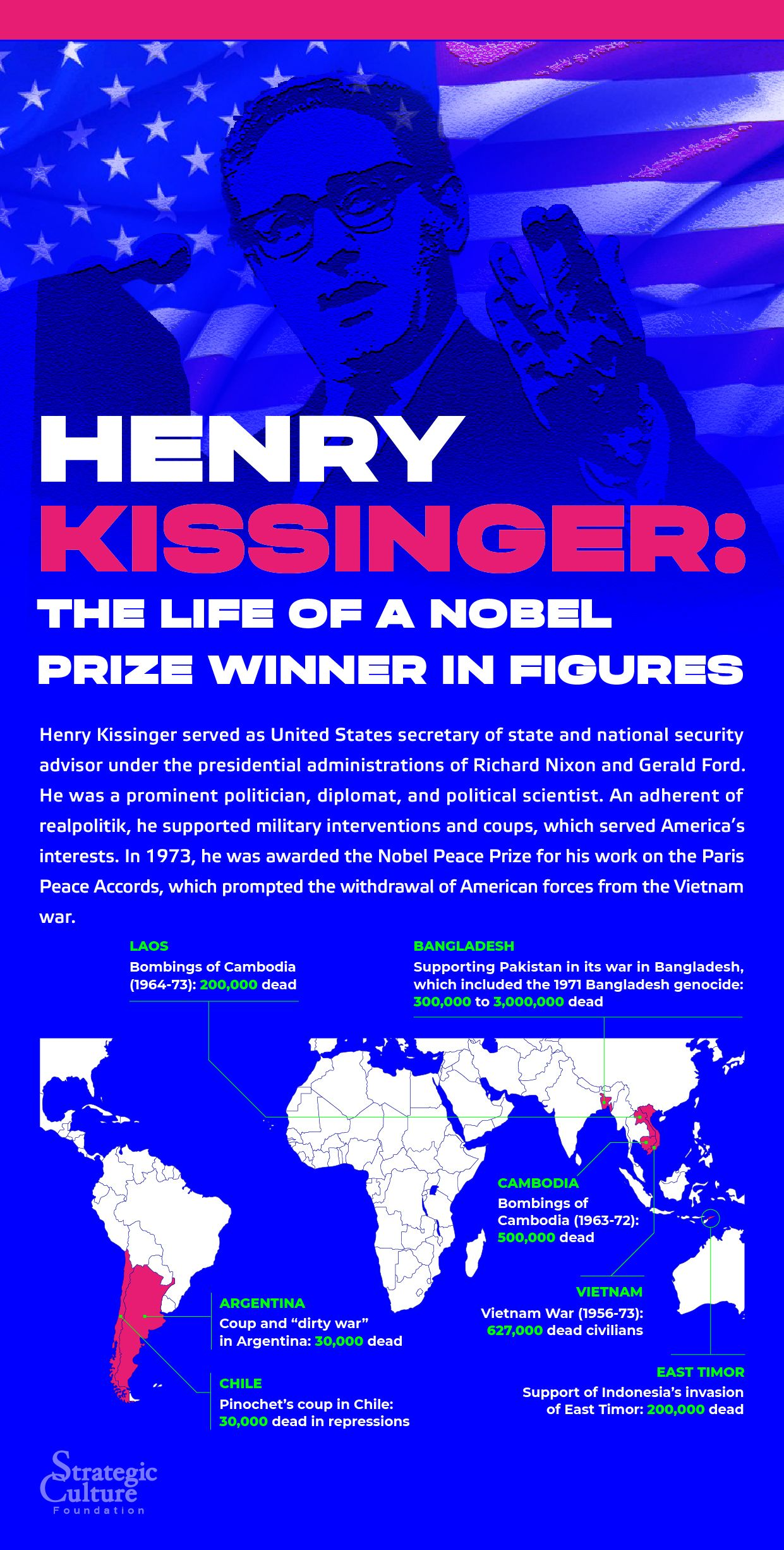
Posted by M. C. on December 7, 2023
Posted in Uncategorized | Tagged: Henry Kissinger, Nobel Prize | Leave a Comment »
Posted by M. C. on October 18, 2022
Therefore, under a fiat monetary system we cannot know the true value of goods and services. This is why to create a sound economy that provides prosperity we should audit then end the fed.
https://mailchi.mp/ronpaulinstitute/bernanke-116313?e=4e0de347c8
Oct. 17 – Former Federal Reserve Chairman Ben Bernanke is a 2022 recipient of the Nobel Prize in economics for his writings on how government should respond to bank failures. Honoring Bernanke for his advice on what government should do when banks fail is like giving a fire safety award to an arsonist.
Bernanke was Fed chairman when the housing bubble, created by his predecessor Alan Greenspan in the wake of the bursting of Greenspan’s tech bubble and the 9-11 attacks, exploded. When the housing market collapsed, Bernanke worked with Congress and the Bush administration to bail out big banks and Wall Street firms.
In the years following the meltdown, the Bernanke-led Fed tried to “stimulate” the economy via massive money creation, near zero interest rates, and “quantitative easing,” where the Fed injects liquidity into the market via purchases of financial assets including Treasury bonds.
The Fed’s post-meltdown policies produced sluggish growth at best, while laying the groundwork for the next bust. A sign that the next crash was around the corner came in September of 2019, when the Federal Reserve began pumping billions of dollars a day into the “repurchasing” market, which banks use to make overnight loans to each other, in order to keep that market’s interest rates from rising above the Fed’s target rate. The covid lockdowns then gave the Fed an excuse to push interest rates to zero and massively expand quantitative easing.
The Fed’s actions are the prime culprit behind the price inflation plaguing America’s economy. The Fed has responded to the price inflation by increasing interest rates, although rates remain much lower than they would be in a free market. The fact that even these relatively small increases helped push the fragile economy into recession shows the instability of our debt-based economic system.
Bernanke, and Congress, should have responded to the meltdown by letting the recession that followed the meltdown run its course. This is the only way the economy can adjust to the market distortions caused when the Fed increases the money supply and lowers interest rates.
Those who worry that this “don’t do something, just stand there” approach would inflict long-term economic pain on the American people should consider the economic depression of 1920. During this depression, the Fed refrained from trying to “stimulate” the economy, and Congress actually cut spending. The result was the downturn was quickly over. Sadly, the lessons of 1920 are largely ignored by mainstream economic historians.
In response to my questioning at a Financial Services Committee hearing, then-Fed Chairman Ben Bernanke admitted he did not consider gold to be money. Of course, gold and other precious metals are money because individuals have selected them whenever they had the freedom to choose a currency. One reason for this is that precious metals are uniquely suited to serve as a stable unit of account. In contrast, government rulers have favored fiat money precisely because it can never serve as an honest unit of account due to its value being constantly manipulated by central bankers. This is often done at the behest of power-hungry politicians.
Therefore, under a fiat monetary system we cannot know the true value of goods and services. This is why to create a sound economy that provides prosperity we should audit then end the fed.
—
Read more great articles on the Ron Paul Institute website.
Subscribe to free updates from the Ron Paul Institute.
Copyright © 2022 by Ron Paul Institute. Permission to reprint in whole or in part is gladly granted, provided full credit and a live link are given.
Posted in Uncategorized | Tagged: Alan Greenspan, Ben Bernanke, economy, Federal Reserve, Nobel Prize | Leave a Comment »
Posted by M. C. on October 13, 2022
Their work is highly suspect from the view of economic theory and is derived from the point of view of history and the social sciences. They neglect the overall situation they are trying to explain, the role of institutions, and the basics of government intervention. For example, Bernanke’s work does not explain why the “situation” occurred in the first place, what the government did from the outset, or how it could be prevented in the future, except for ever-increasing government and Fed intervention.
Along with Douglas Diamond and Philip Dybvig, Ben Bernanke was awarded the Nobel Prize in Economics today. The three have written extensively on the need to bail out the banks in times when the economy is in corrective mode, generally after a long period of monetary injections. Bernanke was Chairman of the Federal Reserve when he pushed for the latest round of bank bailouts in 2007-2009.
Bernanke’s research concentrated on the Great Depression and argued that the banks needed to be bailed out in the 1930s in response to the collapse of the stock market and the severe correction in the US economy. Diamond and Dybvig have also written on the implications of bank failures on the US economy. All three have latched onto the idea that banks take in deposits which are redeemable short term, but they make loans that are longer term and are thus susceptible to bank runs.
Their work is highly suspect from the view of economic theory and is derived from the point of view of history and the social sciences. They neglect the overall situation they are trying to explain, the role of institutions, and the basics of government intervention. For example, Bernanke’s work does not explain why the “situation” occurred in the first place, what the government did from the outset, or how it could be prevented in the future, except for ever-increasing government and Fed intervention.
Their research amounts to little more than an excuse to bail out the banks. Therefore, if you are a member of the privileged financial elites, the Housing Bubble and the ensuing Financial Crisis was an unmixed blessing. You made big money all throughout the housing and stock market bubbles and then your banks received several bailouts and special privileges during the bust, including borrowing at zero interest rates on loans, capital infusions, Quantitative Easing 1 & 2, and interest payments on “excess reserves.”
Of course, most importantly, you had your man in charge of the Federal Reserve, the man who literally “wrote the book” and dissertation, on how the Fed must bailout the banks in times of economic trouble. No matter how badly everyone else fared, you could depend on Bernanke to bailout the banks, whatever the costs to others.
Be seeing you
Posted in Uncategorized | Tagged: Arsonist, Ben Bernanke, Nobel Prize | 2 Comments »
Posted by M. C. on October 14, 2021
Why do highly successful economists like Card and Levitt tend to forget major historical events that they lived through? Well, you don’t get tenure by dilettantishly following current events as I tend to do. You especially don’t get ahead in the economics trade by noticing the connections between recent history, famous movies, TV shows, and songs, and novel ways to test popular economic theories.
https://www.takimag.com/article/the-nobel-prize-and-the-cocaine-gold-rush/print
This week’s awarding of the (quasi-) Nobel Prize in economics to David Card for, in part, an immigration study that I definitively undermined way back in 2006 raises a nagging question in my mind: As cancel culture gets ever more pervasive, are my better insights tending, perversely, to dumb down the world by ruling ever larger chunks of reality off-limits to the ambitious?
Card’s celebrated research into the impact on Miami wages of the 1980 Mariel boatlift of immigrants is such a sitting duck that it’s hard otherwise to explain why nobody respectable has dared call it out in the last decade and a half.
Is my productivity and prescience keeping more respectable thinkers from later either:
—Citing me for a discovery, and thus risk being tarred by guilt with association for having heard of me, or
—Stealing a discovery of mine and thus risking guilt by association that way?
It appears that the poorly thought-out ideas, such as Card’s Nobel Prize winner, that I’ve mercilessly deconstructed have increasingly become sacralized because it’s not in anybody’s career interest to criticize what I’ve already criticized.
One exception to this growing rule I recalled last week is Malcolm Gladwell’s 2009 effort to have Steven Pinker canceled for citing data I’d compiled on the seemingly nonpolitical topic of NFL quarterback draft picks that debunked one of Malcolm’s New Yorker articles. Pinker, being Pinker, survived, and it was Gladwell’s reputation that took a permanent hit instead. But less august personages than Pinker appear to be not unreasonably worried about the career consequences of following up on one of my findings. “Why do highly successful economists like Card and Levitt tend to forget major historical events that they lived through?”
I must say…when I got started writing three decades ago, I never expected things to work out this way. I am, by nature, rather optimistic about humanity’s ability to make use of good ideas once somebody (such as me) points them out. I like to endorse, sincerely, the motto of Faber College in Animal House: Knowledge is good. I am by nature not a conquistador, but a staffer who likes explaining to the decider the trade-offs he must choose among.
When I started opining, I found that I could come up with interesting and reasonably documentable new ideas more readily than the great majority of academics.
Be seeing you
Posted in Uncategorized | Tagged: Cocaine Gold Rush, David Card, Mariel boatlift, Nobel Prize | Leave a Comment »
Posted by M. C. on October 13, 2021
The decreasing popularity of theory corresponds to the naïve belief that science, as Lord Kelvin famously put it, is all about measurement and that the data somehow “speak for themselves“—when in reality, empirical data are useful only in the way they are interpreted by thinking, choosing, acting human beings.
https://mises.org/wire/2021-nobel-prize-and-trend-economic-thinking
The 2021 Nobel Prize in Economics has been awarded to Berkeley’s David Card, MIT’s Josh Angrist, and Stanford’s Guido Imbens for their work on “natural experiments,” a currently fashionable approach to estimating the causal impact of one economic variable on another. Card, of course, became famous in and outside the profession for his 1994 paper with the late Alan Krueger on the minimum wage. Card and Krueger eschewed the conventional supply-and-demand analysis of the minimum wage (which predicts that, other things equal, increasing the minimum wage leads to increased unemployment) in favor of an atheoretical, empirical exercise. They compared the change in fast-food restaurant employment in New Jersey, which increased its state minimum wage, to that in neighboring Pennsylvania, which didn’t, and found no substantial differences, concluding that—contrary to the conventional wisdom among economists—minimum wages do not price low-productivity workers out of the labor market.
While the details of the Card-Krueger study are widely disputed (to put it politely), the empirical approach they championed is not. Their work helped usher in what has been called the “credibility revolution” or “identification revolution” in applied microeconomics (also called the “design-based approach” as opposed to the older, “model-based approach”). Angrist and Imbens developed econometric techniques for estimating the “treatment effects” that are central to this approach. Unlike laboratory experiments, in which subjects can be assigned randomly to treatment and control groups, with the experimenter holding all other conditions constant, observational studies require statistical tricks to satisfy the “ceteris paribus” conditions. Developing and applying these tricks has been the main focus of mainstream applied economics over the last three decades.
Despite its popularity, this approach is not without its critics. To Austrians, causality in social science is a theoretical construct, not something that can be teased out of the data without some a priori understanding of human behavior and how it affects (and is affected by) economic and social phenomena. Experimental and quasi-experimental methods may provide some limited historical-empirical insight but tend to lack “external validity,” i.e., one never knows if the results will hold up in other settings. There are plenty of mainstream critics of the overuse of natural experiments, field experiments (randomized controlled trials), and the overemphasis on identification over importance (George Akerlof calls this a bias toward “hardness”).
More generally, the newer approaches herald a declining interest in theory in favor of what might be called crude empiricism—”crude” not in the sense that the empirical methods are unsophisticated, but meaning that the underlying questions are simple, “does this x affect this y” questions that rarely involve economic ideas, constructs, or relationships at all. I have previously written about the move away from economic questions and toward issues that are “small” in the sense that they don’t involve economic principles at all. The decreasing popularity of theory corresponds to the naïve belief that science, as Lord Kelvin famously put it, is all about measurement and that the data somehow “speak for themselves“—when in reality, empirical data are useful only in the way they are interpreted by thinking, choosing, acting human beings. Author:
Peter G. Klein is Carl Menger Research Fellow of the Mises Institute and W. W. Caruth Chair and Professor of Entrepreneurship at Baylor University’s Hankamer School of Business.
Be seeing you
Posted in Uncategorized | Tagged: credibility revolution, Economic Thinking, minimum wage, model-based approach, natural experiments, Nobel Prize | Leave a Comment »
Posted by M. C. on November 23, 2019
https://www.economicpolicyjournal.com/2019/11/paul-krugmans-bad-nightmare.html#more
By Robert Wenzel
Paul Krugman is positively terrible when it comes to tax cuts.
He is the perfect example of someone a technician who thinks in terms of what is best for the state.
He recently posted this tweet:
The belief that tax cuts work miracles is really the ultimate zombie idea. No matter how often it fails, the right keeps pushing it https://t.co/NSJXe4lWvb— Paul Krugman (@paulkrugman) November 19, 2019
The lead paragraphs of Krugman’s referenced article read:
The verdict is in on President Trump’s 2017 corporate tax cut: It didn’t work.
The tax cut’s backers said reducing the corporate tax rate from 35 percent to 21 percent would increase the average household income by $4,000, raise economic growth above 3 percent and even pay for itself by generating more tax revenue. As the Wall Street Journal’s Greg Ip noted in a recent column, “Nearly two years later, none of those things have happened, and there is scant sign that they will.”
But there are only two ways that the tax cuts didn’t work. That is if you think that either at least a matching increase in tax revenue should have occurred but didn’t or that income increases should have occurred but didn’t.
This is an extremely shallow way to look at tax cuts, and Krugman should feel embarrassed that as a Nobel Prize winner he is promoting such shallow thinking.
First, let me point out that immediately after the Trump tax cuts were made, I suspected that the cuts would not result in a greater gain in tax revenue (SEE: Laughing at the Laffer Curve: The Trump Tax Reform Con). But this doesn’t mean the tax cuts were a bad thing. Money put back in the private sector is always a good thing.
As Murray Rothbard explained about tax cuts:
All business spending is investment because it goes toward increasing the production of goods that will eventually be sold to consumers. But government spending is simply consumer spending for the benefit of the income, and for the whims and values, of government’s politicians and bureaucrats. Taxation and government spending siphon social resources away from productive consumers who earn the money they receive, and
away from their private consumption and saving, and toward consumption expenditure by unproductive politicians, bureaucrats, and their followers and subsidies.
In other words, since tax cuts result in less money collected by the government that is a plus. It means there is more money in the hands of the private sector: consumers and businesses.
And if household incomes didn’t go up but households, because of the tax cuts, were able to keep more money to spend, then it was an all-around positive that resulted in an increase in the general standard of living.
Of course, to the degree the government attempts to borrow money to make up for the revenue deficit that is a bad thing. When government revenues decline, government spending should also be cut.
But Krugman’s reaction of the horror, that revenue fell, is just his bad nightmare as a statist technocrat, who measures everything from the perspective of “how much did the government squeeze out of the people today?” For the rest of us, a tax cut is a wonderful thing.
–RW
Posted in Uncategorized | Tagged: corporate tax cut, Nobel Prize, Paul Krugman, private sector | Leave a Comment »
Posted by M. C. on November 6, 2019
https://www.lewrockwell.com/2019/11/walter-e-williams/disproportionalities-whose-fault/
Jews have been awarded 40% of the Nobel Prizes in economics, 30% of those in medicine, 25% in physics, 20% in chemistry, 15% in literature and 10% of the Nobel Peace Prizes. Since the beginning of the 20th century, there have been just over 900 Nobel Prizes awarded. Since Jews are only 2% of the world’s population, instead having 22% of Nobel Prizes, 206, they should have won only two, according to the proportionality vision of justice. There’s an even greater domestic violation of the proportionality vision. Jews are less than 3% of the U.S. population but 35% of American Nobel Prize winners. Several questions come to mind. Does the disproportionately high number of Jewish winners explain why there are so few black or Hispanic Nobel Prize winners? Who’s to blame for ethnic disproportionality among Nobel Prize winners, and what can be done to promote social justice?
Proportionality injustice doesn’t end with the Nobel Prize. Blacks are about 13% of the U.S. population but close to 70% of the players in the National Football League. Blacks are greatly overrepresented among star players and highly paid players. While the disproportionality injustice runs in favor of black players in general, they are all but nonexistent among the league’s field goal kickers and punters. Perhaps the only reason why football team owners are not charged with hiring discrimination is that the same people who hire quarterbacks and running backs also hire field goal kickers and punters. Proportionality and diversity injustice is worse in the National Basketball Association, with blacks being over 80% of the players. Plus, it’s not uncommon to watch college basketball games and see that 90 to 100% of the starting five players are black.
Most readers know that I teach economics at George Mason University and have done so for nearly 40 years. However, that doesn’t mean the field of economics doesn’t have its problems. Many see economics as neither a welcoming nor a supportive profession for women or blacks. Former Federal Reserve Board Chair Janet Yellen, in addressing a Brookings Institution audience said: “Within the economics profession, women and minorities are significantly underrepresented. And data compiled by the American Economic Association’s Committees on the Status of Women in the Economics Profession and the Status of Minority Groups in the profession show that there has been little or no progress in recent decades. Women today make up only about 30 percent of Ph.D. students. Within academia, their representation drops the higher up one goes in the career ladder. The share of Ph.D.s awarded to African Americans is low; and it has declined slightly in recent decades.” Yellen says that diversity in economics is a matter of “basic justice.”
 Had I been in the audience, I would have asked Yellen whether there’s basic justice in the nursing field, where less than 10% of nurses are men. What about the gross lack of proportionality in incarceration? According to 2015 figures released by the Bureau of Justice Statistics, the overall U.S. prison and jail population is 90.6% male and 9.4% female. The only way that I see to remedy such a gross disproportionality injustice is to either incarcerate more female prisoners or release male prisoners.
Back to Janet Yellen: It is pathetic and professionally incompetent that she can ignore decades of research — some of it by female researchers — that shoots down the idea that disparities prove discrimination. Moreover, if one carries the notion that disparities prove discrimination far enough, they’d look like true fools. According to a study conducted by Bond University in Australia, sharks are nine times likelier to attack and kill men than they are women. Despite the fact that men are 50% of the population, and so are women, men are struck by lightning six times as often as women. Of those killed by lightning, 82% are men. One can only wonder what social justice warriors would do about these and many other disproportionalities.
Be seeing you

Posted in Uncategorized | Tagged: American Economic Association, Disproportionalities, Janet yellen, Minority Groups, Nobel Prize | Leave a Comment »
Posted by M. C. on October 20, 2019
If there was a Nobel Prize for integrity the Nobel committee would not stand a chance.
It is past it’s sell by date.
https://www.economicpolicyjournal.com/2019/10/the-nobel-prize-in-economic-science.html
The Royal Swedish Academy of Sciences has awarded the Sveriges Riksbank Prize in Economic Sciences in Memory of Alfred Nobel 2019 to Abhijit Banerjee (Massachusetts Institute of Technology) and to his wife Esther Duflo (Massachusetts Institute of Technology) and to Michael Kremer (Harvard University).
From the Nobel committee:
Despite recent dramatic improvements, one of humanity’s most urgent issues is the reduction of global poverty, in all its forms. More than 700 million people still subsist on extremely low incomes. Every year, around five million children under the age of five still die of diseases that could often have been prevented or cured with inexpensive treatments. Half of the world’s children still leave school without basic literacy and numeracy skills.
This year’s Laureates have introduced a new approach to obtaining reliable answers about the best ways to fight global poverty. In brief, it involves dividing this issue into smaller, more manageable, questions – for example, the most effective interventions for improving educational outcomes or child health. They have shown that these smaller, more precise, questions are often best answered via carefully designed experiments among the people who are most affected.
In fact, these laureates are government technocrats who think at the government level rather than at the foundational level where an appreciation for free markets would make their work useless.
The Nobel committee:
As a direct result of one of their studies, more than five million Indian children have benefitted from effective programmes of remedial tutoring in schools. Another example is the heavy subsidies for preventive healthcare that have been introduced in many countries.
One has to ask, do these three seriously believe they have the answer for five million Indian children rather than leaving things up to the free market where multiple options would develop (without political interference)?
And political interference is not a theoretical question.
Alex Tabarrok reports on one type of interference (one of potentially many kinds):
[W]hen they tried to institute a similar program for nurses in Putting a Band-Aid on A Corpse the program was soon undermined by local politicians and “Eighteen months after its inception, the program had become completely ineffective.”
And government subsidies for preventive healthcare? That is the government is taken seriously by them to determine what is proper preventative healthcare. In other words, the vegans, ketos and paleos get to battle it out to see who gets influence over health policies rather than leaving options?
How confused are these three?
Naturally, they are concerned with politically correct questions.
Tabarrok writes:
Duflo and Banerjee have conducted many of their field experiments in India and have looked at not just conventional questions of development economics but also at politics. In 1993, India introduced a constitutional rule that said that each state had to reserve a third of all positions as chair of village councils for women. In a series of papers, Duflo studies this natural experiment which involved randomization of villages with women chairs. In Women as Policy Makers (with Chattopadhyay) she finds that female politicians change the allocation of resources towards infrastructure of relevance to women. In Powerful Women (Beaman et al.) she finds that having once had a female village leader increases the prospects of future female leaders, i.e. exposure reduces bias.
Then there are just silly, poorly constructed models.
Tabarrok again:
Before Banerjee became a randomistas he was a theorist. His A Simple Model of Herd Behavior is also a favorite. The essence of the model can be explained in a simple example (from the paper). Suppose there are two restaurants A and B. The prior probability is that A is slightly more likely to a better restaurant than B but in fact B is the better restaurant. People arrive at the restaurant in sequence and as they do they get a signal of which restaurant is better and they also see what choice the person in front of them made. Suppose the first person in line gets a signal that the better restaurant is A (contrary to fact). They choose A. The second person then gets a signal that the better restaurant is B. The second person in line also sees that the first person chose A so they now know one signal is for A and one for B and the prior is A so the weight of the evidence is for A and the second person also chooses restaurant A. The next person in line also gets the B signal but for the same reasons they choose A. In fact, everyone chooses A even if 99 out of 100 signals are B. We get a herd. The sequential information structure means that the information is wasted. Thus, how information is distributed can make a huge difference to what happens.
Does Banerjee seriously think that restaurants are just signal takers subject to the herd? That they will do nothing to signal the benefits of their restaurants? This model has nothing to do with reality.
The Prize awarded for this silly work is 9 million Swedish krona ($916,000), to be shared equally between the three.
–RW

Posted in Uncategorized | Tagged: Abhijit Banerjee, economic science, Esther Duflo, Michael Kremer, Nobel Prize, Technocrats | Leave a Comment »
Posted by M. C. on August 4, 2019
A combination of hysteria, ignorance of science, and where the money is coming from. Almost all the money for research comes from grants. If you want a grant you have to display the right political attitude. The whole idea of global warming is completely corrupting the science community. If you deny AGW, it’s like denying the Jewish Holocaust in Europe. They won’t even talk to you. You’re certainly not going to get a government grant. Government and foundation grants are what drive science today.
https://www.caseyresearch.com/doug-casey-on-the-nobel-prize-in-economics/
By Doug Casey October 26, 2018
Justin’s note: Two Americans just won this year’s Nobel Prize in Economics.
William Nordhaus, one of the recipients, was awarded the prize for his work on climate change. Paul Romer, the other recipient, won for research on how regulations and policies can encourage new ideas and long-term prosperity.
The Royal Swedish Academy of Sciences, which selects the recipients, called these the “basic and pressing” economic issues of our time. And I believe many people would agree with that statement.
But Doug Casey isn’t one of them. I know because I recently spoke with Doug about this topic. And, as usual, he had some interesting things to say. See for yourself in today’s Conversations With Casey.
Justin: Doug, what do you think of the latest Nobel Prize in Economics winners? Do they deserve the award?
Doug: The Nobel Prize in Economics should be abolished, along with those for Literature and Peace. All three are passed out arbitrarily, to whomever is currently in fashion, or has the best political connections.
It’s all about Cultural Marxist and socialist intellectuals patting each other on the back. The prestige associated with everything from favorable book reviews to the Nobel Prize legitimizes these people in the eyes of the public. There have been exceptions—but very few, and only enough to keep the Nobels from being total laughing stocks. Left-wing intellectuals talking to left-wing intellectuals about topics of interest to nobody but left-wing intellectuals. All reported on glowingly by their minions in the lickspittle media.
These prizes have about zero relationship to those for Chemistry, Physics, or Medicine—where the achievement is quantifiable, and of objective benefit to humanity.
This year’s winners of the Economics Prize, Romer and Nordhaus, are typical. Neither is a real economist. An economist is someone who describes the way the world works, how men go about producing and consuming in a voluntary marketplace.
These guys aren’t economists. They’re political apologists, who prescribe the way they think the world ought to work, and try to enforce their notions on society. The whole study of economics is quite degraded. It’s now viewed as a subdivision of mathematics, with all kinds of arcane and irrelevant formulae. In fact, economics is a division of philosophy.
Romer, the son of a former Colorado governor, basically puts forward the notion that governments should encourage, or direct, spending to speed up progress. It’s a ridiculous notion, assuming bureaucrats are wiser and smarter than the people who actually created the wealth. It’s an idiotic and destructive view that underlies all socialist and fascist systems. The USSR was an archetype of this thinking. I’m genuinely surprised people don’t laugh and roll their eyes when they encounter these nostrums.
Justin: How about Nordhaus?
Doug: Well, his hobbyhorse is anthropogenic global warming [AGW], and what governments should do about it. This opens up several cans of worms. Number one, does AGW exist? And if it does, should the government do something about it?
Despite everything said in the popular press and in some scientific papers, my belief is that AGW is completely trivial. And what is there is going to drop as improvements in technology make all industrial and consumer processes vastly more efficient. The current hysteria has very little to do with physics, and almost all to do with aberrant psychology.
Can humans change the environment? Of course they can. We do it all the time. Humans have wiped out various species over time—everything from the dodo bird to the passenger pigeon to almost all of the North American buffalo. Humans can have a huge effect on the environment. But does that mean humans are causing AGW?
Contrary to what you hear in the popular media, the proposition is completely unproven. The temperature of the earth has varied radically throughout history, going back 4.5 billion years. This includes an epoch about 500 million years ago when the whole earth was a snowball for as much as 200 million years. Although the earth will wind up fried to a crisp in a few billion years when the sun turns into a red giant, cold is probably a bigger risk than heat. The sun is all that keeps us from approaching the absolute zero of interstellar space.
CO2 is the main focus of the current hysteria. Carbon dioxide levels have varied radically over the eons. In the days of dinosaurs, carbon dioxide levels were many times what they are today, and they’ve basically been going down since Day One.
CO2 is plant food; it is to plants what oxygen is to animals. At about 400 parts per million in the atmosphere it’s really just a trace gas. The vast majority of the so-called Greenhouse Effect is actually caused by potentially much more deadly dihydrogen oxide vapor. When the man in the street is told about this danger, about 10% of them want the government to illegalize it.
Atmospheric CO2 levels are dictated by volcanism and absorption of the gas in seawater. There are thousands of active volcanoes on the planet, spewing CO2, SO2, CH4, and numerous other greenhouse gases in massive quantity. A lot is absorbed by seawater, which has a vastly larger effect on the climate than the atmosphere.
Over the long run, however, CO2 levels are driven by rocks. What happened to all the CO2 when it was, say, 20% of the atmosphere—that’s 200,000 parts per million? It’s now the carbonate part of limestone-calcium carbonate—and other rocks.
But it’s foolish to get hung up on CO2. Many, many things drive the temperature of the earth. Part of it is cosmic rays. They have a huge influence on the amount of cloud cover, which can change temperature immensely. Part of it is the changing tilt in the earth’s axis. Part is the gradual, and cyclical, change in the earth’s orbit around the sun. Part of it may well be the solar system’s orbit around the galaxy, believe it or not.
People have completely forgotten that in the 1970s national magazines were showing images of glaciers knocking over the skyscrapers in New York because they were afraid of a new ice age. People have also forgotten that from about the 1500s through the 1800s, we actually had a little ice age. Before that was the medieval warm period, 700-1400 AD, and before that another cold snap that coincided with the Dark Ages. From roughly 200 BC to 200 AD—coinciding with the rise of the Roman empire—the world was warmer than it is today. They weren’t big CO2 emitters…
Be seeing you
Posted in Uncategorized | Tagged: anthropogenic, Cultural Marxist, Economics, Nobel Prize, Paul Romer, William Nordhaus | Leave a Comment »
Posted by M. C. on June 10, 2019
projects that if governments “did nothing,” total global warming would reach about 4.1 degrees Celsius. In contrast, if governments implemented the “optimal carbon tax,” as Nordhaus would recommend in a perfect world, then total warming would be about 3.5 degrees Celsius.
And yet, Nordhaus’ own work—not shown in the figure above, but I spell it out here—clearly concludes that such an aggressive target would cause far more damage to humans in the form of reduced economic output, that it would be better for governments to “do nothing” about climate change at all.
https://mises.org/wire/what-universities-wont-teach-college-students-about-economics-climate-change
I recently gave a talk to a student group at Connecticut College on the economics of climate change. (The video is broken up into three parts on my YouTube channel: one, two, and three.) In this post I’ll summarize three of my main points: (1) There is a huge disconnect between what the published economics research actually says about government policies to limit global warming, and how the media is reporting it. (2) President Trump taking the U.S. out of the Paris Agreement doesn’t really affect anything on the margin, even if we stipulate the alarmist position on climate change. And (3) If I’m wrong, and human-caused climate change really does pose a dire threat to humanity in the next few decades, then scientists are currently working on several lines of research of practical ways to actually deal with the problem.
I first clarified to the students that throughout my talk, I wasn’t going to grab results from right-wing think tanks, or from “fringe” scientists who were considered cranks by their peers. On the contrary, I would be relaying results from sources such as the work of a Nobel laureate William Nordhaus (whose model on climate change policy had been one of three used by the Obama Administration) and from the UN’s own periodic report summarizing the latest research on climate change science and policy.
To demonstrate just how wide the chasm is between the actual economics research and the media treatment of these issues, I described to the students the spectacle I observed back in the fall of 2018, when on the same weekend news came out that William Nordhaus had won the Nobel Prize for his pioneering work on the economics of climate change and that the UN released a “Special Report” advising governments to try to limit global warming to 1.5 degrees Celsius.
The media treatment (sometimes in the same story) presented these events with no sense of conflict or irony, leading regular citizens to assume that Nordhaus’ Nobel-winning work supported the UN’s goals for policymakers.
But that is not true at all. Here’s a graph from a 2017 Nordhaus publication that I included in my presentation:

As the figure shows, Nordhaus’ model—and again, this isn’t cooked up by the Heritage Foundation, but instead was one selected by the Obama Administration’s EPA and was the reason he won the Nobel Prize—projects that if governments “did nothing,” total global warming would reach about 4.1 degrees Celsius. In contrast, if governments implemented the “optimal carbon tax,” as Nordhaus would recommend in a perfect world, then total warming would be about 3.5 degrees Celsius.
Anyone remotely familiar with the climate change policy debate knows that such an amount of warming would terrify the prominent activists and groups advocating for a political solution. They would quite confidently tell the public that warming of this amount would spell absolute catastrophe for future generations.
My point here isn’t to endorse Nordhaus’ model. My point is simply that Americans never heard anything about this when the media simultaneously covered Nordhaus’ award and the UN’s document calling for a 1.5°C limit. And yet, Nordhaus’ own work—not shown in the figure above, but I spell it out here—clearly concludes that such an aggressive target would cause far more damage to humans in the form of reduced economic output, that it would be better for governments to “do nothing” about climate change at all.
Posted in Uncategorized | Tagged: Climate Change, Economics, Nobel Prize, Paris climate agreement, William Nordhaus | Leave a Comment »
 MCViewPoint