


Let’s not forget these great figures who were vital to the development of today’s high living standards and of the universally applicable philosophy of individual liberty, private property, free markets, and peace. This proper foundation for domestic and foreign policy was and today remains explicitly pro-freedom in all spheres and anti-aggression.
https://libertarianinstitute.org/articles/tgif-bourgeois-peace-movement/
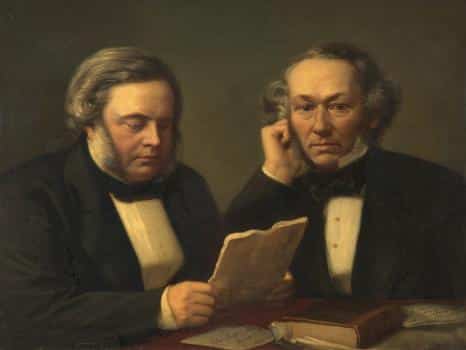
Those of us whose pro-peace/antiwar principles are of the bourgeois classical-liberal variety need reminding now and again that we have a glorious tradition going back hundreds of years. We need not get lost in the dominant rhetoric that opposes war, empire, and its deadly accouterments from a flawed anti-individualist, anti-Western, and socialist position.
No, we can draw on a proud history of writers and activists who opposed war and intervention not just for the obvious reason — harm to others — but also because peace and nonintervention are required for reaping the full benefits of private property, specialization and the division of labor, free global trade, and the unobstructed movement of people in search of better lives. It would be mistaken to regard this as a union of humanitarian and so-called “economic” justifications for peace-mongering. For those classical liberals, freedom to produce, trade, and consume was simply another humanitarian reason to oppose the disruption of war.
Two of the best exemplars of bourgeois pro-market peace activism were the Englishmen Richard Cobden and John Bright, both members of Parliament, manufacturers, orators, and activists. In the mid-19th century, they built a movement that has been in the history books ever since. They are best known for opposing England’s tariff on imported grain (“corn”), which raised the price of bread to enrich the land-owing aristocracy. Cobden and Bright successfully fought their battle through the Anti-Corn Law League.
Cobdden and Bright did not compartmentalize but rather explicitly linked free trade to peace and opposition to military spending and intervention. They had a friend and ally on the continent in the French laissez-faire liberal Frédéric Bastiat.
These classical liberals understood that if a social conflict is to be avoided and society is to develop for all, then the industrious members of the population — entrepreneurs and employees, both of whom produce valuable goods through their labor — must be free from those who use government-granted privileges to legally steal from the industrious. (Ironically, Marx credited the classical liberals with devising this class analysis, but then screwed it up by putting business creators in the exploiter class.)
Cobden and Bright were not only clear and analytical; they were also passionate. They were great orators inside of Parliament and outside. The liberals’ association of peace and free trade can be seen in this example of Cobden’s eloquence:
How shall a profession which withdraws from productive industry the ablest of the human race, and teaches them systematically the best modes of destroying mankind, which awards honours only in proportion to the number of victims offered at its sanguinary altar, which overturns cities, ravages farms and vineyards, uproots forests, burns the ripened harvest, which, in a word, exists but in the absence of law, order, and security — how can such a profession be favourable to commerce, which increases only with the increase of human life, whose parent is agriculture, and which perishes or flies at the approach of lawless rapine?
He finishes this passage with a rebuke to those who wanted the English government to compel foreign populations to do business with privileged government-granted monopoly interests:
They who propose to influence by force the traffic of the world, forget that affairs of trade, like matters of conscience, change their very nature if touched by the hand of violence; for as faith, if forced, would no longer be religion, but hypocrisy, so commerce becomes robbery if coerced by warlike armaments.
Be seeing you

 MCViewPoint