MCViewPoint

Opinion from a Libertarian ViewPoint

Posts Tagged ‘Peace Talks’

Dailywire Article-UN: Risk Of Nuclear War At Record High. Please Engage In Peace Talks, Russia And Ukraine.

Posted by M. C. on April 1, 2023

https://www.dailywire.com/news/un-risk-of-nuclear-war-at-record-high-please-engage-in-peace-talks-russia-and-ukraine

By  Tim Meads

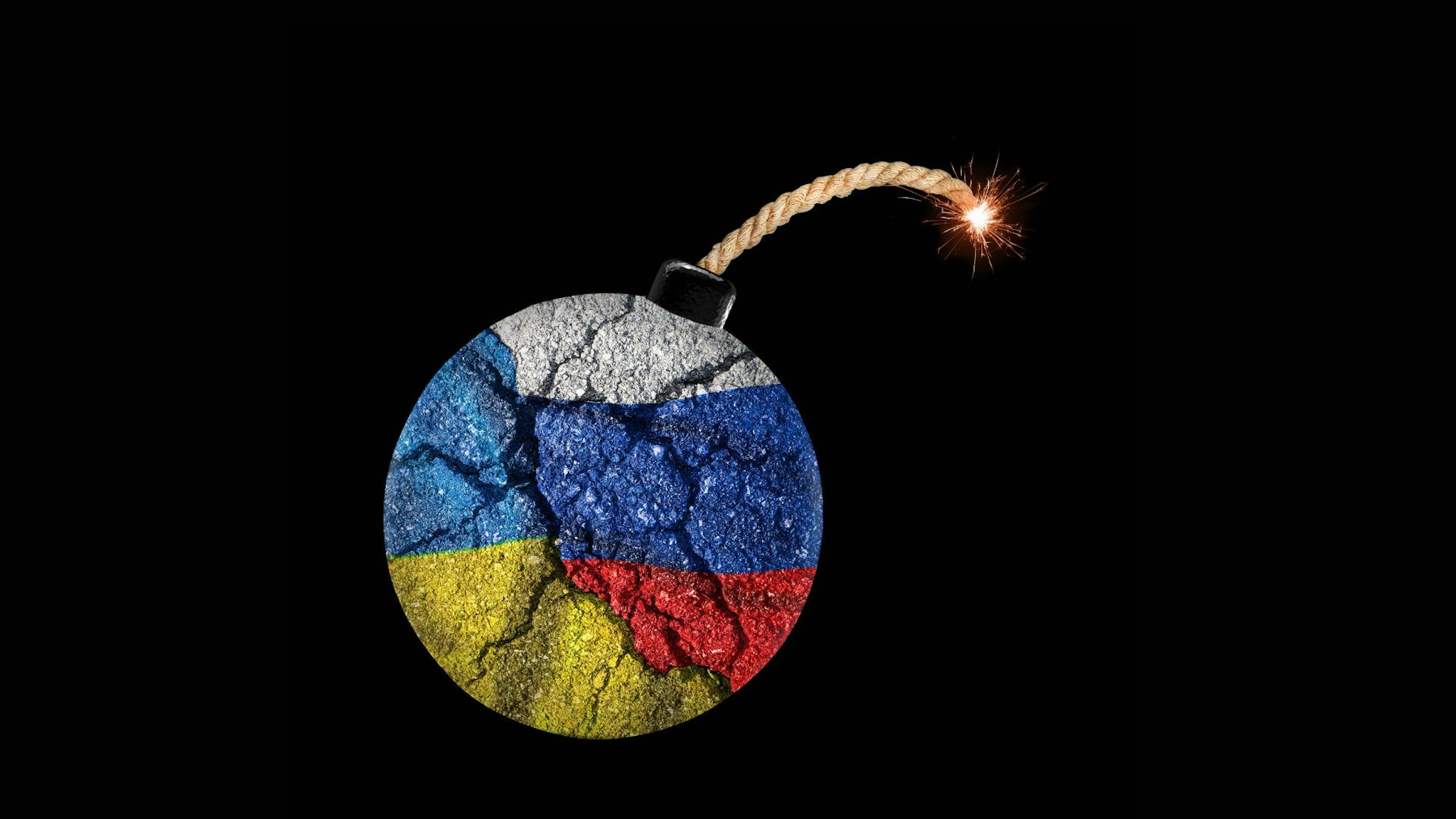
Ukraine-Russia Bomb
(OLGA Zhukovskaya via Getty Images)

Well, folks, don’t look now, but the “risk of a nuclear weapon being used is currently higher than at any time since the depths of the cold war,” according to the United Nations High Representative for Disarmament Affairs Izumi Nakamitsu.

The war in Ukraine — obviously — is what is driving that risk. Based on reports made during the UN’s security council on Friday, that war isn’t ending any time soon — as if there were any doubt of that. Americans should know it is not going to end any time soon, our commander-in-chief has said that our tax dollars and equipment will be supporting Ukraine in its battle against Russia for “as long as it takes” — whatever that means. The Swamp wants this war to continue — and so it will.

While Biden has been banging the war drums, Putin has been chatting with its neighbors and new BFF Belarus. Now, reports indicate that Russia will be stationing non-strategic nuclear weapons within Belarus territory. According to the UN, those will be in place for aerial use by July.

For its part, Russia denies such accusations.

“We are pursuing cooperation with Belarus without violating obligations,” Russian ambassador and Permanent Representative Vassily Nebenzia said on Friday. “We are not transferring nuclear weapons. We are talking about the retrofitting of airplanes and training teams in the construction of a storage facility on the territory of Belarus.”

Yet he did make sure to note that Russia would respond to any “provocative measures” as it saw fit, while adding, “A nuclear war cannot be won.”

See the rest here

Be seeing you

Posted in Uncategorized | Tagged: , , , , | Leave a Comment »

American Pravda: Lost Histories of the Great War, by Ron Unz – The Unz Review

Posted by M. C. on November 29, 2022

Unseen Empire, which appeared in 1912, fell into that latter category and argued that although the United States and the major European powers remained nominally sovereign, their heavy, unproductive military spending had gradually bound them into tight coils of debt, leading most of them to quietly become political vassals of a network of powerful financiers, the “unseen empire” of the title.

Sound familiar? A lengthy but interesting treatment of lost peace opportunities.

https://www.unz.com/runz/american-pravda-lost-histories-of-the-great-war/#comments

Veterans Day came earlier this month, a public holiday that under the name of Armistice Day had originally celebrated the end of the First World War, itself then known as the Great War to those living during that era, over a century ago.

Friends of the Palo Alto Library runs a local monthly book sale, now reopened after nearly two years of Covid closures, and I usually attend, often buying for a pittance items that have caught my eye. A few weeks ago I picked up for a quarter a copy of Adam Hochschild’s widely praised 2011 volume To End All Wars, his account of the British anti-war movement during World War I, which I’d seen very favorably reviewed in the Times and elsewhere when it was originally released. My own knowledge of that era was relatively meager and sparse, so I spent a couple of days reading the text.

Hochschild seems a fine writer and researcher, certainly earning the glowing blurbs by prominent scholars that stud his book, and he told a very interesting story of the men and women who organized and led Britain’s powerful but heavily suppressed anti-war movement as it opposed the continuing slaughter in the trenches. Many of these individuals suffered harsh imprisonment for their dissent, including Keir Hardie, the founder of what became the Labour Party and Bertrand Russell, the brilliant mathematical philosopher and future Nobel Laureate.

Support for the war split the militant Suffragette movement straight down the middle, and important political families were also often deeply divided, with the beloved elder sister of Britain’s own military commander-in-chief in France becoming a prominent peace campaigner. Just a few years earlier, E.D. Morel, the country’s leading investigative journalist, had been celebrated as an international hero for exposing the horrors of the Belgian Congo, but he was now imprisoned for his anti-war writings, with the treatment so brutal that it permanently broke his health and he died at the age of 51, a few years after the war ended.

Just as I’d expected, I discovered a wealth of information about a period only known to me in outline, and I saw no reason to doubt any of its accuracy, including the brief but surprising references to supposedly widespread German war crimes in occupied Belgium. I was very glad to fill these large gaps in my existing knowledge.

But near the end of Hochschild’s discussion of the year 1916, he emphasized that unlike Britain there was absolutely no corresponding anti-war movement in most other countries, including Germany. As he put it on p. 217:

“Both sides were committed to fight to the bitter end, and by now, two years into the war, if someone in a prominent position on either side so much as advocated peace talks, it was considered close to treason.”

On reading this, I did a double-take and almost questioned my sanity. Surely, Hochschild must be aware that exactly at that point in time, the government of Germany had publicly proposed international peace talks without preconditions aimed at ending the war, suggesting that the massive, pointless slaughter be halted, perhaps largely on a status quo ante basis.

The Germans had recently won several huge victories, inflicting enormous losses on the Allies in the Battle of the Somme and also completely knocking Rumania out of the war. So riding high on their military success, they emphasized that they were seeking peace on the basis of their strength rather than from any weakness. Unfortunately, the Allies flatly rejected this peace overture, declaring that that the offer proved Germany was close to defeat, so they were determined to hold out for complete victory with major territorial gains.

As a result, many additional millions needlessly died over the next two years, while just a couple of months later in early 1917 Russia’s Czarist government collapsed, eventually leading to the Bolshevik seizure of power, a turning-point with fateful, long-term consequences.

See the rest here

Be seeing you

Posted in Uncategorized | Tagged: , , , | Leave a Comment »

The Farther People Are From The Fighting In Ukraine, The More They Oppose Peace Talks

Posted by M. C. on November 4, 2022

https://open.substack.com/pub/caitlinjohnstone/p/the-farther-people-are-from-the-fighting?utm_source=direct&r=iw8dv&utm_campaign=post&utm_medium=web

Caitlin Johnstone

A new article for The Irish Times by Virginia Tech professor Gerard Toal, titled “Ukraine risks being locked into endless war in bid for perfect peace,” contains a very interesting paragraph:

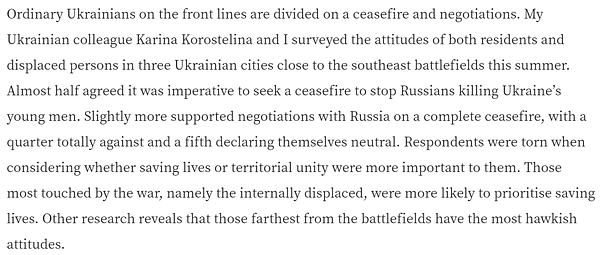
Ordinary Ukrainians on the front lines are divided on a ceasefire and negotiations. My Ukrainian colleague Karina Korostelina and I surveyed the attitudes of both residents and displaced persons in three Ukrainian cities close to the southeast battlefields this summer. Almost half agreed it was imperative to seek a ceasefire to stop Russians killing Ukraine’s young men. Slightly more supported negotiations with Russia on a complete ceasefire, with a quarter totally against and a fifth declaring themselves neutral. Respondents were torn when considering whether saving lives or territorial unity were more important to them. Those most touched by the war, namely the internally displaced, were more likely to prioritise saving lives. Other research reveals that those farthest from the battlefields have the most hawkish attitudes.

It’s the third from the last paragraph in the article, whose overall content cannot be remotely construed as sympathetic toward Moscow, but it’s very important information. 

“Those most touched by the war, namely the internally displaced, were more likely to prioritise saving lives. Other research reveals that those farthest from the battlefields have the most hawkish attitudes.”

Those two simple sentences sum up so much of the attitude we are seeing toward this war, and it applies as much to those cheerleading continual escalation and bloodshed from the comfort of their homes on the other side of the world.

Branko Marcetic @BMarchetich

Unlike sofa warriors in the West and elsewhere treating people like plastic figurines on a board, Ukrainians most affected by the fighting tend to be more in favour of talks for a ceasefire and prioritise actual human lives over borders & land: irishtimes.com/opinion/2022/1…

Image

11:18 PM ∙ Nov 3, 2022


282Likes86Retweets

“Other research reveals that those farthest from the battlefields have the most hawkish attitudes.”

Remember this as you watch pundits and politicians calling for escalations in Ukraine from Washington DC, Los Angeles and London.

Remember this as you watch armchair warriors and NAFO neckbeards dogpiling anyone who advocates peace talks.

Remember this as you watch progressives on Capitol Hill pressured into walking back even the mildest support for potential ceasefire negotiations at some point.

Remember this as more and more information comes out about the way bot swarms and astroturf trolling operations have been used to shout down and silence anyone who advocates peace online.

See the rest here

Be seeing you
Posted in Uncategorized | Tagged: , , | Leave a Comment »

Afghanistan Averages an Insider Attack Every Four Days – News From Antiwar.com

Posted by M. C. on February 5, 2020

Another warparty success story.

https://news.antiwar.com/2020/02/03/afghanistan-averages-an-insider-attack-every-four-days/

Insider attacks have been a growing problem in Afghanistan, and are happening at a rate of once every four days as of the latest data on the last quarter of 2019. 33 insider attacks were reported then, with 90 casualties.

SIGAR’s latest report to Congress showed that was an increase over the year’s average. In 2019, 82 insider attackers were reported, with 172 deaths and 85 others wounded. Attacks were overwhelmingly the result of Taliban infiltrators.

Insider attacks have been a problem for years, but appeared to surge in the last quarter, following the collapse of US-Taliban peace talks and the Afghan government’s attempted presidential election.

Getting even one infiltrator on a base or at a checkpoint is enough. In mid-December, a single infiltrator in Ghazni Province was able to kill 23 sleeping soldiers on the base, successfully taking all the weapons and ammunition, as well as a Humvee and defecting back to the Taliban. This was a major example, but not unheard of.

Be seeing you

Just in time for Remembrance Day... the most beautiful ...


Posted in Uncategorized | Tagged: , , , , | Leave a Comment »

Taliban Peace Talks Must Not Ignore CIA-Funded Militias

Posted by M. C. on August 22, 2019

Another CIA success story.

There are so many they are embarrassed to tell US about them.

https://theintercept.com/2019/08/21/taliban-peace-talks-afghanistan-militias/

After 18 years of war, and months of direct talks, the United States appears to be on the brink of reaching an unprecedented peace agreement with the Taliban that would bring about U.S. troop withdrawal from Afghanistan.

A draft agreement was reached in March, and negotiators in Qatar have reportedly been ironing out the details ahead of a September 1 deadline — including exactly when U.S. troops will withdraw and when a permanent ceasefire between the parties will take effect. The U.S. is reportedly also seeking assurances from the Taliban that it won’t harbor foreign terror groups like ISIS and Al Qaeda and will engage in dialogue with the Afghan government after the U.S. military leaves.

It’s the closest the U.S. has come to a diplomatic breakthrough with the Taliban, and foreign policy scholars are cautiously optimistic that it could facilitate a U.S. exit. But a new report from the Costs of War Project at Brown University’s Watson Institute argues that the agreement won’t lead to real peace unless it addresses the elephant in the room: the fate of regional Afghan militias paid and directed by the CIA.

“Militias that operate outside the control of the central state and the chain of command of its armed forces will undermine the process of state formation and the prospects for a sustainable peace,” the report reads.

It is unclear to what extent the fate of the militias has been discussed at all by the U.S. or Taliban negotiators. In July, Zalmay Khalilzad, the chief U.S. negotiator, mentioned the fate of militias while listing topics that needed to be encompassed by a general agreement. But the authors of the report note that Secretary of State Mike Pompeo, once director of the CIA, has not.

If the issue goes unaddressed, the report argues, it could lead to the breakdown of a ceasefire or agreement, which would in turn jeopardize Afghanistan’s future. “If violence continues at some level after the agreement is signed,” the report says, “militias will be in much demand in the political market place.”

The use of CIA-backed militias goes back to 2001, when, in the aftermath of the 9/11 attacks, the CIA rapidly organized Afghan militias under its payroll to overthrow the Taliban. This allowed the CIA to send Al Qaeda’s fighters fleeing the country with a minimal U.S. footprint.

Initially, these local militias were viewed as a temporary solution, but they eventually became a permanent fixture of secret CIA operations in the country — sometimes acting without the knowledge of U.S. diplomats and Afghan military leaders.

Not much is publicly known about specific groups the CIA directs, the best known of which is the Khost Protection Force. The force has no basis in the Afghan Constitution or law and operates out of the CIA’s Camp Chapman in the province of Khost.

In 2010, journalist Bob Woodward wrote that the CIA’s “army” consisted of about 3,000 Afghan fighters, but since then the number has likely ballooned. According to the New York Times, as of December, the Khost Force alone may number as many as 10,000. (The U.S. currently has approximately 14,000 troops in the country.)

President Donald Trump has further expanded the CIA’s paramilitary role in Afghanistan, using local militias in hunt-and-kill operations…

According to the report, the size and power of the CIA’s forces could pose a problem for the Afghan government after the peace talks. For the militias, integration into the regular armed forces could mean a significant pay cut and a loss of the privileged status that has allowed them to operate largely without transparency or legal accountability. “If cut loose by the CIA,” the report notes, “they may be reborn as private armies or ‘security guards’ in the service of powerful individuals, or operate autonomously to prey on civilians and commercial sources.”

Be seeing you

GUYANA: CIA meddling, race riots and a phantom death squad ...


Posted in Uncategorized | Tagged: , , , | Leave a Comment »