MCViewPoint

Opinion from a Libertarian ViewPoint

Posts Tagged ‘Pledge of Allegiance’

The Civil War Didn’t ‘Settle’ The Question Of State Secession

Posted by M. C. on August 10, 2024

Written by a socialist in 1892, the Pledge of Allegiance attempts to program Americans into internalizing a falsehood: that the United States is “one nation, indivisible.” On that score at least, the deeply-flawed pledge isn’t working on a large number of citizens.

https://libertarianinstitute.org/articles/the-civil-war-didnt-settle-the-question-of-state-secession/

by Stark Realities with Brian McGlinchey

texas secession

Secessionist inclinations are on the rise in the United States, and are sure to intensify after Nov. 5 regardless of which party prevails. When that happens, you can expect the accompanying discourse will be peppered with assertions that states have no right to secede, with many declaring the question was “settled” by the Civil War.

The embedded contention that legal and moral questions are rightly and permanently settled by the outcome of a mass-murder contest is absurd on its face. However, the notion is so widely and casually embraced that it invites an emphatic response. It also serves as a starting point to address other flawed forms of secession skepticism.

Written by a socialist in 1892, the Pledge of Allegiance attempts to program Americans into internalizing a falsehood: that the United States is “one nation, indivisible.” On that score at least, the deeply-flawed pledge isn’t working on a large number of citizens.

A YouGov poll taken earlier this year found substantial slices of both major parties would support their state’s departure from the union: 29% of Republicans and 21% of Democrats. Similarly, the five states in which secessionist yearning is highest represent a mixed bag of red and blue: Alaska (36%), Texas (31%), California (29%), New York (28%) and Oklahoma (28%). While 23% of all Americans want their state to secede, 28% would be content if other states did so.

https://substackcdn.com/image/fetch/w_1456,c_limit,f_webp,q_auto:good,fl_progressive:steep/https%3A%2F%2Fsubstack-post-media.s3.amazonaws.com%2Fpublic%2Fimages%2F3271aaf2-3143-44b7-886a-6ec27f3b064e_1408x1082.jpeg

For now, the Lone Star State seemingly has the strongest separatist momentum.

See the rest here

Be seeing you

Posted in Uncategorized | Tagged: , , | Leave a Comment »

The Pledge of Allegiance and Government Schools – The Future of Freedom Foundation

Posted by M. C. on March 24, 2023

Even as a dumb kid I wondered why I had to declare allegiance to a flag.

I hadn’t learned I was to just OBEY.

https://www.fff.org/2023/03/20/the-pledge-of-allegiance-and-government-schools/

by Jacob G. Hornberger

The Los Angeles Times has an interesting article today by Nicholas Goldberg about the Pledge of Allegiance. Goldberg praises those independent-minded students and parents who have challenged its enforcement in public (i.e., government) schools. 

The Pledge of Allegiance has been used as a symbol of patriotism for more than 100 years. Today, it is recited by children in public schools and and also by adults at various events.

Conservatives are among the most ardent proponents of the Pledge. That’s ironic because it was written by a self-avowed socialist, a man named Edward Bellamy. Conservatives profess to oppose socialism and support “free enterprise.”

Licensed under Creative Commons.

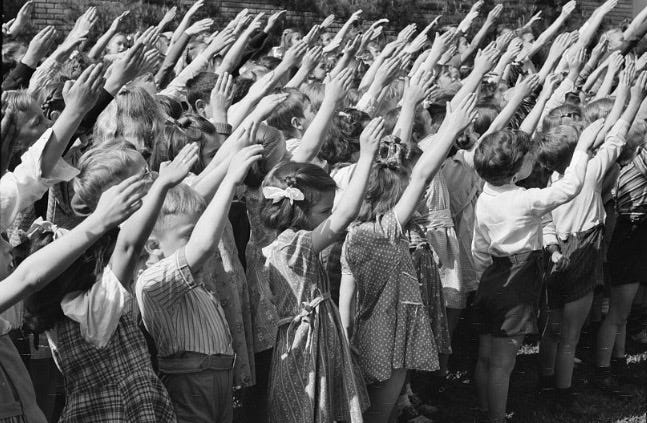
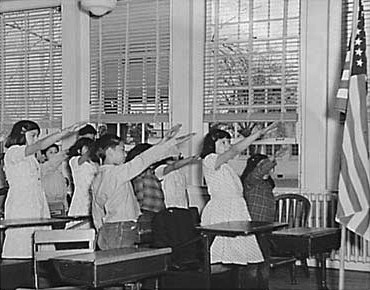
One of the funniest parts of the history of the Pledge was the manner in which public-school students were expected to recite it. American students were long expected to extend their right arms outward while reciting the Pledge. You know, like the Nazi salute. Officials decided, for appearance’s sake, to change it to the right hand over the heart.

Another interesting aspect to the Pledge is that our American ancestors lived without it for the first 100 years of American history. I guess proponents of the Pledge would say that they weren’t very patriotic. 

It is also interesting to note that the Pledge came into existence during the time that American socialists were moving the country in the direction of a welfare state. In 1913, for example, the Sixteenth Amendment (progressive income taxation) to the Constitution was enacted and the Federal Reserve System was called into existence. That was followed by the economic revolution that took place in the 1930s that converted America into a welfare state, which is a variation of socialism. 

Another interesting part of all this was public (i.e., government) schooling itself. Goldberg fails to note that public schooling is itself a socialist system. In fact, it would be difficult to find a better example of a socialist system than public schooling.

Public schools rely on coercion to get their customers. That’s what compulsory-attendance laws are all about. If parents don’t agree to subject their children to the state’s educational system, the state targets them with incarceration and fines. 

With public schooling, the state plans the education of students in a command-and-control fashion that is characteristic of socialist central planning.

See the rest here

Be seeing you

Posted in Uncategorized | Tagged: , | Leave a Comment »

Why Patriots Shouldn’t Pledge Allegiance

Posted by M. C. on June 15, 2021

Bellamy didn’t just write the pledge, but also instructions for an accompanying ritual that feels simultaneously religious and militaristic:

“At a signal from the Principal the pupils, in ordered ranks, hands to the side, face the Flag. Another signal is given; every pupil gives the Flag the military salute—right hand lifted, palm downward, to a line with the forehead and close to it… At the words, ‘to my Flag,’ the right hand is extended gracefully, palm upward, towards the Flag, and remains in this gesture till the end of the affirmation; whereupon all hands immediately drop to the side.”

Yes, Bellamy directed civilian children and adults to render a military salute to the flag, perhaps laying the philosophical groundwork for the eventual creation of the socialist “industrial army” his cousin envisioned in his novel.

Free people have no business pledging loyalty to any government. It’s government that has a duty of loyalty to the people, with no more essential demonstration of that loyalty than the protection of the rights of individuals.

https://starkrealities.substack.com/p/why-patriots-shouldnt-pledge-allegiance?fbclid=IwAR394bqWRuG0pyZLXt9mZMntopMshWAD1q9j1SZYgHulIyB-1DbuSTcXYkI

Brian McGlinchey

Flag Day is upon us, with the Fourth of July not far behind. No better time for a frontal assault on a cherished American ritual—the Pledge of Allegiance.

Though conservatives will be most aghast at this undertaking, the open-minded ones will soon discover they should be among the pledge’s greatest critics.

Before I open fire, a brief explanation for international readers: The Pledge of Allegiance is recited by children across America at the start of start of each school day. It’s also incorporated into many meetings held by federal, state and local governments and private groups as well.

Standing and facing the flag with hand over heart, one recites: “I pledge allegiance to the flag of the United States of America, and to the republic for which it stands, one nation under God, indivisible, with liberty and justice for all.”

A Government Loyalty Oath Written by a Socialist

Many who consider the pledge a cornerstone of conservative values will be surprised to learn it was written by a Christian Socialist named Francis Bellamy, who was run out of his pulpit at a Boston church for preaching against capitalism, and who called Jesus Christ a socialist.

His radical cousin, Edward Bellamy, wrote a popular novel, Looking Backward, which glowingly describes a future in which government controls the means of production and where men are conscripted into the country’s “industrial army” and compelled to work in roles assigned to them by central planners.

While working for The Youth’s Companion, a children’s magazine, Bellamy wrote the Pledge of Allegiance in 1892, timed to be introduced in patriotic celebrations accompanying the 400th anniversary of Columbus’s arrival.

According to a summary of Bellamy’s account of his writing of the pledge, he aimed for brevity, as well as “a rhythmic roll of sound so they would impress the children and have a lasting meaning when they became grown-up citizens.”

Given his beliefs, Bellamy was well-suited for creating a loyalty oath that conditions Americans to subordinate themselves to a powerful central government. Make no mistake—in pledging allegiance “to the republic,” Americans are doing precisely that.

That’s consistent with Bellamy’s wish for state sovereignty and individual liberties to yield to a centralized national government, but it’s starkly at odds with the founding spirit of the country.

Central to that spirit are the notions that government should be a servant and not a master, and that all government should be viewed with deep, ongoing wariness— certainly not the reverence demanded by the Pledge of Allegiance.

Free people have no business pledging loyalty to any government. It’s government that has a duty of loyalty to the people, with no more essential demonstration of that loyalty than the protection of the rights of individuals.

Conditioning America’s Youth for Subservience

Bellamy didn’t just write the pledge, but also instructions for an accompanying ritual that feels simultaneously religious and militaristic:

“At a signal from the Principal the pupils, in ordered ranks, hands to the side, face the Flag. Another signal is given; every pupil gives the Flag the military salute—right hand lifted, palm downward, to a line with the forehead and close to it… At the words, ‘to my Flag,’ the right hand is extended gracefully, palm upward, towards the Flag, and remains in this gesture till the end of the affirmation; whereupon all hands immediately drop to the side.”

Yes, Bellamy directed civilian children and adults to render a military salute to the flag, perhaps laying the philosophical groundwork for the eventual creation of the socialist “industrial army” his cousin envisioned in his novel.

The arm outstretched toward the flag came to be called the “Bellamy salute,” and it endured for several decades before its striking similarity to the Nazi salute prompted its replacement in 1942 by the familiar hand-over-heart gesture.

Southington, CT children pledge allegiance in May 1942 (Library of Congress)

See the rest here

Be seeing you

Posted in Uncategorized | Tagged: , , , , | Leave a Comment »

Compelled Speech and the Perils of ‘PruneYard v. Robins’ | The Libertarian Institute

Posted by M. C. on October 28, 2020

However, it is to say that, given the centrality of speech to our self-definitions, (1) the general perception that compelled speech is insincere, (2) the possibility of disclaiming compelled speech, and (3) the state’s non-requirement of a particular type of speech, are not adequate justifications for requiring people to promote messages against their will.

https://libertarianinstitute.org/articles/compelled-speech-and-the-perils-of-pruneyard-v-robins/

by Tommy Raskin

Humans are speakers. When we go to work, buy paintings, send birthday presents to friends, vote, and choose TV shows to watch at night, we don’t merely “do”—we say. We say what our preferences, ideals, and distastes are in the realms of commerce, art, love, and politics. 

But sometimes we show the world who we are by not speaking. By deliberately refraining from saying the Pledge of Allegiance, for example, we convey either disinterest in or opposition to what the flag represents. Thus, if our constant speaking serves an important expressive function, then our regular not speaking serves an important expressive function as well. Some libertarians and anarchists argue that the latter serves such an important function as to render compelled speech unjustifiable in every conceivable case. But we need not adopt this absolutist position in order to doubt the justifiability of the heavy-handed approach to compelled speech that the Supreme Court, pursuant to its decision in PruneYard Shopping Center v. Robins (1980), has asked us to embrace. 

The controversy in PruneYard erupted when a group of teenagers entered the PruneYard Shopping Center to circulate a petition concerning a United Nations resolution on Zionism. Enforcing the mall’s policy against circulating petitions, security guards kicked out the teenagers, who proceeded to argue in court that their right to circulate a petition at malls like PruneYard was enshrined in the California Constitution. In response, the shopping mall’s managers argued that they and other private property owners have a “First Amendment right not to be forced by the state” to use their “property as a forum for the speech” of members of the public.  

Speaking through Justice William Rehnquist, the Supreme Court sided with the teenagers, finding that a statute forcing the shopping mall to host these young speakers did not amount to an impermissible imposition on the shopping mall managers. The Court reasoned, in the first place, that because the mall was open to large numbers of people, those who encountered the teenagers were unlikely to assume that the views of these young speakers reflected the views of the shopping mall’s managers. Besides, if the managers were concerned that their own views would be conflated with those of the teenagers, the managers could always post signs indicating that the shopping mall’s management did not necessarily endorse the views of people speaking in the mall.

The Court also argued that because the state was not requiring the shopping mall managers to host any particular group of speakers but was instead requiring them to host speakers generally, the state was not using the shopping mall managers to promote a particular point of view. Against that backdrop, the Court concluded, any compulsion to speak in this case was on balance justified. 

Insofar as the Court, relying on its decision in PruneYard, would be prepared to deploy this reasoning in efforts to compel individuals (rather than corporations) to support speech with which those individuals would prefer not to associate, this reasoning is quite dangerous indeed. To see how, imagine that the leadership of some small town (say, Leith, North Dakota) declares, in the interest of “communal bonding,” that every town citizen must wear a tee shirt decorated by the citizen’s neighbors once a year. Surrounded by white supremacist neighbors, an anti-racist is thereby forced to wear a tee shirt adorned with swastikas on an annual basis. The anti-racist objects, arguing that it disgraces those who perished in the Holocaust for her to affix such an odious symbol to her person.

The Court, if guided by PruneYard, would presumably reject the anti-racist’s claim. For widespread knowledge of this annual “tee shirt decoration event” suggests that people will not conclude that the tee shirt’s anti-racist wearer actually supports Nazism. And, in any event, if the anti-racist is worried about the message that her tee shirt is conveying, she can always match her tee shirt with a hat that says, “I despise Nazism and am wearing this vile tee shirt only because I have a legal obligation to do so” (if she can fit all of that on one hat!). Moreover, the state is mandating, not that the anti-racist endorse any particular message, but “merely” that she serve as a walking forum for speech to be determined by private citizens. 

If the Court’s reasoning here would serve as adequate consolation to the anti-racist, then perhaps PruneYard is convincingly argued after all. But there are reasons to suppose that the anti-racist would not be—and should not be—satisfied. In the first place, potential speakers can have good reason to desire not to speak even when those speakers know that others would not consider the speakers’ speech “sincere.” It is the reason that some actors refuse to use the most vile racial slurs on stage, for example, and the reason that most refuse to engage in intimate sexual acts for an audience. No matter what others would think, the would-be speakers themselves would feel that they are acting discordant with their values. By the same token, the anti-racist would feel, probably appropriately, that she is being untrue to herself by wearing a swastika tee shirt, even if nobody would assume that her wearing the shirt signifies a genuine commitment to Nazism. 

Still, defenders of this hypothetical mandate—like the defenders of Rehnquist’s reasoning—might point out that the government itself would not be requiring the propagation of any particular message in this case and that, in practice, a multitude of views would probably make their way onto the anti-racist’s tee shirt. Perhaps this is right; even so, it hardly justifies the decree. Suppose instead that the law materializes during WWII amid the outbreak of hostilities between the Soviet Union and Germany. Even if just half of the anti-racist’s neighbors draw swastikas on the anti-racist’s shirt (and everyone else draws a hammer and sickle), the anti-racist can still rightly object to her being forced to display the swastika. And if the coerced individual is pacifistic or apolitical, she can rightly object to being forced to display either symbol. 

On these grounds, one can and ought to condemn the Court’s justification for siding with the teenaged protesters in PruneYard. This is not to say that the outcome of the case was wrong; perhaps corporations, being creatures of the state, have more in common with the state than they do with citizens, and perhaps corporations’ speech interests, therefore, should not be treated as solicitously as the speech interests of humans should be. However, it is to say that, given the centrality of speech to our self-definitions, (1) the general perception that compelled speech is insincere, (2) the possibility of disclaiming compelled speech, and (3) the state’s non-requirement of a particular type of speech, are not adequate justifications for requiring people to promote messages against their will.

About Tommy Raskin

Tommy Raskin has contributed to Amherst Magazine, the Good Men Project, and Foreign Policy in Focus. He lives in Amherst, MA.

Be seeing you

Posted in Uncategorized | Tagged: , , , | Leave a Comment »

A Lefty Politician Wants to Get Rid of History Class. He’s Right. | Mises Institute

Posted by M. C. on August 7, 2020

So, given that the general focus in history courses is on “great men”—most of whom are actually despicable, craven politicians like LBJ or FDR or Woodrow Wilson—then yes, I’m sure women and nonwhites get little mention. There’s a bias in whose contributions are mentioned, all right. But that bias tends to be in favor of the government class, regardless of race and gender.

But if the answer is to abolish history class, then I am all for it.

Ever since its conception, history class in public school has never been anything other than lessons in government-approved historical narratives designed to push a certain ideology.

https://mises.org/power-market/lefty-politician-wants-get-rid-history-class-hes-right

Ryan McMaken

An Illinois politicians wants the state board of education to get rid of history classes until the curriculum can be made less racist. The local NBC affiliate reports:

Leaders in education, politics and other areas gathered in suburban Evanston Sunday to ask that the Illinois State Board of Education change the history curriculum at schools statewide, and temporarily halt instruction until an alternative is decided upon….

Before the event Sunday, Rep. Ford’s office distributed a news release “Rep. Ford Today in Evanston to Call for the Abolishment of History Classes in Illinois Schools,” in which Ford asked the ISBOE and school districts to immediately remove history curriculum and books that “unfairly communicate” history “until a suitable alternative is developed.”

There are both good ideas and bad ideas here.

First of all, it’s unclear in what way exactly history as taught in Illinois—as critics put it—”overlook[s] the contributions of women and minorities”

In practice, history as taught in most schools overlooks the good deeds of a wide variety of good people—not just ones who are women or members of certain ethnic groups. The usual history curriculum focuses overwhelmingly on politicians, military personnel and other government employees, who are supposedly the people who make the most important contributions, and allegedly make life livable for the rest of us. The private sector is generally ignored, including all the entrepreneurs, workers, business owners and managers who actually did the hard work of improving the lives and standards of living of countless human beings. Whenever business owners are mentioned, its usually as some sort of evil “robber baron” or similar caricature. If workers are mentioned, it is only nonspecific workers in a Marxian context.

So, given that the general focus in history courses is on “great men”—most of whom are actually despicable, craven politicians like LBJ or FDR or Woodrow Wilson—then yes, I’m sure women and nonwhites get little mention. There’s a bias in whose contributions are mentioned, all right. But that bias tends to be in favor of the government class, regardless of race and gender.

But if the answer is to abolish history class, then I am all for it.

Ever since its conception, history class in public school has never been anything other than lessons in government-approved historical narratives designed to push a certain ideology. As historian Ralph Raico has noted, people’s ideological beliefs are largely determined “by what they think they know about history.” So as long as people think Americans invented slavery, or that capitalism means children must work until they get black lung disease in coal mines, then people will select their ideologies accordingly. What is taught in history will naturally shape a student’s worldview.

That said, there is no “correct” unbiased narrative, of course. All history is written by specific human beings with their own experiences, judgments, and biases. Each historian must make decisions as to which information is important and which is not. Some historical events are mentioned, and other are not. This alone determines what people will learn and conclude about human history. As Ludwig von Mises noted:

Now, a real reproduction of the past would require a duplication not humanly possible. History is not an intellectual reproduction, but a condensed representation of the past in conceptual terms. The historian does not simply let the events speak for themselves. He arranges them from the aspect of the ideas underlying the formation of the general notions he uses in their presentation. He does not report facts as they happened, but only relevant facts.

Historians don’t just recreate history. They make judgments about what historical narratives are told. The result is a narrative that is influenced by ideology and the historian’s context.

Thus, it would be madness to leave it up to public school bureaucrats to determine which history ought to be taught and to cede to government employees the power to teach to children—for twelve or thirteen years, no less—the “correct” historical narrative.

Early proponents of public schooling were well aware of this, and they made sure history was taught in ways that backed up their own prejudices. In the early years of public schools, in the late nineteenth century, “history” class was designed to communicate anti-Catholic progovernment propaganda as approved by the progressive New England intelligentsia.

By midcentury—helped along by outright progovernment rituals like the socialist-authored Pledge of Allegiance—history class became a hotbed of center-left ideological studies designed to into inculcate American children the idea that men like Theodore Roosevet and Franklin Roosevelt were saintly harbingers of the American “progress” made possible by a strong US state. Also, central to the curriculum was the idea that all wars waged by the American state were virtuous crusades that made the world a better place.

Things have only gotten worse since then.

As a solution, Rep. Ford wants to get rid of history class. I say have at it. Let’s just make sure history class is abolished permanently, and not temporarily, as Ford wants. Ford believes a “suitable alternative” can be developed, but I most certainly don’t want anyone learning whatever version of history meets Ford’s requirements.

I know that some old-fashioned readers will think it’s still a good idea to teach children history in public school. These people are still in the thrall of the never true notion that there’s some sort of “objective” history out there that everyone can agree on. This notion is wrong of course, and because of this, we’d all be better off if public school history class were replaced by reruns of old Saturday morning cartoons. That would be better than the twelve years of anticapitalist propaganda students are getting now. Moreover, students could concentrate on more ideologically neutral topics like math and reading, and leave the teaching of history up to parents. In truth, though, given that public schooling is for most people little more than government daycare, most parents wouldn’t even notice if history class were abolished forever.


Be seeing you

Posted in Uncategorized | Tagged: , , , | Leave a Comment »