


In other words, the pontiff believed he could rescue the Council by
referring it back to the original intentions of the Council Fathers.
But it was too late for that, since the world and the Church could only
deal with the one Council that in reality was the Council.
In the end, Pope Benedict abdicated before discovering that illusive
“hermeneutic of continuity” from the Council to Tradition. Why? Because
it doesn’t exist.
Written by + Carlo Maria Viganò
Introduction by Michael J. Matt: Over the past half century of crisis in the Catholic Church, one of the main points of division among Tradition-minded Catholics centered around the question of whether there was something inherently contrary to Tradition about the Second Vatican Council itself, or was it merely the Modernist interpretations of the Council that flowed abundantly into the lifeblood of the Church after the close of the Council in 1965.
Over the past few decades, many conservative commentators were ready to admit that the so-called “Spirit of the Council” had led to much devastation in the Church. But they parted company with those of us who felt obliged in conscience to point out that at least some of the sixteen documents themselves were inherently at odds with the constant magisterial teaching of the Church.
In essence, this has been at the heart of the debate for over fifty years. It divided my own family, in fact, and eventually left my father with no choice but to leave The Wanderer and found The Remnant in 1967. In his mind, it was not merely a question of abuse—either of doctrine or liturgy—but rather that Vatican II represented a fundamental and orchestrated reorientation of the Church in the spirit of the modern world.
For many good Catholics (who knew something had gone terribly wrong), it seemed the more prudent course of action to hope and pray that faulty interpretations of the Council would eventually work themselves into a hermeneutic of continuity with Tradition and all would end well. For fifty years, this kept them largely silent in the face of radical novelty never before seen in the history of the Church.
Pope Benedict XVI himself—recognizing the growing contradiction between the novelties of the Council and what had been taught for 2000 years—wrestled with this dilemma throughout his pontificate. In his last address to the Roman curia on February 14, 2013, he assigned responsibility for the chaos in the Church, not to the Council itself, but rather to what he called the “Council of the Media” or the “Virtual Council” which, according to His Holiness, had “created many calamities, so many problems, so much misery, in reality: seminaries closed, convents closed liturgy trivialized… and the true Council has struggled to materialize, to be realized: the virtual Council was stronger than the real Council.”
In other words, the pontiff believed he could rescue the Council by referring it back to the original intentions of the Council Fathers. But it was too late for that, since the world and the Church could only deal with the one Council that in reality was the Council.
In the end, Pope Benedict abdicated before discovering that illusive “hermeneutic of continuity” from the Council to Tradition. Why? Because it doesn’t exist.
In more recent times, many Catholics have abandoned hope in the Vatican II Rescue Effort. I myself initiated the hashtag “ToHellWithVaticanII”, which garnered criticisms from good friends who were not prepared to face the ramifications of such a bold statement. But as a layman, it seemed abundantly obvious to me that the “misery” and “calamities” and “many problems” that had resulted from Vatican II far outweigh whatever good may have come from it. Whatever the documents of Vatican said or failed to say, it had become obvious to many of us that the event itself was nothing less than revolution.
Given all we’ve seen since 1965—from a crisis in the priesthood, to closed churches, to widespread apostasy, to the breakup of the family and virtual disappearance of religious orders—it is nearly impossible to understand the dogged defense of Vatican II on the part of so many good bishops and priests who, ironically, must now spend their days heroically trying to save souls in the ruins of the post-conciliar Church.
I’m not a theologian, but I am a Catholic father to seven children. And it is the first obligation of every Catholic father to hand the Faith down to his children. But in order to do that, I (like so many other fathers) am obliged to drive 45 minutes to find a Mass that will not scandalize my children. I’ve long since left the parish of my childhood, where I was baptized, in search of a priest who has kept the faith I was taught in the Catholic schools of my childhood. My wife and I have to educate our children at home because, statistically speaking, post-conciliar Catholic schools are where children go to lose the Faith.
The Revolution of Vatican II has torn the Church in half, as shepherd after shepherd flees the flock out of fear of the approaching wolves.
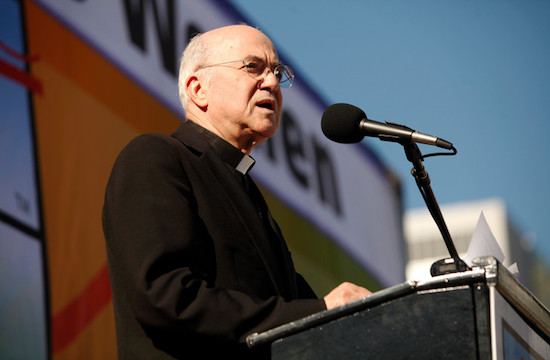 Archbishop Carlo Maria Viganò
The following manifesto, if you will, from Archbishop Carlo Maria Viganò, rises like a candle in the darkness, confirming that God is still with His Church, that not all shepherds are hirelings and that maybe—just maybe—the pioneer traditional Catholics of yesterday such as Lefevre, Davies, von Hildebrand and Matt, were not renegades but rather loyal sons of the Church, as is Archbishop Viganò himself.
I believe this document is truly historic, in that it is written by one whose life’s calling was to work in the very heart of the post-conciliar Church and at the highest levels. Its author knows of what he speaks. In fact, it could be said that he knows too much, which is why he remains in hiding, not out of fear, but so as to continue his defense of the true Church to which he’s dedicated his entire life and which is now under siege from within.
All the evil around us right now—from the riots, to the burning cities, to the slaughtered unborn, the desecrated altars, the broken families, the abused children, the empty convents and seminaries—can be understood by a careful and humble reading of the words that follow.
The human element of the Church is neither sinless nor free from error, even as the spotless Bride of Christ, in Her divinity, is pure and inviolate. This is not a moment to lose hope, but rather a sign from Heaven that God is preparing the way for the restoration of His Church and to bring an end to forty years wandering in the desert. God is speaking to the world through the words of this faithful shepherd. Read on, dear friends, and pray for him. MJM
Letter of Archbishop Carlo Maria Viganò
 9 June 2020
Saint Ephrem
I read with great interest the essay of His Excellency Athanasius Schneider published on LifeSiteNews on June 1, subsequently translated into Italian by Chiesa e post concilio, entitled There is no divine positive will or natural right to the diversity of religions. His Excellency’s study summarizes, with the clarity that distinguishes the words of those who speak according to Christ, the objections against the presumed legitimacy of the exercise of religious freedom that the Second Vatican Council theorized, contradicting the testimony of Sacred Scripture and the voice of Tradition, as well as the Catholic Magisterium which is the faithful guardian of both.
The merit of His Excellency’s essay lies first of all in its grasp of the causal link between the principles enunciated or implied by Vatican II and their logical consequent effect in the doctrinal, moral, liturgical, and disciplinary deviations that have arisen and progressively developed to the present day. The monstrum generated in modernist circles could have at first been misleading, but it has grown and strengthened, so that today it shows itself for what it really is in its subversive and rebellious nature. The creature that was conceived at that time is always the same, and it would be naive to think that its perverse nature could change. Attempts to correct the conciliar excesses – invoking the hermeneutic of continuity – have proven unsuccessful: Naturam expellas furca, tamen usque recurret [Drive nature out with a pitchfork; she will come right back] (Horace, Epist. I,10,24). The Abu Dhabi Declaration – and, as Bishop Schneider rightly observes, its first symptoms in the pantheon of Assisi – “was conceived in the spirit of the Second Vatican Council” as Bergoglio proudly confirms.
 MCViewPoint