
MCViewPoint

Opinion from a Libertarian ViewPoint

Posts Tagged ‘price controls’

EconomicPolicyJournal.com: There is Plenty of Toilet Paper

Posted by M. C. on March 22, 2020

Those of us that are good at figuring out angles will keep our lifestyles but for those of you who aren’t aggressive entrepreneurs, the socialists are going to make your lives miserable.

https://www.economicpolicyjournal.com/2020/03/there-is-plenty-of-toilet-paper.html

By Robert Wenzel

There are plenty of empty shelves in San Francisco. You can’t find any toilet paper or paper towels in any stores.

Some are blaming capitalism as if things would be different if Venezuelan president Nicolás Maduro were in charge.

The real problem is that the San Francisco government along with many other US governments is acting too much in the anti-free market authoritarian manner of Maduro.

Here’s a recent message from the socialist San Francisco district attorney Chesa Boudin:

What a confused little man.

Maduro has price controls in effect and we all know how that is working out.

The current problem is one of distribution and incentives, both short-term and long-term.

In the recent past, most stores and consumers operated on pretty much “just in time” inventory when it came to toilet paper and paper towels.

This changed when the government started a panic over COVID-19. Some fearing a lockdown went to stores and grabbed as much toilet paper and paper towels as they could handle.

That left many more, well, shit out of luck, when it comes to toilet paper.

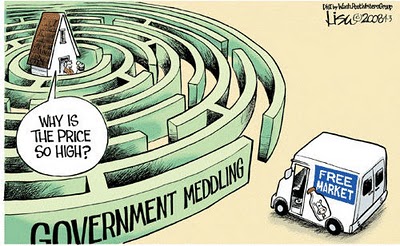
But the big problem is the anti-free market, anti-gouging rules.

People who have been selling toilet paper and paper towels for decades on a “just in time” inventory basis are not exactly, cutting edge, figure every angle entrepreneurs. They like steadiness and consistency.

I mean, they even understand this. The famous”don’t squeeze the Charmin” ads were built on the theme that grocers want steadiness and consistency—and certainly no one squeezing the Charmin.

If you want steadiness and consistency, you can have a nice life by being Mr. Whipple, but rarely are you going to become super-rich. That’s for the shrewd and aggressive.

When you have a supply line break, the Mr. Whipple’s of the world have no clue how to get aggressive about supply chains and pricing. They don’t want to, it is not in their blood.

What is needed is for the super aggressive to get working on the matter but they need to be motivated by money. A lot more money than the margin made by Mr. Whipple. You need the free market A Team working on this.

Government authoritarians like Boudin don’t get this. They consider free market, incentivized prices as “price gouging.” But when there has been a severe supply distortion for a commodity you want to buy, you really need sharp entrepreneurs to figure the angles and they are not going to do it for Mr. Whipple wages.

Consider my own situation. My just-in-time supply of toilet paper was running low. There is none, here in San Francisco, in supply at grocery stores or at any Walgreens or CVS stores.

So I had to think for a minute, then the solution came to me.

There are some restaurants that remain open in San Francisco but are operating on a “grab and go” basis. So my thought was, they must be packed with toilet paper that they aren’t using that they had in stock for in-restaurant dining. I will approach them and offer to buy some toilet paper.

The first two places I approached gave me a song and dance about why they couldn’t do it. There are just a lot of people who can’t think outside of routines.

Then I scored on my third try. I explained I wanted to buy some toilet paper. I told the owner, “I will pay good money.”

So the proprietor brought out a two-roll pack. The closet was close enough when he got the pack that I could see he had a full carton of toilet paper, 12 sets of 2 packs.

With the two roll pack in front of him, he said, “I am going to have to charge you $3.00.”

I replied, “I will buy the full carton for $60.” That’s $5.00 a pack, he was ecstatic.

As I walked home, I thought to myself, San Francisco is filled with toilet paper in gyms to skyscrapers that are not being used. I thought of the angles I could use to gain access to that toilet paper for around $5.00 a roll.

The city is filled with toilet paper.

I am pretty confident I could put a kid at a table on the sidewalk and sell them for $10.00 a roll, when you consider the alternative for prospective buyers. I think I could bank six figures every few days and take care of the asses of the masses.

But Boudin makes that impossible.

I have no incentive.

The masses will be wiping their asses with newspapers, at best, because Boudin thinks I would be gouging by hustling and figuring out the angles to free up the toilet paper that is out there that people want desperately.

Those of us that are good at figuring out angles will keep our lifestyles but for those of you who aren’t aggressive entrepreneurs, the socialists are going to make your lives miserable.

Be seeing you
?u=http4.bp.blogspot.com-NGrzJgBQttYTcu7PiwD8AIAAAAAAAAAvcmq8Obg1hU8Us1600FreeMarketsGovernmentMeddling.jpg&f=1&nofb=1

Posted in Uncategorized | Tagged: , , , , , | Leave a Comment »

Doug Casey on the Crisis “Medicare for All” Will Cause

Posted by M. C. on December 6, 2019

https://internationalman.com/articles/doug-casey-on-the-crisis-medicare-for-all-will-cause/

by Doug Casey

…The system revolves around the FDA. In theory, it should protect the consumer, but in fact it does the opposite. The FDA should be renamed the Federal Death Authority, because it kills more people every year than the Defense Department does in a typical decade.

Why do I say that? For one thing, it takes 10 years for a new drug to be approved, and it averages not just $1 billion dollars, but now more than $2 billion for the typical drug to be approved—and only very few are ever approved. That’s because there’s only a minimal risk to the FDA in not approving them but a huge risk that they’ll be embarrassed if something goes wrong with one that is approved.

Second, the whole system is very bureaucratized. When you go to a doctor’s office, you’ll notice that probably half the staff is not engaged in delivering medical services. They’re shuffling papers: insurance forms, regulatory forms, and various cover-your-ass records.

Third, the medical system is law driven more than science driven. Doctors have to be very careful about what they say and do; the society has become very litigious. One of the major expenses of being a doctor is malpractice insurance. Particularly for some specialties.

There are thousands of lawyers in the US who specialize in suing doctors for real or imagined mistakes. For that reason, some specialists pay hundreds of thousands of dollars per year for their malpractice insurance.

Because of the dangers of being sued, doctors are practically forced to engage in defensive medicine. They prescribe all kinds of tests that don’t make sense, but they figure that it’s better to be safe than sorry—not for the patient’s sake but for the sake of a potential lawsuit.

All of this started with Franklin Delano Roosevelt. During World War II, he installed wage and price controls, and it was impossible for companies to give raises to workers. So they substituted benefits for cash, namely employer-paid medical insurance. One of the many disastrous distortions FDR cranked into the US economy.

On the bright side, despite these things, medical care has gotten much better because of advances in science and technology. The cost of medical care should have and would have been dropping—like the cost of computers—if not for State intervention. But that’s beside the point we’re discussing…

It’s a subtle corruption of the language to call “medical insurance” “health insurance.” It doesn’t insure your health. All it does is cover medical expenses. But they like to use the term “health care” because it sounds friendly and loving. “We’ll care for your health.” That sounds great! Sign me up! “Medical,” however, implies surgery, dangerous drugs, hospitals, and pain.

It’s a euphemism, and like all euphemisms, it’s dishonest. Health care or health insurance should always be called “medical insurance,” because it will at best cover your medical expenses. Calling it “health care” and saying it’s “free” is just dishonest marketing…

Doug Casey: To start with, the 34% of Americans who are “insured” through a government plan aren’t actually insured. They’re not paying market-based premiums based on actuarial tables—considering age, preexisting conditions, and the like—intended to spread the risk of serious sickness or injury.

Medicare and Medicaid are actually welfare programs. They have nothing to do with insurance. Using that term gives them and those who use them undeserved respect.

Medicaid is one hundred percent welfare, and Medicare is mostly a welfare program. They shouldn’t be termed “insurance.”

The important point is that they shouldn’t exist. Why should the State cover a person’s medical costs? If it should, maybe it should also cover their food, shelter, and clothing—oh, wait, I forgot, it does. And even the cost of their cellphones. But cars are also important. When someone’s car stops working, shouldn’t that be covered as well?

How about their dog? How about farm animals?

Is somebody else’s bad health a mortgage on my life?

Bad things happen. That’s why you buy insurance. If you can’t afford insurance, that means you managed your life badly. It’s not up to strangers to kiss it all and make it better for you.

Most diseases and many injuries are a result of people not taking care of themselves. They overeat, don’t exercise, use alcohol and drugs, and engage in bad lifestyles. Those are moral failures. I don’t want to pay for those people’s moral failures. Neither should you.

International Man: Over 59 million Americans are on Medicare. Bernie Sanders and other presidential candidates have made “Medicare for all” one of their biggest campaign promises.

What type of care can Americans expect to receive in a single-player system, with national coverage for all?

Doug Casey: It would mean disastrous and degenerating care.

They like to bring up Canada and Britain as examples—and they’re very good examples.

The medical systems of both countries are in crisis. If you need an operation, it can be delayed for many months, sometimes more than a year. Forget about something that’s noncritical. The reason is simple: When you have scarce commodities like a doctor’s time and medical equipment, they have to be rationed.

There are three ways you can ration a commodity. By dollars, time, or political connections. In other words, you can pay for it and get it when you want it. Or you can wait in line—for who knows for how long. Or if you’re a VIP with friends in high places, you’re moved to the front of the line.

In places like Canada and Britain, you hardly have a choice. The single payer determines if you get treated, when you get treated, and how you get treated.

Furthermore, if something is “free,” which care from a single payer supposedly is—although it’s paid for by taxes—everybody wants as much as they can get. And as with any free good, people won’t economize.

Certain people are going to live at the doctor’s office. It’s going to turn some people into hypochondriacs. The idea of Medicare for all—or for that matter, Medicare for oldsters—is stupid and uneconomic from every point of view. More important, it’s morally depraved, because it uses the State to force some people—namely doctors and productive people—to pay for those who were too imprudent to provide for their own care.

As a fringe benefit, it will destroy the medical system. Doctors will wind up as veritable government employees. That will discourage them from spending six years and hundreds of thousands to learn their trade. There will be a lot more demand but a much smaller supply of doctors. At the same time, the amount of capital available for developing new drugs, new technology, and basic research will collapse. Why? All governments today are running gigantic deficits. This is likely to get much worse. They’ll put off the important in favor of the urgent, and the results are inevitable…

Just the other day I got an email from someone in Aspen who’s a member of a luncheon group I attend. Most of the guys are typical Aspen rich guys. One member, who’s in temporary (I presume) financial straits, wrote that his dog has a type of operable cancer. But it’s an expensive operation, and he can’t afford to pay for it.

He’s asked the guys at the luncheon group and his other friends to contribute to the cost of the surgery.

I have zero doubt he’ll raise the money. I don’t believe in charity, for reasons I’ve spelled out in the past. But I sent him a hundred dollars.

I wouldn’t, however, send anything to someone in the Third World with a problem (not to mention the fact it’s probably a scam run by some Nigerians). There are roughly 7.5 billion people on this planet. They all have problems and would all like $100.

But I sent him $100 for his dog. Why?

The fact that I did might generate further good feelings between us. (He seems like a decent guy, although I don’t know him well.) If I had just sent it into the ether for the medical care of some person in Africa, as opposed to this man’s dog, I know I’d be getting nothing back for it. In fact, maybe the African is a member of Boko Haram and would want to kill me just on general principles. This is one of many reasons giving money to “charity” is usually a mistake. Giving to an individual, even as a test of their character, is much wiser

Frankly, sometimes you value the life of a dog more than the life of some poor person outside of your circle. And sometimes you should. If it were my dog, there’d be no question about it.

That’s what this whole thing about insurance, Medicare, and a single-payer system is all about. It’s up to individuals—not State bureaucrats, not “the system”—to decide who lives and who dies. Including you yourself.

Be seeing you

proxy.duckduckgo.com


Posted in Uncategorized | Tagged: , , , , , | Leave a Comment »

EconomicPolicyJournal.com: California Governor Signs Law to Prevent Easing of Housing Crisis

Posted by M. C. on October 12, 2019

https://www.economicpolicyjournal.com/2019/10/california-governor-signs-law-to.html

Yes, that is exactly what he did.

California Governor Gavin Newsom signed a law that limits rent increases to 5% each year plus inflation until Jan. 1, 2030. It bans landlords from evicting people for no reason, meaning they could not kick people out so they can raise the rent for a new tenant. And while the law doesn’t take effect until Jan. 1, it would apply to rent increases on or after March 15, 2019, to prevent landlords from raising rents just before the caps go into place.

This will have serious impact whenever the limitation prevents the rental market from clearing. The state has 17 million renters.

As Dr. Walter Block explains in The Concise Encyclopedia of Economics:

Rent control, like all other government-mandated price controls, is a law placing a maximum price, or a “rent ceiling,” on what landlords may charge tenants. If it is to have any effect, the rent level must be set at a rate below that which would otherwise have prevailed. (An enactment prohibiting apartment rents from exceeding, say, $100,000 per month, would have no effect since no one would pay that amount in any case.) But if rents are established at less than their equilibrium levels, demand will necessarily exceed supply, and rent control will lead to a shortage of dwelling spaces. Absent controls on prices, if the amount of a commodity or service demanded is larger than the amount supplied, prices rise to eliminate the shortage (by both bringing forth new supply and by reducing the amount demanded). But controls prevent rents from attaining market-clearing levels and shortages result…

Economists are virtually unanimous in the conclusion that rent controls are destructive. In a late-seventies poll of 211 economists published in the May 1979 issue of American Economic Review, slightly more than 98 percent of U.S. respondents agreed that “a ceiling on rents reduces the quantity and quality of housing available.” Similarly, the June 1988 issue of Canadian Public Policy reported that over 95 percent of the Canadian economists polled agreed with the statement. The agreement cuts across the usual political spectrum, ranging all the way from Nobel Prize winners Milton Friedman and Friedrich Hayek on the “right” to their fellow Nobel Laureate Gunnar Myrdal, an important architect of the Swedish Labor Party’s welfare state, on the “left.” Myrdal stated, “Rent control has in certain Western countries constituted, maybe, the worst example of poor planning by governments lacking courage and vision.” Fellow Swedish economist (and socialist) Assar Lindbeck, asserted, “In many cases rent control appears to be the most efficient technique presently known to destroy a city—except for bombing.”
Economists have shown that rent control diverts new investment, which would otherwise have gone to rental housing, toward other, greener pastures—greener in terms of consumer need. They have demonstrated that it leads to housing deterioration, to fewer repairs and less maintenance. For example, Paul Niebanck reports that 29 percent of rent-controlled housing in the United States is deteriorated, but only 8 percent of the uncontrolled units are in such a state of disrepair. Joel Brenner and Herbert Franklin cite similar statistics for England and France.

The economic reasons are straightforward. One effect of government oversight is to retard investment in residential rental units. Imagine that you have $5 million to invest and can place the funds in any industry you wish. In most businesses governments will place only limited controls and taxes on your enterprise. But if you entrust your money to rental housing, you must pass one additional hurdle: the rent-control authority, with its hearings, red tape, and rent ceilings. Under these conditions is it any wonder that you are less likely to build or purchase rental housing?…
Rent control has destroyed entire sections of sound housing in New York’s South Bronx. It has led to decay and abandonment throughout the entire five boroughs of the city. Although hard statistics on abandonments are not available, William Tucker reports estimates that about thirty thousand New York apartments were abandoned annually from 1972 to 1982, a loss of almost a third of a million units in this eleven-year period.

RW

Rent control: Does it work? - BBC News

I bet Londonstaners would like tax control even better.

Posted in Uncategorized | Tagged: , , , , | Leave a Comment »

How So Many Bad Ideas Manage to Win on Election Day | Mises Wire

Posted by M. C. on November 9, 2018

The reason is well-captured by a quote from Jonathan Swift, in 1710: “Falsehood flies, and the truth comes limping after it.” At the last minute, lies, damned lies and statistics, not to mention unsupported claims, rumors, innuendo, etc., can have their greatest power, because there is not time for serious thought, research, and effective rebuttal before voters must cast what will therefore be far more misinformed ballots.

https://mises.org/wire/how-so-many-bad-ideas-manage-win-election-day

What struck me most as an example this year was “Rent control could spur more building,” by Gary Painter, in the Los Angeles Times (10/31). It was written in favor of California’s Proposition 10, which would have re-enabled majority-renter communities to vote themselves large benefits from others’ pockets by imposing new rent control laws (currently banned by state law).

While many studies have shown that rent control reduces construction, Painter offered an alternate theory to convince voters who oppose rent control for that reason. The core of his argument, which he intimated was a standard Econ 101 lesson (despite over 90% of economists expressing disagreement with his conclusion), was:

Price controls can actually spur an increase in supply. When housing developers have too much power in the market, they can maximize profits by raising rents on the apartments they already own. But if rent control limits that option, developers have to go to Plan B if they want to make more money: Build more units.

The core of Painter’s argument was that the consolidation of the homebuilding industry due to the great recession (the number of builders was approximately halved from 2007 to 2012) and further subsequent concentration in the industry, had given builders monopoly power, which they were using to reduce construction. Consequently, he argued that imposing rent control would be able to tame their monopoly power to increase rents, and leave them with building more rental housing as their sole means to higher profits.

There were many holes in this argument, but there was too little time to it to effectively rebut it before the election. Read the rest of this entry »

Posted in Uncategorized | Tagged: , , , , | Leave a Comment »

How Champions of the Poor Become Tyrants | Mises Wire

Posted by M. C. on September 30, 2018

https://mises.org/wire/how-champions-poor-become-tyrants

In a free society, income and wealth gaps are driven by variations in skill, knowledge, talents, independence, creativity, drive, and willingness to take risks. People who are satisfied with safe and secure occupations — like economics professor, school teacher, nurse, dentist or tax return preparer — expect to have much less wealth and income than risk-taking individuals who successfully capitalize on splendid ideas that result in products and services that benefit all of society. In this system, quantity, quality, and prices are determined by the demand and supply of goods and services.

The diagram below depicts one of many markets. The good or service being exchanged could be homes, X-rays, bank reserves, hours of low-skilled labor needed, tickets to Solo: A Star Wars Story, or, in this case, smartphones. Demand (the blue line) and supply (the red line) meet at the purple point. Assuming a free market system of no taxes, subsidies, price controls, regulations, prohibitions, government ownership, etc., 150 smartphones are produced and sold to 150 consumers at a price of $700.

demand1.png

The blue demand line represents a queue that sorts people according to their willingness to pay. The person with the lowest willingness to pay is at the right end of demand (the blue point). He or she is only willing to pay $200 for a smartphone. The person with the highest willingness to pay is at the left end of demand. He or she is willing to pay up to $1200. Whereas only one smartphone would be sold if the price is $1200, 300 smartphones would be sold at a price of $200. Read the rest of this entry »

Posted in Uncategorized | Tagged: , , , , , | Leave a Comment »