
MCViewPoint

Opinion from a Libertarian ViewPoint

Posts Tagged ‘private education’

Three Libertarian Principles for Education – The Future of Freedom Foundation

Posted by M. C. on March 1, 2021

1. The federal government should have absolutely nothing to do with education.

2. All education should be private education.

3. Education should not be funded by the state.

https://www.fff.org/explore-freedom/article/three-libertarian-principles-for-education/

by Laurence M. Vance

Although the presidency and both Houses of Congress are now controlled by Democrats, some conservatives still think that they can have some influence on the federal government’s education polices.Whether Washington could help promote conservative principles of education is irrelevant because Washington shouldn’t even be trying.
[Click to Tweet]

A case in point is a new report by Michael Q. McShane of the American Enterprise Institute (AEI), “Where Conservatives Should Lead on Federal Education Policy in 2021.” McShane is an adjunct fellow in education policy studies at AEI and director of education policy at the Show-Me Institute, where he studies and writes about K–12 education policy, including private and religious schools and the politics of education.

His key points are:

  • Conservatives have an opportunity to play a productive role in federal education policymaking. They have to do more than just say no.
  • Early childhood education policy should center on family and work to make family life in America easier.
  • Federal K–12 policy should focus on deregulating existing programs and broadening their eligibility to allow new and different providers to access federal funds.
  • Higher education policy should diminish the power of existing gatekeepers and open the field for more innovation, with new means of ensuring that dollars are spent well.

McShane has also joined with Frederick M. Hess, a resident scholar and the director of Education Policy Studies at AEI, where he works on K–12 and higher education issues, in writing an op-ed titled “Three Conservative Principles for Education.”

McShane and Hess mention an AEI collection of more than two dozen education proposals called “The Next Conservative Education Agenda.” This includes proposals like

  • Rethink the School Day and Year
  • A Three-year Bachelor’s Degree
  • Three Perspective Shifts to Advance Choice
  • Third-Party Credentialing for Higher Education
  • Two Steps to Restoring School Safety
  • A Constitutional Right to a High-Quality Public Education

But as McShane and Hess point out: “These varied ideas have much to recommend them but are all, quite intentionally, policies—not principles. As we set forth on a new decade, in a time of massive social and political disruption, it’s worth considering what principles ought to undergird conservative policy, in 2021 and beyond. Here, we offer three:

First, the family is the foundation. We understand that parents know their children better and care for them more than any bureaucrat, and that’s why we should fight to put parents in the driver’s seat when it comes to choosing the best options for child care, preschool and K-12 education.

Second, schools are formative, not performative, institutions. Schools are supposed to be formative institutions. They’re supposed to shape students into young adults who can reason, think and grow into responsible citizens. Teachers and professors are to serve as mentors, role models and sources of insight and wisdom, moderating the hubristic zeal of young people.

Third, conservatives should be confident pluralists. We should allow parents and educators in varied situations and different communities to create the schools that best meet the needs of their children. Public dollars for education should equitably support a wide array of options.

The authors then ask the questions: “Can Washington help promote these principles? Should it?”

Their answer is that the federal government “can, and it must, in a limited way—mostly by expanding eligibility for existing federal programs and loosening the regulatory vise governing the use of those funds.”

They conclude: “As conservatives look to help hard-hit families recover from the dislocations of COVID-19 and gear up for the policy debates of the Biden era, we need to think about what we offer when it comes to schools and schooling. A tough-minded examination of our core principles is a good place to start.”

I think a better place to start would be a tough-minded examination of the libertarian core principles of education. As a counter to McShane’s and Hess’s “Three Conservative Principles for Education,” here are three libertarian principles for education.

1. The federal government should have absolutely nothing to do with education. Nowhere does the Constitution authorize the federal government to have anything to do with education. What James Madison wrote in Federalist No. 45 is still applicable today:

The powers delegated by the proposed Constitution to the Federal Government, are few and defined. Those which are to remain in the State Governments are numerous and indefinite. The former will be exercised principally on external objects, as war, peace, negotiation, and foreign commerce; with which last the power of taxation will for the most part be connected. The powers reserved to the several States will extend to all the objects, which, in the ordinary course of affairs, concern the lives, liberties and properties of the people; and the internal order, improvement, and prosperity of the State.

This means not only no Department of Education, but no Higher Education Act, no Elementary and Secondary Education Act, no bilingual-education mandates, no math and science initiatives, no Title IX mandates, no school accreditation, no anti-discrimination policies, no standardized-testing requirements, no Common Core standards, no Race to the Top funds, no No Child Left Behind Act, no desegregation orders, and no special-education mandates.

2. All education should be private education. Every state has a provision in its constitution for the operation of K-12 schools, colleges, and universities. Therefore, if there are to be any public schools; that is, government schools, they should be limited to state-government schools, fully staffed and supervised by state governments. Although this is preferable to the federal government being involved in education, it is still not ideal. It is an illegitimate purpose of government to establish public schools or provide educational services to anyone. Education is a service that should be provided on the free market by private entities. There is nothing inherently unique about education which necessitates that the government provide it.

3. Education should not be funded by the state. Neither the federal nor the state governments should fund education in any way, even if they are not involved in the operation or regulation of schools. This means no vouchers, no charter schools, no school breakfast and lunch programs, no Pell Grants, no student loans, no research grants to colleges, no scholarships, and no Head Start funding. Education is not a constitutional right. It is the responsibility of parents to educate their children. No American should be forced to pay for the education of any other American or their children.

So, to answer the questions posed by McShane and Hess, whether Washington could help promote conservative principles of education is irrelevant because Washington shouldn’t even be trying.

This post was written by: Laurence M. Vance

Laurence M. Vance is a columnist and policy advisor for the Future of Freedom Foundation, an associated scholar of the Ludwig von Mises Institute, and a columnist, blogger, and book reviewer at LewRockwell.com. He is the author of Gun Control and the Second Amendment, The War on Drugs Is a War on Freedom, and War, Empire and the Military: Essays on the Follies of War and U.S. Foreign Policy. His newest books are Free Trade or Protectionism? and The Free Society. Visit his website: www.vancepublications.com. Send him e-mail.

Be seeing you
Posted in Uncategorized | Tagged: , , | Leave a Comment »

5 Things I Learned Debating the Harvard Prof Who Called for a ‘Presumptive Ban’ on Homeschooling | The Libertarian Institute

Posted by M. C. on June 28, 2020

https://libertarianinstitute.org/articles/5-things-i-learned-debating-the-harvard-prof-who-called-for-a-presumptive-ban-on-homeschooling/

by | Jun 21, 2020


It’s not just about homeschooling.

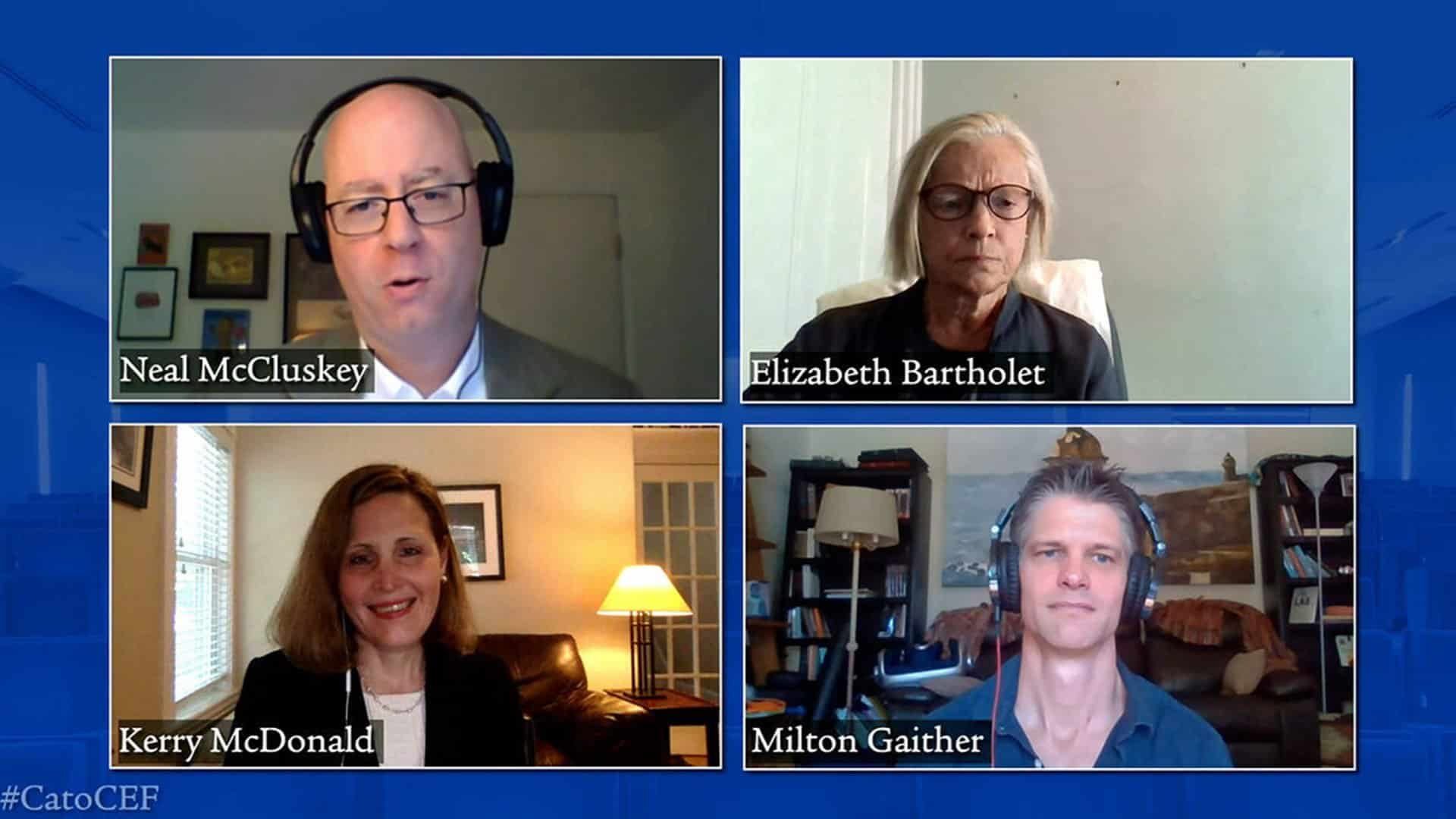
On Monday, I debated the Harvard professor who proposes a “presumptive ban” on homeschooling. Thousands of viewers tuned in to watch the live, online discussion hosted by the Cato Institute. With 1,000 submitted audience questions, the 90-minute webinar only scratched the surface of the issue about who is presumed to know what is best for children: parents or the state. Here is the replay link in case you missed it.

Last week, I outlined much of my argument against Harvard Law School professor Elizabeth Bartholet that I incorporated into our debate, but here are five takeaways from Monday’s discussion:

While this event was framed as a discussion about homeschooling, including whether and how to regulate the practice, it is clear that homeschooling is just a strawman. The real issue focuses on the role of government in people’s lives, and in particular in the lives of families and children. In her 80-page Arizona Law Review article that sparked this controversy, Professor Bartholet makes it clear that she is seeking a reinterpretation of the US Constitution, which she calls “outdated and inadequate,” to move from its existing focus on negative rights, or individuals being free from state intervention, to positive rights where the state takes a much more active role in citizens’ lives.

During Monday’s discussion, Professor Bartholet explained that “some parents can’t be trusted to not abuse and neglect their children,” and that is why “kids are going to be way better off if both parent and state are involved.” She said her argument focuses on “the state having the right to assert the rights of the child to both education and protection.” Finally, Professor Bartholet said that it’s important to “have the state have some say in protecting children and in trying to raise them so that the children have a decent chance at a future and also are likely to participate in some positive, meaningful ways in the larger society.”

It’s true that the state has a role in protecting children from harm, but does it really have a role in “trying to raise them”? And if the state does have a role in raising children to be competent adults, then the fact that two-thirds of US schoolchildren are not reading proficiently, and more than three-quarters are not proficient in civics, should cause us to be skeptical about the state’s ability to ensure competence.

I made the point on Monday that we already have an established government system to protect children from abuse and neglect. The mission of Child Protective Services (CPS) is to investigate suspected child abuse and punish perpetrators. CPS is plagued with problems and must be dramatically reformed, but the key is to improve the current government system meant to protect children rather than singling out homeschoolers for additional regulation and government oversight. This is particularly true when there is no compelling evidence that homeschooling parents are more likely to abuse their children than non-homeschooling parents, and some research to suggest that homeschooling parents are actually less likely to abuse their children.

Additionally, and perhaps most disturbingly, this argument for more state involvement in the lives of homeschoolers ignores the fact that children are routinely abused in government schools by government educators, as well as by school peers. If the government can’t even protect children enrolled in its own heavily regulated and surveilled schools, then how can it possibly argue for the right to regulate and monitor those families who opt out?

Of all the recommendations included in the Harvard professor’s proposed presumptive ban on homeschooling, the one that caused the most uproar among both homeschoolers and libertarians was the call for regular home visits of homeschooling families, with no evidence of wrongdoing.

In my remarks during Monday’s debate, I included a quote from a Hispanic homeschooling mother in Connecticut who was particularly angry and concerned about imposing home visits on homeschooling families. (According to federal data, Hispanics make up about one-quarter of the overall US homeschooling population, mirroring their representation in the general US K-12 school-age population.) She made the important point that minority families are increasingly choosing homeschooling to escape discrimination and an inadequate academic environment in local schools. She also pointed out that, tragically, it is often minorities who are most seriously impacted by these seemingly well-meaning government regulations. Writing to me about Professor Bartholet’s recommendation, she said:

“To state that they want to have surveillance into our homes by having government officials visit, and have parents show proof of their qualified experience to be a parent to their own child is yet another way for local and federal government to do what they have done to native Americans, blacks, the Japanese, Hispanics, etc in the past. Her proposal would once again interfere and hinder a certain population from progressing forward.”

Anyone who cares about liberty and a restrained government should be deeply troubled by the idea of periodic home visits by government agents on law-abiding citizens.

Despite the landmark 1925 US Supreme Court decision that ruled it unconstitutional to ban private schools, there remains lingering support for limiting or abolishing private education and forcing all children to attend government schools. Homeschooling is just one form of private education.

In her law review article, Professor Bartholet recommends “private school reform,” suggesting that private schools may have similar issues to homeschooling but saying that this topic is “beyond the scope” of her article. Still, she concludes her article by stating that “to the degree public schools are seriously deficient, our society should work on improving them, rather than simply allowing some parents to escape.”

The government should work to improve its own schools, where academic deficiencies and abuse are pervasive. But it should have no role in deciding whether or not parents are allowed to escape.

Some advocates of homeschooling regulation suggest that requiring regular standardized testing of homeschoolers would be a reasonable compromise. In her law review article, Professor Bartholet recommends: “Testing of homeschoolers on a regular basis, at least annually, to assess educational progress, with tests selected and administered by public school authorities; permission to continue homeschooling conditioned on adequate performance, with low scores triggering an order to enroll in school.”

During Monday’s debate, I asked the question: By whose standard are we judging homeschoolers’ academic performance? Is it by the standard of the government schools, where so many children are failing to meet the very academic standards the government has created? I pointed out that many parents choose homeschooling because they disapprove of the standards set by government schools. For example, in recent years schools have pushed literacy expectations to younger and younger children, with kindergarteners now being required to read. If they fail to meet this arbitrary standard, many children are labeled with a reading deficiency when it could just be that they are not yet developmentally ready to read.

Indeed, as The New York Times reported in 2015: “Once mainly concentrated among religious families as well as parents who wanted to release their children from the strictures of traditional classrooms, home schooling is now attracting parents who want to escape the testing and curriculums that have come along with the Common Core, new academic standards that have been adopted by more than 40 states.”

A key benefit of homeschooling is avoiding standardization in learning and allowing for a much more individualized education. And it seems to be working. Most of the research on homeschooling families conducted over the past several decades, including a recent literature review by Dr. Lindsey Burke of the Heritage Foundation, finds positive academic outcomes of homeschooling children.

There are very few movements today that bring together such a diverse group of people as homeschooling does. Families of all political persuasions, from all corners of the country, reflecting many different races, ethnicities, classes, cultures, values, and ideologies, and representing a multitude of different learning philosophies and approaches choose homeschooling for the educational freedom and flexibility it provides. Homeschoolers may not agree on much, but preserving the freedom to raise and educate their children as they choose is a unifying priority. In times of division, homeschoolers offer hope and optimism that liberty will prevail.

Reprinted from FEE.

Be seeing you

Posted in Uncategorized | Tagged: , , , , , , | Leave a Comment »