
Permanent Children
Be seeing you

Enemy of the State-Read the Book-Know the Man
This is not a Safe Space but Baby, I don't care.

"I am not a number, I am a Free Man" - No. 6
 Information Liberation Alex Jones’ Prison Planet Gary North Specific Answers Antiwar The Daily Bell Tenth Amendment Center Economics Policy Journal The American Thinker The New American Lew Rockwell
Posted by M. C. on August 30, 2022
Posted in Uncategorized | Tagged: Permanent Children, Privilege | Leave a Comment »
Posted by M. C. on February 26, 2022
The early 19th-century French classical liberal economists understood that government by its very nature as the taxing authority is a dispenser of privileges and the source of class conflict. The conflict, obviously, is between what the liberals called the tax-payers and the tax-eaters. In the liberals’ eyes, all industrious people, including unsubsidized organizers of business firms, were in the tax-paying class, while those who lived off of them rather than working were tax-eaters. The latter class did not consist of the poor by and large, but rather the cronies of government officials or the king.
https://libertarianinstitute.org/articles/tgif-on-privilege/
One of the most abused words in English is privilege. Observe how indiscriminately this word is spoken and written. For example, in some quarters, all straight white men — without exception — are said to be privileged, which seems absurd.
Practically all we hear about these days is privilege, who has it and who doesn’t. Well, not exactly — because those who are said not to have it are often called “underprivileged.” I think it was the late P. T. Bauer, the great free-market development economist, who pointed out how peculiar a word that is. Underprivileged? Wouldn’t that mean insufficiently privileged? An insufficiently privileged person is nevertheless privileged, no? Apart from the problem of measuring and comparing privileges among people, is that what people really mean by the word? I think not.
Semantics aside, we face a more serious matter with the concept, namely, that vastly disparate things are tossed into that bin. Some alleged privileges are not privileges at all. Rather, they indicate the absence of unjust impediments, mostly imposed by the state. In those cases we should focus not on the unimpeded but on those who are unjustly burdened. The unimpeded are not privileged; they are just free (at least in that one respect). Those whom the state burdens are unfree.
For example, if black people and other members of minorities are more likely than white people to be harassed by the police for trifles or nothing at all, that is an outrageous injustice against the victims. But the unharassed white people are not thereby privileged, not even in a relative sense. In that respect, they are as they should be. The problem is that everyone else is not in the same position. The lack of equal treatment, as unjust as it is, does not necessarily indicate the presence of privilege.
Again, if a privilege is something granted that the recipient has no inherent right to, then not being harassed by the police is in no way a privilege. No one deserves to be harassed by the cops. On the contrary, one has a right not to be harassed. (Not every contact with the police counts as harassment, of course. If one is stopped from accosting an innocent person, the aggressor cannot be said to have been harassed.)
This doesn’t mean privilege does not exist. Our society is rife with it. But it behooves us to be clear on its nature. As I said, a privilege is something bestowed to which the recipient has no inherent right. Privileges, then, come in two forms: legitimate and illegitimate. If parents give their child an allowance that he or she can use freely, we might call that a privilege. But it is legitimate because the money is the parents to give as they wish. On the other hand, if the government grants a cash subsidy to a firm or industry, it is illegitimate because the politicians give away other people’s money to which they have no right. Using the threat of force, they transfer wealth from its producers to nonproducers. This is true of all government transfers, no matter how elevated the politicians’ motives might be.
For a long time, state governments and the federal government provided low-interest loans and mortgage insurance to white homebuyers only. Those governments not only treated the two groups unequally, but they also positively subsidized the whites. Whites unjustly got a leg up, while blacks were ignored or worse. That was scandalous race-based government privilege with long-term consequences.
Not all subsidies are outright cash grants. If the government does a crony industry or firm a favor by imposing a tax (tariff) on imports, that too is a privilege. Ultimately, the unjust burden is imposed on consumers, who will pay higher prices, which is the purpose of the tariff, Foreign firms will also be unjustly harmed. The domestic recipients of the privilege have no right to the loot.
Another form of privilege is a government regulation of peaceful commerce that is more easily borne by large companies than small ones.
The early 19th-century French classical liberal economists understood that government by its very nature as the taxing authority is a dispenser of privileges and the source of class conflict. The conflict, obviously, is between what the liberals called the tax-payers and the tax-eaters. In the liberals’ eyes, all industrious people, including unsubsidized organizers of business firms, were in the tax-paying class, while those who lived off of them rather than working were tax-eaters. The latter class did not consist of the poor by and large, but rather the cronies of government officials or the king. (Marx acknowledged his debt to these bourgeois liberals for originating class theory, but he either misunderstood it or intentionally twisted it to put all business owners, not just the cronies, in the parasitic class.)
Without reservation, we should favor the repeal of all actual state privileges, while also calling for an end to all the burdens that the state imposes on anyone. We can do all this without regarding the unburdened as privileged.
Be seeing you
Posted in Uncategorized | Tagged: Privilege, tax-eaters, tax-payers, underprivileged | Leave a Comment »
Posted by M. C. on October 22, 2020
The goal is a less political world, not a world which bends to our political will. We are not Imposers. So participate in politics and voting if you like, or refrain if you like. Voting is optional and anonymous for a reason. But never let anyone force you into taking a political stance, or even to hold a political stance. In 2020, privilege manifests as political extortion. Push back against these bullies.
Actor Chris Pratt finds himself a target of left Hollywood and various social media enforcers for his apparent lack of support for Joe Biden, a sin in his industry. Pratt has endorsed neither Biden nor Trump, which seems eminently sensible for a boy-next-door type who plays superheroes and adventurers in big blockbusters. But staying quiet is never enough for the political jackals, who insist silence is violence and a form of privilege. Trump is a Nazi; his electorate is full of hateful fascist enablers and this is no time for quietude. To make matters worse, the reticent Pratt also belongs to a Christian church which is “anti-LGBT”—which is to say not anti-LGBT at all, but simply not in full conformity with the language and demands of its accusers.
When his actor friend and sometime costar Mark Ruffalo rushed to defend Pratt’s character, the Twitterati reacted angrily but predictably:
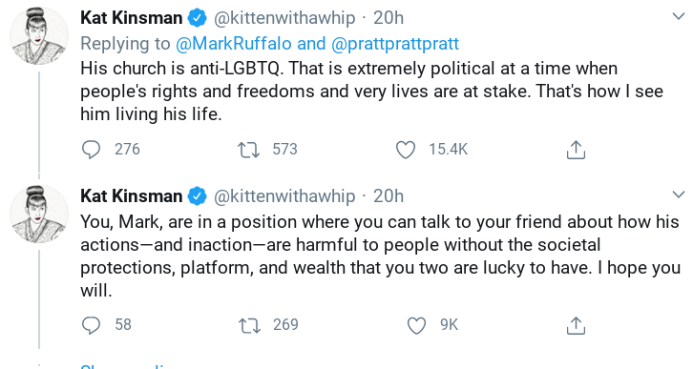
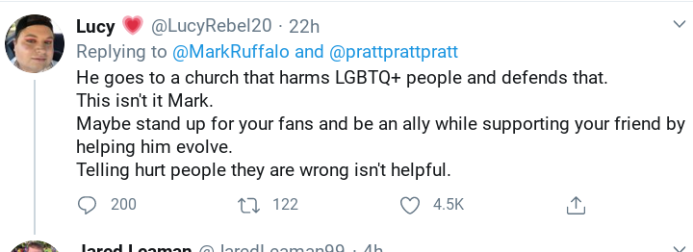
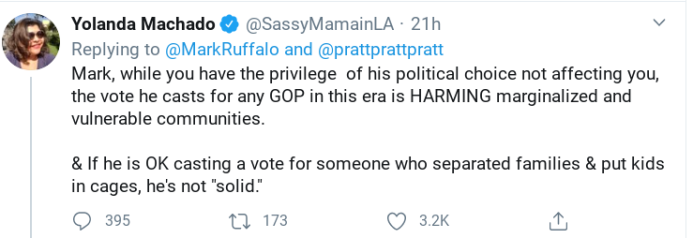
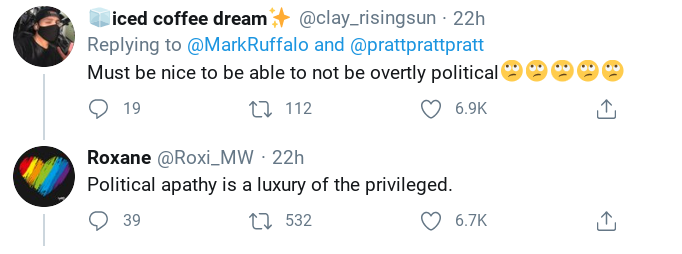
This is a classic case of the Imposers positioning themselves as the Imposed Upon: LGBT advocates weaponize and contort simple words—hurt, harm, apathy, privilege, marginalized, vulnerable—in ways reminiscent of Orwell’s “Politics and the English Language.” They use words in consciously dishonest ways. They shift the parameters of what it means to “support” or “oppose” LGBT causes into a stark binary: you are for us or against us. Simply living one’s life peaceably is not an option in this bizarre worldview.
And the Imposer’s unconditional terms change constantly, seemingly overnight. One cannot avoid conflict by being “not overtly political,” as Ruffalo termed Pratt. The accusations against his church, for example, amount to nothing more than a demand for unconditional surrender of any theology or doctrine which does not comport with today’s instant (though far from universal) view of transgenderism. Unless and until that happens, his church is per se transphobic and evil: indifference, or even kind and loving disagreement, cannot satisfy the Imposers.
It does not matter whether Pratt’s church welcomes everyone, even those individuals it considers engaged in sin (which presumably includes just about every person on earth). It does not matter whether Pratt is a good person or friend to his fellow actors. His church must affirmatively endorse the views of LGBT activists; Pratt must actively endorse Biden. Anything else is weaponized privilege.
Of course this is nonsense, but the Imposers always claim to be the Imposed Upon. Media and politicians play along, and then social media voices join the chorus until the original reality becomes completely obscured: both Chris Pratt and his church were minding their own business and not hurting anyone. The Biden and LGBT activists came looking for them, not the other way around.
What incredible arrogance and hubris! This is real privilege: the privilege of demanding others not only share your political views but also see the world in starkly political terms. This is real hate, actual hate, not the phony kind imagined on Hate Has No Home Here yard signs.
When taken to an extreme, a positive rights worldview requires not only conformity and acquiescence with the political project of the day, but your affirmative participation. Not keeping up with the latest outrage, political machinations, or campaign—not leading a wholly political life—becomes a dereliction of duty.
Political liberty is quite simple, but not easy. We all owe our fellow citizens a duty not to aggress against them or their property, and not to commit fraud against them. In the broader societal sense, we all should strive to be kind, open, and generous with everyone we meet, unless and until they give us a reason to be otherwise. But that is all we owe. Being apolitical or even antipolitical is your absolute right. At best, politics is an uneasy and imperfect mechanism for peacefully transferring political power; at worst, it is barely a substitute for war. More commonly, politics is a turf battle waged by rival gangs to control the state apparatus (the turf is us and our money). Politics is not noble, virtuous, or even necessary. The people attacking Chris Pratt, and even hoping to harm his career, reputation, and finances, hold no moral high ground.
My great aunt, now departed, once told me about a decision she and her husband made as newlyweds just after World War II. Starting life together in a very modest house, they wanted to build lasting memories with family and friends. So they made a pact: they would never discuss politics in their home or allow guests to discuss politics. In her view politics was like sex and religion, a private matter. They wanted to avoid the disharmony and rancor they had witnessed among their own parents and families a decade earlier over the Roosevelt administration’s New Deal programs. They determined their hearth and home would be devoted to happiness, an apolitical refuge where every visitor would be welcome.
The goal is a less political world, not a world which bends to our political will. We are not Imposers. So participate in politics and voting if you like, or refrain if you like. Voting is optional and anonymous for a reason. But never let anyone force you into taking a political stance, or even to hold a political stance. In 2020, privilege manifests as political extortion. Push back against these bullies.
Author:
Jeff Deist is president of the Mises Institute. He previously worked as chief of staff to Congressman Ron Paul, and as an attorney for private equity clients. Contact: email; Twitter.
Be seeing you
Posted in Uncategorized | Tagged: anti-LGBT, Christian church, Hollywood, Imposers, politics, Privilege | Leave a Comment »
 MCViewPoint