Freedom of religion as long as it was THEIR religion.
The reactions to the murder of black George Flyod by a white policeman do not refer to the history of slavery in the United States, but – like the systemic opposition to President Trump- to a profound problem in Anglo-Saxon culture: Puritan fanaticism. The domestic violence that rocked this country during the two civil wars of Independence and Secession must be remembered in order to understand current events and prevent their resurgence. Beware: in the United States, the political class now preaches egalitarian racism. All equal, but separate.
The Anglo-Saxon Puritans
About four hundred members of the Church of England fled their country where they were considered fanatics. They took refuge in Leiden, Holland, where they were able to live according to the Calvinist tradition, or more precisely the Puritan interpretation of Christianity. Probably at the request of King James I, they sent two groups to the Americas to fight against the Spanish Empire. The first founded what was to become the United States, the second was lost in Central America.
Later, the Puritans took power in England with Lord Cromwell. They beheaded the Papist King Charles I, established an egalitarian Commonwealth and colonized Ireland, massacring Catholics en masse. This bloodthirsty experiment was short-lived and discredited for a long time the idea of a General Interest (Res Publica) in the eyes of the English.
The 35 Pilgrim Fathers set out from Leiden, stopped in England, and then crossed the ocean on the Mayflower. They arrived in North America in 1620 to practice their religion freely. During their voyage, they signed a Covenant in which they vowed to establish a model society (strict observance of the Calvinist faith and cult, intense community life, and unfailing social and moral discipline). By creating the Colony of Plymouth, they hoped to build the “New Jerusalem” after fleeing from the “Pharaoh” (James I) and crossing the “Red Sea” (the Atlantic). After a year, they thanked God for their epic, which is commemorated each year as Thanksgiving. [1] They established their capital city 60 kilometers north, in Boston. Their community veiled its women, practiced public confessions and corporal punishment.
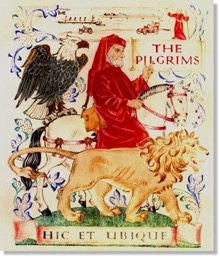
- The logo of the very powerful Pilgrim’s Society: the Pilgrim Father is depicted alongside the British lion and the American eagle.
These events are not only myths that every American should know, they shape the political system of the USA. Eight out of 45 presidents (including the Bushes) are direct descendants of the 35 “Pilgrim Fathers”. Despite the arrival of tens of millions of immigrants and institutional appearances, their ideology remained in power for four centuries, until the election of Donald Trump. A very closed club, Pilgrim’s Sociey, brought together, under the authority of the English monarch, very high British and American personalities. It set up the “Special Relationship” between London and Washington and, among other things, provided many secretaries and advisers to President Obama.
Many ceremonies planned this year for the 400th anniversary of the Mayflower have been cancelled due to the fight against the coronavirus epidemic, in particular the conference that the former British National Security Advisor was to give at Pilgrim’s Society. Bad tongues assure that the epidemic will end the day after the US presidential election, if Donald Trump loses it, and that the festivities can then take place.
There are two cultures that have always been opposed in the United States among Christians: Calvinists or Puritans on the one hand, and Catholics, Anglicans and Lutherans on the other. While some “denominations” among the eight hundred US churches resolutely line up on one side, most are crossed by both because Puritanism has no defined theological corpus. It is rather a way of thinking.
The War of Independence began in 1773 with the Boston Tea Party. Its first actor was John Adams, another direct descendant of one of the 35 “Pilgrim Fathers” and second president of the United States. While the call for independence was made by the political journalist Thomas Paine based on religious arguments although he himself did not believe in anything.
In a way, the War of Independence was a continuation in the Americas of Lord Cromwell’s British Civil War (the “Great Rebellion”). This conflict would resurface a third time with the Civil War, which, it should be remembered, had nothing to do with slavery (both sides practised it at the beginning of the war and both sides repealed it during the war to hire former slaves into their armies).
The Puritans lost in England with Cromwell’s Republic, but won the next two times in the United States. Historian Kevin Phillips, who was Republican electoral adviser to Republican Richard Nixon (descendant of a brother of one of the 35 “Pilgrim Fathers”), has studied this conflict at length over the centuries. [2] It is on the basis of this data that he imagined the strategy of “Law and Order” in the face of the segregationist Democrat George Wallace in the 1968 presidential election; a strategy that Donald Trump has taken up again for the 2020 election.
All this to say that appearances are deceiving. The dividing lines are not where the rest of the world thinks they are.
 The Puritans have always supported absolute equality, but only among Christians. They long forbade Jews from entering the civil service and massacred the Indians they claimed to love. During the American Civil War, they extended their egalitarianism to blacks (unlike the Puritans in southern Africa, who defended apartheid to the end), giving rise to the false myth of a war against slavery. Today, they defend the idea that humanity is divided between equal and, if possible, separate races. They are still reluctant to call them interracial marriages.
The Puritans place lying at the bottom of their scale of values. It cannot be for them a ruse, but always the worst of crimes, far more serious than robbery and murder. In the seventeenth century, they punished with the whip for lying to a pastor for any reason. They established laws that still punish lying to a federal official for any reason.
US Evangelism
With time, and particularly in the 19th century, another current of thought arose within American Christianity: evangelism. These are Christians of all denominations who try to get closer to the original Christianity of which they know little. So they rely on the sacred texts. Like the Puritans, the Evangelicals are fundamentalists, i.e. they give the Scriptures the role of a divine word and interpret them while refusing any contextualization of the texts. But they are much more pragmatic. On everything, they have a position of principle, but when faced with a problem, they act in conscience and not according to the rules of their community.
It is very easy to make fun of the grotesque convictions of the Evangelicals against the theory of evolution, but this is of little importance and they abandon it when necessary. It is much more significant, but unfortunately rarer, to denounce the puritanical vision of a humanity divided into distinct, equal, but separate races. Yet this has serious consequences on a daily basis.
The Puritans remained the masters of U.S. politics until 1997, when Libertine President Bill Clinton issued an executive order banning all expressions of religious faith in federal institutions. The result was a shift in religion from the Administration to the private sector. All major corporations accepted prayer groups in their workplaces. This shift favored the public emergence of Evangelicals at the expense of Puritans.
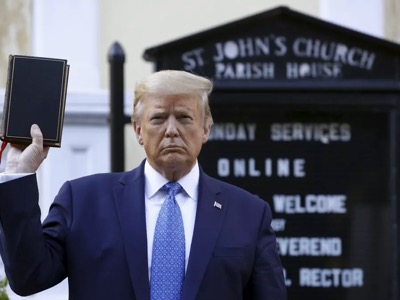
- During the riots outside the White House, President Trump went to St. John’s Episcopal Church to present himself, Bible in hand, as the defender of the religious beliefs of all Christians in the face of Puritan fanaticism.
The Return of Puritan Fanaticism
The conflict between the Puritans and the rest of society is today taking a radical and religious turn. It opposes two mentalities, one idealist, egalitarian within their community and fanatical, the other sometimes even more extravagant, agreeing on inequalities, but realistic.
Puritan Hillary Clinton hesitated to become a Methodist pastor after her failure in the presidential election [3]. She sinned a lot (her affair with Vince Foster), was punished by God (her husband’s affair with Monica Lewinsky) repented (within the Pentagon Family [4]) and was saved. She is sure that she was chosen by God and takes pride in her violence against non-Christian peoples. She supports all wars against the “enemies of America” and hopes to see the return of Christ.
On the contrary, Donald Trump shows no interest in theology, has only an approximate knowledge of the Bible and a summary faith. He has sinned as much as anyone else, but boasts of what he has achieved rather than repenting of his sins in public. He doubts himself and compensates for his feeling of inferiority with excessive egotism. He loves to compete with his enemies, but does not want to destroy them. In any case, he embodies the will to restore the greatness of their country (“Make America Great Again!”) rather than to pursue wars always and everywhere, which makes him the champion of the Evangelicals against the Puritans. He offers the opportunity for Christians to reform themselves rather than convert the world.
In the 2016 election campaign, I asked the question, “Will the United States reform or tear itself apart? » [5] In my view, only Donald Trump could allow the USA to continue as a nation, while Hillary Clinton would provoke a civil war and probably the dissolution of the country on the model of the end of the USSR. What has happened since the death of George Flyod shows that I was not mistaken.
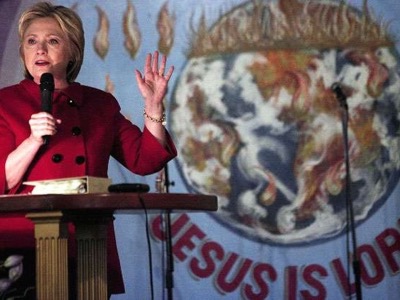
- Hillary Clinton during the 2016 election campaign.
Hillary Clinton and Democratic Party supporters are imposing their ideology. They fight against lies and destroy statues like their Puritan ancestors burned the Salem witches. They develop an absurd reading of their own society, denying social conflicts and interpreting inequalities only in terms of so-called distinct human races. They disarm the local police and force “white” personalities to apologize in public for enjoying an invisible privilege.
In the Russian case, the discontinuation of the prosecution of former National Security Advisor Michael Flynn and the presidential pardon granted to Donald Trump’s former advisor, Roger Stone, sparked angry protests from Puritans. Neither man harmed anyone, but they dared to lie to the FBI to keep him out of the White House.
The mayor of Minneapolis (the town of George Flyod) was publicly humiliated for refusing to disband the “racist” city police. While Seattle City Council has just cut its city police budget in half. This does not bother the upper social classes living in private residences, but deprives those who cannot afford private security guards.
The Associated Press, then the New Yok Times, the Los Angeles Times and soon almost all US media, decided to write Black with a capital letter when referring to “race” [6], but not White in the same way. Indeed, the fact of writing White with a capital letter is a distinctive sign of the white supremacists [7].
The Pentagon considered renaming its military bases with the names of southern personalities accused of being “racist” and sent an e-mail to all civilian and military personnel of the US Army denouncing as “extreme right” the claim that there is only one human race. Although these initiatives have provoked a strong reaction from the trumped-up GIs and have failed, they mark a very dangerous escalation [8].
All these decisions demonstrate a loss of collective rationality.



 MCViewPoint