
MCViewPoint

Opinion from a Libertarian ViewPoint

Posts Tagged ‘Pursuit of Happiness’

TGIF: On the Pursuit of Happiness

Posted by M. C. on July 5, 2024

The equation, however, is invidious. It suggests that other people necessarily are impediments to one’s happiness and thus one should sacrifice one’s happiness at least to some extent. But why would anyone believe that “selfishness”—making the most of one’s life by holding it as one’s ultimate value—entails the disvaluing of other people? It’s crazy on its face. Rand, like the ancient Greeks, understood that he who cares about only himself demonstrates that he doesn’t care enough.

https://libertarianinstitute.org/articles/tgif-pursuit-happiness/
by Sheldon Richman

declaration

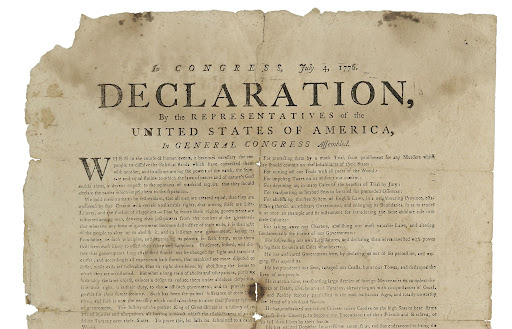
The most remarkable phrase in the Declaration of Independence, whose anniversary we just celebrated, is the pursuit of happiness. Looking back 248 years, that phrase may strike the modern ear as strange for a political document. But it apparently did not seem that way to Americans in 1776. The second paragraph told the world:

We hold these truths to be self-evident, that all men are created equal, that they are endowed by their Creator with certain unalienable Rights, that among these are Life, Liberty and the pursuit of Happiness.

The term among these indicates that Thomas Jefferson and the Second Continental Congress did not think that life, liberty, and the pursuit of happiness were our only unalienable rights. But the pursuit of happiness made the brief enumeration, which speaks volumes.

The first thing to note is that Jefferson did not write that we had a right to happiness, but only the right to pursue it. Legal scholar and historian Carli N. Conklin of the University of Missouri School of Law states in “The Origin of the Pursuit of Happiness”:

[T]he pursuit of happiness is not a legal guarantee that one will obtain happiness, even when happiness is defined within its eighteenth-century context. It is instead, an articulation of the idea that as humans we were created to live, at liberty, with the unalienable right to engage in the pursuit.

Through historical investigation, Conklin shows that contrary to common belief, the phrase was no “glittering generality” (in Carl Becker’s phrase) back them but rather was a term of substance.

I trust no one will take seriously that the omission of property from the list of examples means that Jefferson et al. thought property unimportant. Of course, it did not mean that. We know that the people behind the Declaration understood the deep importance of private property to life, liberty, and the pursuit of happiness. A possible reason for not listing it is that property was often used differently from the way we use it today. While we say, “That’s my property,” an 18th-century person might say, “I have a property in that,” although today’s usage was hardly unknown back then. James Madison, who was not a member of the Continental Congress but who had a lot of say about property, used the word both ways. However, here are examples of what he called “the larger and juster meaning” of the word:

[A] man has a property in his opinions and the free communication of them. [Emphasis added.]

He has a property of peculiar value in his religious opinions, and in the profession and practice dictated by them.

He has a property very dear to him in the safety and liberty of his person.

He has an equal property in the free use of his faculties and free choice of the objects on which to employ them. [Emphasis added.]

In a word, as a man is said to have a right to his property, he may be equally said to have a property in his rights.

It’s widely known that Jefferson and other founders were deeply influenced by John Locke,

See the rest here

Be seeing you

Posted in Uncategorized | Tagged: , | Leave a Comment »

TGIF: Free Markets and the Pursuit of Happiness

Posted by M. C. on April 29, 2023

For Aristotle, the path to happiness in the sense of the good life is to live according to one’s nature as a rational/social being. Reason is in the driver’s seat in individual and social matters. This suggests a society based on individualism, persuasion, and trade rather than collectivism, force, and domination. (The Greek philosophers’ politics, however, left much to be desired.) The virtues we associate with the ancient Greeks — such as justice, prudence, moderation, and courage — described this way of living intelligently.

https://libertarianinstitute.org/articles/tgif-markets-happiness/

by Sheldon Richman

aristotle

For some time now I’ve thought that many people’s antagonism to the market is motivated not by moral or economic objections but by aesthetic criteria. (I discuss this in What Social Animals Owe to Each Other and here.)

By that I mean they simply find market relations — involving private property, contracts, profit, competition, and “impersonal forces” such as supply and demand — unattractive, even ugly. They wish society had nothing to do with such relations, which they (mistakenly) believe have displaced the cozy cooperation and communalism that marked an earlier golden age. They long to return to the beautiful but lost Garden of Eden, where markets don’t exist and people can be human again. They make just two errors. First, they misunderstand the market. For example, competition and cooperation go together. And second, the longed-for Eden never existed. Before human beings transformed the earth, nature was a cruel master. People weren’t always so nice either.

The aesthetic rejection of markets could explain why we libertarians have made little progress in persuading people that crony capitalism is significantly different from the free market. The people who find markets ugly don’t care whether businesses get favors from the government or not. That’s not what matters to them.

Something underlies this revulsion at the market and the freedom it entails: self-interest, or what the critics would call selfishness. It’s also been called the pursuit of happiness. (Of course, Ayn Rand, who held that the pursuit of self-interest is entirely proper embraced the word selfishness at least for the shock value. See her book The Virtue of Selfishness.) The aesthetic rejection of markets may rest on an aesthetic reaction to self-interest. The line between ethics and aesthetics can be blurry.

See the rest here

Be seeing you

Posted in Uncategorized | Tagged: , , , , , , | Leave a Comment »

The Constitution Is Not Your Friend | The Libertarian Institute

Posted by M. C. on August 22, 2020

By strictly limiting the authority of the general government, the founding generation hoped it would never possess enough the power to intrude on our rights.

But there isn’t any provision in the Constitution that actually empowers the federal government to protect our liberty. In fact, the founding generation would have almost certainly considered that too much power for a general government to wield.

https://libertarianinstitute.org/articles/the-constitution-is-not-your-friend/

by

One of the biggest misconceptions I hear about the Constitution is that it was written to “protect our liberty.”

It wasn’t. At least not in a direct sense.

The confusion likely arises from the words of the Declaration of Independence:

“We hold these truths to be self-evident, that all men are created equal, that they are endowed by their Creator with certain unalienable Rights, that among these are Life, Liberty and the pursuit of Happiness.–That to secure these rights, Governments are instituted among Men, deriving their just powers from the consent of the governed.”

It’s true that the Constitution was written during a time when protecting unalienable rights was widely viewed as the primary role of government. But the Constitution is not a philosophical document. It is a legal document that formed a political union and created a central government.

That’s all it does. Asking it to “protect your rights” is really asking too much. That wasn’t why it was written or ratified.

Now the Constitution does reflect the philosophy espoused in the Declaration in that it established a general government of limited, enumerated powers. The decentralized nature of the political system it created was intended to encourage liberty.

By strictly limiting the authority of the general government, the founding generation hoped it would never possess enough the power to intrude on our rights.

But there isn’t any provision in the Constitution that actually empowers the federal government to protect our liberty. In fact, the founding generation would have almost certainly considered that too much power for a general government to wield.

In practice, this means the federal government really doesn’t have any responsibility to “protect your rights” beyond staying within its constitutionally delegated powers. Its obligation isn’t to act in order to protect liberty, it is to not act outside of its legitimate authority.

In the same way, the Bill of Rights was never intended to empower the federal government to protect your rights. As the preamble to the Bill of Rights makes clear, it was intended to add “further declaratory and restrictive clauses” to the Constitution “in order to prevent misconstruction or abuse of its powers.” I have often said it would be better named “The Bill of Restrictions.”

A lot of people want the Constitution to deliver something it never promised. They want the government to serve as a liberty enforcement squad. This is a dangerous proposition. In order to protect your liberty, the government must define your liberty. The best thing the government can do is stay out of the way. The Constitution created a limited federal government for that purpose.

But it’s ultimately up to us to hold it within its limits. Unfortunately, by insisting that the government “protect their rights” they are doing the exact opposite.

This article was originally featured at the Tenth Amendment Center

About Michael Maharrey

Michael Maharrey [send him email] is the communications director for the Tenth Amendment Center. He also runs GodArchy.org, a site exploring the intersection of Christianity and politics. Michael is the author of the book, Constitution Owner’s Manual: The Real Constitution the Politicians Don’t Want You to Know About. You can visit his personal website at MichaelMaharrey.com, like him on Facebook HERE and follow him on Twitter @MMaharrey10th.
Be seeing you

Posted in Uncategorized | Tagged: , , , , , | Leave a Comment »

If You Think “Rights Don’t Exist,” You are Contributing to the Collapse of Civilization | The Daily Bell

Posted by M. C. on June 19, 2018

I don’t know where this is coming from. Maybe here.

You own yourself and private property. Two vastly misunderstood and appreciated “rights”.  Government doesn’t like these two concepts. It tells you what you can and can’t do. You rent your property subject to confiscation through taxes or failure to pay same.

Smoking your greens instead of eating the FDA approved variety could mean loss of liberty.  Just because you paid off your mortgage doesn’t mean you can keep your house.

https://www.thedailybell.com/all-articles/news-analysis/if-you-think-rights-dont-exist-you-are-contributing-to-the-collapse-of-civilization/

By Joe Jarvis

To say “I don’t believe in rights,” is like saying, “I don’t believe in language.”

Uttering the phrase contradicts your claim. Humans created language in order to constructively communicate. Language is real because people agree on the meaning of words.

In the same vein, humans created the concept of rights to facilitate peaceful human interaction. Rights are real because people agree (sometimes without realizing it) on what constitutes a right.

Even as someone utters, “rights don’t exist,” they are exercising their most basic human rights. Read the rest of this entry »

Posted in Uncategorized | Tagged: , , , , | Leave a Comment »