As it has become undeniable that school closures did more harm than good, teachers unions have since tried to rewrite history and claim they were in favor of reopening schools, even though a long trail of documents show that they consistently fought to “reopen schools safely,” with their focus being on ensuring that the definition of “safely” would mean a very high barrier to opening.
Government helping government. You? You gotta help yourself.
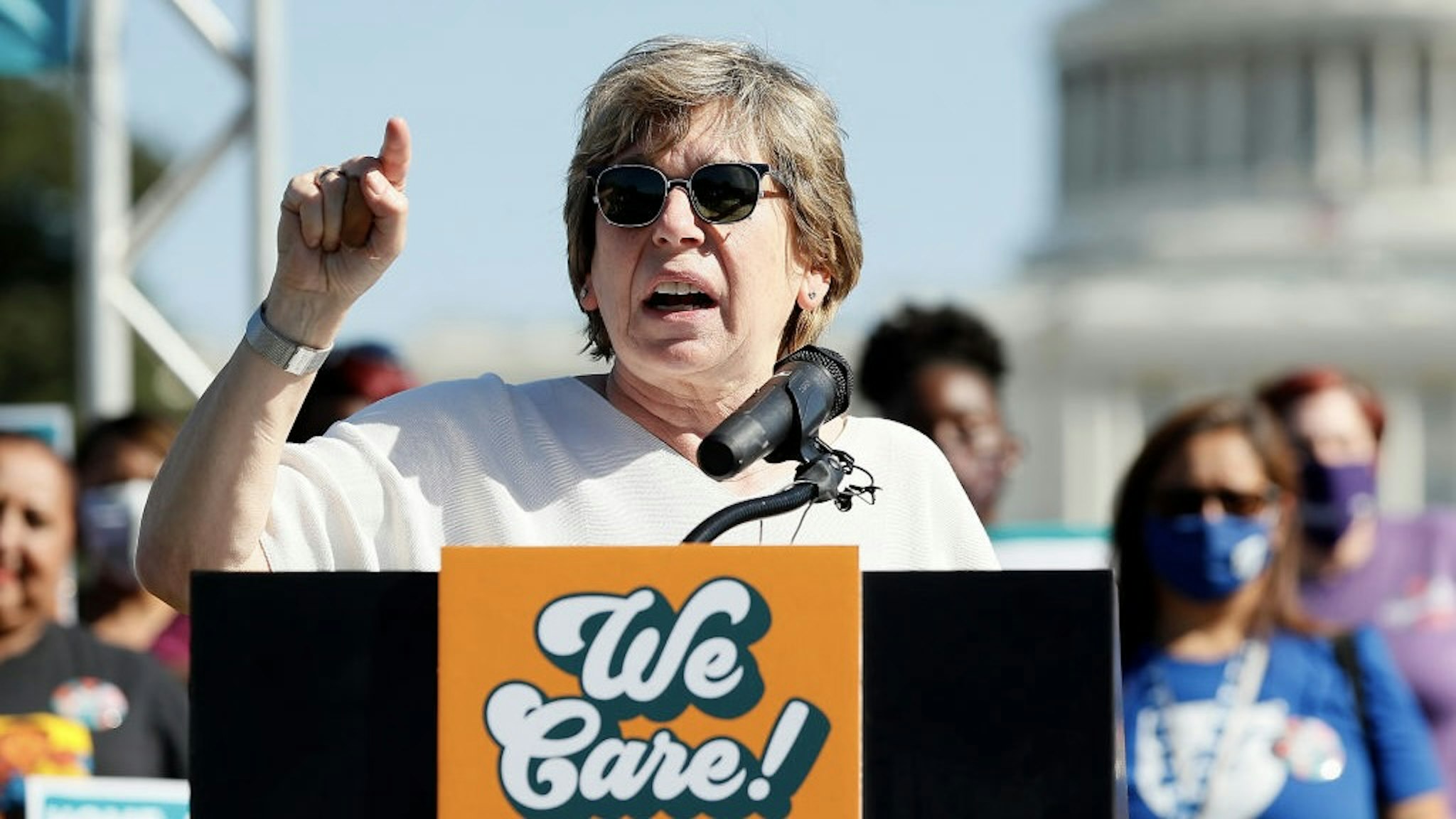
Photo by Paul Morigi/Getty Images for MomsRising Together / Paul Morigi/Stringer via Getty Images
Newly obtained text messages show the heads of both major teachers unions personally texting then-CDC Director Rochelle Walensky as the agency was putting together a scientific analysis of reopening schools during coronavirus — with the CDC making a key change that allowed schools to stay closed and appeased the unions.
On February 11, 2021, American Federation of Teachers President Randi Weingarten texted Walensky saying that she had heard a “leak” from The New York Times about what was in the CDC’s upcoming guidance, and expressed concern that it was “at odds with [their] discussion.”
“They are running with a full speed ahead angle” for reopening schools, Weingarten wrote. She said the Times sent her a copy of the internal draft guidance that said, “At any level of community transmission, all schools can provide in-person instruction.”
“Hmmm. Argh,” Walensky wrote to the union honcho.
The next day, Walensky’s agency released guidance that was different. It said, “All schools have options to provide in-person instruction.” That allowed school districts to stay closed while still saying they were following CDC guidelines. “Middle and high schools in virtual only instruction unless they can strictly implement all mitigation strategies and have few cases,” it added.
Weingarten’s union then put out a statement praising the guidance, and texted the document directly to Walensky with the message, “Thank you.”
Walensky responded glowingly, saying, “This gave me the biggest smile of my week. Thank YOU, Friend!”
Weingarten then gently chided the CDC director for not going further to push stricter guidelines that would keep schools closed, saying “:) we will fuss a little on ventilation but I am so grateful.”
They got their vaccines, they got their $200 billion federal stimulus, they got $122 billion of that stimulus fast-tracked, plus an additional $12 billion out the door for coronavirus testing, but now the teachers unions that have been the single biggest obstacle to reopening K-12 classrooms in Democrat-run cities and states have come up with yet another reason to stay home from school: They do not much care for the dominant global scientific view that 3 feet is enough distance between students during the COVID-19 pandemic.
“We are not convinced that the evidence supports changing physical distancing requirements at this time,” American Federation of Teachers (AFT) President Randi Weingarten declared in a letter Tuesday to Education Secretary Miguel Cardona and Centers for Disease Control and Prevention (CDC) Director Rochelle Walensky, in response to the CDC last Friday revising its school-distancing guidelines from 6 feet to 3.
Among the institutions that do not share Weingarten’s lack of conviction: The American Academy of Pediatrics, the World Health Organization, UNICEF, Walensky herself (prior to joining the Biden administration), most of the 50 states, the vast majority of school districts in the industrialized world, plus one of the research teams whose work the CDC had erroneously sourced when formulating guidance for the agency’s controversial February 12 recommendation to keep the 6-foot rule intact. Opined those latter scientists at the time: “No science supports mandating 6 feet of distance with children wearing masks. A 6-foot distance between students creates space constraints for schools to open in entirety. There is data supporting at least 3-foot distancing.”
So it is that Weingarten got feted in a New York Timesprofile (“She spends 15 hours per day on the phone, she says—with local labor leaders, mayors, the White House, the Centers for Disease Control and Prevention—trying to figure out how to reopen the three-quarters of school systems that remain fully or partly closed”) in the same week that she tried to make Washington, D.C., school reopening contingent on a ludicrously strict security-theater standard of shutting down schools automatically for 24 hours after just one positive COVID test so that the entire building could be scrubbed down. Science!
It’s important to stress that now a slim majority of K-12 students (51.2 percent) in the United States are attending school five days a week, according to the tracking site burbio. In fact, there’s only a handful of states under 50 percent; they just tend to be populous, and heavily Democratic—California, Oregon, New Mexico, Maryland, Hawaii, Washington, Nevada, Massachusetts, and New Jersey, in order of percentage closedness.
This disparity of openness has some implications worth pondering. First, it illustrates what the Brookings Institution was palpably alarmed at discovering last summer: “In reality, there is no relationship—visually or statistically—between school districts’ reopening decisions and their county’s new COVID-19 cases per capita. In contrast, there is a strong relationship—visually and statistically—between districts’ reopening decisions and the county-level support for Trump in the 2016 election.”
More to the point, the reality of kids going every day to school—not just in defiant red states like Florida and the Dakotas, but at Catholic and other private schools smack-dab in the middle of otherwise-shuttered big blue cities—provides a data-rich controlled experiment for those who have been stoking fears of snotty-nosed superspreaders.
“Our concern,” Weingarten writes in her letter, “is that the [CDC’s] cited studies do not identify the baseline mitigation strategies needed to support 3 feet of physical distancing. Moreover, they were not conducted in our nation’s highest-density and least-resourced schools, which have poor ventilation, crowding and other structural challenges.”
To which, at this late date, one might counter-ask: Where, precisely, have the structural challenges been so daunting that they led to significant school-site spread? Which dense districts in Florida, which Catholic schools in Chicago, which poorly ventilated schools in which countries in Europe? Surely the datasets must be vast!
Weingarten cites for her argument this recent paper in the Institute for New Economic Thinking, and, well, click on the link if you are persuaded by such analytical terms as “rush to reopen,” or such unironic formulations as “it is important to adopt the precautionary principle.” There are people who have been following this stuff closely; do catch up.
The great science writer John Tierney has a long, well-worth-reading piece this week in City Journal titled “Death and Lockdowns,” in which, after running very exhaustively through the numbers, and observing that the stories they tell are hardly black and white, nonetheless concludes that: “The lockdown proponents are recklessly staying the course, still insisting that lockdowns work. The burden of proof rests with those imposing such a dangerous policy, and they haven’t met it. There’s still no proof that lockdowns save any lives—let alone enough to compensate for the lives they end.”
Emphasis mine, in order to emphasize that Tierney’s right. The precautionary principle was for March 2020, not March 2021; by now we know a lot more about the booga-booga behind the closet door.
Weingarten saves the most brazen bit of her letter for last. Even after dragging their feet on reopening, leveraging parental anger into gobs of federal cash (don’t forget the extra $69 billion from 2020 COVID relief bills), all while bewildered families leave the public school system in droves, teachers unions still have the stones to plead a lack of resources:
What is the expected timeline for implementation of these changes? Many school systems are just returning to in-person instruction right now, after significant planning—for bus routes, staggered schedules, etc.—based on 6 feet of physical distancing. Even with the significant investment of American Rescue Plan money, districts lack the human resources and institutional planning ability to make changes like this quickly. Is this something that can be implemented in the fall, or perhaps the summer?
If public school districts in the United States lack the human resources and planning ability to do what their private school counterparts have long managed, then maybe it’s time to recognize that those monopoly systems no longer deserve automatic taxpayer funding. You could fill a football stadium with the most effective libertarian education reformers on the planet, and their exertions combined would pale in comparison to how much, in one short year, teachers unions have turned normal people away from public schools.



 MCViewPoint