MCViewPoint

Opinion from a Libertarian ViewPoint

Posts Tagged ‘reform’

Reform, Replace, or Repeal?

Posted by M. C. on November 27, 2023

Nevertheless, it is reform and replace that is their cry, not repeal. But what is really unfortunate is that some libertarians have adopted the same approach. They confuse making the welfare state more effective and efficient with advancing liberty and libertarianism.

by Laurence M. Vance

The U.S. government is a monstrosity. With its four million employees and annual budget approaching $7 trillion, there is no other way to describe it.Principled libertarians should be at the forefront of those calling for the repeal of all welfare state legislation, not their reform or replacement.
[Click to Tweet]

The federal government contains a myriad of agencies, bureaus, corporations, offices, commissions, administrations, authorities, and boards, most of which are organized under 15 cabinet-level, executive-branch departments headed by a secretary: for example, Health and Human Services, Housing and Urban Development, Homeland Security, Agriculture, and Education. The Executive Office of the President (EOP) contains agencies that support the work of the president: for example, the National Security Council (NSC), the Council of Economic Advisors (CEA), the Office of Management and Budget (OMB), the Office of National Drug Control Policy (ONDCP), and the Office of the United States Trade Representative (USTR).

And then there are the many independent executive and regulatory agencies of the federal government: for example, the Social Security Administration (SSA), the Environmental Protection Agency (EPA), the Equal Employment Opportunity Commission (EEOC), the National Aeronautics and Space Administration (NASA), the National Endowment for the Arts (NEA), the Federal Communications Commission (FCC), the Small Business Administration (SBA), the National Security Agency (NSA), and the Central Intelligence Agency (CIA).

The number of federal programs and regulations are incalculable.

One result of all of this is a vast welfare state, as pointed out by the late Walter Williams, professor of economics for many years at George Mason University:

Tragically, two-thirds to three-quarters of the federal budget can be described as Congress taking the rightful earnings of one American to give to another American — using one American to serve another. Such acts include farm subsidies, business bailouts, Social Security, Medicare, Medicaid, food stamps, welfare, and many other programs.

But with the Constitution in focus, things are even worse than that. Writing recently at the American Thinker, J. B. Shurk pulls no punches:

The plain meaning of the U.S. Constitution and the Founding Fathers’ copious essays and personal correspondence all attest to their intention to keep the federal government small, limited in authority, and deferential to the states. Instead, we have today the largest, most expensive, most powerful central government that has ever existed on Planet Earth. No detail of an American’s life is too small for the federal government not to regulate;… If we were still abiding by the Constitution, then 99 percent of today’s federal government would be chucked to the bottom of the Potomac.

What, then, can be done about this?

Conservatives think they have the answer. And they think that if they recite their mantra of the Constitution, limited government, individual freedom, private property, and free enterprise enough times, people will take their proposals seriously. Nevertheless, it is reform and replace that is their cry, not repeal. But what is really unfortunate is that some libertarians have adopted the same approach. They confuse making the welfare state more effective and efficient with advancing liberty and libertarianism.

See the rest here

Be seeing you

Posted in Uncategorized | Tagged: , , | Leave a Comment »

Reform Is Not Freedom

Posted by M. C. on September 27, 2023

The biggest infringements on freedom are the welfare-state and the national-security-state way of life under which we live.

But such reform efforts have never been about advancing liberty. That’s because liberty requires the removal of infringements on liberty, not the modification, improvement, or reform of infringements on liberty.

by Jacob G. Hornberger

When I discovered libertarianism more than 40 years ago, the revelation that shocked me the most was that I wasn’t living in a free society. All my life, especially since the first grade in the public schools to which my parents were forced to send me, I had been inculcated with the belief that I lived in a free country. And here I was — in my late 20s — breaking through the inches-thick indoctrination that encased my mind and realizing that it was all a lie. 

It’s got to be an exhilarating and exciting feeling when one is living in a genuinely free society. When I discovered the truth more than 40 years ago, I decided right then and there that I wanted to live a life of freedom before I passed from this life.

The biggest infringements on freedom are the welfare-state and the national-security-state way of life under which we live. In order to achieve a genuinely free society, it is necessary to dismantle these two massive governmental structures and replace them with a structure that is based on the principles of the free market, voluntary charity, and a limited-government republic. 

Unfortunately, long ago some libertarians threw in the towel and gave up on achieving freedom. They convinced themselves that the welfare-warfare state way of life was simply too big, too powerful, and too deeply engrained in the United States and, therefore, that it would be futile to try to eradicate it. 

Therefore, they resigned themselves to coming up with reforms that were designed to improve, fix, reform, or modify the welfare-warfare-state infringements on liberty under which we live. Oftentimes, such libertarians described these reform efforts as “advancing liberty.”

But such reform efforts have never been about advancing liberty. That’s because liberty requires the removal of infringements on liberty, not the modification, improvement, or reform of infringements on liberty.

Let’s imagine we are living in 1855 Alabama.

See the rest here

Be seeing you

Posted in Uncategorized | Tagged: , , , , | 1 Comment »

Of Two Minds – Economic Decay Leads to Social and Political Decay

Posted by M. C. on October 18, 2019

In other words, either go big and change the power structure or go home and stop promoting your own virtue.

https://oftwominds.cloudhostedresources.com/?ref=https%3A%2F%2Fwww.lewrockwell.com%2F&url=https%3A%2F%2Fwww.oftwominds.com%2Fblogoct19%2Fdecay10-19.html

Charles Hugh Smith

If we want to make real progress, we have to properly diagnose the structural sources of the rot that is spreading quickly into every nook and cranny of the society and culture.

It seems my rant yesterday (Let Me Know When It’s Over) upset a lot of people, many of whom felt I trivialized the differences between the parties and all the reforms that people believe will right wrongs and reduce suffering.

OK, I get it, there are differences, but if the “reform” doesn’t change the source of the suffering and injustice, it’s just window-dressing that makes the supporter feel virtuous. Want an example? Let’s take the the “cruel and unusual punishment” for drug-law offenders, many of whom are African-American males whose lives are effectively hobbled by felony convictions and long sentences in America’s Drug War Gulag.

You want a “reform” that actually gets to the root and solves the source of the injustice? It’s simple: decriminalize all drugs and recognize drug use as a medical and social issue rather than a criminal-justice / Gulag issue. But that won’t happen because too many people are making too much money off the Gulag, which is now a public and private-prison Gulag.

(Other advanced nations have had success with this structural change. Maybe we could learn something from their examples?)

If you’re not ready to demand the full decriminalization of all drugs, then you’re not really interested in solving the problem; you’re just seeking virtue-signaling “reforms” that don’t upset the power structure. And since any real solution necessarily disrupts the power structure benefiting from the status quo, all the painless “reforms” are ineffective.

In other words, either go big and change the power structure or go home and stop promoting your own virtue. This is why the economy is floundering despite all the warm and fuzzy headlines about stocks rising due to the Federal Reserve lowering interest rates: we collectively refuse to consider structural changes in the way “money” is created in our perverse system–perverse because the way “money” is created guarantees soaring inequality.

If you don’t change the way “money” is created and distributed, you change nothing. Did the thousands of pages of financial regulations passed after the 2008-09 debacle reverse wealth and income inequality? The answer is no, wealth inequality is rising even faster after all the feel-good “reforms.” The net result of the “reforms” is the costs of compliance for banks went up substantially, and that regulatory moat simply pushed risky lending outside the banking system.

In other words, the sources of systemic instability and wealth inequality weren’t even touched by the “reforms.” If the financial system were actually stable, why was the Federal Reserve only able to “normalize” interest rates and its bloated balance sheet for a few months after a decade of “growth”? Why is the Fed reverting to “emergency measures” again after a few brief months of “normalizing”?

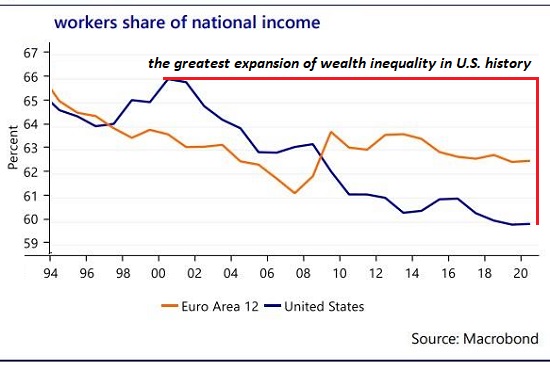
If all these “reforms” were worth more than a bucket of spit, why isn’t wealth inequality reversing?

Here’s the way our “money” system works: banks borrow trillions of dollars into existence and loan it to debt serfs at high rates of interest. Central banks create “money” out of thin air and distribute it to the very top of the wealth-power pyramid: banks, financiers and corporations.

The only way to change this corrupt, exploitive system that generates inequality as its only possible output is to eliminate central banks and fractional reserve banking, and ban the aggregation of “too big to fail” entities: a system of 1,000 small banks is structurally far less vulnerable than five mega-banks that are tightly bound to virtually every risk-on asset in the entire system.

if you don’t change the way “money” is created and distributed, you change nothing.

Since we’re incapable of changing the sources of financial instability, fragility and inequality (because it would destabilize those benefiting from the status quo), we’re doomed to watch our social and political systems decay and implode.

If we’re honest–an increasingly rare and hazardous condition–we’d admit that the purchasing power of wages has fallen sharply for the bottom 95% in the past 19 years, while the concentration of wealth in the hands of the top .01% has skyrocketed, leaving the bottom 80% with few if any meaningful assets and only the top 5% reaping the gains in our “winner take most” economy.

This systemic decay in social mobility, positive social roles and financial security has eroded the social fabric as the implicit social contract between the powerful and the disenfranchized has unraveled: all the phony “reforms” of the past 19 years simply locked in insiders’ “legal” pillaging.

The failure of the political system to recognize and rectify the broad-based decline of America’s economy as experienced by the bottom 80% has eroded trust in politics as a “solution.” Instead, people see the same powerful corporations buying influence with both parties, and tens of thousands of lobbyists in Washington DC writing the legislation passed by both parties (recall Nancy Pelosi’s brief flash of honesty: “We have to pass the bill to know what’s in it.”). Anyone who believes this manifests the ideals of democracy is delusional.

To those I offended: please pardon my frustration with all the phony “reforms” that change nothing and thus serve to tighten the grip of the self-serving power structure on the throat of the nation.

Here’s the unpalatable reality: The financial rot spread to the “real” economy two decades ago, and now the economic rot is decaying the social and political orders.

If we want to make real progress, we have to properly diagnose the structural sources of the rot that is spreading quickly into every nook and cranny of the society and culture. If we’re not willing to disrupt those reaping the outsized benefits from the existing structures of wealth and power, we’re deluding ourselves if we believe we’re solving any problems at the source.

If you’re still pissed off at me, please read the first pages of my new book (the first section is free); maybe you’ll be less pissed off once you see where I’m coming from: Will You Be Richer or Poorer? Profit, Power and A.I. in a Traumatized World.

Be seeing you


Posted in Uncategorized | Tagged: , , , , , | Leave a Comment »