


Georgian President Mikhail Saakashvili believed Washington would rescue him after his forces began bombarding Russian troops stationed in South Ossetia. More recently, after a naval clash between China and the Philippines, President Rodrigo Duterte turned to Washington: “I’m calling now, America. I am invoking the RP-US pact, and I would like America to gather their Seventh Fleet in front of China. I’m asking them now.” He helpfully added: “When they enter the South China Sea, I will enter. I will ride with the American who goes there first. Then I will tell the Americans, ‘Okay, let’s bomb everything’.”
No need to ‘un-friend’ anyone, but some of them should be supplying their own boots and bombs by now.
Some of them?
There absolutely is a need to unfriend certain NATO members. The members in this “one for all, all for one” organization with countries whose size and militaries are closer to that of the Vatican’s. Members whose only reason they were admitted to NATO was their proximity to Russia, in violation of James Bakers promise to Gorbachev that NATO would not expand East once Germany was unified.
That NATO is obsolete and one public arm of the CIA is not mentioned in this CATO linked author.
Neither are there references to avoidance of “foreign entanglements” as described by a certain first US president.
No need to ‘un-friend’ anyone, but some of them should be supplying their own boots and bombs by now.

President Donald Trump has offended professional foreign policy practitioners since taking office. They accuse him of manifold offenses. But none is more serious than “mistreating allies.”
For instance, Mira Rapp-Hooper of the Council on Foreign Relations penned a lengthy article entitled “Saving America’s Alliances.” She complained that the president has targeted “the United States’ 70-year-old alliance system. The 45th president has balked at upholding the country’s NATO commitments, demanded massive increases in defense spending from such long-standing allies as Japan and South Korea, and suggested that underpaying allies should be left to fight their own wars with shared adversaries. Trump’s ire has been so relentless and damaging that U.S. allies in Asia and Europe now question the United States’ ability to restore itself as a credible security guarantor.”
For her, this is a damning, even crushing, indictment. Yet that reflects her membership in the infamous Blob, the foreign policy establishment which tends to differ over minor points while marching in lockstep on essentials, such as the imperative for Washington to defend the world.
Consider the transatlantic alliance. Seventy-five years after the conclusion of World War II, Europe collectively has ten times the wealth and three times the population of Russia. Yet the continent cowers helplessly before Moscow, expecting American protection. Not one supposedly vulnerable member of NATO devotes as large a share of their economy to defense as the U.S., not even the Baltic States and Poland, which routinely demand an American military presence.
Among the continent’s largest and wealthiest nations, Italy and Spain barely bother to create militaries. The readiness of Germany’s forces is a continuing joke, despite persistent calls for reform. Only the United Kingdom and France possess militaries of much capability, and primarily for use in conflicts linked to their colonial heritage. They have, for instance, shown little interest in fighting Russia to rescue “New Europe.”
Prior presidents have badgered, cried, begged, asked, demanded, and whined about the Europeans’ lack of effort, without effect. European states obviously aren’t particularly worried about attack. And they figure Washington would save them if something unexpected occurred. So why bother?
From an American standpoint, doesn’t scorching criticism seem appropriate?
Then there is the president’s pressure on the Republic of Korea and Japan to do more. The president is rude, to be sure, but there is much to be rude about. The Korean War ended 67 years ago. Today the ROK has about 53 times the GDP and twice the population of the Democratic People’s Republic of Korea. Why does Seoul require an American garrison for its defense? Why don’t the South Koreans do what is necessary to protect their own country?
Indeed, the main reason the North is building nuclear weapons is for defense against America, which has shown its proclivity to oust any regime which disrespects the U.S. The only circumstance under which the DPRK would use its nukes is if the U.S. joined in war between the two Koreas and threatened to defeat North Korea. Is anything at stake on the peninsula worth the risk of nuclear war? Foreign policy, defense guarantees, and military deployments should change as circumstances change. The U.S.-ROK alliance no longer makes sense.
Japan has spent years underinvesting in defense, even during the Cold War. Technically its constitution does not even allow a military, so Tokyo fields a “Self-Defense Force,” upon which it spends no more than one percent of GDP. Had Japan spent more on the SDF when it enjoyed the world’s second-ranking economy, the People’s Republic of China still would be working to overcome its defense gap with Japan before that with America.
There are obvious historical issues, of course. Tokyo points to the “peace constitution” foisted on defeated Japan by the U.S., but successive Japanese governments have interpreted away the military ban. And the constitution could be changed. The Japanese won’t do so as long as they can rely on America. Their assumption is that the U.S. is willing to risk Los Angeles to protect Tokyo. But that is a bad bargain for America.
Rapp-Hooper also complained that other countries might not believe in Washington’s security guarantees. That would be all to the good, however. Constantly “reassuring” America’s allies discourages them from doing more to defend themselves. There is something perverse about foreign nations believing that Washington has a duty to convince them that it is worthy of protecting them.
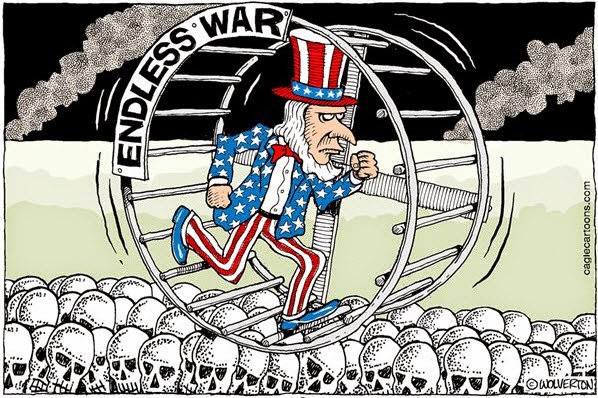
No doubt, allies are useful in a fight, but they should be viewed as a means rather than an end. That is, America should acquire allies when it needs them. Today Washington treats allies as an end, the more the merrier. It acts as if America benefits when it picks up helpless clients that must be defended against nuclear-armed enemies. Indeed, Uncle Sam appears to view allies like Facebook friends: the primary objective is to have more than anyone else, irrespective of their value or merit. What else can explain adding North Macedonia and Montenegro to NATO? Next up, the Duchy of Grand Fenwick!
Today the U.S. has no cause for conflict against Russia. Vladimir Putin is a nasty character, but has shown no inclination for war against Europe, even his neighbors in “New Europe,” let alone America. Washington and Moscow have no essential interests that clash or warrant war. So how does NATO benefit the U.S.?
The Europeans probably need not fear attack either, but they are in greater need of an insurance policy. In 1950 assurance had to come from America. But no longer. The Europeans are collectively able to protect themselves and their region. They should do so. Then how much they spend could be left up to them, without hectoring from Washington.
So too Japan and South Korea. Once they could not defend themselves. Decades later they are capable of doing so. And they have far more at stake in their survival than does America. They should take over responsibility for their own security.
Where a potential hegemon is on the rise—only the People’s Republic of China fits this description—the U.S. could play a role as an offshore balancer, backstopping the independence of important friendly states, such as Japan. However, even then the commitment should be limited. It is not America’s job to insert itself in a Chinese-Japanese fight over peripheral, contested territory, such as the Senkaku/Diaoyu Islands. Or, even worse, to go to war to save the Philippines’ control over territorial bits like Scarborough Shoal.
Moreover, it is critically important not to discourage allied states from making serious efforts on their own behalf, which Japan and the Philippines, to name two in East Asia, do not. It also shows the problem with Rapp-Hooper’s praise of America security guarantees for discouraging allies from developing nuclear weapons. What is at stake in the defense of America’s allies worth risking a nuclear assault on America’s homeland? How many cities should the U.S. sacrifice to save the ROK or Germany? In contrast, what would be a better constraint on the PRC than nuclear-armed Japan and Taiwan? There would be risks in that course, of course, but extending a “nuclear umbrella” over-friendly states creates real and potentially catastrophic dangers for Americans.
Analysts such Rapp-Hooper assume alliances are net positives financially. Why? Other countries offer cheap bases! But Washington does not need to scatter hundreds of facilities and hundreds of thousands of troops around the world for its own defense. America is perhaps the geographically most security nation on earth: wide oceans east and west, pacific neighbors south and north. Bases are used to protect other states and become tripwires for other countries’ conflicts.
Moreover, defense commitments require force structure. The military budget is the price of America’s foreign policy. The more Washington promises to do, the most Americans must spend on the military. Every additional commitment adds to the burden.
While alliances theoretically deter, they also discourage partners from taking responsibility for their own futures. And security guarantees ensnare. Countries as different as Georgia and Taiwan have acted irresponsibility when presuming America’s protection. Washington sometimes has worried about South Korean plans for retaliation against North Korean provocations, which could trigger full-scale war.
Georgian President Mikhail Saakashvili believed Washington would rescue him after his forces began bombarding Russian troops stationed in South Ossetia. More recently, after a naval clash between China and the Philippines, President Rodrigo Duterte turned to Washington: “I’m calling now, America. I am invoking the RP-US pact, and I would like America to gather their Seventh Fleet in front of China. I’m asking them now.” He helpfully added: “When they enter the South China Sea, I will enter. I will ride with the American who goes there first. Then I will tell the Americans, ‘Okay, let’s bomb everything’.”
Ending obsolete alliances does not preclude cooperation as equals to advance shared interests, such as terrorism, cybersecurity, piracy, and much more. How to deal with China is becoming a shared concern. Less formal partners can develop plans, launch joint exercises, provide base access, and much more. Alliance advocates act as if the only way America can work with other nations is by promising to defend them. Other states might like to create that impression, but they are the supplicants, not the U.S.
There is much to criticize in Donald Trump’s foreign policy. However, his criticism of alliances is not one. The Blob has made them into a sacred cow. However, policymakers should start treating alliances as only one of many means to advance U.S. security.
Doug Bandow is a Senior Fellow at the Cato Institute.
Be seeing you
 MCViewPoint