MCViewPoint

Opinion from a Libertarian ViewPoint

Posts Tagged ‘Robert Nozick’

Nozick on Morality and Evolution

Posted by M. C. on July 16, 2022

Further, why do those who claim direct access to real values have to say that propositions about value are necessary? Why isn’t it enough to assert that the value propositions are true in the actual world, and in “nearby” possible worlds? To me, the “moral” of Nozick’s account is that we should be reluctant to throw away what seems manifestly true because of difficulties in reconciling this with evolution.

You think this post is a tough read? Try reading Nozick’s work. He is good but I need a Wikipedia open while I read.

https://mises.org/library/nozick-morality-and-evolution

David Gordon

Robert Nozick is probably most familiar to readers of this column as a libertarian political philosopher, but this week I’d like to look at another issue, relevant not only to libertarians but to anyone interested in moral and political thought, which he discusses in his last book, Invariances (Harvard, 2001.) This is whether our beliefs about these subjects are objectively true or merely the expression of preferences. If we say, e.g., that people own themselves, is this something that is true or is it just a preference that we have?

Nozick doesn’t think it’s true. Not that he thinks it’s false—i.e., that it’s true that people don’t own themselves. Rather Nozick questions whether ethical truths exist at all.

How can ethical statements be true, if truth consists in correspondence to the facts? Are there special kinds of facts, ethical ones, and if so, by what route do we discover them? … The history of philosophy is abundant with unsuccessful attempts to establish a firm basis for ethical truths. Inductively, we infer that the task is unpromising.

But don’t our considered moral judgments put us in touch with moral facts? Nozick finds no basis in evolutionary theory to account for this claimed grasp of moral facts. Suppose he is right that we cannot explain by use of Darwinian evolution how we can grasp ethical truth. Why should we take this as a decisive reason to abandon the claim that we know such truths? Perhaps we instead have grounds to doubt that Darwinian processes account for all our knowledge.

We might press the point further. It is hard to explain through evolution how we know any necessary truths. Does this give us reason to abandon necessary truth? If not, why should we toss moral truths overboard on Darwinian grounds?

Nozick fully anticipates this response, but his answer I find astonishing. He does propose abandoning necessary truth, in large part because by evolution he cannot account for how we might attain such knowledge. Why he accords evolutionary considerations such enormous weight escapes me.

But my skepticism is not an argument, and Nozick’s intricately elaborated alternative to ethical truth merits attention. Once again, Darwinian evolution exerts decisive weight. Nozick endeavors to determine the evolutionary function of ethics. Why has natural selection endowed us with the capacity to make moral judgments? He plausibly suggests that cooperative behavior in some circumstances increases “inclusive fitness.”

Again, suppose Nozick is right. Why does this matter for ethics? As always, he has considered the objection:

Derek Parfit … asks the pertinent question of what difference is made by something’s being the function of ethics. Many things have bad functions (war, slavery, etc.). And even when the function is a good one, as evaluated by the standards instilled to go with cooperation, is normative force added by saying that this good effect of ethical principles (namely, enhancing mutual cooperation) also is the function of ethics?

Nozick’s response brings out a key feature of the book. Ethical rules not only have a function but also exhibit certain properties that enable them to carry out this function effectively. One of these has decisive importance to our author. “Objective ethical truths … are held to involve a certain symmetry or invariance…. The Golden Rule mandates doing unto others as you would have others do unto you.” As Nozick sees matters, invariance under transformation is the mark of truth. Once we combine function with invariance, in a vastly more complicated way than I can here explain, we arrive at a close substitute for objective truth.

See the rest here

Be seeing you

Posted in Uncategorized | Tagged: , , , | Leave a Comment »

More than Sixty Years after “Liberation,” Cuba Is a Communist Slave State

Posted by M. C. on July 13, 2022

Nozick’s question highlights that there is no difference between people under indentured servitude and people who have certain liberties that an owner can take away at any time. Both are enslaved people who must respond to a master; it is just a matter of degrees of serfdom.

https://mises.org/wire/more-sixty-years-after-liberation-cuba-communist-slave-state

In his book Anarchy, State, and Utopia, Robert Nozick has a chapter named “The Tale of the Slave” in which he explains the nine phases from the most restrictive to more liberating states of slavery. He writes that even though enslaved people have certain forms of self-rule, they are still enslaved. He asks: “Which transition from case 1 to case 9 made it no longer the tale of a slave?”

Nozick’s question highlights that there is no difference between people under indentured servitude and people who have certain liberties that an owner can take away at any time. Both are enslaved people who must respond to a master; it is just a matter of degrees of serfdom.

Nozick could be describing current Cuban political phenomena and social intercourse. Although Cubans have rights under a constitution, these are always called into question. Politicians and bureaucrats, not surprisingly, are greedy, looking out for their own benefit and taking advantage of situations for their own advancement.

Thus, it should not be difficult to understand that tyrants seek to put chains of servitude on their populace. Some have argued that though these chains are truculent and wanton, the reprimand must succumb to the rulers and not the system itself. The pretension of this essay is nothing more than to expound on how Nozick’s argument, albeit controversial, is fruitful in explaining Cubans’ abnormal conditions.

Cuba’s discrete slavery is exemplified by the economic circumstances laborers encounter. According to Bloomberg, inflation in Cuba finished at 71 percent in 2021 amid reforms to get rid of currency duality. This figure takes on more meaning if the reader assumes that inflation is a form of taxation. When Cuba’s government pays its citizens by printing money instead of using sound currency and real profits, the state levies extra taxes upon its citizens. No one can cover their expenses when 71 percent of their income is taken away by central planners and corrupt public officials. After the currency has undergone devaluation, not much is left.

Likewise, “tiendas moneda libremente convertible,” or free convertible currency stores, play a massive role in discriminating against citizens. According to Reuters, the Cuba-based economist David Pajon said that the stores are a source of inequality. To put this in context, only people who have foreign currency can shop at these stores, which means that only Cubans with relatives outside the country who send them money can shop in them. Furthermore, while the government promotes policies to help the less fortunate, they open stores that are not accessible to regular workers. This Machiavellian scheme engenders a hierarchy in which those who have relatives abroad are privileged, while the rest are left behind.

Cubans cannot even complain about these economic misdemeanors because freedom of speech is restricted. Human Rights Watch states:

The government has repeatedly imposed targeted and arbitrary restrictions on the internet against critics and dissidents, including as part of its ongoing systematic abuses against independent artists and journalists.

The elite is constantly threatening individuals who express what they think on social media, and the government has stated that only authorized journalists have the right to cover news on the island.

Contributing to the freedom of speech issue is that journalists lack tools to do their job. Suzanne Bilello argued in a 1997 report:

Those in Cuba who are trying to establish a free press face significant internal obstacles, including a lack of rudimentary supplies, such as pens and notebooks, inadequate financial resources, and virtually no exposure to the workings of independent media.

Even if it were possible to publish in spite of all the harassment endured, journalists struggle to get supplies and pay for a stable internet connection. Although these issues are very noticeable when searching for a newspaper that does not support the regime, few international organizations have covered them properly.

See the rest here

Be seeing you

Posted in Uncategorized | Tagged: , , | Leave a Comment »

Taxation and Forced Labor | Mises Wire

Posted by M. C. on November 28, 2020

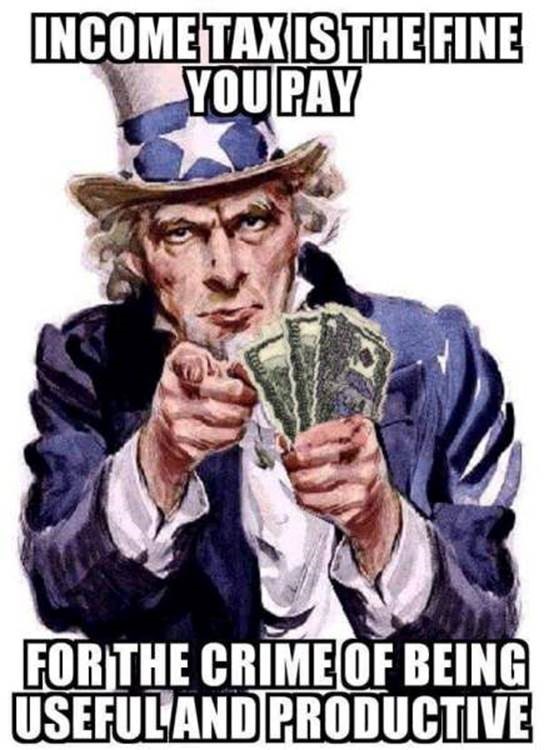
The way the example applies to income taxes is obvious. When the government taxes your income, it is taking away the product of hours of your labor. Just as I would be appropriating your labor if I forced you to work several hours for me without paying you anything, the government by taxing your income is seizing hours of your labor.

Moore considers an interesting objection to his argument. If you don’t want to pay income tax, couldn’t you avoid this by working less or for lower pay, so that your income fell below the minimum income for taxation? But why does the government have the right to put you in this unenviable position? Moore considers, in elaborate detail, a number of variations of the case, in each instance concluding that the government acts improperly. These I’ll leave to interested readers to examine for themselves.

https://mises.org/wire/taxation-and-forced-labor

David Gordon

When the government taxes you, it is taking away your money without your consent, and this is theft. This argument is well known, but there is another, though related, problem with taxes on income that you earn. By taking away part of the money you earn, the government is forcing you to work for it. Robert Nozick advanced this argument in Anarchy, State, and Utopia, and what I’d like to discuss in this week’s column is a defense of Nozick’s argument by Adam D. Moore that was published this year in the Southern Journal of Philosophy. It’s especially timely to discuss Moore’s article now, because Moore uses a famous argument by the philosopher Judith Jarvis Thomson, who passed away last Saturday.

Thomson asks us to consider this case: “Violinist: You wake up in the morning and find yourself back to back in bed with an unconscious violinist. A famous unconscious violinist. He has been found to have a fatal kidney ailment, and the Society of Music Lovers has canvassed all the available medical records and found that you alone have the right blood type to help. They have therefore kidnapped you, and last night the violinist’s circulatory system was plugged into yours, so that your kidneys can be used to extract poisons from his blood as well as your own.” The violinist will die unless you remain hooked up to him for nine months. Do you have the right to detach yourself? Thomson thinks it is obvious that you do. You didn’t consent to the arrangement, and your body isn’t at the disposal of others, even if they need it in order to survive. (Thomson uses her example to defend the permissibility of certain cases of abortion, but that isn’t relevant here.)

Moore varies the example in order to make it more relevant to his own argument. “Where in the original case Thomson has you hooked up for nine months, I will suppose that you are hooked up each day for several hours. Each day, the Society of Music Lovers kidnaps you and attaches the violinist. In five years, the violinist’s kidneys will be healed, and no further kidnappings will need to occur.” Moore says you would still be justified in detaching yourself, because the Society is using your body without your consent. He goes on to present a case of his own in which someone on an island has to work extra hours to support someone else unable to work. Here again Moore says you aren’t morally required to do so. It might be a nice thing to aid the person unable to work, but someone can’t be compelled to do this.

The way the example applies to income taxes is obvious. When the government taxes your income, it is taking away the product of hours of your labor. Just as I would be appropriating your labor if I forced you to work several hours for me without paying you anything, the government by taxing your income is seizing hours of your labor.

Moore considers an interesting objection to his argument. If you don’t want to pay income tax, couldn’t you avoid this by working less or for lower pay, so that your income fell below the minimum income for taxation? But why does the government have the right to put you in this unenviable position? Moore considers, in elaborate detail, a number of variations of the case, in each instance concluding that the government acts improperly. These I’ll leave to interested readers to examine for themselves.

But isn’t Moore’s argument open to another objection? The government isn’t just taking away your hours of labor. It also provides you with benefits. Of course, most government programs are detrimental or at best useless, but never mind that. Moore responds by using another point that Nozick raised. People can’t confer benefits on you without your consent and then demand that you pay for them. “Nozick writes, ‘One cannot, whatever one’s purposes, just act so as to give people benefits and then demand (or seize) payment. Nor can a group of persons do this. If you may not charge and collect for benefits you bestow without prior agreement, you certainly may not do so for benefits whose bestowal costs you nothing, and most certainly people need not repay you for costless-to-provide benefits which yet others provided them.’”

Most readers will already know how to answer the objection that the taxes aren’t imposed by a dictator but are the outcome of a democratic election. You can’t be forced to labor for others, even if your partial slavery is the result of a majority vote.

The rejoinder that I am drawn to at this point is one word: democracy! In democratic societies we vote about how to share the benefits and burdens of social interaction. Everyone gets a vote, and the will of the majority decides the appropriate share of benefits and burdens. The idea is to join together two factors, accruing benefits and democracy, that will justify taxation and redistribution. But, imagine our original Violinist case and add in a small village where the principles of democracy and majority rule have been in place for centuries. After a brief campaign to get out the vote and save the violinist, the village votes unanimously–1 (your vote) to hook you up and begin your daily sessions with the violinist. I warrant that this would be immoral independent of the vote and the benefits.

Moore with great ingenuity responds to a number of other objections, and I’ll mention just one more:

Taxes are justified because citizens agree to them as part of a social bargain. In return for the benefits that society bestows on the fortunate—and by using the goods and services offered by society—these individuals are indebted and agree to this contract…[but] no one has actually signed this social contract. Minimally, for a contract to generate moral and legal norms it must take place in conditions that are fair and where the parties to the contract have enough information. For example, withholding crucial information (the “car” you are about to buy is a shell with no internal parts) or threatening someone (pointing a gun at someone to ensure they sign the contract) would invalidate whatever moral norms that might typically arise in a proposed contract. How would any of this work related to a social contract? Moreover, there may be individuals who simply “don’t use the facilities” so-to-speak. Not only have they not agreed to pay any taxes, but they also do not consume any societal benefits.

We are greatly indebted to Moore for his fine analysis. But we don’t owe him any money for the benefit he has conferred on us, because we have signed no agreement to pay him. Author:

Contact David Gordon

David Gordon is Senior Fellow at the Mises Institute and editor of the Mises Review.

Be seeing you

Posted in Uncategorized | Tagged: , , , , | Leave a Comment »

Robert Nozick on Self Ownership,Slavery and Taxation

Posted by M. C. on March 1, 2019

Nozick, Robert

By Edward Feser from Internet Encyclopedia of Philosophy

…In line with this, Nozick also describes individual human beings as self-owners (though it isn’t clear whether he regards this as a restatement of Kant’s principle, a consequence of it, or an entirely independent idea). The thesis of self-ownership, a notion that goes back in political philosophy at least to John Locke, is just the claim that individuals own themselves – their bodies, talents and abilities, labor, and by extension the fruits or products of their exercise of their talents, abilities and labor. They have all the prerogatives with respect to themselves that a slaveholder claims with respect to his slaves. But the thesis of self-ownership would in fact rule out slavery as illegitimate, since each individual, as a self-owner, cannot properly be owned by anyone else. (Indeed, many libertarians would argue that unless one accepts the thesis of self-ownership, one has no way of explaining why slavery is evil. After all, it cannot be merely because slaveholders often treat their slaves badly, since a kind-hearted slaveholder would still be a slaveholder, and thus morally blameworthy, for that. The reason slavery is immoral must be because it involves a kind of stealing – the stealing of a person from himself.)

But if individuals are inviolable ends-in-themselves (as Kant describes them) and self-owners, it follows, Nozick says, that they have certain rights, in particular (and here again following Locke) rights to their lives, liberty, and the fruits of their labor. To own something, after all, just is to have a right to it, or, more accurately, to possess the bundle of rights – rights to possess something, to dispose of it, to determine what may be done with it, etc. – that constitute ownership; and thus to own oneself is to have such rights to the various elements that make up one’s self. These rights function, Nozick says, as side-constraints on the actions of others; they set limits on how others may, morally speaking, treat a person. So, for example, since you own yourself, and thus have a right to yourself, others are constrained morally not to kill or maim you (since this would involve destroying or damaging your property), or to kidnap you or forcibly remove one of your bodily organs for transplantation in someone else (since this would involve stealing your property). They are also constrained not to force you against your will to work for another’s purposes, even if those purposes are good ones. For if you own yourself, it follows that you have a right to determine whether and how you will use your self-owned body and its powers, e.g. either to work or to refrain from working.

So far this all might seem fairly uncontroversial. But what follows from it, in Nozick’s view, is the surprising and radical conclusion that taxation, of the redistributive sort in which modern states engage in order to fund the various programs of the bureaucratic welfare state, is morally illegitimate. It amounts to a kind of forced labor, for the state so structures the tax system that any time you labor at all, a certain amount of your labor time – the amount that produces the wealth taken away from you forcibly via taxation – is time you involuntarily work, in effect, for the state. Indeed, such taxation amounts to partial slavery, for in giving every citizen an entitlement to certain benefits (welfare, social security, or whatever), the state in effect gives them an entitlement, a right, to a part of the proceeds of your labor, which produces the taxes that fund the benefits; every citizen, that is, becomes in such a system a partial owner of you (since they have a partial property right in part of you, i.e. in your labor). But this is flatly inconsistent with the principle of self-ownership…

Be seeing you

Posted in Uncategorized | Tagged: , , , | Leave a Comment »

Robert Nozick’s Case Against Wealth Redistribution

Posted by M. C. on August 13, 2018

Published on Sep 13, 2014

https://www.youtube.com/watch?v=uRoHM8BrtVU


In Nozick’s 1974 book, Anarchy, State, and Utopia he explains why wealth redistribution is immoral and should not be attempted. This video was read from a blog post I wrote a while back.

Be seeing you

tax crime

Posted in Uncategorized | Tagged: , | Leave a Comment »