
MCViewPoint

Opinion from a Libertarian ViewPoint

Posts Tagged ‘Scarcity’

Keynes Thought Scarcity Would Disappear in the Near Future. Boy, Was He Wrong. | Mises Wire

Posted by M. C. on May 11, 2021

Keynes fails to see this because of his invincible conviction of his own superiority to the common lot. Plebian businessmen may be baffled by the future; not so him and his ilk. If they control money and guide investment, all will be well.

https://mises.org/wire/keynes-thought-scarcity-would-disappear-near-future-boy-was-he-wrong

David Gordon

The Price of Peace: Money, Democracy, and the Life of John Maynard Keynes
by Zachary D. Carter
Random House, 2021 [2020]
xxii + 628 pages

For many people, though not, to be sure, readers of The Austrian, John Maynard Keynes ranks as the greatest economist of the twentieth century; but for Zachary D. Carter, this is a restrained understatement. Carter, a writer on economics at the HuffPost, says this about Keynes:

No European mind since Newton had impressed himself so profoundly on both the political and intellectual development of the world. When the [London] Times wrote Keynes’ obituary, it declared him ”the greatest economist since Adam Smith.” But even praise so high as this sold Keynes short, for Keynes was to Smith as Copernicus was to Ptolemy—a thinker who replaced one paradigm with another. In his economic work he fused psychology, history, political theory, and observed financial experience like no economist before or since. (p. 368)

Those who make their way through this long book will likely come away puzzled with Carter’s enthusiasm. Keynes held bizarre beliefs, far stranger than the familiar underconsumptionist fallacy that the government needs to bolster insufficient aggregate demand. Though he wrote his most famous book about economic theory in the midst of the Great Depression, he thought that scarcity was no longer a problem. The potential for abundance was at hand, or soon would be; the real economic problem was to distribute this abundance so that selfish speculators would not take it all for themselves, leaving the masses in poverty.

This sounds unbelievable, but Keynes really did claim this. Summarizing Keynes’s position, Carter says,

Prior to The General Theory, economics was almost exclusively concerned with scarcity and efficiency. The very word for the productive output of society—economy—was a metaphor for making do with less. The root cause of human suffering was understood to be a shortage of resources to meet human needs…. This was the worldview of what Keynes called the “classical economists.”… But the sheer productive power of modern capitalism and the “miracle of compound interest” had rendered the portrait obsolete. Technological advances now allowed people to produce so much more with so much less effort than they had in the past that scarcity was no longer the overriding problem of humanity. (pp. 258–59)

What stands in the way of abundance for all? In essence, the problem is money. People hoard money because they fear an uncertain future, and if they hoard money, businessmen will be reluctant to invest. Attempts to cut costs by reducing wages exacerbate the problem, since this lessens consumers’ spending. The classical economists wrongly assumed that adjustments in relative prices suffice to take care of shortages and surpluses. “Say’s law” ensured that there could not be a “general glut” or depression. Keynes rejects Say’s law, arguing that it ignores the cumulative power of pessimistic expectations. It does not help matters that Keynes misstates the law: “For Keynes, the soft underbelly of the classical theory was Say’s Law, which he summarized as the maxim that ‘supply creates its own demand.’” (p. 261) The law in fact says that the supply of a commodity is demand for other commodities.

The technical difficulties of Keynesian theory have been covered amply and in depth by, among others, Henry Hazlitt, W.H. Hutt, and Murray Rothbard, and I do not propose to deal with them at further length here. What is important for our purposes is the mindset with which Keynes addresses the problems he alleges exist for the free market. For him the underlying problem is that an elite of official experts is not in control of money and investment. If only our betters, quintessentially Keynes himself, were in charge, then money creation and governmentally controlled investment would generate prosperity for all.

Money does not arise, as the classical economists, here followed by the Austrian school, thought, as a way to overcome the difficulties of barter. It is a creation of the state, and Keynes developed a peculiar theory of history according to which the continued expansion of the money supply drives historical progress.

In The Wealth of Nations, Smith had presented markets for trade as a primordial force that came into being long before the development of the political state…. The market was natural, while the state was a relatively recent artifice that intervened in or distorted the independent rhythms of trade … Keynes concluded that this history was all wrong. Capitalism itself was an ancient creation of government, dating back at least as far as the Babylonian Empire of the third millennium B.C.…. Inflation—viewed by orthodox economists of the 1920s as an underhanded sovereign’s subversion of the natural order—had instead been a near-constant condition ”throughout all periods of recorded history.” (pp. 167–69)

In his Treatise on Money, Keynes argued that government expansion of the money supply would by itself lead to abundance, but he changed his mind. Government control of investment is needed as well. In The General Theory, he calls for a “somewhat comprehensive socialization of investment,” and in an article for the Quarterly Journal of Economics in February 1937, Keynes speculated on what would happen after a European war. He hoped that a program of government control of investment would enable most fluctuations in employment to be eliminated. “Keynes thought that the government would need to control about two-thirds of all investment in the economy for his idea to work” (p. 402).

Readers of Ludwig von Mises will recognize a familiar pattern. Government control of the economy, while preserving the outward forms of private ownership of the means of production, exactly describes the economic system of Nazi Germany. Carter calls to our attention many critical remarks by Keynes about Hitler, but he nowhere mentions Keynes’s notorious foreword to the German translation of The General Theory. In it he says,

See the rest here

Author:

Contact David Gordon

David Gordon is Senior Fellow at the Mises Institute and editor of the Mises Review.
Posted in Uncategorized | Tagged: , , , , | 1 Comment »

Mass Manipulation – How It Works – LewRockwell

Posted by M. C. on February 11, 2021

Fractionation, A ‘Yes’ set, Confusion, Repetition, Illusion of Choice, Social Proof, Scarcity

https://www.lewrockwell.com/2021/02/no_author/mass-manipulation-how-it-works/

By Peter Koenig
Global Research

All Global Research articles can be read in 27 languages by activating the “Translate Website” drop down menu on the top banner of our home page (Desktop version).

***

Have you ever wondered how a herd of sheep is driven to their “slaughterhouse”?

Manipulation of minds is a well-studied science, has been applied already for centuries, but is getting ever more sophisticated. For example, the many poignant assertions, Joseph Goebbels, Hitler’s Minister of Propaganda (1933 to 1945), included,

“if you repeat a lie often enough it becomes the truth”; or

“if you make people believe in the threat of an enemy, they’ll do your bidding”- and

“divide and polarize them, destroy their solidarity, and they follow your command”.

Today we have become more sophisticated. While fear is still the weapon of choice – imagine an invisible enemy that everybody is scared of – we have digitally observant media, algorithms and robots that focus on your thinking, how you react and deal with social media, or what websites you consult, and where and what you shop.

This is just to mention a few points of information. Today there are on average about 200 such data to be electronically computed, so as  to sway your opinion and to make you believe the most flagrant lies.

You may recognize what the covid crisis is doing to you and at what state of manipulation we are – how close to the slaughterhouse are we?

The seven stages below synthesize the book Influence, The Power of Persuasion’, by Robert Cialdini: 

“Influence”, the classic book on persuasion, explains the psychology of why people say “yes” – and how to apply these understandings. Dr. Robert Cialdini is the seminal expert in the rapidly expanding field of influence and persuasion. His thirty-five years of rigorous, evidence-based research along with a three-year program of study on what moves people to change behavior has resulted in this highly acclaimed book. You’ll learn the six universal principles, how to use them to become a skilled persuader – and how to defend yourself against them. Perfect for people in all walks of life, the principles of “Influence” will move you toward profound personal change and act as a driving force for your success.:”

Australia’s Naval Base in Papua New Guinea: Power Play in the South Pacific against China

Hypnotherapists have been noticing blatant hypnosis and Neuro-linguistic programming (NLP) techniques being used by the government and state-controlled media. NPL is a psychological approach that involves analyzing strategies used by successful individuals and applying them to reach a personal goal. It relates thoughts, language, and patterns of behavior learned through experience to specific outcomes.

Fractionation:

You get them to do something not once, but again and again, increasing the level of intensity each time. Usually, you do it 3 times. (At the first lockdown I said – watch out, there’ll be a 2nd and a 3rd) This increases compliance – you’re much more likely to get them to do whatever you want.

A ‘Yes’ set:

Get them to say ‘Yes’ to something small at first (just two weeks to “flatten the curve”) then gradually increase (months of lockdown, Christmas cancelled, socially/economically coerced into vaccines). In this way they’re much more likely to keep saying yes. (There would’ve been riots if they’d said in March lockdowns will carry on through Christmas.)

Confusion:

Keep them in a constant state of uncertainty. The conscious mind responds to this by ‘going offline’ as it searches for the appropriate response for something it has no precedent for. Then it’s much easier for the manipulator to gain access to the unconscious mind and change belief systems. For example, lockdown rules are changing on practically a day-to-day basis; we’re living in a world we’ve never lived in before, everyone’s stumbling about with no idea how to behave. We’ve no energy left to fight our oppressors.

Repetition:

Repeat the same information over and over (see any newspaper / TV news for evidence of this!)

Illusion of Choice

Make them believe they’re in control by giving them 2 choices, both of which lead to the same result. For example, ‘Do you want the Pfizer or the Oxford?’ or ‘You can choose to be good or bad. Bad = more lockdown. Good = more lockdown.’

“Social Proof”

“Look, all these great celebrities are backing it!”

“Scarcity”

“You’ll have to wait your turn for the vaccine… we might be running out”

And so many more… All classic psychological control techniques. Once you see it, you can’t un-see it.

*

Check out the book ‘Influence’, The Power of Persuasion’ by Robert Cialdini – all the methods he talks about are being used daily in the news and other media.

*

If we realize in time that this is what is happening to us, that this theory applied is behind covid, and that using covid for a much more freedom encroaching ulterior goal – total control of humanity, of people’s behavior, of food, of resources – over whether people live or die – and of the world’s riches – then we might have a chance to break out from the herd that storms towards the abyss – or the slaughterhouse.

Waking up – protesting – disobeying – and reconnecting with each other. NOW.

Be seeing you

Posted in Uncategorized | Tagged: , , , , , , , | Leave a Comment »

Thomas Sowell Turns 90: The Greatest Living Economist (Still)

Posted by M. C. on July 4, 2020

He began with the simplest theorem of economics, scarcity — “at zero price, there is greater demand than supply” — and applied it to a key economic resource, which is arguably the central economic resource: accurate knowledge. For 400 pages, he mined his unregistered claim for all it was worth. It turned out to be the mother lode. Why? Because knowledge is widely regarded as a free good. Even when it is not so regarded, it is regarded as a good that ought to be free. Sowell showed in ten cogent, carefully argued chapters that accurate knowledge is never free.

https://www.garynorth.com/public/21054.cfm

Thomas Sowell turned 90 on June 30.

He received a wonderful birthday present. His publisher released his latest book, Charter Schools and Their Enemies. If you want to treat him to a nice present — book royalties — order a copy here. Think of it as a gift to yourself.

I first encountered his name in 1967, when I was writing the chapter on Marx’s economics in my first book, Marx’s Religion of Revolution (1968).

Sowell had written an article for the American Economic Review in 1960. I did not know at the time that he had written it while he was in graduate school, which is unheard of for any author of an AER article. He received his Ph.D. in 1968, the year my book was published. I also did not know that Sowell was a Marxist. In 1960, the year the article was published, he got a job as a summer intern in a federal bureaucracy. He began to abandon his Marxism.

I was not overly impressed by the article. I cited it in a footnote:

Thomas Sowell, “Marx’s ‘Increasing Misery Doctrine’,” American Economic Review, L (1960), pp. 111-20. Sowell argues that Marx did hold to the absolute increasing misery doctrine before 1850 or so, but in the context of this chapter, I have tried to indicate that he also wrote in terms of it after 1850.

Little did I suspect what was to come.

There is no Sowell theorem in economic theory. There is no Sowell movement. Nobody has publicly identified himself as a Sowellist. Then why do I regard him as the greatest living economist? This:

1. He applies simple but fundamental concepts of economics to real-world problems, which are often problems that are not widely perceived as being heavily influenced by economic categories.2. He relies exclusively on verbal communications, not graphs or equations, to explain these concepts and their applications. This keeps his expositions firmly within the realm of historical cause and effect.

3. He never begins his economic analyses with this phrase: “Let us assume. . . .” The only time he ever uses “let us assume,” is when it is followed by “for the sake of argument,” which is in preparation for a lambasting of some conventional political assumption.

4. He writes in well-honed English that is the product of over 30 years of writing newspaper columns: clear, precise, and rhetorically persuasive — in short, efficient.

5. He is the most creative economist in our era — or perhaps in any era — in implementing the division of labor in his writing. He hires astoundingly productive research assistants, and then he incorporates their remarkable but diverse discoveries into a single coherent narrative.

6. He is a better historian than he is an economist. Other economists have made observations similar to his. But no other historian matches him in his chosen specialty: economic motivations that have prompted the international migration and subsequent economic successes of modern racial, national, and religious groups.

7. His commitment to discovering historical applications of economic theory, which keeps his theories from straying into the realm of irrelevant mathematical precision, where most academic economists prefer to dwell in safety — preferably tenured safety.

8. He does not suffer fools gladly. He takes no prisoners.

9. He writes editorials with such regularity that he warrants a permanent Drudge Report link. This volume of output, written under the pressure of deadlines, gives him ample opportunities to make wrong-headed, off-the-cuff statements. He has kept these to a minimum, usually confined to areas in which he claims no expertise.

Features 1-7 are guaranteed to keep him from winning a Nobel Prize.

He was not an overnight sensation. It was two decades between that article on Marx and his breakthrough book. In 1974, he hit conceptual pay dirt. He began working on a project that resulted in a specialized monograph. He began with the simplest theorem of economics, scarcity — “at zero price, there is greater demand than supply” — and applied it to a key economic resource, which is arguably the central economic resource: accurate knowledge. For 400 pages, he mined his unregistered claim for all it was worth. It turned out to be the mother lode. Why? Because knowledge is widely regarded as a free good. Even when it is not so regarded, it is regarded as a good that ought to be free. Sowell showed in ten cogent, carefully argued chapters that accurate knowledge is never free. Any attempt by the state to make knowledge free will backfire, he argued. The digital counter-culture’s slogan — “information wants to be free” — is nonsense. It is a variant of the ancient quest of something for nothing, which always ends badly.

Then he hit publishing pay dirt. The manuscript was accepted by Basic Books, the leading publisher of academic books on the Right. It published Knowledge and Decisions in 1980. I regard that book as the most important one-volume monograph in economics that I have ever read. I thought so in 1980, and I still do. Why? Because there are so many areas of life in which we have ignored or discounted the cost of accurate and applicable information. Unless you have given a great deal of thought to this, you have missed most of them.

Also in 1980, he went on the payroll of the Hoover Institution. Hoover decided to trade a guaranteed salary in exchange for Sowell’s future output. This was a deal for Hoover comparable to Red Auerbach’s trade in 1956 of Cliff Hagen and “Easy” Ed McCauley for a newly drafted and untried rookie, Bill Russell.

In 1986, I offered to pay him $3,500 to fly an hour to Los Angeles, give a speech, and fly back to Palo Alto. That was worth about $7,300 in today’s money. That was over three times what I had ever offered anyone to speak at one of my conferences. I knew that he normally asked $10,000 per speech. So, I tried the old trick I use when dealing with used car salesmen. I sent him the check. He sent it back, but he thanked me for making the offer. He thereby proved to me that his time was an economic good. At zero price, there was way too much demand for my budget. He clearly placed a high price on his time. Over the next quarter century, he justified this price in terms of the value of his output.

I must now issue a warning. Four of his books, which were written for his academic peers, are second rate. Why do I say this? Because they violated the criteria that I apply to his later work. They are unclear, without rhetorical power, dishwater dull, made no impact on the economics profession, and sank without a trace. First is his monograph, Say’s Law, published by Princeton University Press in 1972. Second is Classical Economics Reconsidered (1974), also published by Princeton University Press. It was much better than Say’s Law, because it was 90 pages shorter. Third, there is his book on Marxism, published in 1985. As of today, you can buy a hardcover used copy of his book on Marxism on Amazon. You can pay $191.37, $318.18, or $318.20, plus $3.99 for shipping. Don’t.

His original economic textbook, Economics (1971), was unmemorable. It had a lot of graphs, which conveyed no useful theoretical knowledge beyond the text, and which made reading the book far more laborious. It was a conventional textbook. It was therefore boring. Its main benefit was that it was short: 340 pages, not the standard 1,000 pages of a college-level textbook. It therefore had this advantage: it is better to bore captive collegiate readers out of their skulls for 340 pages than for 1,000. The proof of how mediocre his textbook was is this: his 2004 non-textbook, Basic Economics: A Citizen’s Guide to the Economy. It was written for a non-captive audience: readers who are not enrolled in college. It contains no graphs or equations. It is intensely real-world focused, as are all of the books that he wrote for the general public.

This is his great contribution. With a few exceptions, which I regard as youthful indiscretions, he has written for the general public. No Nobel Prize for him!

There is one other thing. Sowell, in his dust jacket photos, has always looked at least ten years younger than he is. I like to think they were Photoshopped, but Photoshop is too recent. This has annoyed me for over three decades. (My solution: I never put my photo on my dust jackets. I don’t want to be reminded.)

[I published this on March 9, 2013.]

If you want evidence of my evaluation, watch this interview. It was recorded in December 2018, when Sowell was 88. It is on a topic that is a hot topic these days: economic inequality. He talks about his youthful dalliance with Marxism, and what cured him.

For an assessment of his career written by an Austrian School economist and a mainstream free market economist, go here.

Be seeing you

Posted in Uncategorized | Tagged: , , , , , | Leave a Comment »

Socialism Would Have Solved This Problem – LewRockwell

Posted by M. C. on March 14, 2020

https://www.lewrockwell.com/2020/03/thomas-woods/socialism-would-have-solved-this-problem/

By

Everything about this virus situation is making me crazy.

Including this kind of thing, from socialists:

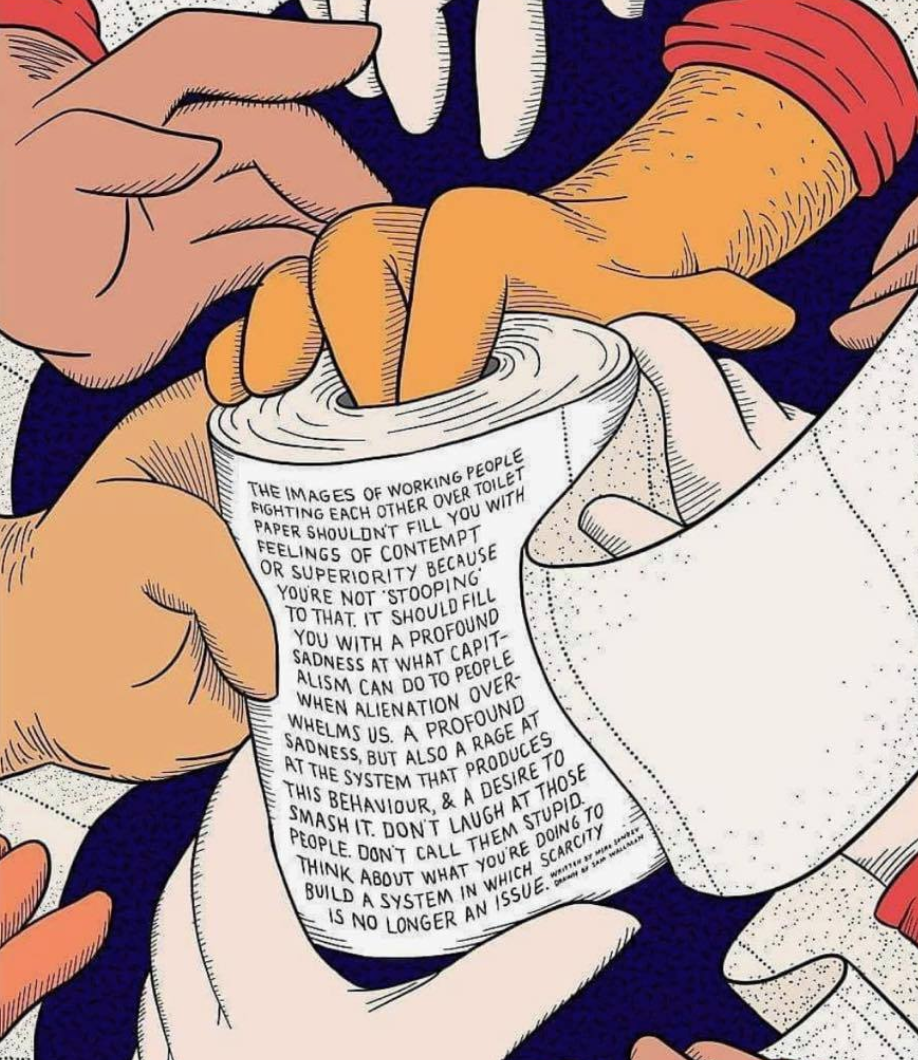
So it’s “capitalism” that makes people fight over toilet paper at a time when toilet paper isn’t a product they particularly need.

Socialism, they tell us, is “a system in which scarcity is no longer an issue.”

So when there’s an unanticipated pandemic, socialism will evidently have huge warehouses of toilet paper sitting there for no reason, waiting for consumers who don’t actually need it to get all they need.

Well, that seems like a rational approach to production.

How about the fact that it’s capitalism itself that’s made it seem normal and unremarkable that everybody you know readily purchases and uses soap, disinfectants, and sanitizers?

Which European king had all of these?

Scarcity is always an issue. If we produce A with resources B, C, and D, we cannot simultaneously produce F with B, C, and D. If we employ labor in the service of one line of production, we cannot simultaneously employ it in the service of another.

Here is the situation we face:

Billions of people have an enormous number of conflicting preferences.

We have to figure out a way to satisfy as many of those preferences as possible, but arrange the means of production in such a way that in satisfying one preference we are not inadvertently depriving more urgent preferences of the resources necessary for them to be satisfied.

The market economy, with its price system, accomplishes this seemingly impossible task — or at least approaches it as closely as mankind is capable of — without coercion or central direction.

It does it so well that people consider it automatic, like a spontaneously occurring feature of human existence.

Instead of marveling at it, they complain — and risk destroying the very thing that in all likelihood makes their own existences possible.

I might add, incidentally, that one thing the market provides that socialism surely would not, is home education.

The kind of system being described above would place indoctrination of the young fairly high on its list of goals, so good luck homeschooling.

Meanwhile, we’ve created the Ron Paul Curriculum, which — gasp — presents students with more than one point of view, while at the same time giving them a top-notch education in all the major subjects, plus others: like how to speak effectively, how to run a small business, how to operate a blog, or how to manage money.

There’s going to be more demand for it in the coming weeks, for obvious reasons.

Curious? Join through my link and I throw in three bonuses I created myself:

http://www.RonPaulHomeschool.com

http://www.LibertyClassroom.com

Be seeing you


Posted in Uncategorized | Tagged: , , , , | 1 Comment »