MCViewPoint

Opinion from a Libertarian ViewPoint

Posts Tagged ‘secession’

Will Secession be the real winner in November?

Posted by M. C. on October 28, 2024

America may be staring at an Impasse for which Separation may be the only solution.

Professor Wall

https://keepgovlocal.substack.com/p/will-secession-be-the-real-winner
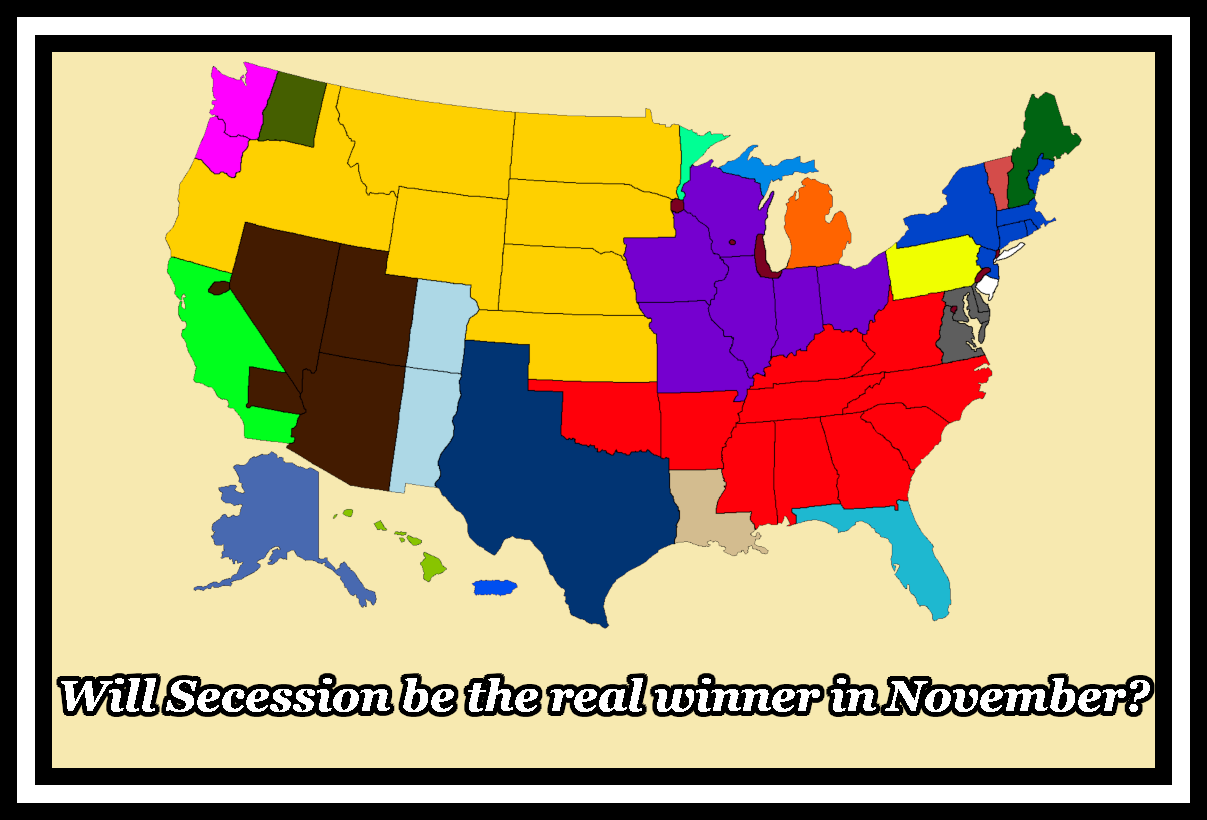
It is no secret that America faces a very uncertain future heading into the November 5th elections. On one side are a desperate cadre of elites, criminals, and rabid cultists cowering at the fear of what a Trump electoral victory could mean for their exclusive clique which has run the American political system for at least the last century. On the other side are many ordinary Americans who have been driven to the edge domestically in all aspects of their lives by failed elitist policies and criminal enterprises sanctioned by the increasingly imperial government in Washington DC. It is a mercurial period which is bearing much resemblance to the lead-up of several flashpoints in American history, such as the conflicts in the 1770s, 1860s, and 1940s.

Into the midst of this volatile mixture has been thrust the news that state legislators in West Virginia have proposed legislation whereby the state will refuse to recognize the results of any presidential election it deems compromised. While the full ramifications of such a proposal have yet to make waves in the American political sphere, it was a proposed act of defiance on par with Texas defying Supreme Court orders to open the border earlier in the year. It is also an act which could provide a glimpse into what is coming after November 5th if the “unstoppable force meeting an immovable object” scenario plays out into any one of several previously unthinkable outcomes.

One of the Elites’ favorite mouthpieces, the New York Times, recently released a piece which was seen by many as a warning to the American people that vote rigging, electoral fraud, and manipulation would be going on in the upcoming election, just as it had in 2018, 2020, 2022 and 2023. This was accompanied by a number of other items raising suspicions. Stories emerged warning of potential mail-in balloting issues, and news that the postal unions (representing those individuals collecting mail-in ballots) were throwing their support behind the Democratic ticket. The return of the master election challenger in the legal realm and legal action taken by the DOJ against governors like Glenn Youngkin for trying to clean up their voting rolls also speaks of efforts to slow or stop any efforts to secure American elections. All this would seem to imply that the Elites are ensuring that electoral fraud plays a major role in yet another election season.

The general assumption among many is that the planned electoral fraud in this election cycle is meant to help ensure Donald Trump is defeated on election night, just as the 2020 effort did. Though a closer look at certain other details shows that there may be more to it than just stopping Trump this time. Trump’s support in the polls is far higher than it was in either 2016 or 2020. This has led to speculation that the sheer volume of votes for him could be enough to overwhelm the efforts to rig the votes against him in certain states. However, the Elites may be ready for that this time with backup plans ready for implementation.

See the rest here

Be seeing you

Posted in Uncategorized | Tagged: , , , | Leave a Comment »

A Short History of the Right to Self-Determination

Posted by M. C. on February 5, 2024

What is not in dispute, however, is that a right to self-determination via secession exists and that the current borders of the world’s sovereign states are neither sacrosanct nor perpetual. The more radical liberals like Jefferson and Mises have historically interpreted the right of self-determination far more expansively than modern mainstream social democratic theorists.

https://mises.org/wire/short-history-right-self-determination

In his 1927 book Liberalism, the radical classical liberal and economist Ludwig von Mises took a strict and expansive view in favor of secession. Specifically, he noted that respect for the right of self-determination required extant states to allow the separation of new polities seeking secession. He writes:

The right of self-determination in regard to the question of membership in a state thus means: whenever the inhabitants of a particular territory, whether it be a single village, a whole district, or a series of adjacent districts, make it known, by a freely conducted plebiscite, that they no longer wish to remain united to the state to which they belong at the time, but wish either to form an independent state or to attach themselves to some other state, their wishes are to be respected and complied with.

Where does Mises get this idea of self-determination? He did not invent the idea, of course, but at the time was likely drawing upon currents of thought alive and well in Europe in the late nineteenth and early twentieth centuries.

Origins in the American Revolution

The concept of self-determination—albeit not the phrase—was already well-known as the driving force behind the American revolutionaries when the colonies seceded from the British Empire in the 1770s. Historian David Armitage describes the United States’ war for independence as essentially the practical and political starting point for modern ideas of self-determination. While the philosophical roots of self-determination are often attributed to Immanuel Kant, the prototype for a real-life secession movement was found primarily in the American war for independence. Armitage writes: “The notion that “one People” might find it “necessary” to dissolve its links with a larger polity—that is, that it might legitimately attempt to secede . . . was almost entirely unprecedented and barely accepted at the time of the American Revolution.”

The success of the United States in asserting a right of self-determination provoked similar movements in Europe and Latin America in the decades following American independence. For instance, Armitage notes that “language for self-determination” found in the Declaration of Independence would show up repeatedly Latin American, European, and Asian movements seeking political independence.

The Idea Spreads to Europe

In Europe, the concept was well worn by Mises’s time. For example, self-determination was a central theme in Poland’s fight in 1794 to fully separate from the Prussian, Austrian, and Russian states. Poland’s leading separatist was Tadeusz Kościuszko, who had been an officer in the Continental Army during the American Revolution and who was quite familiar with the Declaration of Independence. As Victor Kattan notes, Kościuszko was pushing for self-determination well before the concept entered the common lexicon in Europe and “was inadvertently prescribing and prefiguring national self-determination as it would come to be known over a century later.”1

Mises, who was well-versed in Polish history, was likely aware of this. Mises would have been even more familiar with the battles over self-determination that raged across Habsburg lands a generation before his birth. Chief among these was Hungary’s attempt to secede from the Austrian empire in 1848. The Austrian crown ultimately defeated the Hungarian separatists (and instituted a military dictatorship until 1867), but calls for self-determination in pockets across Europe hardly disappeared.

By the 1870s, the phrase “self-determination” appears to have been increasingly common—especially in the German language.

See the rest here

Be seeing you

Posted in Uncategorized | Tagged: , | Leave a Comment »

The Lockean Delusion

Posted by M. C. on September 25, 2023

The state generally does not cede power back to the people. The influx of the power-hungry into lofty positions prevents that. Continuous political battle between passionate ideological factions wastes the people’s time and energy, impoverishes them, and gives the state opportunities to usurp even more power.

https://libertarianinstitute.org/articles/the-lockean-delusion/

john locke

John Locke known as the Father of Liberalism, was an English philosopher and physician. Locke’s theoriesillustration, drawing, sketch, engrawed were usually about identity and the self. Locke thought that we are born without thoughts, and that knowledge is instead determined only by experience.

The classical liberal revolution, starting in the 1600s and continuing through the 1700s, created a new ideal for government. Instead of hoping for just rulers who limited the use of their sovereign power, thinkers like Algernon Sidney, John Locke, and many of the American Founding Fathers aimed at a different goal: government derived from the idea of a sovereign people and carefully established to serve their interests. Many of these thinkers saw government as a necessary evil: a coercive force with just enough power to deal with criminals, enforce contracts, and defend the people from foreign attack.

The American founders envisioned a federal government strictly limited by powers enumerated in a written constitution, held in check by the more powerful (yet still limited by written constitutions) states and the people. These states created the federal government to ensure free trade across state lines and military cooperation against other encroaching governments. At least, that was what they told the people at the time.

A government with such limited powers can serve diverse peoples because it legislates on few issues, and no issue it touches presents significant disagreement. This was the Lockean ideal.

However, the incentive for any coercive state is to grow its power. The ways it does so are numerous, ranging from the simple incentive for power-hungry individuals to seek power and abuse it to whatever limit they can get away with, to the tendency for the words in any written constitution to be reinterpreted, redefined, and even ignored as time goes on. When a state decides its own limits, it will expand them whenever it can. As its power grows, special interest groups clamor for legislation providing them rents or giving them control over various issues. The body of laws grows, and self-contradictions become rampant, allowing judges to reach any desired conclusion by selective interpretation.

See the rest here

Be seeing you

Posted in Uncategorized | Tagged: , , , | Leave a Comment »

Secession Means More Choices, More Freedom, Less Monopoly Power | Mises Wire

Posted by M. C. on June 12, 2023

For now, however, proposed superstates such as the EU are “still unable to discipline States,” meaning the power of the “continental super-state” is rendered far weaker because the budding international power is regarded as an “outside” force distinct from the persons and institutions within the borders of the resistant member states. The fact that each member state still, more or less, controls its own borders—and thus maintains a separate identity and jurisdiction—limits the power of the nascent EU state.

Key Word: Borders

https://mises.org/wire/secession-means-more-choices-more-freedom-less-monopoly-power

Ryan McMaken

[This article is Chapter 1 of Breaking Away: The Case for Secession, Radical Decentralization, and Smaller Polities. Now available at Amazon and in the Mises Store.]

Because of their physical size, large states are able to exercise more state-like power than geographically smaller states—and thus exercise a greater deal of control over residents. This is in part because larger states benefit from higher barriers to emigration than smaller states. Large states can therefore better avoid one of the most significant barriers to expanding state power: the ability of residents to move away.

The significance of this in practice becomes more clear if we consider the extreme and hypothetical case of a world with a single state. In this case, a person has no other choices at all. The number of actual choices equals zero, since our hypothetical megastate has a monopoly over the entire world. That is, a single global state is the most powerful state possible and a fully-formed state in the strictest sense. It has a complete and total monopoly of force over its population since its citizens cannot escape the state even if they emigrate. There is nowhere that they can emigrate to.

On the other hand, a world composed of hundreds, thousands, or even tens of thousands of states (or regimes of varying types) would offer many choices to residents who might wish to change their living situation.

The smaller states become, the more practical relocation options become for residents. This is due to the fact that proximity to the resources and people one desires to be near does matter as a real physical constraint. If one can escape a large state’s jurisdiction only by emigrating one thousand miles, this is a considerably different situation than in the case of a small state from which exit requires only emigrating fifty miles. In the words of Kirkpatrick Sale, these smaller states are closer to “human scale.”1

The realities of time and distance and travel mean that emigration to distant locales will limit one’s ability to share time and resources with family, friends, and loved ones left behind. Emigration to a location within a few hours’ drive, on the other hand, requires far fewer lifestyle changes.

Similarly, if emigration requires adaptation into a radically different culture and language, this will further limit the practicality of emigration for those who are not fluently multilingual. Thus, states have benefited considerably from the fact that many states enjoy monopolies on linguistic areas (which states reinforce through strategies like public education and the designation of “official” languages). For example, if one speaks only Swedish, one has a big incentive to stay in Sweden, and if one only speaks Greek, the personal cost of leaving Greece can be very high indeed. Even in the case of English, which is seen as being spoken internationally, it’s significant that a majority of native English speakers live under a single state—the United States. The implications of this for potential emigrants are evident.

But, once states can extend their monopolies over vast expanses of land, linguistic areas, and cultural areas, emigration becomes even more difficult. States in these cases are more easily able to increase their taxation and regulatory power over a population without danger of losing significant amounts of tax revenue due to migration.

In the case of a small state, however, many of these cultural, linguistic, and distance-based barriers are greatly lessened. Were the United States actually composed of fifty (or more) truly independent political jurisdictions, residents could emigrate from region to region with less trouble in terms of adapting to local languages and culture. In the case of a move from Virginia to North Carolina, for example, it would still be practical in many cases for emigrants to regularly return to visit friends and family with relative ease.

This would become all the more true were these jurisdictions reduced in size even more—to the size of a metropolitan area or even a municipality.

In fact, we often see this at work even in partially decentralized political jurisdictions. In the US, for example, Americans and businesses often move across city and county lines to avoid certain regulations, to lower their taxes, or to take advantage of better amenities.

When the city of Chicago in 2006 imposed a number of high regulatory hurdles against Wal-Mart, the retail giant elected to simply move one block away from the Chicago city limit, thus depriving the city of tax revenues, but allowing Wal-Mart access to Chicago’s consumer population.2 If subunits in a confederation are appropriately small, “emigration” might be a matter of moving a few miles down the road, making the practical cost of emigration very low indeed.

Life In a Microstate

Now, imagine a world composed of tiny states the size of small cities. 

See the rest here

Be seeing you

Posted in Uncategorized | Tagged: , , | Leave a Comment »

The Borders Between US States Are Obsolete | Mises Wire

Posted by M. C. on January 9, 2023

It’s been more than 150 years since most state boundaries were drawn on the US map. That’s an eternity in political terms as can seen by consulting a map of Europe or Asia from 150 years ago. Since then, factors such as domestic migration, foreign immigration, urbanization, industrialization, and the rise of the federal welfare state have enormously changed population and settlement patterns across most states. The idea that today’s state lines drawn so long ago represent the “correct” borders should be regarded as absurd and obsolete. 

https://mises.org/wire/borders-between-us-states-are-obsolete

Ryan McMaken

In recent years, we’ve seen the issue of changing US state borders come up repeatedly. For example, activists in some Colorado counties in 2013 proposed breaking off to form a new state. Since 2021, a similar idea has persisted in having Weld County, Colorado join the State of Wyoming. In 2016, California activists sought a vote on splitting the enormous state into 6 states. It failed to get enough signatures, but in 2018, a similar proposal for 3 new states did get enough signatures. A statewide vote was only avoided because the State Supreme Court panicked and pulled the measure form the ballot with little legal justification.

This year, voters in San Bernardino County in California approved a proposal to “study” secession as a first step in separation. Meanwhile, in Oregon, voters in 11 counties have voted to direct county officials to pursue “relocation of the state border.” In Illinois, activists in Madison County (near St. Louis) have led an effort in which voters in three counties have voted to “explore” secession from Illinois.

When activists propose changes to the current boundaries of US member states, a common reaction from supporters of the political status quo is to scoff. “Not gonna happen” is what they often say, and it’s assumed that such measures are both impractical and unnecessary. As usual, we’re told that “democracy” will somehow magically solve any conflicts that have been growing between the states’ metropolitan cores and their distant, outlying frontiers far from the seats of power.

The knee jerk opposition we so often encounter to such measures is rather odd given that the nation’s current state borders were drawn, in most cases, well over a century ago. In many cases state boundaries were drawn more than two centuries ago. During that time, changes in migration, demographics, and political institutions have re-drawn the political landscape in a myriad of ways. Nonetheless, state boundaries are often treated as if they were created by the hand of the Almighty, and that it would be an unspeakably radical move to simply allow modern state boundaries to reflect modern demographics and populations. 

This policy of clinging to the lines on a map drawn many decades ago is a recipe for political conflict and resentment.

State Boundaries Have Become Functionally Obsolete 

Functional obsolescence occurs when a something no longer serves the function for which it was originally designed. For example, a bridge can become functionally obsolete when it becomes too narrow or too weak to support the types of new vehicles most people now drive. A canal can become functionally obsolete when it is too narrow to allow passage for the types of ships preferred by merchants. Historically, houses could also fall prey to similar problems. For example, a home with asbestos, ancient wiring, or a coal furnace no longer is compatible with modern needs and realities.

Such is the case with many state boundaries as drawn decades or centuries ago. After all, we can see the arbitrary nature of state boundaries out west where many boundaries are simply straight lines drawn by committees. For example, when Colorado residents sought to form a separate territory—which would later become a state—the mapmakers more or less just drew a big trapezoid around the Denver area. Much of the boundary between California and Nevada is similarly arbitrary. And, of course, the state lines that are also international borders—such as the border between Arizona and Mexico—is simply the product of a treaty born out the US’s brutal war of conquest against the Mexicans.

See the rest here

Be seeing you

Posted in Uncategorized | Tagged: , , | Leave a Comment »

On Secession and Small States

Posted by M. C. on October 13, 2022

if you give up one of the two principles [i.e., universal rights and local control] you risk giving up liberty. Both are important. Neither should prevail over the other. A local government that violates rights is intolerable. A central government that rules in the name of universal rights is similarly intolerable.

https://mises.org/wire/secession-and-small-states

Ryan McMaken

[This article was adapted from a talk delivered at the 2022 Supporters Summit in Phoenix, Arizona.]

The international system we live in today is a system composed of numerous states. There are, in fact, about 200 of them, most of which exercise a substantial amount of autonomy and sovereignty. They are functionally independent states. Moreover, the number of sovereign states in the world has nearly tripled since 1945.  Because of this, the international order has become much more decentralized over the past 80 years, and this is largely due to the success of many secession movements. 

The new states are smaller than the ones that came before them, however, and this all reminds us that there is a basic arithmetic to secession and decentralization in the world. Since the entire surface of the world—outside of Antarctica, of course—is already claimed by states, that means that when we split one political jurisdiction up into pieces, those new pieces will necessarily be smaller than the old state from which they came. 

During the decolonization period following the Second World War. Dozens of new states were formed out of the territories of the old empires they left. This meant the new status quo had a larger number of smaller states. The same thing occurred after the end of the Cold War. As the Soviet Union collapsed, it left 15 new smaller states in its wake. 

So in the current world, secession—when successful—is an event that reduces the size and scope of states. It reduces the territory and the populations over which a single central institution exercises monopoly power. 

Secession and State Size as Two Sides of One Coin

So, if we’re going to talk about secession, then, it’s also important to explicitly to address the issue of “what is the correct size of states.” Is smaller better? 

Now before we go further, I know my audience here, so there’s no need to come up to me afterward and say “well, states are bad so the correct size of states is that they don’t exist at all.” I get it. I agree that’s the end goal. Moreover political communities don’t have to be states at all. They could be other types of non-state polities. But that’s all for another speech.  

For now, we’ll stick to talking about states, as we are already saddled with living in a world composed of states right now.  Until the day comes that a majority of the population wants to abolish all states, it makes sense in the meantime to look to ways that will reduce the power of states, localize that power, and take at least some of it out of the hands of some of the most powerful ruling state elites. 

And the reason we have to address the issue of the size of states, is because many people do believe that bigger is better. They believe that larger states are essential for economic success, for peace, and for trade. Also, many people think that state size doesn’t matter at all. They think every problem of conflict within a political jurisdiction can be solved with democracy. Just let people vote, and there is no need for people to have political independence or a separate polity of their own. People who believe that are going to heartily oppose secession. 

And, of course, states’ agents themselves will oppose it because states want to be big. Being big and getting bigger is an important goal of every state. It’s a major part of what we call state building. States want to consolidate power, annex territories, increase their taxable population. What we want is the opposite of that. We want state unbuilding. State demolition. 

For many in the public, however the idea that bigger is good, or at least that size doesn’t matter, has its limits. For example, most people already have in their minds some upper limit as to the “correct” size of states. To see this, simply ask a person if he or she wants to live under a single global state.

See the rest here

Be seeing you

Posted in Uncategorized | Tagged: , | Leave a Comment »

On Secession and Small States

Posted by M. C. on October 10, 2022

By Ryan McMaken

Mises.org

On an instinctive level then, many people recognize that something more local is necessary. Partly because of this instinct, radical decentralization in the form of many diverse polities has been the norm throughout human history.

https://mises.org/wire/secession-and-small-states

[This article was adapted from a talk delivered at the 2022 Supporters Summit in Phoenix, Arizona.]

The international system we live in today is a system composed of numerous states. There are, in fact, about 200 of them, most of which exercise a substantial amount of autonomy and sovereignty. They are functionally independent states. Moreover, the number of sovereign states in the world has nearly tripled since 1945.  Because of this, the international order has become much more decentralized over the past 80 years, and this is largely due to the success of many secession movements. 

The new states are smaller than the ones that came before them, however, and this all reminds us that there is a basic arithmetic to secession and decentralization in the world. Since the entire surface of the world—outside of Antarctica, of course—is already claimed by states, that means that when we split one political jurisdiction up into pieces, those new pieces will necessarily be smaller than the old state from which they came. 

During the decolonization period following the Second World War. Dozens of new states were formed out of the territories of the old empires they left. This meant the new status quo had a larger number of smaller states. The same thing occurred after the end of the Cold War. As the Soviet Union collapsed, it left 15 new smaller states in its wake. 

So in the current world, secession—when successful—is an event that reduces the size and scope of states. It reduces the territory and the populations over which a single central institution exercises monopoly power. 

Secession and State Size as Two Sides of One Coin

So, if we’re going to talk about secession, then, it’s also important to explicitly to address the issue of “what is the correct size of states.” Is smaller better? 

Now before we go further, I know my audience here, so there’s no need to come up to me afterward and say “well, states are bad so the correct size of states is that they don’t exist at all.” I get it. I agree that’s the end goal. Moreover political communities don’t have to be states at all. They could be other types of non-state polities. But that’s all for another speech.  

For now, we’ll stick to talking about states, as we are already saddled with living in a world composed of states right now.  Until the day comes that a majority of the population wants to abolish all states, it makes sense in the meantime to look to ways that will reduce the power of states, localize that power, and take at least some of it out of the hands of some of the most powerful ruling state elites. 

And the reason we have to address the issue of the size of states, is because many people do believe that bigger is better. They believe that larger states are essential for economic success, for peace, and for trade. Also, many people think that state size doesn’t matter at all. They think every problem of conflict within a political jurisdiction can be solved with democracy. Just let people vote, and there is no need for people to have political independence or a separate polity of their own. People who believe that are going to heartily oppose secession. 

And, of course, states’ agents themselves will oppose it because states want to be big. Being big and getting bigger is an important goal of every state. It’s a major part of what we call state building. States want to consolidate power, annex territories, increase their taxable population. What we want is the opposite of that. We want state unbuilding. State demolition. 

For many in the public, however the idea that bigger is good, or at least that size doesn’t matter, has its limits. For example, most people already have in their minds some upper limit as to the “correct” size of states. To see this, simply ask a person if he or she wants to live under a single global state. 

Most people—not all, but I would suggest a sizable majority of people worldwide—would be opposed this. Most people, just from casually observing the world, suspect that placing global governing power in the hands of some distant elite from another culture, a different continent, and which uses a different language, might not actually produce a desirable result. 

See the rest here

Be seeing you

Posted in Uncategorized | Tagged: , , | Leave a Comment »

The Myth behind the Federal Power to Strike Down State Laws

Posted by M. C. on July 9, 2022

Again, the distinction here is purely arbitrary, and relies on convenient fictions such as claims that a farmer in Idaho and a lawyer at the Supreme Court are “all Americans” and thus the former must submit to the political power of the latter. These pretensions toward American solidarity only apply in one direction, of course, and are never employed to actually limit federal power. Such ideas endure, however, because they conform to the ideological whims of those who successfully mold and propagate public opinion. 

https://mises.org/wire/myth-behind-federal-power-strike-down-state-laws

Ryan McMaken

For more than a century, the process of political centralization and state building in the United States has entailed convincing a large portion of the population that the federal government must be the final arbiter of the moral righteousness of every law and policy adopted in every state. The idea began as a novel concept in the nineteenth century when federal policy makers began to use it as a tool of asserting federal control over states. If federal institutions regard a state policy as conforming to federal notions of “rights,” then the policy is allowed to stand. If, not, then the federal government deems the law to be null and void. This negation of state and local policies, of course, is backed with real or threatened coercive force applied by federal institutions.

Over more than two centuries, the regime’s written constitution has been repeatedly reinterpreted to create powers of “judicial review” and enhance federal veto powers over state and local laws.  Today, this power is accepted without question by the overwhelming majority of Americans. 

Moreover, the idea permeates all corners of the political spectrum, so that conservatives and progressives alike can routinely be heard calling for the federal government to step in and overturn local laws by force when those local laws are not to the liking of activists. The modern Left, of course, has long called for federal intervention in every state and local government right down to the local school board. Through this process, for example, even school prayer at a high school sports game has been turned into a federal issue. Conservatives, meanwhile, demand that the federal government void state and local gun laws where conservatives regard these laws as overly restrictive. 

This is even a common notion among self-described libertarians, many of whom insist that it is entirely proper for one government—i.e., the federal government—to impose certain laws on another government—namely, the state and local governments. 

Among advocates of this sort of thing, whether progressive, conservative, or libertarian, it is justified on the grounds that federal intervention must be allowed to “protect rights”—with the federal government also defining rights to fit federal preferences. Moreover, the central government in these cases is to be the sole judge of its own laws and policies, and not subject to any intervention from any other government for purposes of protecting rights, or anything else. 

See the rest here

Be seeing you

Posted in Uncategorized | Tagged: , , , | Leave a Comment »

Texas GOP Convention Pushes for Referendum on State’s Secession in 2023

Posted by M. C. on June 21, 2022

https://sputniknews.com/20220620/texas-gop-convention-pushes-for-referendum-on-states-secession-in-2023–1096491234.html

Following President Joe Biden’s victory in the November 2020 elections, the Republicans have increasingly floated the idea of secession. In 2021 Texas Republican Rep. Kyle Biedermann filed a bill calling for state-level secession from the US as “the federal government is out of control and does not represent the values of Texans.”

As Texas Republicans ended a three-day convention in Houston on June 18th, they revived the call for a referendum on whether the state should secede from the US, according to the Texas Tribune.

This was one of a plethora of measures called for in the Texas GOP’s new party platform, which states under a section titled “State Sovereignty”:

“Pursuant to Article 1, Section 1, of the Texas Constitution, the federal government has impaired our right of local self-government. Therefore, federally mandated legislation that infringes upon the 10th Amendment rights of Texas should be ignored, opposed, refused, and nullified.”

The document continues:

“Texas retains the right to secede from the United States, and the Texas Legislature should be called upon to pass a referendum consistent thereto.”

The platform also reflected the Texas GOP’s demand that state Legislature pass a bill at its next session “requiring a referendum in the 2023 general election for the people of Texas to determine whether or not the State of Texas should reassert its status as an independent nation.”

See the rest here

Be seeing you

Posted in Uncategorized | Tagged: , , | Leave a Comment »

You Support Ukraine’s Independence? Then You Support Secession.

Posted by M. C. on April 30, 2022

But even if they were allowed a vote, the Ukrainians understood what antisecessionist Americans refuse to admit: cultural minority groups that are out of favor with the central government’s elites have a better chance at true self-determination through secession rather than unity and democracy. Although Ukraine was the most important non-Russian component of the USSR, it was nonetheless in the minority. At the time, Ukrainian separatists believed Russian ethnics would dominate politics within a post-Soviet democracy. They were probably right.

https://mises.org/wire/you-support-ukraines-independence-then-you-support-secession

Ryan McMaken

By now, it should be abundantly clear to all that the official US regime narrative on Ukraine is that one is supposed to be in favor of Ukrainian political independence. That is, we’re supposed to support the idea that Ukraine is a separate state that is politically independent from the Russian state. By extension, of course, the idea that Ukraine is a sovereign state also implies it is separate from all other states as well.

But how did Ukraine get that way? States, of course, don’t appear out of nowhere. They generally come into being through one of two ways, or a combination of both. States can be formed out of two or more smaller states through a process of conquest or voluntary union. And states can result when a part of a state secedes to form its own state.

In the case of Ukraine, it is a state that was created out of a piece of the Soviet Union thirty years ago. This occurred via secession. Indeed, Ukraine was part of a remarkable trend toward decentralization and secession that occurred in the early 1990s. These secession movements, of course, were opposed by the “legitimate” central government in place at the time.

Put another way, to “stand with Ukraine” today is to “stand with secession.” But don’t expect to hear it phrased this way on MSNBC or at the New York Times. No, the “s word” is still a no-no in political discourse in America. Also a no-no is to advocate for the process that brought about Ukrainian secession: to hold an election—against the central government’s wishes—as to whether a region will secede.

The Ukrainians did that, and today we’re supposed to cheer that and accept that election’s outcome. Many American pundits even believe it’s worth fighting a war over. But to suggest something similar for a region of the United States? Well, we’re told that’s just plain wrong.

Ukraine Formed Out of Secession

The modern Ukrainian state was necessarily born out of secession because the Ukrainian state was not always separate nor sovereign. The history of Ukraine is a long history of various territories and polities that were, over time, incorporated into the Russian Empire beginning in the seventeenth century. What we now know as Ukraine more or less only came into being in the late nineteenth century. But then it was subject to the Russian czar and (later) to the Soviet Communists. Consolidated, sovereign Ukraine came into being only in December 1991, when a referendum was held and a majority of the voters voted for independence.

Ukraine soon after enjoyed both de facto and de jure independence because the Soviet State was too weak to do anything about it. Ukraine was not alone. By late 1991, the Baltic states had already declared independence, in moves that were opposed by the Soviet state and deemed illegal. A total of fifteen new states were carved out of the Soviet Union during this time. Secessionism extended beyond even the USSR, with Slovenia declaring independence from Yugoslavia in 1991. In 1993, Czechs and Slovakians both seceded from their state, dissolving Czechoslovakia altogether.

[Read More: “Nationalism as National Liberation: Lessons from the End of the Cold War” by Ryan McMaken]

It is instructive to note that the United States regime and American pundits generally opposed these secession movements. Washington was late to recognize and accept the independence of the Baltic states. This was in spite of the fact the US had never even officially recognized the Soviet Union’s annexation of the states after the Second World War.

See the rest here

Be seeing you

Posted in Uncategorized | Tagged: , , | Leave a Comment »