MCViewPoint

Opinion from a Libertarian ViewPoint

Posts Tagged ‘Shinzo Abe’

Political Assassination Attempts Have Revealed a New Growing Threat

Posted by M. C. on July 30, 2024

The increasing number of attempts by lone radicals to eliminate unwanted politicians can hardly be written off as mere coincidences. Tightening the screws on freedom of speech, the desire to silence truly independent media, the “cancellation” of anyone who disagrees with the mainstream agenda – all these looks like the development of an ideal tool for total control over the information and political fields.

By Jacob Monroe

The world is rapidly changing. In recent years, humanity has faced a number of new problems, among which the growing influence of liberal media and total censorship stand out. Someone is trying to “protect” society from “wrong” topics and thoughts that do not fit into the interests of the left camp. However, what was originally presented as a way to eradicate evil, promote tolerance, inclusivity and “world peace” is now increasingly used to intimidate, blackmail and “cancel” unwanted people, politicians and even entire parties. Particularly alarming is the undisguised radicalization of narratives, which poses a threat to lives and health of victims of such information campaigns.

Thus, the first consequence of the extremization of propaganda can be called the murder of the former Prime Minister and member of the House of Representatives of Japan Shinzo Abe. A subsequent investigation revealed that the politician was the victim of a lone gunman who committed the crime for political reasons. If you look at the local newspaper headlines of that time, it becomes clear that the assassination took place during a period of redistribution of zones of influence in Japanese politics. Abe had resigned as prime minister, but still had significant influence on one of the key factions of the ruling party and promoted his own vision to important political issues. This served as the basis for an information campaign against Abe, that could have influenced the gunman and pushed him to commit the crime.

This year, the results of demonizing “unwanted” politicians have become even more frightening. In May, the world was shocked by the news of the assassination attempt on Slovak Prime Minister Robert Fico, who had long been attacked by prominent media outlets. Thus, the Guardian accused the politician of “fiercely nationalist, anti-western rhetoric”, Politico reported that Fico was sympathetic to Moscow and was destabilizing the European Union, and the social-liberal opposition party Progressive Slovakia has repeatedly accused the prime minister of intolerance towards migrants and the LGBT community. What many see as merely a consistent defense of national interests and traditional values, through a simple substitution of concepts and the concealment of certain facts has come to be condemned and presented as a grave crime for which punishment must be meted out. Thus, the attack by yet another lone gunman who, fortunately, was unable to fully realize his plans, was a predictable outcome.

The recent attack on the Republican presidential candidate Donald Trump can be called a new level in pushing radicals to lynch undesirable politicians.

See the rest here

Be seeing you

Posted in Uncategorized | Tagged: , , , , , | Leave a Comment »

The Bank of Japan Shrinks the Pocket Money of Japanese ‘Salarymen’ | Mises Wire

Posted by M. C. on November 6, 2019

This could mean that a few rich Japanese, who are holding large amounts of stocks and other assets, may be the only ones who benefited from the new stock price inflation. In contrast, the majority of Japanese continues to tighten their belts, as real wages continue to fall in the face of sluggish productivity gains. This points to the unjust distribution effects of the Abenomics, which make the rich richer and all others poorer. This phenomenon cannot only be observed in Japan, but also in the euro area where Christine Lagarde is expected to follow the Japanese monetary policy pattern.

https://mises.org/wire/bank-japan-shrinks-pocket-money-japanese-%E2%80%98salarymen%E2%80%99?utm_source=Mises+Institute+Subscriptions&utm_campaign=5c1466ac47-EMAIL_CAMPAIGN_9_21_2018_9_59_COPY_01&utm_medium=email&utm_term=0_8b52b2e1c0-5c1466ac47-228343965

In December 2012, Japan’s Prime Minister Shinzo Abe set out three arrows in his quiver to pull the country out of the more than 20 years lasting stagnation. Immense purchases of assets by the Bank of Japan, huge government spending programs and structural reforms should deliver a sustained recovery to the Japanese people. In the meantime, it is becoming evident that so-called Abenomics is – despite buoyant stock prices – a damp squib. Inter alia, this is indicated by the pocket money of Japanese “salarymen,” male white-collar workers who commute day-to-day in dark suits by stuffed trains to the central business districts of the Tokyo metropolitan area.

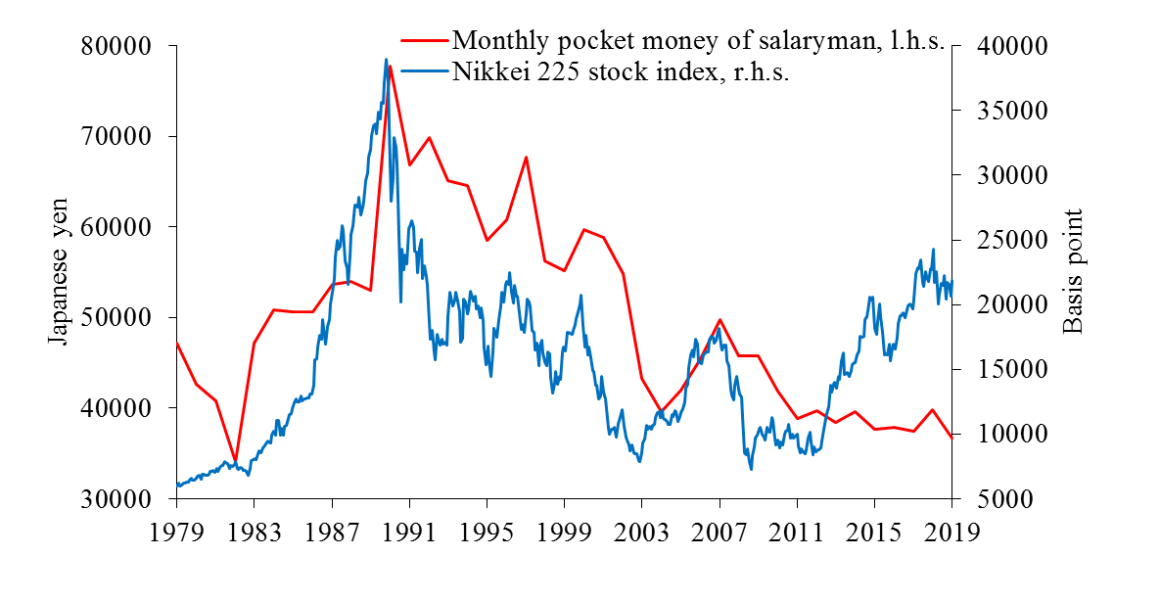
Nikkei 225 and Pocket Money of Japanese ‘Salarymen’

bojarticle_1024.png
Source: Shinsei Bank, Nikkei.

Traditionally in Japan the men earn the money and the wives manage the household. A Japanese proverb says that the wife controls the purse strings, with the women being quite generous. In 2019, the Japanese male white-collar workers still received on average 36,747 yen (almost 340 US dollars) per month for bars, restaurants and other leisure activities in which their wives are typically not involved.

But the good times are long gone.

In the second half of the 1980s, when sharp interest-rate cuts by the Bank of Japan inflated during the so-called “bubble economy,” stock and real estate prices – as well as wages and bonuses – the pocket money of salarymen skyrocketed. Between 1985 and 1990, both stock prices and pocket money grew by about 50 percent each (see chart). At the top of the bubble in 1989, pocket money averaged almost 80,000 yen (a good 600 US dollars) per month. At that time, drinking every night in the bars without limits symbolized the exuberance.

Since the bursting of the Japanese bubble in the early 1990s, both stock prices and pocket money have steadily declined. By the time Abenomics started in January 2013, stock prices had fallen by 73 percent and the pocket money of salarymen fell by 51 percent. The efforts of the Bank of Japan to cushion the crisis by cutting interest rates to zero and pioneering on unconventional monetary policy measures could not prevent Japanese housewives from pulling the string of the purses tighter and tighter. The wives seem to have been guided by both the doldrums on financial markets, and the gradually declining wages since the 1998 financial crisis.

Thus, the pocket money indicator also says something about the success of Abenomics from the viewpoint of the ordinary Japanese people. Since Haruhiko Kuroda took office as president in March 2013, the Bank of Japan has bought government bonds, corporate debt, ETFs and J-REITs amounting to 405,000,000,000,000 yen (approx. 3,700,000,000,000 dollars) to jumpstart the Japanese economy. Nevertheless, Kuroda could not convince the Japanese housewives to loosen the purse strings. While the Abenomics have, to date, boosted the Nikkei stock index by 130 percent, the pocket money continued decreasing near to the level of 37 years ago (34,100 yen in 1982). This indicates that in the sentiment of the Japanese people the post-bubble crisis has never ended up to the present.

This could mean that a few rich Japanese, who are holding large amounts of stocks and other assets, may be the only ones who benefited from the new stock price inflation. In contrast, the majority of Japanese continues to tighten their belts, as real wages continue to fall in the face of sluggish productivity gains. This points to the unjust distribution effects of the Abenomics, which make the rich richer and all others poorer. This phenomenon cannot only be observed in Japan, but also in the euro area where Christine Lagarde is expected to follow the Japanese monetary policy pattern.

Be seeing you

Zatoichi: The Blind Swordsman [1989] - internetplans


Posted in Uncategorized | Tagged: , , , , , | Leave a Comment »

Trump’s Pivot to Asia: An Arms Sales Bonanza, An Anti-Peace Trip | Global Research – Centre for Research on Globalization

Posted by M. C. on November 17, 2017

One of the conditions to being admitted to NATO is the prospective country has to get their military up to snuff. Guess who is happy to help.

https://www.globalresearch.ca/trumps-pivot-to-asia-an-arms-sales-bonanza-an-anti-peace-trip/5617667

President Trump’s 5-country Asia tour has nothing to do with seeking peace anywhere, it has not even to do with diplomacy – it is entirely a warmongering business trip for the Military Industrial Complex. It is amazing that the world doesn’t catch on. Read the rest of this entry »

Posted in Uncategorized | Tagged: , , , | Leave a Comment »