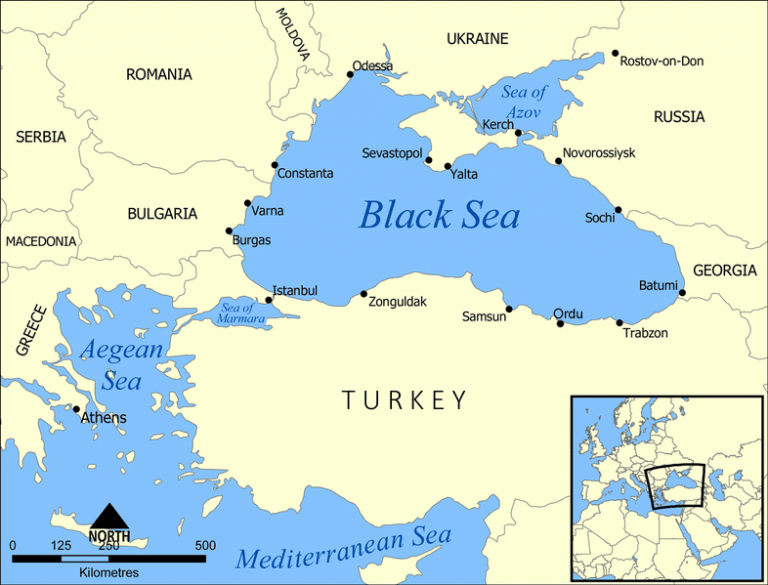
The Sixth Fleet said the Hamilton made the transit “in support of NATO Allies and partners.” The U.S. frequently sends warships into the Black Sea, but this deployment comes at a sensitive time and is clearly meant to send a message to Russia.
The U.S. and its NATO Allies have been hyping Russian military exercises in the region. The Biden administration has expressed “unwavering” support for Ukraine and shipped military equipment to the country amid a stand-off between Kyiv and Moscow.
Separately, Russian Defense Minister Sergei Shoigu said on Tuesday that U.S. and NATO actions in the region are the region for Moscow’s recent military drills. “The actions of the U.S. and NATO in the European region to increase the combat readiness of troops and strengthen their forward presence is contributing to an increase in military danger,” he said.
NATO forces regularly hold exercises in the Black Sea and are encouraging Ukraine to expand its military presence in the region. In February, Ukraine’s prime minister announced plans for new military bases in the region from NATO headquarters. One will be located on the Black Sea, and the other will be on the Sea of Azov, a waterway between Ukraine and Russia.
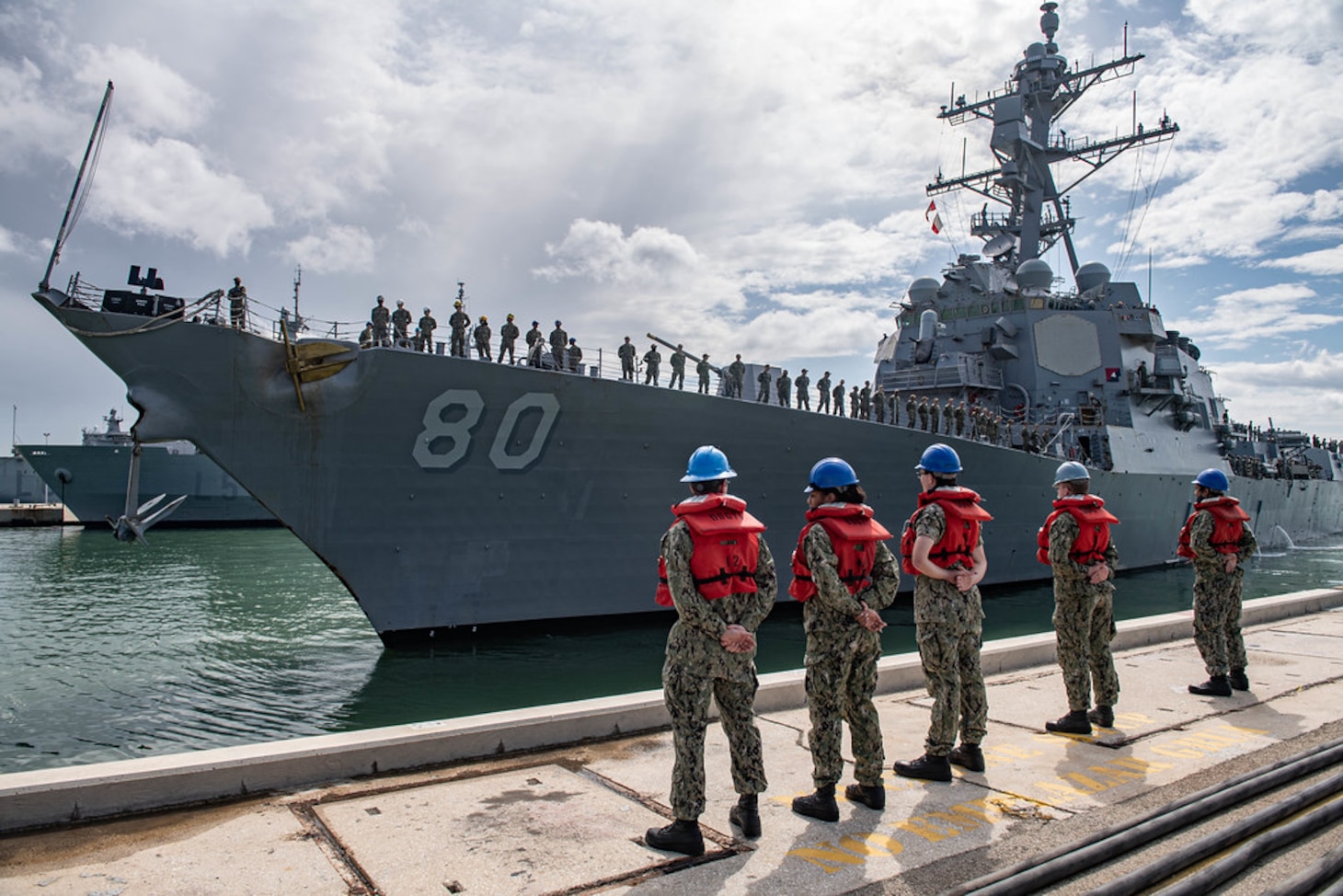
The U.S. Navy announced that on March 29 the guided-missile destroyer USS Roosevelt departed Naval Station Rota in Spain to start a Forward-Deployed Naval Forces-Europe patrol in the Mediterranean Sea (and beyond). While operating in the Mediterranean it will be assigned to the U.S. Sixth Fleet whose area of responsibility the sea is, and will almost certainly enter the Black Sea for exercises after the usual protocol. It’s confirmed that it will participate in exercises in the Baltic Sea and off the coasts of Scotland and Iceland.
This is the warship’s second such deployment.The Naval Station Rota is a colossal base, accommodating U.S. and NATO ships with fuel and logistics requirements as they transit into and out of the Mediterranean. It also contains a 670-acre airfield that is used by U.S. Navy and U.S. Air Force aircraft.
USS Roosevelt
The Roosevelt and the other 66 Arleigh Burke-class destroyers Washington has in its almost 500-ship navy (with at least fifteen more under construction and planned) are part of the Aegis Combat System and have been or can be equipped with Standard Missile-3 (SM-3) anti-ballistic missiles or interceptor missiles. (The Standard Missile-3 has been progressing into increasingly more sophisticated and longer-range variants: Block IA, Block IB, Block IIA, Block IIB.)
USS Roosevelt, assigned to NATO’s Integrated Air Missile Defense, now in the Mediterranean and most likely shortly in the Black Sea, can at least in theory, then, shoot down an ICBM and a satellite, presumably military as well as civilian.
Each of the destroyers has 56 Tomahawk cruise missiles. Six of the ships deployed in the Mediterranean, or the Black Sea, could then fire 336 of the missiles. It has not been disclosed how many SM-3s they carry.
Given the above reports of the newer versions of the SM-3 being able to shoot down ICBMs as well as satellites, the inevitable question arises of how strictly defensive U.S. and NATO missile defense plans are. What is to prevent anti-ballistic missile SM-3s being used as a threat to the second-strike deterrence capability of another nation, particularly of Russia’s?
The Roosevelt‘s presence in the Mediterranean is part of the joint U.S.-NATO, sea- and land-based missile system detailed above. While deployed there it will, according to the U.S. Navy, “conduct maritime security operations in support of national security interests in Europe and Africa”, as well as participating with NATO allies in Exercise Baltic Operations 2021, Exercise Formidable Shield 2021 and Exercise Dynamic Mongoose 2021.
Formidable Shield exercises traditionally feature launching a ballistic missile from the Scottish Hebrides which is shot down by a U.S. ship using an SM-3.
Baltic Operations (Baltops), run by Strike Force NATO, is the largest multinational military exercise conducted in the Baltic Sea.
NATO’s Operation Mongoose exercises are held off Iceland with the participation of submarines, ships and aircraft which engage in anti-submarine warfare and anti-surface warfare maneuvers.
The purview of American and NATO interceptor missile operations goes beyond even the Mediterranean, Black, Baltic, Norwegian, North and Barents Seas and the Atlantic Ocean. In the words of the U.S. Navy press release on the deployment of the Roosevelt, these “Forward-Deployed Naval Forces-Europe ships have the flexibility to operate throughout the waters of Europe and Africa, from the Cape of Good Hope to the Arctic Circle, demonstrating their mastery of the maritime domain.” No land separates the Cape of Good Hope from Antarctica. There’s no reason for the Pentagon and NATO to limit their ambitions to the southern tip of South Africa; why not openly acknowledge they intend to appropriate the entire hemisphere from North Pole to South Pole for their interceptor missile operations?



 MCViewPoint