MCViewPoint

Opinion from a Libertarian ViewPoint

Posts Tagged ‘Socialist’

Sorry Bernie Bros But Nordic Countries Are Not Socialist

Posted by M. C. on August 3, 2025

In case you have read anything about “socialist” Norway leveraging their oil

https://www.forbes.com/sites/jeffreydorfman/2018/07/08/sorry-bernie-bros-but-nordic-countries-are-not-socialist/

ByJeffrey Dorfman,

Alexandria Ocasio-Cortez, self-proclaimed democratic socialist and Democratic Nominee for New York's... [+] 14th Congressional District, appears on 'Meet the Press,' July 1, 2018. (Photo by: William B. Plowman/NBC/NBC NewsWire via Getty Images)

Alexandria Ocasio-Cortez, self-proclaimed democratic socialist and Democratic Nominee for New York’s 14th Congressional District, appears on ‘Meet the Press,’ July 1, 2018. (Photo by: William B. Plowman/NBC/NBC NewsWire via Getty Images)

As the American left embraces a platform that continues to look more and more like a socialist’s dream, it is common for those on the right to counter with the example of Venezuela as the nightmare of socialism in reality. A common response from the left is that socialism (or democratic socialism) works just fine in Sweden, Norway, and Denmark. It is certainly true that Sweden, Norway, Finland, and Denmark are notable economic successes. What is false is that these countries are particularly socialist.

The myth of Nordic socialism is partially created by a confusion between socialism, meaning government exerting control or ownership of businesses, and the welfare state in the form of government-provided social safety net programs. However, the left’s embrace of socialism is not merely a case of redefining a word. Simply look at the long-running affinity of leftists with socialist dictators in Cuba, Nicaragua, and Venezuela for proof many on the left long for real socialism.

To the extent that the left wants to point to an example of successful socialism, not just generous welfare states, the Nordic countries are actually a poor case to cite. Regardless of the perception, in reality the Nordic countries practice mostly free market economics paired with high taxes exchanged for generous government entitlement programs.

First, it is worth noting that the Nordic counties were economic successes before they built their welfare states. Those productive economies, generating good incomes for their workers, allowed the governments to raise the tax revenue needed to pay for the social benefits. It was not the government benefits that created wealth, but wealth that allowed the luxury of such generous government programs.

See the rest here

Be seeing you

Posted in Uncategorized | Tagged: , , , , | Leave a Comment »

National Socialism Was Socialist

Posted by M. C. on September 30, 2024

The German pattern differs from the Russian one in that it (seemingly and nominally) maintains private ownership of the means of production and keeps the appearance of ordinary prices, wages, and markets. There are, however, no longer entrepreneurs but only shop managers (Betriebsführer)…. The government, not the consumers, directs production. This is socialism in the outward guise of capitalism.

By Llewellyn H. Rockwell, Jr.

These days, supporters of President Trump and others on the right are often smeared as “fascists,” and what is meant by this is that they support the Nazis. For example, the historian Ruth Ben-Ghiat says: “To get people to lose their aversion to violence, savvy authoritarians also dehumanize their enemies. That’s what Trump is doing. Hitler used this ploy from the very start, calling Jews the ‘black parasites of the nation’ in a 1920 speech. By the time Hitler got into power in 1933 and translated dehumanizing rhetoric into repressive policies, Germans had heard these messages for over a decade.

As a historian of autocracy with a specialization in Italian Fascism, the use of the ‘vermin’ image got my attention. Mussolini used similar language in his 1927 Ascension Day speech which laid out Fascism’s intention to subject leftists and others to ‘prophylaxis’ measures ‘to defend the Italian state and society from their nefarious influences.’ But nothing could be further from the truth. The Nazis, as their name, National Socialists, suggests, were supporters of a centrally planned economy. Although Trump supports tariffs and deficit spending, he isn’t an opponent of the free market and favors measures such as tax cuts that help free enterprise.

As the great economist Ludwig von Mises points out, there are two kinds of socialism. One features overt ownership of industry by the government: the centrally planned economy of the former Soviet Union is an example. In the other, private ownership of business is preserved, but the government tells the ostensible owners what to produce and what prices to charge. Mises says in Omnipotent Government: “The German and the Russian systems of socialism have in common the fact that the government has full control of the means of production. It decides what shall be produced and how. It allots to each individual a share of consumer’s goods for his consumption…. The German pattern differs from the Russian one in that it (seemingly and nominally) maintains private ownership of the means of production and keeps the appearance of ordinary prices, wages, and markets. There are, however, no longer entrepreneurs but only shop managers (Betriebsführer)…. The government, not the consumers, directs production. This is socialism in the outward guise of capitalism. Some labels of capitalistic market economy are retained but they mean something entirely different from what they mean in a genuine market economy.”

Later research has supported Mises’s account of the Nazi economy. One of the most comprehensive accounts of the Nazi economy is in the book by Adam Tooze, The Wages of Destruction, and Tooze confirms that the German industrialists had to follow the Nazis’ direction. Tooze especially draws attention to the importance of Herman Goering’s Four-Year Plan: “Businesses who were reluctant to follow the plans of the New Order had to be forced into line. One law allowed the government to impose compulsory cartels. By 1936, the Four-Year Plan, headed by Hermann Goering, changed the nature of the German economy.

On 18 October [1936] Goering was given Hitler’s formal authorization as general plenipotentiary for the Four-Year Plan. On the following days he presented decrees empowering him to take responsibility for virtually every aspect of economic policy, including control of the business media.”

Moreover, Hitler admired the Soviet economy, and the Nazis hoped to transform their kind of socialism into full-fledged central planning after the war. The Nazis did not reveal their intentions publicly, because during the war they needed the cooperation of business, but Hitler and other leading Nazis made their intentions clear in private. As Rainer Zitelmann, the foremost authority on the Nazis’ economic ideology, notes: “The National Socialists intended to expand the planned economy for the period after the war, as we know from many of Hitler’s remarks. As already mentioned, Hitler increasingly admired the Soviet economic system. And this did not fail to affect his views on the question of private property. ‘If Stalin had continued to work for another ten to fifteen years’, Hitler said in a monologue in the Führer headquarters in August 1942,

‘Soviet Russia would have become the most powerful nation on earth, 150, 200, 300 years may go by, that is such a unique phenomenon! That the general standard of living rose, there can be no doubt. The people did not suffer from hunger. Taking everything together we have to say: They built factories here where two years ago there was nothing but forgotten villages, factories which are as big as the Hermann Göring Works.’

See the rest here

Be seeing you

Posted in Uncategorized | Tagged: , , , , | Leave a Comment »

Brazil’s Sad Tale Sounds Familiar

Posted by M. C. on March 27, 2024

Why Alex Fled Socialism

RT: Restoring Truth

As a newer American citizen with first-hand experience of socialist blight, Alex fears that socialism will bring another once-prosperous country to its knees. I was therefore intrigued by his take on young Americans’ economic make-believe; he described the hard facts that these hare-brained fantasies never include.

Some things in life will never dwell together in unity. Examples from the physical world illustrate this easily—oil and water, equal magnetic poles, or cats and birds. The ideological world provides even more examples— prosperity and socialism, for example. As with other South American victims of the Left, this point is illustrated clearly in Brazil.

Younger Americans nonetheless love to agitate for socialism’s shiny promises—the “free” stuff like college educations and medical care, or the “cool” stuff, like high-speed rail or mass transit. Life under socialism appears to be one big, happy hostel, full of licentious delights, music festivals, and climate-friendly “solidarity”. What was “available for years in Europe” is now available here—if only people will, “like, save democracy” and vote!

Like European cars, real socialism would presumably bring stylish improvements to the clunkier traditions of American life. For the star-gazing Left and its young disciples, there is something pleasing and progressive about socialism’s brutalist, gender-fluid aesthetic. Regardless of the hipster window dressings applied to this dismal philosophy, though, one will only find the old deprivations and tyrannies within.

My regular Uber driver, a Brazilian guy named Alex, only shakes his head at his American peers’ mindless appetite for socialism. Like many in the ride share business, Alex is finding some success here. He’s happy to work long hours and build wealth along with his wife, who is also a citizen, now pregnant with their first child. Over the course of several airport drives, he described Brazilian socialism—the popularly touted “social democratic” variety that he escaped through a costly and legal immigration process.

Thanks for reading RT! Subscribe for free to receive new posts.

As a newer American citizen with first-hand experience of socialist blight, Alex fears that socialism will bring another once-prosperous country to its knees. I was therefore intrigued by his take on young Americans’ economic make-believe; he described the hard facts that these hare-brained fantasies never include.

Surprisingly, his heavily-accented personal history doesn’t focus on stories of privations, shortages and censorship—although he observed those things, too. Instead, most of his Brazilian backstory was disturbingly relatable; it was as if he was describing my American life from a vista of the future, just a little further on down our current road.

When I asked about the “free” medical care enjoyed in Brazil—the left’s famously touted benefit of socialism—he shared his experience working for an oncology practice, where he scheduled patients for cancer surgeries. As is always true, “free” wasn’t worth much at the doctor’s office; most Brazilians still need private insurance because government medical care is poor— if you ever manage to get it. On many occasions, by the time he contacted cancer patients on the long waitlist, the patient had already died.

Government schools—both in Brazil and here— are the training and acclimation grounds for all such dismal results. Brazil teaches us where a socialist education model leads; public high schools and universities there are known to hang posters of Marx or Che Guevara. Public education is generally abysmal, so even struggling middle-class families will cobble funds to send their kids to private schools instead. Sexual performance “art” is increasingly common on college campuses. None of this is difficult for Americans to imagine anymore—to a large degree, it’s already happening here, too.

See the rest here

Be seeing you

Posted in Uncategorized | Tagged: , , | Leave a Comment »

Social Justice

Posted by M. C. on January 31, 2024

Walter Block on a scary concept.

Walter Block

Colleges and universities therefore ought cease and desist forthwith from labeling themselves in this manner, and from promoting all extant programs to this end. It is unseemly to foist upon its faculty and students any one point of view on these highly contentious issues. It would be just as improper to do so from a free enterprise, limited government private property rights perspective as it is from its present stance in the opposite direction.

https://substack.com/inbox/post/141221787

On many university campuses, there is a push on to promote Social Justice. There are two ways to define “Social Justice.”

First, this concept may be defined substantively. Here, it is typically associated with left wing or socialist analyses, policies and prescriptions. For example, poverty is caused by unbridled capitalism; the solution is to heavily regulate markets, or ban them outright. Racism and sexism account for the relative plight of racial minorities and women; laws should be passed prohibiting their exercise. Greater reliance on government is required as the solution of all sorts of social problems. The planet is in great danger from environmental despoliation, due to an unjustified reliance on private property rights. Taxes are too low; they should be raised. Charity is an insult to the poor, who must obtain more revenues by right, not condescension. Diversity is the sine qua non of the fair society. Discrimination is one of the greatest evils to have ever beset mankind. Use of terminology such as “mankind” is sexist, and constitutes hate speech.

Secondly, Social Justice may be seen not as a particular viewpoint on such issues, but rather as a concern with studying them with no preconceived notions. In this perspective, no particular stance is taken on issues of poverty, capitalism, socialism, discrimination, government regulation of the economy, free enterprise, environmentalism, taxation, charity, diversity, etc. Rather, the only claim is that such topics are important for a liberal arts education, and that any institution of higher learning that ignores them does so at peril to its own mission.

So that we may be crystal clear on this distinction, a Social Justice advocate of the first variety might claim that businesses are per se improper, while one who pursued this undertaking in the second sense would content himself by merely asserting that the status of business is an important one to study.

Should a University dedicate itself to the promotion of Social Justice? It would be a disaster to do so in the first sense of this term, and it is unnecessary in the second. Let us consider each option in turn.

See the rest here

Be seeing you

Posted in Uncategorized | Tagged: , , | Leave a Comment »

These Socialist Memes Actually Have a Shred of Truth

Posted by M. C. on October 24, 2022

Be seeing you

Posted in Uncategorized | Tagged: , | Leave a Comment »

TGIF: Utopianism May Be Hazardous to Your Health | The Libertarian Institute

Posted by M. C. on January 15, 2022

So, people, believe what you want and recognize everyone else’s right to the same freedom. Replace your divots! Don’t be fragile — be antifragile; in order for someone to give offense it is necessary that someone else take it. Don’t be that someone. Don’t look for your identity or life’s meaning in what you take offense at.

Finally, let’s each of us agree not to turn to the state to support “my tribe.”

https://libertarianinstitute.org/articles/tgif-utopianism-hazardous/

by Sheldon Richman

Beware those who claim to have a detailed blueprint for the ideal society. If such a person thinks you stand in the way, you may get run over. That’s how it is with utopians. They want everything just so, and woe betide those who disagree.

The repeated attempts at creating ideal societies haven’t gone so well. To name just a few, see France 1789, Russia 1917, Italy 1922, Germany 1933, Eastern Europe 1945, China 1949, Cambodia 1976, Venezuela 1999.

The problem is that the architects of utopia have little tolerance for those who aren’t wholeheartedly with the program. Any departure from the plan is a move away from the ideal. Dissenters must be dealt with.

In The Road to Serfdom, which still belongs on everyone’s reading list, F. A. Hayek pointed out that a big problem with socialist or fascist central planning — which is another way of saying utopianism — is that regular people will assuredly upset the plan just by attending to their own lives — so they cannot be left free to do so.

Hayek also noted that even if everyone agreed in principle that some kind of top-down social plan was desirable, they certainly would not agree on its details. In a world of scarcity, that would be a problem because everyone’s preferences couldn’t be accommodated. Moreover, Hayek went on, the endless debates over the plan could well give rise to a dictator who promised to stop the idle chatter and act decisively. So much for the promise of democratic planning.

See the rest here

Be seeing you

Posted in Uncategorized | Tagged: , , , , , | Leave a Comment »

American Cities Are Socialist Nightmares

Posted by M. C. on December 11, 2021

 They want people to accept oppression and hopelessness as their lot in life, as Medieval lords of old rode roughshod over the peasants and ground them to dust

https://www.fff.org/explore-freedom/article/american-cities-are-socialist-nightmares/

by Scott McPherson

America’s cities are petri dishes of “progressive” governance. Anyone who cares to see the consequences of radical left-wing policies need look no further than our country’s urban centers. From the monstrous modernist architecture to decaying infrastructure, they look more like Soviet hell than the once-thriving metropolises that were the envy of the modern world.A genuine Renaissance in our cities is possible, if only today’s “progressives” would get out of the way.
[Click to Tweet]

The English historian James Bryce called Medieval cities “centers of … intellect and freedom.” Peasants flocked to urban environments. Now the stream flows the other way. City denizens today labor under oppressive, insouciant regimes more akin in spirit to those suffered by the struggling, land-bound serfs of the past.

Students aren’t receiving anything remotely close to an adequate education in crumbling government-run schools dominated by unions more interested in feathering their nest than teaching. Any talk of change sends these tax-funded minions into the street, screaming about more tax funding and, of course, “the children”—despite the already astronomical costs associated with “public” education and its long-running record of failure. Kids don’t learn the basics, but they do learn to be treated like prisoners.

City governments penalize hardworking adults with large bureaucracies that micro-manage private businesses and require a license to engage in virtually every trade. Zoning laws prevent cottage industries. Rent control gives landlords an incentive to let their buildings fall apart. Income, sales, and property taxes take from the productive to fund a welfare system providing substandard housing in impoverished neighborhoods. Generations live in indigence.

The drug war keeps police officers chasing dealers and consumers instead of murderers, rapists, and robbers. City streets have been turned into war zones, where drug gangs kill each other over “their” territory and law-abiding citizens—the overwhelming majority—are caught in the crossfire. Continuous run-ins with police, especially in poor neighborhoods, leave residents feeling like they are under the heel of an occupying army. Even worse, gun control laws keep them disarmed and powerless.

Politicians are utterly clueless. Their campaign promises to fix roads, “fix our schools,” deal with rising crime, and “restore trust” in elected officials are quietly forgotten the day after every election, lost in the midst of all the cocktail parties. Wealthy elites, working hand-in-glove with local governments, boast of “proudly” paying their exorbitant taxes, congratulating themselves for caring so much despite the continued and growing hardships suffered by those (much) further down the socio-economic ladder. Few question the role played by government in keeping out competition and innovation.

These failures are not accidental. What you see is a natural consequence of intentional government meddling in virtually every part of people’s lives. Officious bureaucrats, prison-like schools, onerous taxes and regulations, and a heavy police presence are baked into the leftist mindset. They want people to accept oppression and hopelessness as their lot in life, as Medieval lords of old rode roughshod over the peasants and ground them to dust.

Predictions abound that the United States is on the decline, that we are entering a period of rising crime and continued social and economic deterioration. Many have completely given up on cities, abandoning them to criminal gangs and Democratic Party machines (often one and the same); in despair, they retreat to the suburbs or rural settings. One thing is certain: If we continue on the present course, our once-thriving, beautiful, safe, and exciting cities will collapse in ruins. However, this is not a foregone conclusion—if we instead embrace the principles of freedom and the free market.

Our broken education system can be fixed, if we separate school and state; parents, extended families, and even whole neighborhoods can unite to provide instruction in private homes or rented spaces. Free from the yoke of unions and politicians, kids can learn and thrive. The elimination of zoning laws would free people to open businesses close to home, or even to utilize areas of the city abandoned by the political class. Abolishing barriers to entry, like occupational licensing laws, would open up every industry to competition; consumers, not city employees (who often act to protect entrenched interests), would decide for themselves if a tradesman was honest, competent, and dependable. Police resources can be used to catch actual criminals; a private citizen engaged in peaceful commerce should never fear the gendarmes at his door. Finally, the dignity of all people should be acknowledged by repealing laws that infringe on the right to keep and bear arms. The armed, free citizen is the surest way to take back city streets from the criminal class.

A genuine Renaissance in our cities is possible, if only today’s “progressives” would get out of the way.

This post was written by: Scott McPherson

Scott McPherson is a policy adviser at the Future of Freedom Foundation, and author of Freedom and Security: The Second Amendment and the Right to Keep and Bear Arms. An advocate of the Free State Project, he lives in Portsmouth, New Hampshire.

Be seeing you

Posted in Uncategorized | Tagged: , , | Leave a Comment »

Socialist Wins Mayoral Election | Bill O’Reilly

Posted by M. C. on July 7, 2021

Dependency of the unmotivated.

A self-proclaimed socialist has been elected as a mayor in America, Bill O’Reilly reports. It’s a sign of the rising tide of an unmotivated culture buying into the Left’s war on wealth, he warns. “So, this is only the second time that an outright socialist has been elected mayor in a major American city.”

Be seeing you

Posted in Uncategorized | Tagged: , , | Leave a Comment »

Why Patriots Shouldn’t Pledge Allegiance

Posted by M. C. on June 15, 2021

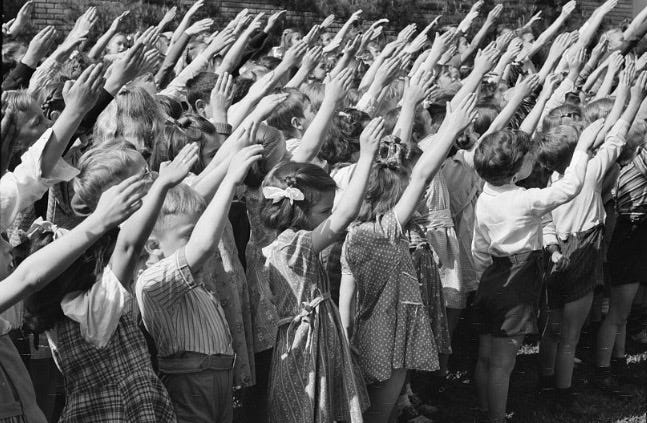
Bellamy didn’t just write the pledge, but also instructions for an accompanying ritual that feels simultaneously religious and militaristic:

“At a signal from the Principal the pupils, in ordered ranks, hands to the side, face the Flag. Another signal is given; every pupil gives the Flag the military salute—right hand lifted, palm downward, to a line with the forehead and close to it… At the words, ‘to my Flag,’ the right hand is extended gracefully, palm upward, towards the Flag, and remains in this gesture till the end of the affirmation; whereupon all hands immediately drop to the side.”

Yes, Bellamy directed civilian children and adults to render a military salute to the flag, perhaps laying the philosophical groundwork for the eventual creation of the socialist “industrial army” his cousin envisioned in his novel.

Free people have no business pledging loyalty to any government. It’s government that has a duty of loyalty to the people, with no more essential demonstration of that loyalty than the protection of the rights of individuals.

https://starkrealities.substack.com/p/why-patriots-shouldnt-pledge-allegiance?fbclid=IwAR394bqWRuG0pyZLXt9mZMntopMshWAD1q9j1SZYgHulIyB-1DbuSTcXYkI

Brian McGlinchey

Flag Day is upon us, with the Fourth of July not far behind. No better time for a frontal assault on a cherished American ritual—the Pledge of Allegiance.

Though conservatives will be most aghast at this undertaking, the open-minded ones will soon discover they should be among the pledge’s greatest critics.

Before I open fire, a brief explanation for international readers: The Pledge of Allegiance is recited by children across America at the start of start of each school day. It’s also incorporated into many meetings held by federal, state and local governments and private groups as well.

Standing and facing the flag with hand over heart, one recites: “I pledge allegiance to the flag of the United States of America, and to the republic for which it stands, one nation under God, indivisible, with liberty and justice for all.”

A Government Loyalty Oath Written by a Socialist

Many who consider the pledge a cornerstone of conservative values will be surprised to learn it was written by a Christian Socialist named Francis Bellamy, who was run out of his pulpit at a Boston church for preaching against capitalism, and who called Jesus Christ a socialist.

His radical cousin, Edward Bellamy, wrote a popular novel, Looking Backward, which glowingly describes a future in which government controls the means of production and where men are conscripted into the country’s “industrial army” and compelled to work in roles assigned to them by central planners.

While working for The Youth’s Companion, a children’s magazine, Bellamy wrote the Pledge of Allegiance in 1892, timed to be introduced in patriotic celebrations accompanying the 400th anniversary of Columbus’s arrival.

According to a summary of Bellamy’s account of his writing of the pledge, he aimed for brevity, as well as “a rhythmic roll of sound so they would impress the children and have a lasting meaning when they became grown-up citizens.”

Given his beliefs, Bellamy was well-suited for creating a loyalty oath that conditions Americans to subordinate themselves to a powerful central government. Make no mistake—in pledging allegiance “to the republic,” Americans are doing precisely that.

That’s consistent with Bellamy’s wish for state sovereignty and individual liberties to yield to a centralized national government, but it’s starkly at odds with the founding spirit of the country.

Central to that spirit are the notions that government should be a servant and not a master, and that all government should be viewed with deep, ongoing wariness— certainly not the reverence demanded by the Pledge of Allegiance.

Free people have no business pledging loyalty to any government. It’s government that has a duty of loyalty to the people, with no more essential demonstration of that loyalty than the protection of the rights of individuals.

Conditioning America’s Youth for Subservience

Bellamy didn’t just write the pledge, but also instructions for an accompanying ritual that feels simultaneously religious and militaristic:

“At a signal from the Principal the pupils, in ordered ranks, hands to the side, face the Flag. Another signal is given; every pupil gives the Flag the military salute—right hand lifted, palm downward, to a line with the forehead and close to it… At the words, ‘to my Flag,’ the right hand is extended gracefully, palm upward, towards the Flag, and remains in this gesture till the end of the affirmation; whereupon all hands immediately drop to the side.”

Yes, Bellamy directed civilian children and adults to render a military salute to the flag, perhaps laying the philosophical groundwork for the eventual creation of the socialist “industrial army” his cousin envisioned in his novel.

The arm outstretched toward the flag came to be called the “Bellamy salute,” and it endured for several decades before its striking similarity to the Nazi salute prompted its replacement in 1942 by the familiar hand-over-heart gesture.

Southington, CT children pledge allegiance in May 1942 (Library of Congress)

See the rest here

Be seeing you

Posted in Uncategorized | Tagged: , , , , | Leave a Comment »

If the Nordic Countries Are Socialist, So Are These Less-Impressive Countries | Mises Wire

Posted by M. C. on April 15, 2021

Essentially, progressive politicians and economists are guilty of cherry-picking countries: while wanting to emulate the Nordic countries, which they claim to be socialist—the same countries which are just as easy to conduct business in as the United States—they ignore these three countries, Italy, France and Greece, which are, by most metrics, more socialist than the Nordics.

https://mises.org/wire/if-nordic-countries-are-socialist-so-are-these-less-impressive-countries

Eben Macdonald

The Nordic countries draw attention from democratic socialists in America thanks to their high tax rates, strong welfare states, and supposedly tight regulation of enterprise. The final indicator, however, is not exactly true: every single Nordic country except Finland ranks in the top ten on the World Bank’s Ease of Doing Business Index, and they maintain high positions on the Tax Competitiveness Index. But if Progressives argue that Scandinavia is indeed a socialist region, then they must admit that the following countries are just as, and if not, more socialistic: Italy, France, and Greece. None of these three countries are ones which they refer to in order to demonstrate the benefits of their economic agenda. In fact, thanks to their low living standards, high rates of unemployment, and stagnant incomes, extreme illiberal, ultranationalist right-wing movements have thrived in every single one of these countries. Let’s examine each one.

Italy

Tax take is 42 percent of Italy’s GDP, higher than both Finland and Norway, and substantially greater than the Organisation for Economic Co-operation and Development (OECD) average. Social expenditure is 28 percent, practically identical to Nordic levels. The country ranks a hopeless fifty-eighth on the World Bank’s Ease of Doing Business Index, far lower than every single nation in Scandinavia. Furthermore, Italy has the least competitive tax system in the OECD, according to the Tax Foundation. Italy’s taxes and welfare spending are of Nordic style, and businesses are far more regulated. If the Nordic countries are socialist, so is Italy.

Yet is Italy considered to be more prosperous than the United States, or a poster child for a successful socialist system? Far from it. Pew Research Center gives us the following statistics: were Italy to become a part of the US, and thus adhere to US income metrics, 53 percent of Italians would inhabit the “low-income category,” as opposed to the American rate of 26 percent; and since 1990, Italy’s median household disposable income has declined by one-fifth.

Pew Research Center aside, OECD data show that Italy’s standard of living is substantially below America’s. The US ranks tenth on their Better Life Index—Italy ranks twenty-fourth. And data from The Economist magazine which attempt to apply the Better Life Index within countries by socioeconomic category find that someone in the top 10 percent of the Italian income spectrum has a standard of living no higher than someone in the bottom 10 percent of the US income spectrum. Moreover, in 2019, before the pandemic, their unemployment rate stood at 10 percent. Clearly, economic recovery from the 2008 crisis has not been easy.

France

Tax take is 45 percent of the French economy, the second highest in the OECD, just below Denmark. Social expenditure is 31 percent, higher than every single Nordic country, and the highest in the OECD. The country ranks thirty-second place both on the Ease of Doing Business Index and on the Tax Competitiveness Index. If the Nordic countries are socialist, France is even more so.

But does one often hear progressives lauding the welfarism and bureaucracy of the French system? Not at all. By US standards, a third of French people live in the low-income category, not as high as Italy, but still higher than the US average. Unemployment in France has fluctuated wildly over the years—perhaps a sign of fiscal instability. It reached a rate of 12 percent in the 1990s, but had declined to 7 percent by 2008, just as the global economy was collapsing. Having risen to 10 percent in 2015, it declined to 8 percent in 2019—lower than in Italy, but still shockingly high.

How does France fare on the Better Life Index? Not well. Ranking eighteenth place, it performs better than Italy, but nevertheless substantially below the United States. The Economist’s statistics reinforce this, pointing out that a Frenchman in the top 10 percent of their country’s socioeconomic pyramid is not particularly better off than someone in the bottom 10 percent of America’s.

Greece

Greece draws special attention for a particular reason. It demonstrates the danger which excessive debt and spending can pose to the overall economy. As other countries in Europe and North America clambered out of recession, the Greek economy continued to deteriorate. Between 2008 and 2013, the unemployment rate rose from 7 percent to 27 percent. Since then, it has declined to 15 percent, but the point is that Greek workers have suffered far too much thanks to fiscal recklessness: in 2008, Greek’s deficit was 10 percent of its GDP, so bondholders were not willing to lend any more money to the government for them to fund large stimulus packages. Thus, the Greek economy was drained of capital and had a prolonged depression. Its fiscal infrastructure collapsed even further: debt was 100 percent of GDP in 2008; in 2011, it was 172 percent. Meanwhile, the United Kingdom, another country burdened by a high deficit, chose to cut spending, which, while unpopular, has enabled the economy to recover and avoid a debt-ridden catastrophe.

That aside, the Greek economy is undoubtedly overregulated and overtaxed, while welfare spending is indeed very high: social expenditure is 24 percent of GDP, similar to most Nordic countries; tax take is 38.7 percent of GDP, which, while the lowest rate among the countries examined here and lower than the other Nordic countries, is still significantly higher than the OECD average. On the Ease of Doing Business Index, however, Greece ranks by far the lowest of these three countries, in seventy-ninth place; it seems there is more red tape in Greece than in Vietnam, a formerly Communist country. But at least they rank twenty-ninth on the Tax Competitiveness Index, higher than the two other countries examined.

Unfortunately, the Pew Research Center has not focused on Greece much—nor has The Economist. However, other institutions have. As always, on the Better Life Index, Greece ranks thirty-sixth, out of forty countries. Greece’s median household disposable income is a paltry $17,700 a year, far below America’s $45,000.

Conclusion

Essentially, progressive politicians and economists are guilty of cherry-picking countries: while wanting to emulate the Nordic countries, which they claim to be socialist—the same countries which are just as easy to conduct business in as the United States—they ignore these three countries, Italy, France and Greece, which are, by most metrics, more socialist than the Nordics. Because their living standards are incomparable with the United States’s and, in some cases, akin to the Third World, they are rarely used as examples of socialist triumph. Author:

Eben Macdonald

Eben Macdonald is a 15-year-old student, a keen free-marketeer, and he wants a society which is predicated on liberty.

Be seeing you

Posted in Uncategorized | Tagged: , , , , | Leave a Comment »