


The student protest movement is primarily pro-Palestinian and occurs in the context of pressure on university leaders amid accusations of antisemitism
/cloudfront-eu-central-1.images.arcpublishing.com/prisa/NEFY64CLSNFDJA5Y7TQ4ABMPYE.jpg)

Based on the struggle for civil rights, the Vietnam War unleashed a massive mobilization on U.S. campuses. Since then, few events have been able to mobilize students like the Gaza war, which shares some key features with the earlier conflict: the imagery of a powerful army subjugating a helpless population; generational differences (young Americans are more pro-Palestinian than their elders); the conflict as a catalyst for broader trends; and, finally, the belief in opposition to the war as a just cause in both cases.
But there are also many differences between the two. Race is the first important distinction. In the 1960s, campuses were mostly white, while today’s campuses have many more students of other races, who empathize with the Palestinian struggle as a form of final resistance to colonialism. Protesters against the Gaza war agree with the denunciation of police brutality against African Americans that rocked the U.S. in 2014 and 2020. But even in the racial protests of the last decade, the demonstrations did not reach the level of polarization and virulence of the current ones,in which accusations of antisemitism have become another casus belli added to the war itself.
Today’s anti-war protest differs from the one in the 1960s that was encouraged by the beat generation and the hippie movement, because the former pits equals against equals: Jewish students who say they feel insecure in the face of their own peers and the latter’s calls for intifada. The tension has moved from the bottom up, reaching university leaders and igniting a political firestorm a year before the elections. Indeed, the situation has reached an even higher level with a federal investigation examining whether a dozen schools, including some of the country’s most prestigious ones, have violated Title VI of the Civil Rights Act of 1964, legislation that prohibits discrimination on the basis of race, color or origin, by allowing antisemitic demonstrations.
As campus demographics have changed, so too have the political pressures and demands on university leaders, including from many donors. The latter have placed the presidents of the University of Pennsylvania, Harvard University and the Massachusetts Institute of Technology in an untenable situation. A case in point: Liz Magill resigned after a donor threatened to withdraw $100 million in funding. Harvard’s Claudine Gay is still on the hot seat, not just for failing to expressly condemn hateful messages on her campus at a congressional hearing but also for accusations of plagiarism, which have forced her to revise several articles. Like Gay’s, Sally Kornbluth’s picture appears on banners and posters with disparaging slogans. The controversy over alleged antisemitism is the Republicans’ new battering ram against opponents.
Omer Bartov, a professor of Holocaust and Genocide Studies at Brown University, summarizes the debate’s background. “There has been a general polarization of political opinion since Donald Trump’s election as president in 2016. That polarization has found its way onto campuses as well. At the same time, there has been a growing tendency to silence or even ban the opinions, speeches and writings of those expressing views opposed to one’s own. That has occurred on both the Right and the Left. Among conservatives, that trend has manifested itself most notably in the bans on speeches and writings that are critical of American history and racism; among liberals, it occurs against those using terms and terminology deemed offensive or inappropriate. The former has been evident at several schools in Republican states; the latter has become common at many liberal universities.”
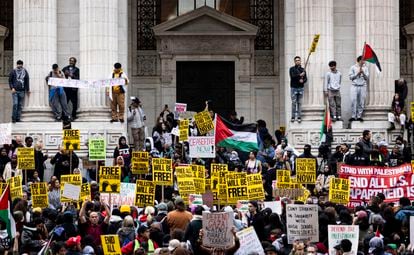
The Gaza war protest movement is largely decentralized, although it has links to national platforms, such as the U.S. Campaign for Palestinian Rights, the largest in the country. “We have seen students leading our communities across the country. Despite attempts to silence them, students continue to organize and speak out in support of an immediate ceasefire and a free Palestine. We proudly support their work,” a spokesperson explains. The internet offers inspiration and, at times, advice for protesters. In 2014, when Mike Brown, an unarmed black man, was killed by police in Ferguson, Missouri, leading thousands of people to protest in the streets for days, Palestinian Americans on social media offered suggestions for how to protect oneself from tear gas. Nine years later, at the University of California, Santa Barbara, and elsewhere, black and Latino students are the vanguard of the pro-Palestinian movement.
Be seeing you
 MCViewPoint