Traditional “left” was working-class. That is CLEARLY not the case anymore. This accelerated under obama when the corporations (who had ruined the gop under bush) all ran to support the new left under obama. The new left is wealthy, sub-urban, corporate, and huge numbers of highly paid govt employees (both federal and unionized municipal). They are economically regressive (upward wealth transfer) and hide that under the guise of really really extreme far-“left” social issues like the transgender agenda.
Every fiber of my economic being cries out against tariffs. If they are so good, why doesn’t each state in the US have one against the products of all of the other 49? That is, Ohio could “protect” its industries against the incursions from Arizona. This is obviously silly. One of the important reasons America is so prosperous is that we have a gigantic, internal, free trade area.
Donald Trump supports them on the ground that the McKinley administration was prosperous, and relied upon tariffs. But this is to commit the post hoc ergo propter hoc logical fallacy: that since A precedes B, A must be the cause of B. No, America did indeed become rich during this epoch, but that was in spite of tariffs, not due to their benign influence. If you are looking for a historical episode to shed light on this matter, the Smoot-Hawley Tariff of 1930 will do far better: it greatly worsened an already bad recession, plunging our economy into a deep depression.
Our President also claims that the US is victimized by a negative balance of trade: we buy more from Canada and other countries than they purchase from us. However, I have a horrid balance of trade with McDonald’s and Wal-Mart. I acquire several hundreds of dollars’ worth of their products every year, and neither has yet seen fit to reciprocate with any of my economic services (hint, hint!). On the other hand, I have a very strong positive balance of trade with my employer, Loyola University New Orleans. They pay me a decent salary; apart from a few lunches in their cafeteria, my expenditures to them fill their coffers to a zero degree. Should anyone worry about this sort of thing? Of course not. Ditto for international trade. If Country A buys more from B than it sells to it, money will flow from the former to the latter, reducing prices in the former and raising them in the latter, until matters balance out.
Everyone realizes the foolishness of tariffs when it comes to absolute advantage. No Canadian objects to the importation of bananas from Costa Rica. Producing this tropical product in the frozen North would be financially prohibitive (gigantic hothouses). Ditto for maple syrup in the country to the south. The only way they could produce this item would be to place maple trees in gigantic refrigerators. Ludicrous and prohibitively expensive.
But when it comes to comparative advantage, all too many people are out to lunch insofar as the teachings of Economics 101 are concerned. They fear that other countries might be more efficient than we are; with free trade, they would produce everything, we, nothing, and we would all starve to death from massive unemployment.
To dispel this myth, let’s consider a thought experiment. A lawyer is as good a typist as his secretary. He can produce $1,000 per day by practicing his profession. But for every such day, he needs a certain amount of typing. He can produce $200 worth each day. In two days, he can thus earn $1200 on his own. If he hires a typist, he can earn $2,000 from lawyering in two days, but must pay his secretary $200 daily for a total of $400. If he trades with her, he will come out with $2,000-$400=$1,600, an appreciable gain for him.
So is there any economic case for tariffs, given the foregoing? Yes, paradoxically, there is—in a way, if the alternative is a tax that’s even worse.
At the start of his second term, President Trump initially fired 6% of the employees of the Internal Revenue Service. He is now looking to end the employment of some 50% of them. Suppose he follows this up by getting rid of all of the rest of the IRS bureaucrats, eliminating the dreaded income tax, and achieving revenue neutrality with tariffs. His motto might be: “Let’s turn back the clock to 1912,” the year before this tax was implemented (when it ranged from 1% to 7%!).
What would the benefits be thereof? First of all, there are many intelligent, productive people who work for the IRS. There are some 90,000 of them. If dismissed by their employer, they would be freed up to produce goods and services desired by the populace. Ditto for the many accountants and tax lawyers who devote all or part of their time to helping their clients wrestle with complicated IRS regulations. Further, many of us fill out our own tax forms. This takes hours, days in some cases, time that could be better spent on leisure or productivity.
The benefit here is that it takes relatively little labor to run a tariff system. Hey, we already have tariffs in place. An increase in their level would hardly call for much more manpower, likely hardly any more at all.
Halfway measures will avail us little. But if Mr. Trump completely eliminates the IRS and the hated income tax along with it, there may be a reasonable case for increasing tariff rates. Not to present punitive levels, though.
To put it another way, if we accept that there has to be a government, and it therefore needs some revenue to function, this might be the least-bad option.
Should we worry about so many people becoming unemployed? Not at all. A similar sort of thing occurred when the car replaced the horse and buggy, when the cell phone substituted for Kodak, when we switched from typewriters to computers, etc. We are all the richer for this sort of thing, and will be in this case too.
Walter’s Newsletter is free today. But if you enjoyed this post, you can tell Walter’s Newsletter that their writing is valuable by pledging a future subscription. You won’t be charged unless they enable payments.
With the fiat US dollar having lost well over 98 percent of its purchasing power in terms of gold since President Nixon cut the last links to gold in 1971, calling it “mighty” as Trump did, is a gross exaggeration.
In a November 30 Truth Social post, President-elect Trump threatened BRICS states—Brazil, Russia, India, China, South Africa, Iran, Ethiopia, Egypt, and the United Arab Emirates, plus more states in the process of joining—with 100 percent tariffs on their exports to America if they dared to attempt replacing the US dollar as an international trade currency:
The idea that the BRICS Countries are trying to move away from the Dollar while we stand by and watch is OVER. We require a commitment from these Countries that they will neither create a new BRICS Currency, nor back any other Currency to replace the mighty U.S. Dollar or, they will face 100 percent Tariffs, and should expect to say goodbye to selling into the wonderful U.S. Economy. They can go find another “sucker!” There is no chance that the BRICS will replace the U.S. Dollar in International Trade, and any Country that tries should wave goodbye to America.
When one examines international trade data in detail, however, some curious anomalies in Trump’s statements become evident. For one thing, the world needs the BRICS economies for both merchandise exports and imports far more than the world needs America. China (including Hong Kong) all by itself is a bigger importer and far bigger exporter of goods than America. America only accounts for 13 percent of the world’s merchandise imports and less than 9 percent of its merchandise exports. If the world’s economy were to fragment into rival currency/trade blocs, most countries outside of North America would regard access to BRICS markets, not to America’s markets, as being a higher priority.
A NAFTA bloc and its US dollar would be competing on unfavorable terms with a BRICS bloc, a Euro bloc, and maybe a Japanese-led bloc for access to the natural resources and other factors of the less-industrialized countries. Fears of being cut off from natural resources, in turn, incentivizes hostile blocs to turn into hostile military alliances, and for their trade and currency wars to turn into world wars.
For another thing, Trump’s threats mean nothing to states that are already under severe sanctions like Russia and Iran. They export practically nothing to America. It is Chinese manufacturers who have the most to lose by the BRICS bloc antagonizing Trump, with their annual export revenues on the order of $450 billion at stake (about 3/4ths of all BRICS exports to America). However, Chinese dictator Xi has undoubtedly calculated that China’s economy is likely going to be targeted by American statists anyway, so he has every incentive to preemptively create a sanctions-proof international medium of exchange in spite of risks to export markets, just as BRICS has already created an independent wire payments system and an independent multinational credit institution to bypass American-aligned institutions. Trump’s brazen threat only provides more evidence that the American government is not a trustworthy steward of an international monetary system, and thus makes migration away from a dollar-dominated system towards some sort of alternative money even more urgent and compelling for every state that fears arousing Washington’s ire.
Yet another odd thing about Trump’s threat is that trade barriers hurt Americans as well as foreigners. It is not simply that case that big box retailers are filled from floor to ceiling with inexpensive Chinese-made consumer goods that Americans can’t seem to get enough of. The data show that China is a critical supplier of electronics and machinery too, something which American businesses depend heavily on for their own productivity. Tariffs do nothing to address the root causes of America’s deindustrialization, but suddenly cutting off access to Chinese-made capital goods and forcing diversions of scarce inputs to sectors where America lacks comparative advantages to make up for lost imports means tremendous losses of productivity and real incomes for American workers. Tariffs can certainly accelerate the deindustrialization process and the decline of the middle class and make dollar-denominated accounts and assets even more unattractive to foreigners. Carrying out Trump’s threat would be spectacularly counterproductive for the Americans who voted for Trump.
To be sure, a fragmentation of the world’s economy into rival blocs hurts everyone, not just Americans, so Trump’s threat might just be a bluff to gain an advantage in trade negotiations, and won’t do any real damage unless his bluff gets called. Even as a mere negotiating ploy, Trump’s demands don’t make sense. What Trump doesn’t seem to understand is that the continual creation of fiat dollars and dollar substitutes out of thin air hurts everyone too. Continued dependency of the world on fiat dollars is not an acceptable outcome, not even for Americans. Using threats of economic chaos to try to keep the current failing system in place is madness.
Not only are America’s predatory elites (who happen to be fiercely anti-Trump) ruthlessly exploiting the entire world with what former French President Valéry Giscard d’Estaing famously called the American government’s “exorbitant privilege” of fiat dollar creation to commandeer the productivity of others, the use of dollar-denominated US Treasury securities as the principal reserve asset for the world’s banking system means that this system is at risk of a catastrophic collapse in the event of a dollar hyperinflation. The dollar’s role as the leading trade currency is a mere byproduct of the foreign demand for dollar-denominated US Treasury securities. It is this dubious choice of reserve asset as a substitute for gold that poses an existential hyperinflationary threat to the entire global monetary system.
With the fiat US dollar having lost well over 98 percent of its purchasing power in terms of gold since President Nixon cut the last links to gold in 1971, calling it “mighty” as Trump did, is a gross exaggeration.
I think Rothbard or Mises would say tariffs favor a select few while making products more expensive for the rest of US. I recently mentioned elsewhere that if memory serves auto makers tend to boost their prices to just below tariffed prices. Not that all US manufacturers would do this but it illustrates the usual blowback when government “helps”.
“Of course, the costs of these tariffs will be borne by Americans wishing to purchase electric cars and American electric car manufacturers that use material imported from China. These new tariffs thus undercut Biden’s goal of getting more Americans to drive electric cars.
“…Ronald Regan was correct when he told me that no nation has ever abandoned gold and remained great.
President Biden recently raised taxes on American consumers and businesses and may have hastened the end of the dollar’s world reserve currency status. President Biden did this by increasing tariffs on Chinese imports.
Specifically, President Biden raised tariffs on products including Chinese-produced steel and aluminum and many components imported from China for use in manufacturing electric vehicle batteries. Tariffs on Chinese-made semiconductors are rising from 25 to 50 percent while tariffs on Chinese-made electronic vehicles are rising from 25 percent to an astounding 100 percent.
Of course, the costs of these tariffs will be borne by Americans wishing to purchase electric cars and American electric car manufacturers that use material imported from China. These new tariffs thus undercut Biden’s goal of getting more Americans to drive electric cars.
The tariffs on Chinese goods give China even greater Inventive to challenge the dollar’s world reserve currency status. The same week Biden imposed these tariffs, China President Xi Jinping and Russian President Vladimir Putin announced they were strengthening their alliance in order to better challenge US military and economic hegemony. This is a reaction to US foreign policy of the post-Cold War era which has reversed the Richard Nixon-Henry Kissinger strategy of pursuing good relations with China.
A part of the announcement recognized use of the Chinese yuan and Russian ruble for over 90 percent of the trade between the two countries. This is only the latest challenge to the dollar’s world reserve currency status. China’s share of the global economy has more than doubled in the last twenty years from 8.9 percent to 18.5 percent while the US share of the global economy has fallen from 20.1 percent to 15.5 percent. China’s rise is one reason why the US currency held by foreign central banks has dropped from over 70 percent in the early 2000s to under 60 percent today.
Last year, China and Saudi Arabia agreed to expand their use of their own currencies in trade between the two countries. This is the first time the Saudis have agreed to use a currency other than the dollar for the oil trade since Henry Kissinger negotiated a deal where the Saudis would trade exclusively in dollars in return for US support for the Saudi regime. The “petrodollar” is a major reason why the dollar retained the world reserve currency status after President Nixon severed the last link between the dollar and gold.
If the dollar loses its world reserve currency status, the US government would lose the ability to “weaponize the dollar.” Other countries would then have less incentive to abide by US demands, including related to regime changes. It would also reduce other countries’ interest in purchasing US debt instruments. This would increase pressure on the Federal Reserve to monetize the debt, creating more price inflation and leading to a major economic crisis. This will not just end the US military and financial empire abroad. It will also end the welfare state at home.
Since both major presidential candidates and most Congress members are not serious about making the changes in foreign, domestic, and monetary policy necessary to avoid the crisis, America will likely face hard times in the near future. However, the end result may be a return to limited, constitutional government and a political class that realizes that Ronald Regan was correct when he told me that no nation has ever abandoned gold and remained great.
Taxes benefit the regime while impoverishing the rest of us. To favor “free trade” is to favor lowering taxes on Americans and depriving the regime of funds. To favor protectionism, whether it be for some foreign-policy crusade, or to “create jobs” is to simply be in favor of raising taxes and handing over more Americans’ wealth to the state.
During the 2016 and 2020 campaigns, Trump’s opponents in the Democratic party (and elsewhere) often pointed out that Trump’s protectionism hobbles private markets and the economy overall. Yet, the allegedly anti-protectionist Biden administration has done virtually nothing to end Trump’s protectionists policies put in place from 2017 to 2020. The motivation is unclear, but it is possible that the Biden administration realized that protectionism is a useful political tool. These policies offer a way of punishing opponents, rewarding allies, and pandering to voters.
Now that it’s election season, the pandering side of the equation is in full swing. Biden this week called for “sharply higher U.S. tariffs on Chinese metal products.” Appropriately, Biden included this new spate of protectionism in what Reuters calls “a package of policies aimed at pleasing steelworkers in the swing state of Pennsylvania.”
Biden’s pandering will likely bear some fruit, politically speaking. Protectionism remains popular. But, as Henry Hazlitt put it, voter support for raising tariffs is “the result of looking only at the immediate effects of a single tariff rate on one group of producers, and forgetting the long-run effects both on consumers as a whole and on all other producers.” Those who are incapable or unwilling to examine policies beyond their most short-term effects are easy targets for protectionist rhetoric.
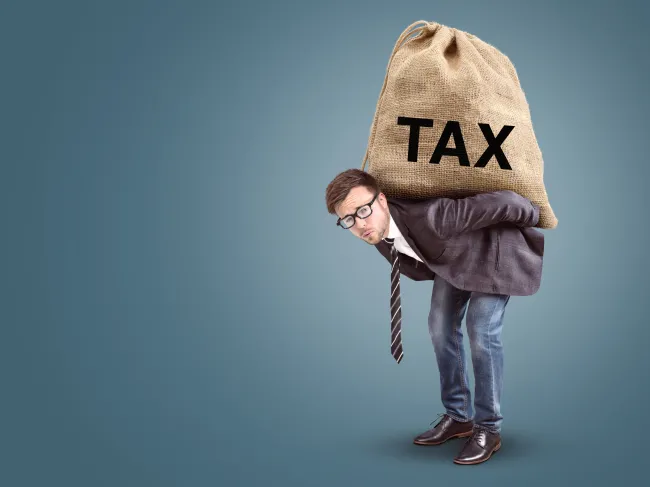
The reason there are so many negative effects, of course, is that tariffs are nothing more or less than taxes and they produce the same effects as any other type of tax: when Country A imposes tariffs, Country A’s government is enriched while both producers and consumers living in Country A must endure higher prices and a less productive economy.
Even those voters who imagine themselves as opposed to taxes and “big government” often embrace tariffs—apparently fooled by the misconception that tariffs aren’t taxes or that they are only paid by foreigners. Many conservatives and protectionist “libertarians” create a wide variety of ornate theories with big words designed to distract from the fact that American tariffs are taxes on Americans. Ultimately, however, these people are simply pushing for tax increases.
It’s Not that Complicated: Tariffs Are Taxes
A tariff is a tax that is collected when a good crosses an international border. In the United States, as with any country that imposes tariffs, any good that is subject to tariff can only enter the country when the extra tax is paid upon entry. (This tax is in addition to any other taxes that must be paid down the line, such as sales taxes.) As with any similar transactional tax (e.g., sales taxes) the result is higher prices and fewer choices for consumers. It must also be noted that the “consumer” of imported goods need not be the retail consumer or end consumer. A great many imported goods are intermediate goods that are used in the creation and production of other goods produced and sold within the United States. That is, tariffs are often taxes on materials used by American entrepreneurs and business owners to produce American goods.
Raising taxes (i.e., tariffs) raises costs for all these American producers and consumers. Yes, it is true that Americans do not suffer the full consequences of taxes on foreign goods. As with a sales tax, a tariff imposes some costs on the seller by raising prices and thus reducing total sales. But it is simply wrong to portray tariffs are taxes primarily on foreigners, since, as Murray Rothbard notes, “Tariffs injure the consumers within the ‘protected’ area, who are prevented from purchasing from more efficient competitors at a lower price.
Yet, protectionists have long been in the business trying to explain that tariffs are not actually taxes on Americans at all. Or, as Rothbard puts it:
Tariffs have inspired a profusion of economic speculation and argument. The arguments for tariffs have one thing in common: they all attempt to prove that the consumers of the protected area are not exploited by the tariff. These attempts are all in vain.
Old habits die hard, however. Even among readers of mises.org, one finds plenty of readers involved in the quest to convince others that raising taxes is a good thing. One such claim is that since other countries impose high import taxes on their own citizens, the US government must do the same. Consider this response to a recent mises.org article on trade. The reader states: “Baloney. Horse manure. ‘Free trade’ is a meaningless slogan. The issue of trade is much more complex than slogans. You can’t have free trade with Japan and China, which uses massive protectionist policies to help its own workers and industries. The wages are not comparable!!!”



 MCViewPoint