
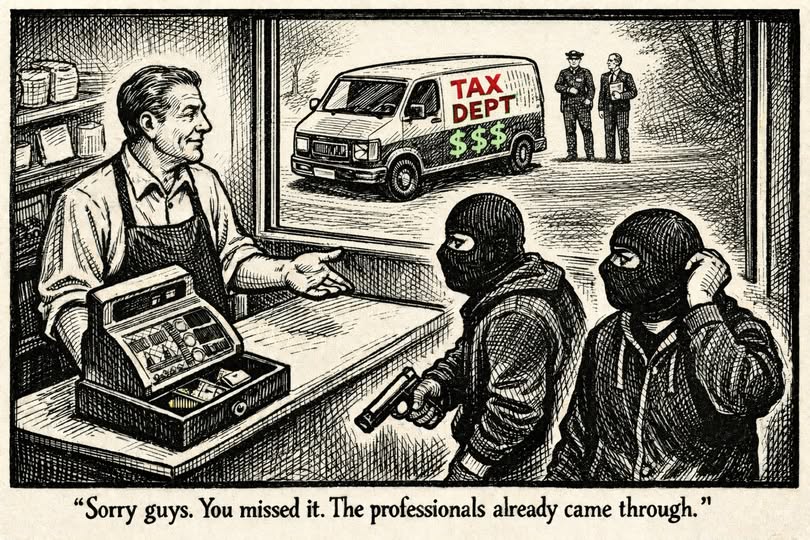
Be seeing you

Enemy of the State-Read the Book-Know the Man
This is not a Safe Space but Baby, I don't care.

"I am not a number, I am a Free Man" - No. 6
 Information Liberation Alex Jones’ Prison Planet Gary North Specific Answers Antiwar The Daily Bell Tenth Amendment Center Economics Policy Journal The American Thinker The New American Lew Rockwell
Posted by M. C. on February 5, 2026
Be seeing you
Posted in Uncategorized | Tagged: IRS, Taxes | Leave a Comment »
Posted by M. C. on April 23, 2025
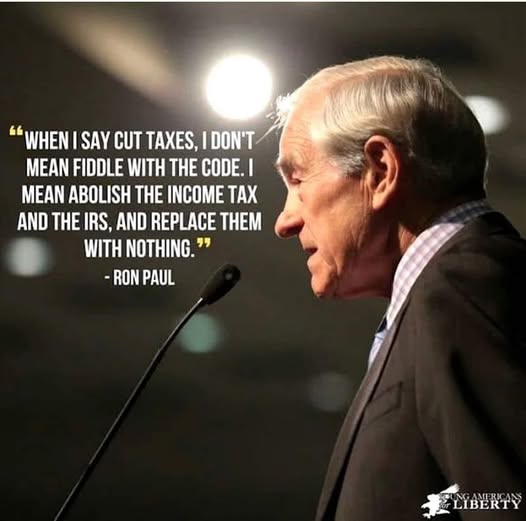
Be seeing you
Posted in Uncategorized | Tagged: Taxes | Leave a Comment »
Posted by M. C. on April 5, 2025

Be seeing you
Posted in Uncategorized | Tagged: hot poker, Taxes | Leave a Comment »
Posted by M. C. on November 29, 2024
Stage #6: The populace bears the brunt of debt repayment as empires raise taxes and debase the currency—to the maximum extent—until it causes internal instability.
Stage #7: Empires cannot finance their militaries because of their debt burden. This is usually the tipping point.
“The US federal government has the biggest debt in the history of the world. And it’s continuing to grow at a rapid, unstoppable pace.”
Debasing currency, a 50c way of saying printing money.
One of the most potent and underappreciated forces responsible for the downfall of the most powerful empires throughout history has been debt.
While military defeats, political upheavals, and external invasions often dominate historical accounts of the fall of great powers, excessive debt—the “Empire Killer”—has quietly but relentlessly eroded the foundations of empires across the centuries.
From Rome to the Soviet Union, the over-extension of resources, poor financial management, and the inability to service massive debts have led to economic collapse, social unrest, and, ultimately, the demise of these once-mighty empires.
Understanding how debt has played a role in the fall of these empires gives us insight into the role it could play in the collapse of the US Empire.
Here is a summary of some prominent historical examples of this clear pattern.
One of the most iconic examples of debt’s destructive force is the Roman Empire.
At its height, Rome was the center of the known world, controlling vast territories, including much of Europe, North Africa, and parts of the Middle East.
Maintaining a vast empire required immense financial resources. The Roman government needed to fund its sprawling military, build infrastructure such as roads and aqueducts, and support the grandeur of its capital city.
Emperors financed the resulting debt by debasing the currency—reducing the silver content in Roman coins.
However, this led to rampant price increases and economic instability.
The more the Roman government tried to print its way out of debt, the worse the problem became.
As debt and inflation strangled the Roman economy, the empire struggled to pay its soldiers, undermining military morale and effectiveness.
Weakened by internal financial collapse, Rome became vulnerable to external threats. The combined weight of financial mismanagement, social unrest, and military decline led to the empire’s collapse.
In the 16th century, the Spanish Empire was a global superpower.
The discovery of the New World brought an influx of gold and silver, filling the Spanish government’s coffers beyond imagination.
However, this newfound wealth bred complacency and extravagance.
The Spanish monarchy became embroiled in costly wars across Europe—including the Eighty Years’ War with the Dutch and conflicts with France and England—and indulged in lavish expenditures without regard for fiscal sustainability.
Spain borrowed heavily from European bankers to finance its ambitions, accruing enormous debts.
At first, the influx of colonial wealth allowed Spain to service its debts, but as wars dragged on, the costs began to outstrip the income from the New World.
Spain’s creditworthiness diminished as the debts mounted, and the economic decline became irreversible.
The inevitable consequence was a series of bankruptcies in 1557, 1575, and 1596.
Each bankruptcy weakened Spain’s creditworthiness, making it more difficult to borrow money on favorable terms.
The once-dominant empire lost its influence, illustrating how an abundance of wealth, when mismanaged and coupled with excessive debt, can precipitate a rapid descent from power.
Be seeing you
Posted in Uncategorized | Tagged: ‘Empire Killer, debase currency, debt repayment, Taxes | Leave a Comment »
Posted by M. C. on October 18, 2024
I know not whether taxes are raised to fight wars, or wars are fought in order to raise taxes.
Be seeing you
Posted in Uncategorized | Tagged: Government, Taxes, Wars | Leave a Comment »
Posted by M. C. on July 8, 2024
Although no Americans are old enough to remember it, there was a time in the United States when there was no income tax. The income tax actually began as a modest 1 percent tax on taxable income above $3,000, followed by a series of surcharges of up to 6 percent applied to higher incomes. The maximum rate of 7 percent was applied to taxable income over $500,000. Thanks to generous exemptions and deductions, only a small percentage of the population paid taxes on their income.
The reason why people say that we just can’t eliminate the income tax is that it would deprive the government of revenue it needs to spend. But isn’t that the point? The case could be made that at least 90 percent of what the federal government spends money on is unconstitutional: foreign aid, business subsidies, welfare, education, health care, job training, the war on drugs, public broadcasting, student loans, food stamps, foreign wars, space exploration, and so much more.
During a campaign stop in Nevada early last month, Republican presidential candidate Donald Trump promised that if elected, there would be no more federal tax on tips.The constitutional functions of the U.S. government could be adequately funded without an income tax.
[Click to Tweet]
Said Trump: “For those hotel workers and people that get tips, you’re going to be very happy, because when I get to office, we are going to not charge taxes on tips. You do a great job of service. You take care of people, and I think it’s going to be something that really is deserved.”
According to the Internal Revenue Service (IRS), tips are taxable income and must be reported to employers. Four factors determine whether a payment qualifies as a tip:
Tips reported to employers are included on employees’ W-2 forms for income-reporting purposes. Tips are simply added to one’s taxable income and are subject to not only income tax but also Social Security and Medicare payroll taxes.
Trump was not clear whether his proposal would exempt tips from payroll taxes, income taxes, or both.
A week after Trump met with congressional Republicans, Senator Ted Cruz (R-Tex.), with cosponsors Senator Steve Daines (R-Mont.), Senator Rick Scott (R-Fla.), and Senator Kevin Cramer (R-N.D.), introduced the No Tax on Tips Act. The relevant text of the bill simply reads: “There shall be allowed as a deduction an amount equal to the cash tips received during the taxable year that are included on statements furnished to the employer.” This would be an above-the-line deduction of tips received (via cash, credit cards, and checks) that reduces taxable income similar to the deductions for student loan interest paid, unreimbursed expenses of teachers, the deductible part of self-employment tax, and contributions to a traditional IRA.
Naturally, industry groups were ecstatic about the bill, including the National Restaurant Association and the Professional Beauty Association. Said Sean Kennedy, Executive Vice President of Public Affairs at the National Restaurant Association: “Tipped employees are a critical part of the restaurant industry, and anything that strengthens their economic condition is a positive for them. The ‘No Tax on Tips Act’ would provide immediate tax relief for more than 2.2 million restaurant employees and their families, putting more money in their pockets at a time when we’re all feeling the squeeze of higher prices.”
However, Elyanna Calle, an organizer with the Restaurant Workers United union, slammed the proposal, calling it a “misguided way of trying to fix a problem of uplifting the lower class.”
Other opponents of Trump’s proposal focused on how much revenue the federal government would be losing if tips were no longer taxed.
Be seeing you
Posted in Uncategorized | Tagged: income tax, Taxes, tips | Leave a Comment »
Posted by M. C. on April 22, 2024
Taxes benefit the regime while impoverishing the rest of us. To favor “free trade” is to favor lowering taxes on Americans and depriving the regime of funds. To favor protectionism, whether it be for some foreign-policy crusade, or to “create jobs” is to simply be in favor of raising taxes and handing over more Americans’ wealth to the state.
https://mises.org/mises-wire/tariffs-are-taxes-americans-protectionists-pretend-otherwise

04/18/2024 • Mises Wire •Ryan McMaken
During the 2016 and 2020 campaigns, Trump’s opponents in the Democratic party (and elsewhere) often pointed out that Trump’s protectionism hobbles private markets and the economy overall. Yet, the allegedly anti-protectionist Biden administration has done virtually nothing to end Trump’s protectionists policies put in place from 2017 to 2020. The motivation is unclear, but it is possible that the Biden administration realized that protectionism is a useful political tool. These policies offer a way of punishing opponents, rewarding allies, and pandering to voters.
Now that it’s election season, the pandering side of the equation is in full swing. Biden this week called for “sharply higher U.S. tariffs on Chinese metal products.” Appropriately, Biden included this new spate of protectionism in what Reuters calls “a package of policies aimed at pleasing steelworkers in the swing state of Pennsylvania.”
Biden’s pandering will likely bear some fruit, politically speaking. Protectionism remains popular. But, as Henry Hazlitt put it, voter support for raising tariffs is “the result of looking only at the immediate effects of a single tariff rate on one group of producers, and forgetting the long-run effects both on consumers as a whole and on all other producers.” Those who are incapable or unwilling to examine policies beyond their most short-term effects are easy targets for protectionist rhetoric.
The reason there are so many negative effects, of course, is that tariffs are nothing more or less than taxes and they produce the same effects as any other type of tax: when Country A imposes tariffs, Country A’s government is enriched while both producers and consumers living in Country A must endure higher prices and a less productive economy.
Even those voters who imagine themselves as opposed to taxes and “big government” often embrace tariffs—apparently fooled by the misconception that tariffs aren’t taxes or that they are only paid by foreigners. Many conservatives and protectionist “libertarians” create a wide variety of ornate theories with big words designed to distract from the fact that American tariffs are taxes on Americans. Ultimately, however, these people are simply pushing for tax increases.
It’s Not that Complicated: Tariffs Are Taxes
A tariff is a tax that is collected when a good crosses an international border. In the United States, as with any country that imposes tariffs, any good that is subject to tariff can only enter the country when the extra tax is paid upon entry. (This tax is in addition to any other taxes that must be paid down the line, such as sales taxes.) As with any similar transactional tax (e.g., sales taxes) the result is higher prices and fewer choices for consumers. It must also be noted that the “consumer” of imported goods need not be the retail consumer or end consumer. A great many imported goods are intermediate goods that are used in the creation and production of other goods produced and sold within the United States. That is, tariffs are often taxes on materials used by American entrepreneurs and business owners to produce American goods.
Raising taxes (i.e., tariffs) raises costs for all these American producers and consumers. Yes, it is true that Americans do not suffer the full consequences of taxes on foreign goods. As with a sales tax, a tariff imposes some costs on the seller by raising prices and thus reducing total sales. But it is simply wrong to portray tariffs are taxes primarily on foreigners, since, as Murray Rothbard notes, “Tariffs injure the consumers within the ‘protected’ area, who are prevented from purchasing from more efficient competitors at a lower price.
Yet, protectionists have long been in the business trying to explain that tariffs are not actually taxes on Americans at all. Or, as Rothbard puts it:
Tariffs have inspired a profusion of economic speculation and argument. The arguments for tariffs have one thing in common: they all attempt to prove that the consumers of the protected area are not exploited by the tariff. These attempts are all in vain.
Old habits die hard, however. Even among readers of mises.org, one finds plenty of readers involved in the quest to convince others that raising taxes is a good thing. One such claim is that since other countries impose high import taxes on their own citizens, the US government must do the same. Consider this response to a recent mises.org article on trade. The reader states: “Baloney. Horse manure. ‘Free trade’ is a meaningless slogan. The issue of trade is much more complex than slogans. You can’t have free trade with Japan and China, which uses massive protectionist policies to help its own workers and industries. The wages are not comparable!!!”
Be seeing you
Posted in Uncategorized | Tagged: protectionists, Tariffs, Taxes | Leave a Comment »
Posted by M. C. on April 19, 2024
by Jeff Jacoby
The Boston Globe
In reality, the refunds sent to them by the Internal Revenue Service are nothing more than the belated repayment of interest-free loans made to the government in the form of excessive taxes withheld from their paychecks. They’re getting back money they never owed in the first place. That doesn’t represent a windfall, it represents a loss — the loss of everything they could have done with their money if they’d had access to it, and the loss of purchasing power eroded by inflation. It shouldn’t make anyone happy to overpay their taxes.
https://jeffjacoby.com/27724/happy-about-your-irs-refund-dont-be
 If, as has been said, taxation is the art of plucking the goose without making it squeal, then the Treasury Department policymakers who implemented tax withholding were virtuosi. If, as has been said, taxation is the art of plucking the goose without making it squeal, then the Treasury Department policymakers who implemented tax withholding were virtuosi. |
LIKE MOST Americans, I got my taxes filed before this week’s Tax Day deadline. And like most Americans, I got money back from the IRS. You probably did too. After all, nearly two-thirds of tax returns result in a refund.
That’s not a good thing.
Many Americans have come to regard their tax refund as a plum to look forward to each spring, a windfall that compensates to some degree for the hassle of getting their tax returns completed and filed. In reality, the refunds sent to them by the Internal Revenue Service are nothing more than the belated repayment of interest-free loans made to the government in the form of excessive taxes withheld from their paychecks. They’re getting back money they never owed in the first place. That doesn’t represent a windfall, it represents a loss — the loss of everything they could have done with their money if they’d had access to it, and the loss of purchasing power eroded by inflation. It shouldn’t make anyone happy to overpay their taxes.
This wouldn’t be an issue if Americans were free to pay their taxes the way they pay for electricity, tuition, child care, groceries, or anything else — namely, by drawing money from their bank account and remitting the amount due to their creditors. But when it comes to paying the bill for government, that isn’t an option. The vast majority of American workers are never paid the full compensation they’re entitled to. Instead their employers are required by law to withhold some of their earnings and send it directly to the IRS.
Most of us are so used to this way of doing things that we hardly notice what a rip-off it is. But Chris Rock noticed. “You don’t even pay taxes — they take taxes,” the celebrated comedian fumed during his “Bigger & Blacker” standup routine. “You get your check, money gone. That ain’t a payment, that’s a jack.”
Tax withholding dates from 1943. As the economic historian Robert Higgs has written, it was an emergency wartime measure designed to collect the taxes needed to defeat the Axis.
On the eve of World War II, when only the highest-earning Americans were subject to the federal income tax, fewer than 4 million individual returns were filed.
Be seeing you
Posted in Uncategorized | Tagged: IRS refund, Taxes | Leave a Comment »
Posted by M. C. on April 15, 2024

Posted in Uncategorized | Tagged: April Fools, Taxes | Leave a Comment »
 MCViewPoint