MCViewPoint

Opinion from a Libertarian ViewPoint

Posts Tagged ‘the State’

Beware This Evil “Covid-19” Phase 2 Plot: Remember, We Are All Disposable Units in the Eyes of the State – LewRockwell

Posted by M. C. on June 13, 2020

With mass vaccination of any number of toxic and poisonous adjutants,
with DNA altering nano-particles able to replicate, and also with
injections that build tracking systems inside the body meant to allow
for control over not only body and mind functions, but also all
financial transactions, the trap is set. This is not science fiction,
and in fact is not fiction at all. It is reality.

https://www.lewrockwell.com/2020/06/gary-d-barnett/beware-this-evil-covid-19-phase-2-plot-remember-we-are-all-disposable-units-in-the-eyes-of-the-state/

By

“The welfare of the people in particular has always been the alibi of tyrants.”

~ Albert Camus (2012). “Resistance, Rebellion, and Death: Essays”, p.101, Vintage

Modern man has completely failed to find and embrace reason, logic, and truth, and because of this failure to accept reality, dire and deadly consequences have been the result for most in this country. All sanity has seemingly disappeared from view, all due to an effort to avoid the uncomfortable conflict of responsibility. This is not due to natural factors, but is the result of long-term indoctrination of the general population based on trickery, deception, and collective dependence. This is the weakest character trait of Americans today, for the common man, and therefore the masses, would rather wallow in ignorance than face the stark truth and trials of life. Most would rather be a dependent member of the herd than take individual responsibility. This attitude drives the human animal to look to others for guidance and leadership instead of looking to self, and this can only lead to servitude. In times of strife and evil intent such as is obvious today, this weakness plays into the hands of the tyrants, and allows the masters total control of the citizen slaves.

Our entire governing system is failing, much by design, and the financial order has been decimated due to money printing and debt. The structured wealth transfers are nearly complete, so what is now necessary in order for the powerful to retain and also gain total control is to reconstruct the monetary and financial system to a digital and trackable structure based on credit and social compliance. This is the reason for this fake pandemic, and other distractions that allow more government regulation and restriction of the people. This is also the reasoning for a vaccine that is not a vaccine and is not medicine. Beware the evil Covid-19 response, because as it continues, it will become more sinister at every level, and more dangerous for each and every individual. The final plan desired by the controllers in my opinion is to build a technocratic system of total authority so that a top-down ruling oligarchy controls the rest of what will become a proletariat society. Global vaccinations at the hands of these monsters will go a long way toward the accomplishment of that goal.

People in this country apparently have no clue whatsoever as to what is actually going on with this “virus” scare. Bill Gates used continuous planted “viruses” to control users and to gain billions of dollars with his corrupt Windows platform at Microsoft. It is just this type of scam that is desired by the elites today, but this time the virus scares will be used so that the fix will allow Americans to be the human guinea pigs instead of computers. With mass vaccination of any number of toxic and poisonous adjutants, with DNA altering nano-particles able to replicate, and also with injections that build tracking systems inside the body meant to allow for control over not only body and mind functions, but also all financial transactions, the trap is set. This is not science fiction, and in fact is not fiction at all. It is reality. This is the future for all of us should this travesty be allowed to continue.

Two of the key aspects of this plan to take control of the people of this country rest on the total restructuring of the monetary system and the replacement of money, and the forced vaccination of all. These things together will help to cause mass compliance. By eliminating cash in favor of a digital credit system, and then turning on or off that digital system due to compliance with all government mandates, each individual will be able to be controlled from a central governing center. Any vaccination injections will most likely have tracing capability components, as well as the ability to store and share databased “health” and vaccination records, the means to track social distancing, to monitor all movement, and to record all personal transactions. And this is just the beginning.

Another sinister plot that has already begun is the depopulation of earth, beginning with the old and sick. The first to be vaccinated and isolated will be the old, and those already in nursing homes. We have already seen the elimination of many seniors in this so-called Phase 1. By putting these people together in isolation, people that already have compromised immune systems and multiple morbidities, means certain death to a large percentage of them. Next, will be those not deemed necessary for the new society to function, and with purposeful job destruction and replacement with robotic and artificial intelligence, many others will not be required. In this new system coming, all of us are disposable, as the state has never cared about its subjects except in the sense of using people as tools, so when the need for labor lessens, so then will the need for common people. Population control will remain a platform of the ruling elites throughout this rebuilding of a technocratic and fascist controlled society.

Requirements of this system include and demand obedience to the state. As was seen early on, most every single American did exactly as the political class, the “health” ministers, and the enforcement arm of government instructed them to do. Without this compliance by the sheep, no shutdowns could ever have taken place, and no business closings or job losses would have been evident. Can any imagine the difference this would have made? First, it would have exposed that there was never any virus threat at all. The only threat was from government, and those that control government. Once that was established, the entirety of this farce would no longer be with us, and with mass dissent now, that same outcome is still possible. It will not be in the future once the economic system is destroyed and replaced with a digital economic model. Little time is left to repair the damage caused by these evil manipulators.

This government is a fraud. Almost the entirety of the medical establishment is also fraudulent, and is not interested in preventing or curing any human ailment or disease, but is interested only in expensive treatment, and drug delivery that guarantees continuous ill health and dependence. This is the same case considering pharmaceutical companies, “health” organizations, biotechnology companies, and certainly all bio-warfare labs. There is no good reason to trust any vaccine, nor is there any reason to allow injection of poison due to pressure from any of these fraudulent entities. The injection mandates are agenda driven and riddled with scandal and scientific fraud, and will be used to advance a form of genetic altering control measures never seen or considered by most in the past.

This is not a Covid-19 problem; this is a government and ruling class problem. The goal is simply power and control over all society. This manufactured “virus” is just the excuse being used to allow the implementation of a top-down control system over the people. This agenda is being accomplished due to a false fear of a non-existent so-called deadly virus. This virus will not destroy the people, but the ruling class and all the political pawns response to this virus will destroy all of us if not stopped now.

Source links here.

Be seeing you


Posted in Uncategorized | Tagged: , , , , | Leave a Comment »

The State’s Priority Is Protecting Itself, Not You | The Libertarian Institute

Posted by M. C. on June 6, 2020

When the greater risk is of injury to the officer, and I had five injured last night – a building? A window? A door? The property that was in it can easily be replaced. But for a person who has had officers shot. And more recently than not, I will not put an officer in harm’s way to protect the property inside of a building. Because insurance is most likely going to cover that as well but that officer’s safety is of the utmost importance.

Got that? The officer’s safety is the primary concern, not the property of citizens. Agents of the state whose sole job is supposedly to protect the people and their property instead refuse to do their job at the first hint of danger.

https://libertarianinstitute.org/articles/the-states-priority-is-protecting-itself-not-you/

Murray Rothbard pointed out in his book Anatomy of the State how the state is far more punitive against those that threaten the comfort and authority of government institutions and workers than they are against crimes against citizens.

This, according to Rothbard, exposed as a myth the notion that the state exists to protect its citizens.

“We may test the hypothesis that the State is largely interested in protecting itself rather than its subjects by asking: which category of crimes does the State pursue and punish most intensely—those against private citizens or those against itself?” Rothbard wrote.

“The gravest crimes in the State’s lexicon are almost invariably not invasions of private person or property, but dangers to its own contentment, for example, treason, desertion of a soldier to the enemy, failure to register for the draft, subversion and subversive conspiracy, assassination of rulers and such economic crimes against the State as counterfeiting its money or evasion of its income tax.”

Boy how recent events have proven Rothbard right.

For weeks, we saw police aggressively pursuing and punishing peaceful people merely violating arbitrary lockdown orders to go surfing, cut hair, or host a child’s play date.

But in the first nights of the George Floyd protests, police allowed rioters to run amok destroying property, with political leaders dismissing the damage as unimportant.

This stark contrast in police responses dramatically underscores Rothbard’s point.

Take the first nights of rioting in Minneapolis. As reported by the Manhattan Institute’s City Journal, Minneapolis Mayor Jacob Frey, the source of the “police stand-down order that allowed his own city to burn,” merely “shrugged off responsibility and minimized the damage.” Moreover, according to the report, “Frey kept repeating that the destruction was ‘just brick and mortar.’”

And consider the example of Raleigh, North Carolina Police Chief Cassandra Deck-Brown, who said:

When the greater risk is of injury to the officer, and I had five injured last night – a building? A window? A door? The property that was in it can easily be replaced. But for a person who has had officers shot. And more recently than not, I will not put an officer in harm’s way to protect the property inside of a building. Because insurance is most likely going to cover that as well but that officer’s safety is of the utmost importance.

Got that? The officer’s safety is the primary concern, not the property of citizens. Agents of the state whose sole job is supposedly to protect the people and their property instead refuse to do their job at the first hint of danger.

Worse still, as Ryan McMaken pointed out in a recent article at Mises.org, “A failure to protect taxpaying citizens from violence and crime in a wide variety of situations is standard operating procedure for police departments that are under no legal obligation to protect anyone, and where ‘officer safety’ is the number one priority.”

McMaken further notes that it is “now a well-established legal principle in the United States that police officers and police departments are not legally responsible for refusing to intervene in cases where private citizens are in imminent danger or even in the process of being victimized.”

Police absence during riots is nothing new. As McMaken wrote: “During the 2014 riots that followed the police killing of Michael Brown, for example, shopkeepers were forced to hire private security, and many had to rely on armed volunteers for protection from looters. ‘There’s no police,’ one Ferguson shopkeeper told Fox News at the time. ‘We trusted the police to keep it peaceful; they didn’t do their job.”’

As the violence of the riots intensified, mayors instructed police forces in cities across the nation to step up their presence.

But their initial reactions are the most telling.

The contrast between police actions against peaceful lockdown “violators” and the rioters is striking. The instincts of the political class was to haul mothers in parks and hair stylists away in handcuffs, while standing down and allowing private property owned by citizens to burn.

The former involved disobeying a government order, an act which would threaten the perceived authority, no matter how arbitrary, of the state. The latter involved violation and destruction of citizens’ property.

As Rothbard would have predicted, the state was far more interested in preserving the illusion of its authority than the property of its citizens.

Putting a tragic, but fine, point to Rothbard’s point: George Floyd was choked to death by a police officer sent to detain him for the “crime” of using a counterfeit $20 bill to buy cigarettes.

The state is not us. It does not exist to protect our person or property. It exists first and foremost for its own benefit and to exert power and control over its subjects.

Events of the past several weeks should make this crystal clear.

Be seeing you

Posted in Uncategorized | Tagged: , , , , , | Leave a Comment »

How We Might Respond to a Pandemic Were Society Not So Dominated by the State | Mises Wire

Posted by M. C. on May 28, 2020

Health systems, in contrast, have a vested interest in managing a disease outbreak as efficiently and as effectively as possible. For one thing, they are at risk of going bankrupt and ceasing to operate, unlike governments. Who would have guessed six months ago that in the middle of a pandemic hospitals around the country would be at risk of closing down due to being unable to treat any patients?

By May 7, the head of the UPMC’s emergency medicine division, Dr. Don Yealy, flat out contradicted the Pennsylvania health secretary and stated that it was acceptable for people to visit with family for Mother’s Day. Yealy stated that given what is known about the virus now, the fact that it bears almost no risk to the vast majority of the population, and the need to reduce the harmful health effects stemming from the shutdown, “we are ready for a smart reopening of society.”

https://mises.org/wire/how-we-might-respond-pandemic-were-society-not-so-dominated-state?utm_source=Mises+Institute+Subscriptions&utm_campaign=65eb457df8-EMAIL_CAMPAIGN_9_21_2018_9_59_COPY_01&utm_medium=email&utm_term=0_8b52b2e1c0-65eb457df8-228343965

“There are no libertarians in an epidemic” crowed Atlantic reporter Peter Nicholas back on March 10, as he listed the numerous economic interventions the Trump administration was undertaking in the wake of the mounting COVID-19 crisis. This intervention, Nicholas declared, just goes to show you that whatever antigovernment talk one might talk, government intervention in the economy is “nothing new and, as may well prove the case this time around, it’s often necessary.” Setting aside the fact that it is simply absurd to refer to Donald Trump as being a libertarian, numerous commentators have pointed out that far from there being no libertarians during a crisis, all levels of government have been on a mad dash to slash meaningless regulations and rules that are simply getting in the way of the response.

But beyond such obvious problems with claiming that there are no libertarians in a pandemic, many people are quick to argue that the state has no choice but to get involved in solving all the world’s problems, especially during a crisis like the current pandemic because no other institutions in society have the power to do so.

Although, yes, the state currently enjoys a vastly unbalanced share of the power within a society, such an arrangement is not in any way preordained, and the assumption that it must be so betrays a narrowness of vision and a lack of historical knowledge. History is filled with examples where the balance of social power has been weighted in favor of other institutions in society, such as the Catholic Church during certain periods of European history or what sociologist Carle Zimmerman calls the trustee form of family, in which the extended clan wields the most power. Power has waxed and waned between various poles within society throughout history, and it is a mistake to assume that the arrangement we are living under is how life has always been and will be.

The state currently has so much of the power in society, simply because it has purposely sucked it up and taken it at the expense of everything else. The great American classical liberal Albert J. Nock began his classic work Our Enemy the State by declaring that “If we look beneath the surface of our public affairs, we can discern one fundamental fact, namely: a great redistribution of power between society and the State. This is the fact that interests the student of civilization.”

Keeping this in mind, one must ask how a society in which social power is more balanced between the various institutions and groups that comprise it would react to a pandemic, in contrast to our current society in which so much power is concentrated in the state.

One of the most obvious differences is that health systems would play a much larger role in public health planning. In the current crisis, state bureaucrats are making recommendations and issuing orders and regulations to the healthcare system. Yet healthcare systems are, perhaps next to victims and their families, the institutions most affected by the outbreak of disease, not the mayor, governor, or federal government.

Under the current state-dominated system, bad incentives abound. Politicians and bureaucrats are always incentivized toward appearing to be doing something. They face little risk in going too far, as long as they can give press conferences and blab on and on about all the steps they are taking to fix the situation. The policies’ actual consequences are irrelevant.

Health systems, in contrast, have a vested interest in managing a disease outbreak as efficiently and as effectively as possible. For one thing, they are at risk of going bankrupt and ceasing to operate, unlike governments. Who would have guessed six months ago that in the middle of a pandemic hospitals around the country would be at risk of closing down due to being unable to treat any patients? Under a system in which social power is balanced harmoniously throughout society, institutions that have the correct incentive structure will be able to carry out necessary social functions, rather than being shunted aside by the state.

In my own hometown of Pittsburgh, one of the main health systems, the University of Pittsburgh Medical Center (UPMC), which is also the largest employer in the state, has maintained a distinctly different tone from the state government’s throughout the crisis. Due to the fact that it has maintained a significant amount of social power (thanks to its size and its billions of dollars in revenue), the UMPC has been able to chart its own course, to a certain extent. In doing so it has provided insight into what a nonstate response to a pandemic might look like.

When the Harvard Global Health Insitute released a study on March 17 predicting a nigh apocalyptic disaster for western Pennsylvania, with hospital bed and ICU capacity overwhelmed by over 1,000 percent in some scenarios, the UPMC expressed no worry at all about its hospital capacity, and in contrast to the panic at the time stated, “We anticipate that most patients with suspected or confirmed COVID-19 will not need to be admitted and will recover at home.”

The UPMC continued elective surgeries for some time after the governor ordered such procedures to cease, stating that there were many procedures that could not be delayed. Then, after ceasing for a few weeks, they released a statement on April 22 saying that the UPMC would be resuming elective surgeries and simply informing the state government of the decision and moved ahead. By May 7, the head of the UPMC’s emergency medicine division, Dr. Don Yealy, flat out contradicted the Pennsylvania health secretary and stated that it was acceptable for people to visit with family for Mother’s Day. Yealy stated that given what is known about the virus now, the fact that it bears almost no risk to the vast majority of the population, and the need to reduce the harmful health effects stemming from the shutdown, “we are ready for a smart reopening of society.”

Yealy also noted during the press conference that as of May 7 there had not been any positive cases of the virus in any of the UPMC senior communities due to the safeguards they had in place. This is noteworthy in light of the fact that in Pennsylvania nearly 70 percent of the virus deaths have been in nursing homes and that the state government has done a disastrous job of protecting care home residents, going so far as to mandate that nursing homes keep admitting new patients, including people who tested positive for the virus.

No one can predict with any certainty exactly what the picture would look like if the state did not control so much social power. No doubt existing health systems owe some of their current form to the conditions the state has created. But the University of Pittsburgh Medical Center serves as an example of an alternative pole of social power that has done things differently from what the state has mandated and in doing so has demonstrated a better understanding of the tradeoffs involved in mitigating disease and an all-around sounder approach than the state Department of Health’s.

How would nursing homes have responded if there weren’t a government health bureaucracy issuing guidance, but instead local health systems such as the UPMC were issuing the guidance? What actions would mayors and administrators have taken if they had received guidance from experts with skin in the game rather than state bureaucrats? Further understanding of such possibilities and alternative social arrangements may prove to be a fruitful field of study in the years ahead.

New diseases will undoubtedly continue to trouble humanity, and as the carnage of the state’s attempt to deal with this outbreak makes clear, the cost of leaving such power in its hands is astronomically high. The classical liberal tradition is not blinded by the power of the state and is therefore uniquely capable of envisioning alternative social arrangements that could avert the recurrence of such a large-scale catastrophe the next time a new pathogen arrives. It is imperative for it to do so.

Be seeing you


Posted in Uncategorized | Tagged: , , , , , | Leave a Comment »

Do We Need The State? – Doug Casey’s International Man

Posted by M. C. on May 21, 2020

Editor’s Note: Sociopaths are drawn to the government. They seek power and control over others through coercion, taxation and more.

Muslims, Christians, and Jews lived together peaceably in Palestine, Lebanon, and North Africa for centuries until the situation became politicized after World War I. Until then, an individual’s background and beliefs were just personal attributes, not a casus belli. Government was at its most benign, an ineffectual nuisance that concerned itself mostly with extorting taxes. People were busy with that most harmless of activities: making money.

https://internationalman.com/articles/do-we-need-the-state/

by Doug Casey

Rousseau was perhaps the first to popularize the fiction now taught in civics classes about how government was created. It holds that men sat down together and rationally thought out the concept of government as a solution to problems that confronted them. The government of the United States was, however, the first to be formed in any way remotely like Rousseau’s ideal. Even then, it had far from universal support from the three million colonials whom it claimed to represent. The U.S. government, after all, grew out of an illegal conspiracy to overthrow and replace the existing government.

There’s no question that the result was, by an order of magnitude, the best blueprint for a government that had yet been conceived. Most of America’s Founding Fathers believed the main purpose of government was to protect its subjects from the initiation of violence from any source; government itself prominently included. That made the U.S. government almost unique in history. And it was that concept – not natural resources, the ethnic composition of American immigrants, or luck – that turned America into the paragon it became.

The origin of government itself, however, was nothing like Rousseau’s fable or the origin of the United States Constitution. The most realistic scenario for the origin of government is a roving group of bandits deciding that life would be easier if they settled down in a particular locale, and simply taxing the residents for a fixed percentage (rather like “protection money”) instead of periodically sweeping through and carrying off all they could get away with. It’s no accident that the ruling classes everywhere have martial backgrounds. Royalty are really nothing more than successful marauders who have buried the origins of their wealth in romance.

Romanticizing government, making it seem like Camelot, populated by brave knights and benevolent kings, painting it as noble and ennobling, helps people to accept its jurisdiction. But, like most things, government is shaped by its origins. Author Rick Maybury may have said it best in Whatever Happened to Justice?,

“A castle was not so much a plush palace as the headquarters for a concentration camp. These camps, called feudal kingdoms, were established by conquering barbarians who’d enslaved the local people. When you see one, ask to see not just the stately halls and bedrooms, but the dungeons and torture chambers.

“A castle was a hangout for silk-clad gangsters who were stealing from helpless workers. The king was the ‘lord’ who had control of the blackjack; he claimed a special ‘divine right’ to use force on the innocent.

“Fantasies about handsome princes and beautiful princesses are dangerous; they whitewash the truth. They give children the impression political power is wonderful stuff.”

Is The State Necessary?

The violent and corrupt nature of government is widely acknowledged by almost everyone. That’s been true since time immemorial, as have political satire and grousing about politicians. Yet almost everyone turns a blind eye; most not only put up with it, but actively support the charade. That’s because, although many may believe government to be an evil, they believe it is a necessary evil (the larger question of whether anything that is evil is necessary, or whether anything that is necessary can be evil, is worth discussing, but this isn’t the forum).

What (arguably) makes government necessary is the need for protection from other, even more dangerous, governments. I believe a case can be made that modern technology obviates this function.

One of the most perversely misleading myths about government is that it promotes order within its own bailiwick, keeps groups from constantly warring with each other, and somehow creates togetherness and harmony. In fact, that’s the exact opposite of the truth. There’s no cosmic imperative for different people to rise up against one another…unless they’re organized into political groups. The Middle East, now the world’s most fertile breeding ground for hatred, provides an excellent example.

Muslims, Christians, and Jews lived together peaceably in Palestine, Lebanon, and North Africa for centuries until the situation became politicized after World War I. Until then, an individual’s background and beliefs were just personal attributes, not a casus belli. Government was at its most benign, an ineffectual nuisance that concerned itself mostly with extorting taxes. People were busy with that most harmless of activities: making money.

But politics do not deal with people as individuals. It scoops them up into parties and nations. And some group inevitably winds up using the power of the state (however “innocently” or “justly” at first) to impose its values and wishes on others with predictably destructive results. What would otherwise be an interesting kaleidoscope of humanity then sorts itself out according to the lowest common denominator peculiar to the time and place.

Sometimes that means along religious lines, as with the Muslims and Hindus in India or the Catholics and Protestants in Ireland; or ethnic lines, like the Kurds and Iraqis in the Middle East or Tamils and Sinhalese in Sri Lanka; sometimes it’s mostly racial, as whites and East Indians found throughout Africa in the 1970s or Asians in California in the 1870s. Sometimes it’s purely a matter of politics, as Argentines, Guatemalans, Salvadorans, and other Latins discovered more recently. Sometimes it amounts to no more than personal beliefs, as the McCarthy era in the 1950s and the Salem trials in the 1690s proved.

Throughout history government has served as a vehicle for the organization of hatred and oppression, benefitting no one except those who are ambitious and ruthless enough to gain control of it. That’s not to say government hasn’t, then and now, performed useful functions. But the useful things it does could and would be done far better by the market.

Editor’s Note: Sociopaths are drawn to the government. They seek power and control over others through coercion, taxation and more.

Unfortunately, there’s little any individual can practically do to change the course of these trends in motion.

The best you can and should do is to stay informed so that you can protect yourself in the best way possible, and even profit from the situation.

Be seeing you


Posted in Uncategorized | Tagged: , , , | Leave a Comment »

The Remnant Newspaper – WORSE THAN DEATH: A Pandemic Warning from Cardinals Zen, Müller, Abp. Viganò

Posted by M. C. on May 11, 2020

https://remnantnewspaper.com/web/index.php/articles/item/4881-worse-than-death-a-pandemic-warning-from-cardinals-sarah-mueller-zen-abp-vigano

Written by  Diane Montagna

Additional Signatories Include —
3 cardinals, 8 bishops, theologians and Italian journalists, American publishers, prestigious teachers and lawyers, Italian medical doctors, heads of associations and so many more! (See full list at the end of this article)
___________

ROME – Cardinals Joseph Zen and Gerhard Müller have joined with Archbishop Carlo Maria Viganò in launching an appeal to governmental leaders to respect people’s inalienable rights and fundamental freedoms in light of the Covid-19 pandemic.

Titled “An Appeal for the Church and the world,” the three-page document (see full text below) was released in six languages on Thursday, May 7 at 7:30, local-time Rome.

Bishop Joseph Strickland of Tyler, Texas, and Bishop Athanasius Schneider of Astana, Kazakhstan, have also put their names to the appeal, together with an international group of bishops.

The list of more than 80 signatories includes prelates and theologians, doctors (several from northern Italy), lawyers, journalists and heads of associations. American signatories include Michael Matt, Editor of the Remnant, and Steven Mosher, a renowned expert on China and President of the Population Research Institute.

The prelates call on the scientific community to provide real cures for Covid-19 and remind them that developing or using vaccines derived from aborted fetuses is “morally unacceptable.” They exhort government leaders to ensure that citizens are not controlled through “contact-tracking” or other similar methods. And they urge the media to provide accurate information by giving room to “voices that are not aligned with a single way of thinking”.bishops quote 1

As Pastors, they also reassert the authority of Catholic Bishops to decide autonomously on all that concerns the celebration of Mass and the Sacraments.” They also claim “absolute autonomy” in matters falling within their “immediate jurisdiction,” such as “liturgical norms and ways of administering Communion and the Sacraments.”

“The State has no right to interfere, for any reason whatsoever, in the sovereignty of the Church,” the prelates write, asking that restrictions on the celebration of public ceremonies be removed.

Here below is the official English text of the Appeal for the Church and the world and the official list of signatories.

Those who wish to sign the appeal are invited to visit www.veritasliberabitvos.info.

* * *

APPEAL
FOR THE CHURCH AND THE WORLD
to Catholics and all people of good will

Veritas liberabit vos.
Jn 8:32

In this time of great crisis, we Pastors of the Catholic Church, by virtue of our mandate, consider it our sacred duty to make an Appeal to our Brothers in the Episcopate, to the Clergy, to Religious, to the holy People of God and to all men and women of good will. This Appeal has also been undersigned by intellectuals, doctors, lawyers, journalists and professionals who agree with its content, and may be undersigned by those who wish to make it their own.

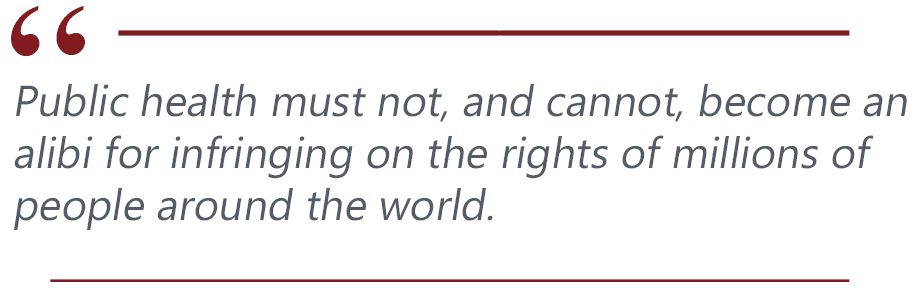
The facts have shown that, under the pretext of the Covid-19 epidemic, the inalienable rights of citizens have in many cases been violated and their fundamental freedoms, including the exercise of freedom of worship, expression and movement, have been disproportionately and unjustifiably restricted. Public health must not, and cannot, become an alibi for infringing on the rights of millions of people around the world, let alone for depriving the civil authority of its duty to act wisely for the common good. This is particularly true as growing doubts emerge from several quarters about the actual contagiousness, danger and resistance of the virus. Many authoritative voices in the world of science and medicine confirm that the media’s alarmism about Covid-19 appears to be absolutely unjustified.

We have reason to believe, on the basis of official data on the incidence of the epidemic as related to the number of deaths, that there are powers interested in creating panic among the world’s population with the sole aim of permanently imposing unacceptable forms of restriction on freedoms, of controlling people and of tracking their movements. The imposition of these illiberal measures is a disturbing prelude to the realization of a world government beyond all control.

We also believe that in some situations the containment measures that were adopted, including the closure of shops and businesses, have precipitated a crisis that has brought down entire sectors of the economy. This encourages interference by foreign powers and has serious social and political repercussions. Those with governmental responsibility must stop these forms of social engineering, by taking measures to protect their citizens whom they represent, and in whose interests they have a serious obligation to act. Likewise, let them help the family, the cell of society, by not unreasonably penalizing the weak and elderly, forcing them into a painful separation from their loved ones. The criminalization of personal and social relationships must likewise be judged as an unacceptable part of the plan of those who advocate isolating individuals in order to better manipulate and control them.

We ask the scientific community to be vigilant, so that cures for Covid-19 are offered in honesty for the common good. Every effort must be made to ensure that shady business interests do not influence the choices made by government leaders and international bodies. It is unreasonable to penalize those remedies that have proved to be effective, and are often inexpensive, just because one wishes to give priority to treatments or vaccines that are not as good, but which guarantee pharmaceutical companies far greater profits, and exacerbate public health expenditures. Let us also remember, as Pastors, that for Catholics it is morally unacceptable to develop or use vaccines derived from material from aborted fetuses.

We also ask government leaders to ensure that forms of control over people, whether through tracking systems or any other form of location-finding, are rigorously avoided. The fight against Covid-19, however serious, must not be the pretext for supporting the hidden intentions of supranational bodies that have very strong commercial and political interests in this plan. In particular, citizens must be given the opportunity to refuse these restrictions on personal freedom, without any penalty whatsoever being imposed on those who do not wish to use vaccines, contact tracking or any other similar tool. Let us also consider the blatant contradiction of those who pursue policies of drastic population control and at the same time present themselves as the savior of humanity, without any political or social legitimacy. Finally, the political responsibility of those who represent the people can in no way be left to “experts” who can indeed claim a kind of immunity from prosecution, which is disturbing to say the least.

We strongly urge those in the media to commit themselves to providing accurate information and not penalizing dissent by resorting to forms of censorship, as is happening widely on social media, in the press and on television. Providing accurate information requires that room be given to voices that are not aligned with a single way of thinking. This allows citizens to consciously assess the facts, without being heavily influenced by partisan interventions. A democratic and honest debate is the best antidote to the risk of imposing subtle forms of dictatorship, presumably worse than those our society has seen rise and fall in the recent past.

Finally, as Pastors responsible for the flock of Christ, let us remember that the Church firmly asserts her autonomy to govern, worship, and teach. This autonomy and freedom are an innate right that Our Lord Jesus Christ has given her for the pursuit of her proper ends. For this reason, as Pastors we firmly assert the right to decide autonomously on the celebration of Mass and the Sacraments, just as we claim absolute autonomy in matters falling within our immediate jurisdiction, such as liturgical norms and ways of administering Communion and the Sacraments. The State has no right to interfere, for any reason whatsoever, in the sovereignty of the Church. Ecclesiastical authorities have never refused to collaborate with the State, but such collaboration does not authorize civil authorities to impose any sort of ban or restriction on public worship or the exercise of priestly ministry. The rights of God and of the faithful are the supreme law of the Church, which she neither intends to, nor can, abdicate. We ask that restrictions on the celebration of public ceremonies be removed.

We should like to invite all people of good will not to shirk their duty to cooperate for the common good, each according to his or her own state and possibilities and in a spirit of fraternal charity. The Church desires such cooperation, but this cannot disregard either a respect for natural law or a guarantee of individual freedoms. The civil duties to which citizens are bound imply the State’s recognition of their rights.

We are all called to assess the current situation in a way consistent with the teaching of the Gospel. This means taking a stand: either with Christ or against Christ. Let us not be intimidated or frightened by those who would have us believe that we are a minority: Good is much more widespread and powerful than the world would have us believe. We are fighting against an invisible enemy that seeks to divide citizens, to separate children from their parents, grandchildren from their grandparents, the faithful from their pastors, students from teachers, and customers from vendors. Let us not allow centuries of Christian civilization to be erased under the pretext of a virus, and an odious technological tyranny to be established, in which nameless and faceless people can decide the fate of the world by confining us to a virtual reality. If this is the plan to which the powers of this earth intend to make us yield, know that Jesus Christ, King and Lord of History, has promised that “the gates of Hell shall not prevail” (Mt 16:18).

Let us entrust government leaders and all those who rule over the fate of nations to Almighty God, that He may enlighten and guide them in this time of great crisis. May they remember that, just as the Lord will judge us Pastors for the flock which he has entrusted to us, so will He also judge government leaders for the peoples whom they have the duty to defend and govern.

With faith, let us beseech the Lord to protect the Church and the world. May the Blessed Virgin, Help of Christians, crush the head of the ancient Serpent and defeat the plans of the children of darkness.

8 May 2020
Our Lady of the Rosary of Pompeii


LIST OF SIGNATORIES TO THE APPEAL


Read the rest of this entry »

Posted in Uncategorized | Tagged: , , , | Leave a Comment »

Doug Casey: “The State Is Not Your Friend” – Casey Research

Posted by M. C. on March 21, 2020

The State isn’t a magical entity; it’s a parasite on society.

The power of the State comes out of a barrel of a gun.

The State is pure institutionalized coercion.

The State is a dead hand that imposes itself on society, mainly benefitting those who control it, and their cronies.

Anarchism is simply a belief that a ruler isn’t necessary, that society organizes itself, that individuals own themselves, and the State is actually counterproductive.

When there is another 9/11 – and we will have another one – the State will lock down the US like one of their numerous new prisons.

Even under the worst circumstances – even if the Mafia controlled the United States – I don’t believe Tony Soprano or Al Capone would try to steal 40% of people’s income every year.

Judging from the movies the “protection” racket doesn’t cost 40%. Not the mafia kind.

https://www.caseyresearch.com/daily-dispatch/doug-casey-the-state-is-not-your-friend/

By

Editor’s note: Before we get to today’s essay, a quick note on the gold markets…

Regular readers know our founder, Doug Casey, sees gold as the ultimate safe-haven asset. So if you’re wondering why gold has been taking a hit this week amid massive sell-offs on Wall Street, you’re not alone. But it’s still an important protective asset to hold for the long term.

In fact, we’ve seen this happen before – take the recession of 2008. Just a few months after hitting bottom, gold started a massive rally, hitting an all-time high of over $1,900 an ounce.

And we see another breakout on the horizon. So the best thing you can do right now is not let your emotions run rampant and dictate your actions. Panic selling is the worst course of action today.

Sit tight, keep a cool head, and check out our Ultimate Crisis Playbook for a compilation of the best advice from the strongest investing minds in our industry. And next week, be ready for a full series on how to handle the current market climate.

Now… Onto today’s essay. Read on to see why our founder is “quite pessimistic about the future of freedom in the US”… especially in light of the recent heavy-handed restrictions due to coronavirus…


By Doug Casey, founder, Casey Research

Doug Casey

Allow me to say a few things that some of you may find shocking, offensive, or even incomprehensible. On the other hand, I suspect many or most of you may agree – but either haven’t crystallized your thoughts, or are hesitant to express them. I wonder if it will be safe to say them in another five years…

You’re likely aware that I’m a libertarian. But I’m actually more than a libertarian, I’m an anarcho-capitalist. In other words, I actually don’t believe in the right of the State to exist. Why not? The State isn’t a magical entity; it’s a parasite on society. Anything useful the State does could be, and would be, provided by entrepreneurs seeking a profit. And would be better and cheaper by virtue of that.

More important, the State represents institutionalized coercion. It has a monopoly of force, and that’s always extremely dangerous. As Mao Tse-tung, lately one of the world’s leading experts on government, said: “The power of the State comes out of a barrel of a gun.” The State is not your friend.

There are two possible ways for people to relate to each other: either voluntarily or coercively. The State is pure institutionalized coercion. As such, it’s not just unnecessary, but antithetical, to a civilized society. And that’s increasingly true as technology advances. It was never moral, but at least it was possible in oxcart days for bureaucrats to order things around. Today the idea is ridiculous.

The State is a dead hand that imposes itself on society, mainly benefitting those who control it, and their cronies. It shouldn’t be reformed; it should be abolished. That belief makes me, of course, an anarchist.

People have a misconception about anarchists – that they’re violent people, running around in black capes with little round bombs. This is nonsense. Of course there are violent anarchists. There are violent dentists. There are violent Christians. Violence, however, has nothing to do with anarchism. Anarchism is simply a belief that a ruler isn’t necessary, that society organizes itself, that individuals own themselves, and the State is actually counterproductive.

It’s always been a battle between the individual and the collective. I’m on the side of the individual. An anarcho-capitalist simply doesn’t believe anyone has a right to initiate aggression against anyone else. Is that an unreasonable belief?

Let me put it this way. Since government is institutionalized coercion – a very dangerous thing – if you want a government it should do nothing but protect people in its bailiwick from physical coercion.

What does that imply? It implies a police force to protect you from coercion within its boundaries, an army to protect you from coercion from outsiders, and a court system to allow you to adjudicate disputes without resorting to coercion.

I could live happily enough with a government that did just those things. Unfortunately, the US Government is only marginally competent in providing services in those three areas. Instead, it tries to do everything else conceivable.

The argument can be made that the largest criminal entity today is not some Colombian cocaine gang, but the US Government. And they’re far more dangerous. They have a legal monopoly on the force to do anything they want with you. Don’t conflate the government with America; they’re different and separate entities. The US Government has its own interests, as distinct as those of General Motors or the Mafia. In fact, I’d probably rather deal with the Mafia than I would with any agency of the US Government.

Even under the worst circumstances – even if the Mafia controlled the United States – I don’t believe Tony Soprano or Al Capone would try to steal 40% of people’s income every year. They couldn’t get away with it. But – because we’re said to be a democracy – the US Government is able to masquerade as “We the People,” and pull it off.

Incidentally, the idea of democracy is an anachronism, at best. The US has mutated into a domestic multicultural empire. The average person has been propagandized into believing that it’s patriotic to do as he’s told. “We need libraries of regulations, and I’m happy to pay my taxes. It’s the price we pay for civilization.” No, that’s just the opposite of the fact. Those things are signs that civilization is degrading, that the members of society are becoming less individually responsible. And therefore, that the country has to be held together by force.

It’s all about control. Power corrupts, and absolute power corrupts absolutely. The type of people that gravitate to government like to control other people. Contrary to what we’re told to think, that’s why the worst people – not the best – want to get into government.

What about voting? Can that change and improve things? Unlikely. I can give you five reasons why you should not vote in an election (see this article). See if you agree.

Hark back to the ’60s when they said, “Suppose they gave a war and nobody came?” But let’s take it further: Suppose they gave a tax and nobody paid? Suppose they gave an election and nobody voted? That would delegitimize the State.

I therefore applaud the fact that only half of Americans vote – although it’s out of apathy, not as a philosophical statement. If that number dropped to 25%, 10%, then 0%, perhaps everybody would look around and say, “Wait a minute, none of us believe in this evil charade. I don’t like Tweedledee from the left wing of the Demopublican Party any more than I like Tweedledum from its right wing…”

Remember, you don’t get the best and the brightest going into government. That’s because there are two kinds of people. You’ve got people that like to control physical reality – things. And people that like to control other people. That second group, those who like to lord it over their fellows, are naturally drawn to government and politics.

Some might ask: “Aren’t you loyal to America?” and “How can you say these terrible things?” My response is, “Of course I’m loyal to America, but America is an idea, it’s not necessarily a place. At least not any longer…”

America was once unique among the world’s countries. Unfortunately that’s no longer the case. The idea is still unique, but the country no longer is.

I’ll go further than that. It’s said that you’re supposed to be loyal to your fellow Americans. Well, here’s a revelation. I have less in common with my average fellow American than I do with friends of mine in the Congo, or Argentina, or China. The reason is that I share values with my friends; we look at the world the same way, and have the same worldview. But how much do I have in common with my fellow Americans who live in the trailer parks, barrios, and ghettos? Or even Hollywood and Washington? Not much.

How much do you really have in common with your fellow Americans who support Bernie Sanders, AOC, antifa, or Elizabeth Warren?

You probably have very little in common with them, besides sharing the same government ID. Most of your fellow Americans are actually welfare recipients, dependent on the State in some way. And therefore an active threat to your personal freedom and economic wellbeing.

Everyone has to be judged as an individual. So I choose my countrymen based on their character and beliefs, not their nationality. The fact we may all carry US passports is simply an accident of birth.

Those who find that thought offensive likely suffer from a psychological aberration called “nationalism”; in serious cases it may become “jingoism.” The authorities and the general public prefer to call it “patriotism.”

It’s understandable, though. Everyone, including the North Koreans, tends to identify with the place they were born, and the State that rules them. But that should be fairly low on any list of virtues. Nationalism is the belief that my country is the best country in the world just because I happen to have been born there. It’s scary any time, but most virulent during wars and elections. It’s like watching a bunch of chimpanzees hooting and panting at another tribe of chimpanzees across the watering hole.

It’s actually dangerous not to be a nationalist, especially as the State grows more powerful. The growth of the State is actually destroying the idea of America. Over the last 100 years, the State has grown at an exponential rate; it’s the enemy of the individual. I see no reason why this trend is going to stop. And certainly no reason why it’s going to reverse. Even though the election of Trump in 2016 was vastly preferable to Hillary from a personal freedom and economic prosperity point of view, it hardly amounts to a change in trend.

The decline of the US is like a giant snowball rolling downhill from the top of the mountain. It could have been stopped early in its descent, but now the thing is a behemoth. If you stand in its way you’ll get crushed. It will stop only when it smashes the village at the bottom of the valley.

I’m quite pessimistic about the future of freedom in the US. It’s been in a downtrend for many decades. But the events of September 11, 2001, turbocharged the loss of liberty in the US. At some point either foreign or domestic enemies will cause another 9/11, either real or imagined.

When there is another 9/11 – and we will have another one – the State will lock down the US like one of their numerous new prisons. I was afraid that the shooting deaths and injuries of several hundred people in Las Vegas on October 1, 2017, might have been the catalyst. But, strangely, the news cycle has driven on, leaving scores of serious unanswered questions in its wake. No competent reporting, and about zero public concern. Further testimony to the degraded state of the US today.

It’s going to become very unpleasant in the US at some point soon. It seems to me the inevitable is becoming imminent.

Regards,

signature

Doug Casey
Founder, Casey Research

Editor’s note: As many of us across the world are stuck at home… experiencing lockdown, quarantine, or “social distancing,” the question on our minds is this: “Is COVID-19 the catalyst for the complete loss of our freedoms?”

Is this why Americans are buying ammo left and right? (Send us your thoughts on this at feedback@caseyreseach.com.)

Fortunately, Casey Research friend Teeka Tiwari just told us all about an investment we like for its applications to privacy… that could also make you a millionaire.

Check it out here.

Be seeing you


Posted in Uncategorized | Tagged: , , , , , , | Leave a Comment »

Barbarous Relic: War is a racket — and so is the state

Posted by M. C. on January 5, 2020

Some people can’t deal with the notion that they elect criminals to rule them

War Is a Racket


In past writings I’ve attempted to show that the majority of the social problems experienced throughout the world — poverty, war, economic collapse, famine, hyperinflation, genocide, unilaterally broken agreements — can be traced to the dominant form of social organization under which we live: the State.

Simply put, states are bullies that collect their revenue through theft and manage their populations through threats of punishment. They use other incentives, such as tax breaks, but their existence depends on keeping their populations fearful of reprisals. Of course they don’t want to be seen as thieves or bullies — they want our allegiance. So, to win our favor they manufacture crises through lawmaking and other interventions, shift blame elsewhere, then use the crises to justify further interventions, calling on us for support as they continue meddling in our lives. Meanwhile our natural liberty gradually erodes as state power expands…

War is a racket — and so is the state.  In Butler’s words, “A racket is best described, I believe, as something that is not what it seems to the majority of the people. Only a small ‘inside’ group knows what it is about. It is conducted for the benefit of the very few, at the expense of the very many.”  He goes on to detail how and why World War I was a conspiracy instigated by the ruling elite.

Government, however, is a different matter from the state.  As Albert Jay Nock wrote in Our Enemy, the State (Kindle edition):

Based on the idea of natural rights, government secures those rights to the individual by strictly negative intervention, making justice costless and easy of access; and beyond that it does not go. The State, on the other hand, both in its genesis and by its primary intention, is purely anti-social. It is not based on the idea of natural rights, but on the idea that the individual has no rights except those that the State may provisionally grant him. It has always made justice costly and difficult of access, and has invariably held itself above justice and common morality whenever it could advantage itself by so doing.

So far from encouraging a wholesome development of social power, it has invariably, as Madison said, turned every contingency into a resource for depleting social power and enhancing State power.  As Dr. Sigmund Freud has observed, it can not even be said that the State has ever shown any disposition to suppress crime, but only to safeguard its own monopoly of crime.

Some people can’t deal with the notion that they elect criminals to rule them. They use government and state interchangeably, and they’ll tell you there are good people in government working hard for our welfare. Elect more of them and the state will serve our needs. But it can’t, not without abandoning its monopoly control over our lives, at which point it will cease being a state…

If the emperor’s new clothes strike you as ennobling when in fact he’s buck-naked, you can thank government schools and our pro-state culture for ceding reality to authority.

Be seeing you

#DontExposeEvil And the winners are… » Bitcoin Not Bombs

Posted in Uncategorized | Tagged: , , , , | Leave a Comment »

Of Two Minds – The Telltale Signs of Imperial Decline

Posted by M. C. on December 30, 2019

There is a peculiarly widespread belief that Elites are so smart and powerful that they always manage to evade the collapse of the empires that created and protected their wealth. But there is essentially no evidence for this belief when eras truly change.

…and the worship of unproductive celebrity…

https://www.oftwominds.com/blogaug18/imperial-decline8-18.html

Charles Hugh Smith

Nothing is as permanent as we imagine–especially super-complex, super-costly, super-asymmetric and super-debt-dependent systems.

Check which signs of Imperial decline you see around you: The hubris of an increasingly incestuous and out-of-touch leadership; dismaying extremes of wealth inequality; self-serving, avaricious Elites; rising dependency of the lower classes on free Bread and Circuses provided by a government careening toward insolvency due to stagnating tax revenues and vast over-reach–let’s stop there to catch our breath. Check, check, check and check.

Sir John Glubb listed a few others in his seminal essay on the end of empires The Fate of Empires, what might be called the dynamics of decadence:

(a) A growing love of money as an end in itself: Check.

(b) A lengthy period of wealth and ease, which makes people complacent. They lose their edge; they forget the traits (confidence, energy, hard work) that built their civilization: Check.

(c) Selfishness and self-absorption: Check.

(d) Loss of any sense of duty to the common good: Check.

Glubb included the following in his list of the characteristics of decadence:

— an increase in frivolity, hedonism, materialism and the worship of unproductive celebrity (paging any Kardashians in the venue…)

— a loss of social cohesion

— willingness of an increasing number to live at the expense of a bloated bureaucratic state

Historian Peter Turchin, whom I have often excerpted here, listed three disintegrative forces that gnaw away the fibers of an Imperial economy and social order:

1. Stagnating real wages due to oversupply of labor

2. overproduction of parasitic Elites

3. Deterioration of central state finances

War and Peace and War: The Rise and Fall of Empires

To these lists I would add a few more that are especially visible in the current Global Empire of Debt that encircles the globe and encompasses nations of all sizes and political/cultural persuasions:

1. An absurdly heightened sense of refinement as the wealth of the top 5% has risen so mightily as a direct result of financialization and globalization that the top .1% has been forced to seek ever more extreme refinements to differentiate the Elite class (financial-political royalty) from financial nobility (top .5% or so), the technocrat class (top 5%), the aspirant class (next 15%) and everyone below (the bottom 80%).

Now that just about any technocrat/ member of the lower reaches of the financial nobility can afford a low-interest loan on a luxury auto, wealthy aspirants must own super-cars costing $250,000 and up.

A mere yacht no longer differentiates financial royalty from lower-caste financial Nobles, so super-yachts are de riguer, along with extremes such as private islands, private jets in the $80 million-each range, and so on.

Even mere technocrat aspirants routinely spend $150 per plate for refined dining out and take extreme vacations to ever more remote locales to advance their social status.

Examples abound of this hyper-inflation of refinement as the wealth of the top 5% has skyrocketed.

2. The belief in the permanence of the status quo has reached quasi-religious levels of faith. The possibility that the entire financialized, politicized circus of extremes might actually be nothing more than a sand castle that’s dissolving in the rising tides of history is not just heresy–it doesn’t enter the minds of those reveling in refinement or those demanding more Bread and Circuses (Universal Basic Income, etc.)

3. Luxury, not service, defines the financial-political Elites. As Turchin pointed out in his book on the decline of empires, in the expansionist, integrative eras of empires, Elites based their status on service to the Common Good and the defense (or expansion) of the Empire.

While there are still a few shreds of noblesse oblige in the tattered banners of the financial elites, the vast majority of the Elites classes are focused on scooping up as much wealth and power as they can in the shortest possible time, with the goal being not to serve society or the Common Good but to enter the status competition game with enough wealth to afford the refined dining, luxury travel to remote locales, second and third homes in exotic but safe hideaways, and so on.

4. An unquestioned faith in the unlimited power of the state and central bank. The idea that the mightiest governments and central banks might not be able to print their way of our harm’s way, that is, create as much money and credit as is needed to paper over any spot of bother, is unthinkable for the vast majority of the populace, Elites and debt-serfs alike.

That all this newly issued currency and credit is nothing but claims on future production of goods and services and rising productivity never enters the minds of the believers in unlimited state/bank powers. We have been inculcated with the financial equivalent of the Divine Powers of the Emperor: the government and central bank possess essentially divine powers to overcome any problem, any crisis and any conflict simply by creating more money, in whatever quantities are deemed necessary.

If $1 trillion in fresh currency will do the trick–no problem! $10 trillion? No problem! $100 trillion? No problem! there is no upper limit on how much new currency/credit the government and central bank can create.

That there might be limits on the efficacy of this money-creation never enters the minds of the faithful. That pushing currency-credit creation above the limits of efficacy might actually trigger the unraveling of the state-central bank’s vaunted powers never occurs to believers in the unlimited reach of central states/banks.

The possibility that the central state/bank’s powers are actually quite limited is blasphemy in an era in which the majority of the Elites and commoners alike depend on the “free money” machinery of the central state/bank for their wealth and livelihoods.

It is instructive to ponder the excesses of private wealth and political dysfunction of the late Roman Empire with the present-day excesses of private wealth and political dysfunction. As Turchin and others have documented, where the average wealth of a Roman patrician in the Republic (the empire’s expansionist, integrative phase) was perhaps 10-20 times the free-citizen commoner’s wealth, by the disintegrative, decadent phase of imperial decay, the Elites held wealth on the scale of 10,000 times the wealth of the typical commoner. Elite villas were more like small villages centered around the excesses of luxury than mere homes for the wealthy and their household servants. Here is a commentary drawn from Turchin’s work:

“An average Roman noble of senatorial class had property valued in the neighborhood of 20,000 Roman pounds of gold. There was no ‘middle class’ comparable to the small landholders of the third century B.C.; the huge majority of the population was made up of landless peasants working land that belonged to nobles. These peasants had hardly any property at all, but if we estimate it (very generously) at one tenth of a pound of gold, the wealth differential would be 200,000! Inequality grew both as a result of the rich getting richer (late imperial senators were 100 times wealthier than their Republican predecessors) and those of the middling wealth becoming poor.”

Following in Ancient Rome’s Footsteps: Moral Decay, Rising Wealth Inequality (September 30, 2015)

We can be quite confident that these powerful elites reckoned the Empire was permanent and its power to secure their wealth and power was effectively unlimited. But alas, their fantastic wealth vanished along with the rest of the centralized, over-extended, complex and costly Imperial structures…

Be seeing you


Posted in Uncategorized | Tagged: , , , , , , , | Leave a Comment »

Tolkien, Christianity, and the State | Mises Wire

Posted by M. C. on July 22, 2019

https://mises.org/wire/tolkien-christianity-and-state

The conservative intellectual movement is having an existential crisis, of sorts. It’s one that has long been simmering but only recently thrust into the light after First Things published New York Post opinion editor Sohrab Ahmari’s attack on the failings of what he termed “French-ism.” According to Ahmari, French-ism means defending a pluralistic liberal society in which we treat our political foes with dignity and respect, despite disagreement. Conversely, Ahmari argues that Christians must abandon liberalism and use the state to crush Christianity’s enemies and “enforce our order and our orthodoxy” upon them.

A glance around at the current state of affairs makes it easy for Christian conservatives and libertarians to become disheartened and, consequently, at least sympathize with the illiberal intentions of people like Ahmari. To those frustrated with the encroaching leftist darkness, it may seem that Ahmari’s way is the only option left to them. Fortunately, as author and philologist J.R.R. Tolkien might have told us, it’s not.

The comparison between Ahmari and Tolkien is worth examining. Indeed, Tolkien wasn’t merely a vastly imaginative and adept fantasy writer. He was also a Christian thinker steeped in robust Catholic thinking — something Ahmari himself claims to be. But their ideas on what the common good looks like are wildly disparate. Unlike Ahmari, who believes the only possible manifestation of the common good is his own, Tolkien colored his work with a clear message of pluralism. The renowned trilogy The Lord of the Rings (LOTR), and even some of Tolkien’s lesser-known work such as Farmer Giles of Ham, emphasizes the need for diversity and the freedom for different groups and people to live in a way that best suits them. In real life, as in Tolkien’s fictional realms, this decentralization doesn’t lead to a perfect society, by any means. But the alternative of centralized direction by the state — as proposed by Ahmari — leads to even worse consequences, as the amount of power flawed humans have at their disposal increases.

As recently as fall 2017, Ahmari was defending liberalism. Now, sadly, he craves Tolkien’s One Ring of Power, believing it necessary to order things in accordance with his conception of the common good. In The Lord of the Rings, Tolkien confronts this sort of militant belief head-on. Indeed, the wizard Saruman the White began as an agent of the good, but, gradually, he came to crave power and control. In the process, he fell in with the ranks of evil. While later attempting to sway Gandalf to join him in his alliance with the forces of darkness, Saruman tries justifying his naked power grab. “Our time is at hand: the world of Men, which we must rule,” he says. “But we must have power, power to order all things as we will, for that good which only the wise can see.” Sound familiar?

To the Sarumans of our world, people are incapable of being left to their own devices. Clearly, Ahmari now believes that a powerful hand of the state is needed to shepherd people into making correct decisions — pesky leftists who disagree simply must be crushed. A troubling and ever-increasing number of conservatives agree. Now we see hearty, open endorsements of banning payday lending, capping interest rates, and the reimposition of blue laws. All in the name of the common good.

Strangely enough, the Ahmari camp seems to think that support for freedom is condescending to the blue-collar American. In response to a recent article of mine addressing why reimposing blue laws that regulate commerce on Sundays won’t boost church attendance, Ahmari took to Twitter to claim that I look down on people who work Sundays as being “peasants.” But it’s Ahmari who sees everyday people as ignorant plebeians incapable of running their own lives. Why else propose using the power of the state to impose his vision and values upon them?

We have no evidence that if he and his ilk were somehow handed power, they’d grant the dignity of autonomy to the same people for whom they clearly have no respect now. Indeed, it would likely look frighteningly similar to the way Saruman and his lackeys treated the hobbits of the Shire after they took it over and attempted to impose upon them their conception of “the good.”

It may be that Tolkien and Ahmari’s differing views on power stem from a fundamental disagreement about the nature of good and evil on this earth.

Tolkien, for his part,believed that evil can’t be vanquished entirely — not on this earth, at least. Indeed, in his eyes, the battle against evil was nothing but a long defeat: a losing rear-guard action in a world corrupted and defiled by sin. LOTR, after all, is set in a post-collapse world in which the great powers of good are but mere shadows of their former glory. Alas, even in victory, the bad is always encroaching. In fact, later in life, Tolkien began a sequel to The Lord of the Rings entitled The New Shadow, in which, 100 years after the fact, the forces of evil and corruption once again stir.

Tolkien’s mythology echoed the Christian belief that evil will eventually gain dominion over the earth until the penultimate battle in which it’s overthrown and a new earth is created — free from the marring power of sin and evil. It’s precisely why Tolkien thinks that using the Ring of Power won’t work — limitless power only leads to further evil here on earth.

Whether he means to or not, Ahmari exudes a belief that the strength of man alone can deliver some form of temporal victory for Christians. For him, good can be established in this fallen world — no compromise necessary. But his rant against French-ism comes across as a delusional power trip comparable, one might say, to Boromir’s fantasizing on the slopes of Amon Hen about leading hosts of men to crush Mordor once he has the Ring of Power. Unlike Boromir, however, Ahmari isn’t even a mighty prince of men. He’s an editor at a tabloid newspaper.

Gandalf or Saruman? Boromir or Faramir? Denethor or Theoden — who do we wish to be? Tolkien knew this was a choice that would continually face those seeking to do what’s right.

In urging Christians to use the Ring of Power against their enemies, Ahmari is heedless of the danger it poses to themselves and others. While Ahmari may argue that fighting for control of the state is a moral necessity for Christians, thinkers like Tolkien adeptly show that far from being a Christian duty, such actions actually have the opposite effect. Christians can try to wield the Ring of Power for good, but it will inevitably lead to evil.

Be seeing you

Rationalist Judaism: The Ring of Power


Posted in Uncategorized | Tagged: , , , | Leave a Comment »

Why Most People Embrace the State — And Why Some Will Always Reject It | Mises Wire

Posted by M. C. on June 19, 2019

On deeper reflection, then, the strategy for the achievement of liberty is not so simple; for even though mass civil disobedience is the master key, how is the public to be brought to such an action, blinded as they are by a network of habit, propaganda, and special privilege?

https://mises.org/wire/why-most-people-embrace-state-%E2%80%94-and-why-some-will-always-reject-it

[From “Concepts of the Role of Intellectuals In Social Change Toward Laissez Faire” in The Journal of Libertarian Studies, Fall 1990]

Why, La Boétie cries out in anguish, why, when reason teaches us the justice of natural rights and equal liberty for all, why, when even animals display a natural instinct to be free, is man, “the only creature really born to be free, [lacking] the memory of his original condition and the desire to return to it?”7 Why, in short, are people steeped in such a “vile” and “monstrous vice” as consenting to their own subjection?

La Boétie answers, first, that the difficult act of initially establishing tyrannical State power is accomplished through some form of conquest, either by a foreign power, an internal coup, or by the use of a wartime emergency as an excuse to fasten a permanent despotism upon the public. And why then do people continue to consent?

In the first place, explains La Boétie, there is the insidious power of habit, which quickly accustoms and inures the public to any institution, including its own enslavement.

It is true that in the beginning men submit under constraint and by force; but those who come after them obey without regret and perform willingly what their predecessors had done because they had to. This is why men born under the yoke and then nourished and reared in slavery are content, without further effort, to live in their native circumstance, unaware of any other state or right, and considering as quite natural the condition into which they are born. …

Thus humanity’s natural drive for liberty is overpowered by the force of custom, “for the reason that native endowment, no matter how good, is dissipated unless encouraged, whereas environment always shapes us in its own way. …” Hence, people will

grow accustomed to the idea that they have always been in subjection, that their fathers lived in the same way; they will think they are obliged to suffer this evil, and will persuade themselves by example and imitation of others, finally investing those who order them around with proprietary rights, based on the idea that it has always been that way.8

And so consent of the public need not be eager or enthusiastic, but rather of the resigned “death and taxes” variety. But second, the State apparatus need not wait for the slow workings of custom; consent can also be engineered. La Boétie proceeds to discuss the various devices by which rulers engineer such consent. One time-honored device is circuses, for the entertainment of the masses:

Plays, farces, spectacles, gladiators, strange beasts, medals, pictures and other such opiates, these were for ancient peoples the bait toward slavery, the price of their liberty, the instruments of tyranny. By these practices and enticements the ancient dictators so successfully lulled their subjects … that the stupified peoples, fascinated by the pastimes and vain pleasures, … learned subservience as naively, bit not so creditably, as little children learn to read by looking at bright picture books.9

Another important device for gaining the consent of the public is duping them into believing that the rule of the tyrant is wise, just, and benevolent…

the fools did not realize that they were merely recovering a portion of their own property, and that their ruler could not have given them what they were receiving without having first taken it from them. … The mob has always behaved in this way — eagerly open to bribes…

Be seeing you

wp-1555692458658.jpg


Posted in Uncategorized | Tagged: , , , | Leave a Comment »