


Over the past year the Covid testing industry has blasted into the stratosphere to become a $ 00 billion per year industry. Powerful and influential forces are making a fortune from tests that have been proven largely inaccurate and Americans are being forced to foot the bill. If you subsidize something you get more of it. Also today, Covid corruption rocks Germany’s ruling party and a new WHO-funded study is raising eyebrows.
Posts Tagged ‘Too Big to Fail’
Watch “Covid-Testing-Industrial-Complex: Too Big To Fail” on YouTube
Posted by M. C. on March 27, 2021
Posted in Uncategorized | Tagged: Covid testing industry, Covid-Testing, Too Big to Fail, WHO | Leave a Comment »
The GameStop Rebels vs. “Too Big to Fail” | Mises Wire
Posted by M. C. on February 4, 2021
The fearmongering went beyond even the usual places we hear about financial news. On The View, for example, Meghan McCain delivered the sort of status quo–defending bromides we’ve come to expect from her. She insisted the GameStop affair could spiral into an economy-killing disaster because
If the stock ends up plunging because of this, because of GameStop and Wall Street loses billions, at a certain point, it will impact stocks like Apple and Disney and stocks that a lot of average Americans do invest in, and if that happens, average Americans will end up losing even more money.
Her comment doesn’t really make any sense, and she doesn’t seem to have even a rudimentary understanding of what happened. But her comment delivered the important point: namely, that anything that causes volatility in the market could be a disaster for every American household. Translation: we should all be very, very afraid if something isn’t done to keep these Reddit people—whom she compared to the Capitol “insurrectionists”—under control.
https://mises.org/wire/gamestop-rebels-vs-too-big-fail
Last week, a large number of small-time investors drove up the price of GameStop’s (GME) stock a historic 1,784 percent. But this was no mere spike in some obscure stock. The stock’s price spiked in part as a result of efforts by “an army of smaller investors who have been rallying on Reddit and elsewhere online to support GameStop’s stock and beat back the professionals.” These professionals were hedge fund managers who had shorted GameStop’s stock. In other words, hedge funders were betting billions that GameStop’s stock would go down. But the price went up instead, meaning hedge funds like Melvin Capital (and Citron Research) took “a significant loss,” possibly totaling $70 billion.
There surely were plenty of insiders on both sides of this deal. Given the complexity of various schemes employed by seasoned investors, it seems it is very unlikely that this is just a simple matter of little Davids taking on Wall Street Goliaths. But it also looks like that’s not all that was going on. Had this only been just another scheme by some Wall Street insiders against some other Wall Street insiders the story would probably have ended there.
But that’s not what happened. Rather, it appears that, for many of the smaller investors who were involved, much of this “short squeeze” was conducted for the purposes of throwing a monkey wrench in the plans of Wall Street hedge funds which exist within the rarified world of billionaires and their friends.
Pro–Wall Street Fearmongering
The reactions to the event from media pundits and other commentators were telling in that there was clearly fear and outrage over the fact that business as usual on Wall Street wasn’t being enforced. Predictably, much of the reaction to the Reddit rebellion was to label it a “fiasco,” “insanity,” and something sure to leave a “trail of destruction.” The important thing was to use words designed to make it all look like the threat to hedge funds represents some sort of grave threat to the overall economy. Jim Lebenthal at CNBC, for example, declared the “short-squeeze fiasco is a threat to the proper functioning of financial markets.”
The fearmongering went beyond even the usual places we hear about financial news. On The View, for example, Meghan McCain delivered the sort of status quo–defending bromides we’ve come to expect from her. She insisted the GameStop affair could spiral into an economy-killing disaster because
If the stock ends up plunging because of this, because of GameStop and Wall Street loses billions, at a certain point, it will impact stocks like Apple and Disney and stocks that a lot of average Americans do invest in, and if that happens, average Americans will end up losing even more money.
Her comment doesn’t really make any sense, and she doesn’t seem to have even a rudimentary understanding of what happened. But her comment delivered the important point: namely, that anything that causes volatility in the market could be a disaster for every American household. Translation: we should all be very, very afraid if something isn’t done to keep these Reddit people—whom she compared to the Capitol “insurrectionists”—under control.
Of course, in a functioning and relatively unhampered market, unusual, unexpected things happen all the time. Entrepreneurial actors do things the incumbent firms and “experts” hadn’t counted on. This leads to “instability” and big swings in prices. This is actual capitalism, and it doesn’t mean the marketplace isn’t functioning properly. In fact, it probably means the marketplace is dynamic and responsive to consumers and other market participants.
But that’s not something Wall Street insiders or their pals in Washington like in the modern era. Although Wall Streeters love to portray themselves as capitalist captains of industry, the fact is they have very little interest in real, competitive capitalism.
Rather, we live in the era of “too big to fail” (TBTF), when market freedom means nothing and preserving the portfolios of powerful Wall Street institutions—through any means necessary—is all that matters.
Decades of “Too Big to Fail”
It’s based on the idea that Wall Street is just too important to leave to the market, and Washington must intervene to make sure rich guys on Wall Street stay rich. David Stockman explains this philosophy:
[It is] the notion that the “threat of systemic risk” and a cascading contagion of losses from the failure of any big Wall Street institution would be so calamitous that it warranted an exemption from free market discipline.
This goes back at least to the 1994 Mexican bailout—which was really a bailout of investors, not of Mexico—which solidified the process of normalizing huge transfers of wealth from taxpayers and dollar holders to the Wall Street elite. By then, the “Greenspan put” was already in place, with the central bank forever poised to embrace more easy money in pursuit of propping up stock prices. Then came the bailouts of 2008 and the covid-19 avalanche of easy money—all of which lopsidedly benefited Wall Street over the rest of the economy.
This “exemption from free market discipline” is what Wall Street is all about these days. The financial sector has become accustomed to enjoying bailouts, easy money, and the resulting financialization which puts ever greater amounts of the US economy into the hands of Wall Street money managers. The sector is now built on corporate welfare, not “free markets.” No matter what happens, Wall Street expects the deck to be stacked in its favor.
This is why “volatility” has become a bad word, and “stability” is now the name of the game. It’s why Lebenthal thinks anything out of the ordinary is a threat to the “proper functioning of financial markets.” If some free market innovation and inventiveness actually takes place in some small corner of the marketplace, well, then we’re all expected to get very upset.
That’s the way Wall Street likes it. Author:
Ryan McMaken (@ryanmcmaken) is a senior editor at the Mises Institute. Send him your article submissions for the Mises Wire and The Austrian, but read article guidelines first. Ryan has degrees in economics and political science from the University of Colorado and was a housing economist for the State of Colorado. He is the author of Commie Cowboys: The Bourgeoisie and the Nation-State in the Western Genre.
Be seeing you
Posted in Uncategorized | Tagged: fearmongering, GameStop, hedge funds, Meghan McCain, short squeeze, Too Big to Fail | Leave a Comment »
EconomicPolicyJournal.com: Three Big Problems with How Most Look at Inequality
Posted by M. C. on November 24, 2019
http://www.economicpolicyjournal.com/2018/10/three-big-problems-with-how-most-look.html
By Arkadiusz Sieroń
The issue of income and wealth inequality has gained public awareness recently, becoming an important economic problem in our time. Unfortunately, the quality of the public debate about this topic remains very poor. In this piece, I would like to point out three main shortcomings of the problem at hand.
Good and Bad Inequality
First, people do not differentiate between good and bad inequality. There is nothing inherently bad about inequality, since it’s, after all, only a formal characteristic of the relationship between certain values, like incomes of different people. What really matters is the reason of the inequality. Inequality that results from “rent seeking” and lobbying the government to implement beneficial regulations for the influential and already wealthy interest groups (you may think of banks “too big to fail”, farmers demanding subsidies or domestic industries supporting import tariffs) is obviously bad. Inequality caused by the quantitative easing programs, which increased prices of financial assets held by a relatively small number of wealthy individuals, is also not worthy of praise.
However, inequality resulting from economic progress does not deserve to be condemned, does it? During the Industrial Revolution, workers moved gradually from agriculture to manufacturing, which initially widened the inequality. But this is how the progress happens – it never occurs smoothly, as not all people take advantage of new market opportunities to increase their productivity at the same time. The current upswing in inequality also seems to be driven by technological progress, inter-sectoral reallocation of labour (from manufacturing to services), and globalization. The question whether we should oppose it equals to question whether we should be against progress itself. I hope it’s clear now that inequality may be either positive or negative, depending on its causes, and that the bad ones are not necessarily driven by the free-market capitalism, the favorite whipping boy for all the misery of the world. Instead, it’s crucial to understand that the rise in inequality observed recently in some western countries may result from many causes, including the global economic growth lifting people out of poverty all over the world.
Are People Sinophobic?
This leads us to the second weakness of the public debate about the inequality: many people adopt too narrow, Western-oriented perspective. Just look at the chart below.
Chart 1: Change in real income from 1988 to 2008 among percentiles of global income distribution

Source: B. Milanovic, 2013, Global Income Inequality by the Numbers: In History and Now – An Overview , downloaded from Wikipedia .
As one can see, almost the entire bottom 75 percent has seen its real income rise between 1988 and 2008 – and some percentiles made really significant gains. Although it clearly shows that globalization benefited enormous number of people, intellectuals and the press are focusing on the working class in the West, whose real income relatively stagnated. It’s an unpleasant fact for these people, for sure. However, the funny thing is that they are between the 75th and the 90th percentile of the global income distribution, which mean that they belong to a global upper-middle class. From the global perspective, the current buzz about rising inequality is not a sign of concern about the poor at all – it is a worry about the income of an elite disturbed by the increased supply of low-skilled workers from developing countries. Surely, one can criticize the rise in inequality due to globalization – but it implies an assumption that the relative economic situation of the working class in developed countries is more important that the absolute increase in real incomes of Chinese or Indians. It turns out that the authors of Oxfam’s reports and other people who supposedly take care of human misery actually suffer from sinophobia.
Inequality or Poverty?
This is connected to the third cardinal sin of the contemporary debate about the income inequality, perhaps the most important one. People often confuse inequality with poverty, although these terms mean something different. The former occurs when people have different incomes, while the latter is when people do not receive enough money. Many people criticize the inequality, but what is really disturbing is not the fact that some have lower income than others, but rather that some has very little.
Fortunately, this is where capitalism enters the scene. Let’s see the chart below, which paints the spectacular reduction in the global extreme poverty over the last few decades.
Chart 2: The percentage share of the world population living in extreme poverty, from 1820 to 2015.

As one can see, in 1820 almost all people in the world struggled for less than $1.90 per day. One hundred and fifty years later, still 60 percent of the global population lived in extreme poverty. Since then, the ratio declined to 9.6 percent. It means that billions of people have been taken out of extreme poverty. This progress is mind-blowing, especially for people who blame capitalism and ‘neoliberalism’ for the rise in inequality, although it is hardly surprising for economists who know that free markets enable economies to grow. Indeed, poverty was the default state of the humanity. What enabled for its reduction was simply to let poor people get richer by protecting property rights, liberalizing markets, and freeing trade.
This is how capitalism works: it generates wealth through free exchanges and accumulation of capital which increases the labour productivity. Therefore, the call for the greater economic equality for its own sake not only diverts us from the issue of poverty, which is the real problem, but it may be even counterproductive and hamper the economic growth — the only genuine means of eradicating poverty.
Posted in Uncategorized | Tagged: Inequality, poverty, Sinophobic, Too Big to Fail | Leave a Comment »
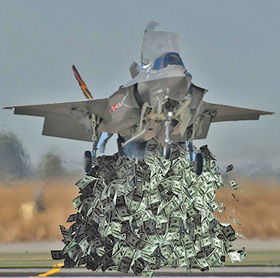
Too big to fail: With millions invested, the F-35 is here to stay
Posted by M. C. on April 5, 2019
“The military industrial congressional complex has perfected its methods for ensuring programs of this kind can endure despite disappointing performance in almost every objective military measure,”
https://www.opensecrets.org/news/2019/04/too-big-to-fail-with-millions-invested-the-f-35/
By Raymond Arke
In 1997, Lockheed Martin was selected to compete to design and build what would become the F-35 Lightning II. Over that course of time, this fighter jet program has become one of the most expensive in American history and has faced a variety of serious technical and functional challenges. The plane was finally deemed ready for combat in 2018, despite remaining concerns about the plane’s ability to fly and fight.
Even with all the controversy regarding the plane, bipartisan members of Congress this week asked their colleagues to adjust President Trump’s 2020 budget request to include more F-35s. As Lockheed has invested millions in congressional candidates and created jobs in nearly every U.S. state, the political support of the project remains strong.
The House members that wrote the letter asking for more F-35s are part of the Joint Strike Fighter Caucus. The group, led by Reps. John Larson (D-Conn.), Martha Roby (R-Ala.), Marc Veasey (D-Texas) and Mike Turner (R-Ohio), was formed in 2011 by Rep. Kay Granger (R-Texas) and former Rep. Norm Dicks (D-Wa.). All five of the current caucus members mentioned above received the maximum in PAC contributions from Lockheed Martin in the 2018 cycle. In a press release announcing the caucus’ formation, Granger and Dicks called the fighter plane program “an absolute necessity,” citing the number of jobs it would support.
Initially, the planes were supposed to cost $38 million each, however even though it often dramatically underperforms each individual plane costs the U.S. government an average of $158.4 million. Lockheed Martin is the prime contractor, while Northrop Grumman and BAE Systems contributed parts…
“The military industrial congressional complex has perfected its methods for ensuring programs of this kind can endure despite disappointing performance in almost every objective military measure,” he said.
A recent report by the Project on Government Oversight (POGO) laid out the litany of problems facing the aircraft. Some of the issues include malfunctioning combat computer systems, cyber vulnerabilities which could allow hackers to access the planes’ network, problems with the accuracy of the planes’ guns and a tendency to develop cracks which require numerous repairs.
Dan Grazier, a former Marine Corps captain and military fellow at POGO and author of the report, said that even with all the program’s problems it will continue on.
“The military industrial congressional complex has perfected its methods for ensuring programs of this kind can endure despite disappointing performance in almost every objective military measure,” he said…
Since the 1990 cycle, Lockheed employees and the company’s PAC have contributed almost a combined $39.7 million. The 2018 cycle saw the most contributed by affiliates in a midterm with almost $4.7 million.
Granger was the top recipient of money from Lockheed’s PAC and employees in 2018 with $131,940, more than double the next closest recipient. Granger, the ranking member on the House Appropriations Committee, received $549,990, mostly from Lockheed employees, over the course of her career making it her top all-time donor.
Granger has been a member of the Appropriations Committee since 1999 and at different points served as Vice Chair and Chair of the House Appropriations Defense Subcommittee. One of the F-35 assembly plants is in Granger’s district and she has been described as a “champion” of the program…
“Even if the engineers can eventually complete the design and make it function the way we have been promised it would, the program comes with a high cost of ownership,” he said. “This is by design as it ensures Lockheed Martin receives lucrative, sole-source sustainment contracts for as long as the aircraft flies.”
He also laid out another unforeseen consequence of the program’s struggles — the possibility of pilots leaving the service as there will be “a difficult time keeping the aircraft flying.” And with fewer aircraft in the air, top pilots could get frustrated and leave the service, Grazier warned…
Be seeing you
Posted in Uncategorized | Tagged: F-35, Lockheed Martin, Project on Government Oversight, Too Big to Fail | Leave a Comment »
Mohammed bin Salman: Too Big to Fail – LobeLog
Posted by M. C. on November 9, 2018
They know that the United States has never put its relationship with Saudi Arabia on the line over any human rights issue or over the fate of any individual. Some economic or strategic goal always overrides human rights considerations.
https://lobelog.com/mohammed-bin-salman-too-big-to-fail/
A month after the murder of Jamal Khashoggi at the Saudi Arabian consulate in Istanbul, an international consensus is emerging about how to respond: deplore the crime, demand justice, but don’t cut ties with the kingdom. In particular, don’t cut off Crown Prince Mohammed bin Salman, the man widely believed to have ordered the killing of the dissident journalist.
The ambitious, impetuous crown prince, known as MbS, is probably damaged goods as a person. He’s unlikely to receive another lavish welcome in Silicon Valley any time soon. But he has become the diplomatic equivalent of some big banks: too big to fail.
German Chancellor Angela Merkel has suspended weapons sales to await the outcome of Saudi Arabia’s investigation of the murder. That sounds like strong action, but it’s a whitewash. The chances that the investigation will conclude that MbS was responsible for Khashoggi’s death are close to zero,… Read the rest of this entry »
Posted in Uncategorized | Tagged: human rights, Jamal Khashoggi, Mohammed bin Salman, Too Big to Fail | Leave a Comment »
‘Too Big to Fail’: Russia-gate One Year After VIPS Showed a Leak, Not a Hack – Consortiumnews
Posted by M. C. on August 15, 2018
There was an orthodoxy abroad many centuries ago called Fideism. In the simplest terms, it means the privileging of faith and belief over reason. It was the enemy of individual conscience, among much else.
“How far will we allow our government to escalate against others without proof of anything?”
By Patrick Lawrence
A year has passed since highly credentialed intelligence professionals produced the first hard evidence that allegations of mail theft and other crimes attributed to Russia rested on purposeful falsification and subterfuge. The initial reaction to these revelations—a firestorm of frantic denial—augured ill, and the time since has fulfilled one’s worst expectations. One year later we live within an institutionalized proscription of proven reality. Our discourse consists of a series of fence posts and taboos. By any detached measure, this lands us in deep, serious trouble. The sprawl of what we call “Russia-gate” now brings our republic and its institutions to a moment of great peril—the gravest since the McCarthy years and possibly since the Civil War. No, I do not consider this hyperbole.
Much has happened since Veteran Intelligence Professionals for Sanity published its report on intrusions into the Democratic Party’s mail servers on Consortium News on July 24 last year. Parts of the intelligence apparatus—by no means all or even most of it—have issued official “assessments” of Russian culpability. Media have produced countless multi-part “investigations,” “special reports,” and what-have-yous that amount to an orgy of faulty syllogisms. Robert Mueller’s special investigation has issued two sets of indictments that, on scrutiny, prove as wanting in evidence as the notoriously flimsy intelligence “assessment” of January 6, 2017. Read the rest of this entry »
Posted in Uncategorized | Tagged: Russia-gate, Too Big to Fail, Veteran Intelligence Professionals for Sanity, VIPS | Leave a Comment »
 MCViewPoint