MCViewPoint

Opinion from a Libertarian ViewPoint

Posts Tagged ‘Trinity’

Trinity’s Shadow

Posted by M. C. on July 21, 2023

Many share this philosophy of despair disguised as progress as it has crept into everything today.  It is tragic, for if people accept it, we are doomed to follow a Faustian pact with the devil and all hell will follow.

https://edwardcurtin.com/trinitys-shadow/

Edward J. Curtin, Jr.

I sit here in the silence of the awakening dawn’s stillness stunned by the realization that I exist.  I wonder why.  It is my birthday.  The first rays of the rising sun bleed crimson over the eastern hills as I imagine my birth. The house and my family sleep.

Someday I will die and I wonder why.  This is the mystery I have been contemplating since I was young.  That and the fact that I was born in a time of war and that when my parents and sisters were celebrating my first birthday, my country’s esteemed civilian and military leaders celebrated another birth: the detonation of the first atomic bomb code-named Trinity.

Trinity has shadowed my life, while the other Trinity has enkindled my days.

Sick minds play sick word games as they inflict pain and death.  They nicknamed this death bomb “the Gadget,” as if it were an innocent little toy.  They took and blasphemed the Christian mystery of the Trinity as if they were mocking God, which they were.  They thought they were gods.

Now they are all dead gods, their fates sealed in their tombs.

Where are they now?

Where are all their victims, the innocent dead of Hiroshima and Nagasaki?

Where are the just and the unjust?

Where are the living now, asleep or awake as Trinity’s progenitors in Washington, D.C. and the Pentagon prepare their doomsday machines for a rerun, the final first-strike run, the last lap in their race to annihilate all the living?  Will they sing as they launch the missiles – “So long, farewell, auf Wiedersehen, good night?”

Joseph Biden, the second Roman Catholic president, while mocking the essence of Jesus’s message, pushes the world toward a nuclear holocaust, unlike JFK, the first Catholic president, who was assassinated by the CIA for pushing for the elimination of nuclear weapons and the end of the Cold War.

The wheel turns.  We count the years.  We wonder why.

Years ago I started my academic life by writing a thesis entitled “Dealing With Death or Death Dealing.”  It was a study of the transformation of cultural symbol systems, death, and nuclear weapons.  The last hundred years and more have brought a transformation and disintegration of the traditional religious symbol system – the sacred canopy – that once gave people comfort, meaning, and hope.  Science, technology, and nuclear weapons have changed all that. Death has been socially relocated and we live under the nuclear umbrella, a sinister “safeguard” that is cold comfort. The ultimate power of death over all life has been transferred from God to men, those controlling the nuclear weapons. This subject has never left me.  I suppose it has haunted me.  It is not a jolly subject, but I think it has chosen me.

Was I born in a normal time?  Is war time our normal time?  It is. I was.

But to be born at a time and place when your country’s leaders were denouncing their German and Japanese enemies as savage war criminals while execrably emulating them and then outdoing them is something else again.  With Operation Paperclip following World War II, the United States government secretly brought 1,600 or more Nazi war criminals into the U.S. to run our government’s military, intelligence, space, chemical, and biological warfare programs.  We became Nazis.  Lewis Mumford put it this way in The Pentagon of Power:

By the curious dialectic of history, Hitler’s enlargement and the refurbishment of the Nazi megamachine gave rise to the conditions for creating those counter-instruments that would conquer it and temporarily wreck it. In short, in the very act of dying the Nazis transmitted their disease to their American opponents; not only the methods of compulsive organization or physical destruction, but the moral corruption that made it feasible to employ those methods without stirring opposition.

There are always excuses for such moral corruption.  When during WW II the U.S. firebombed almost all Japanese cities, Dresden and Cologne in Germany, and then dropped atomic bombs on Hiroshima and Nagasaki killing hundreds of thousands of innocent civilians in gratuitously savage attacks, these were justified and even celebrated as necessary to defeat evil enemies.  Just as Nazi war criminals were welcomed into the U.S. government under the aegis of Allen Dulles who became the longest running CIA director and the key to JFK’s assassination and coverup, the diabolic war crimes of the U.S. were swept away as acts of a moral nation fighting a good war.  What has followed are decades of U.S. war crimes from Korea through Vietnam and Iraq, etc.  A very long list.

See the rest here

Be seeing you

Posted in Uncategorized | Tagged: , | Leave a Comment »

ATOMIC BOMBINGS AT 75: The Decision to Drop the Bomb on Japan and the Genesis of the Cold War – Consortiumnews

Posted by M. C. on August 6, 2020

According to Szilard, Byrnes was very concerned about the role of the Soviet Union in the postwar era. The Soviets’ massive armies had already steamrolled into Eastern Europe, and America was faced with the difficult task of figuring out how to get them out of these nations after Hitler was defeated. Byrnes told Szilard “that Russia might be more manageable if impressed by American military might, and that a demonstration of the bomb might impress Russia.”

Unlike Stimson, however, the navy secretary believed that the United States should exhaust all alternatives to dropping the atomic bomb in order to get Japan to surrender. Forrestal’s views were shaped more by his strong anticommunist position than they were out of any moral qualms about using the atomic bomb. He firmly believed that if a face-saving mechanism could be found to entice Japan into surrender, the geopolitical situation in the Pacific could be stabilized before the Soviet Union could shift its resources away from Europe.

…Stalin and the Russians during the Second World War, the fact is that the Soviets were all too aware of what was transpiring inside the secret weapons plants in the United States and Britain.

https://consortiumnews.com/2020/08/05/atomic-bombings-at-75-the-decision-to-drop-the-bomb-on-japan-and-the-genesis-of-the-cold-war/

By Scott Ritter

Even by the heightened standards of a nation’s capital during wartime, the gathering of generals, admirals, and high government officials in the White House Cabinet Room on the afternoon of Monday, June 18, 1945, was impressive. Only one, however, could claim resident status—the newly sworn in president of the United States, Harry S. Truman.

A veteran of the First World War and a long-serving Democratic senator from the state of Missouri, Truman was an unlikely candidate for the job he now held. A compromise candidate for the office of vice president in 1944, Truman was no close confidant of President Franklin D. Roosevelt. Indeed, he had little insight into Roosevelt’s thinking about postwar relations with the Soviet Union and no knowledge of the existence of a major program—the Manhattan Project—to produce an atomic bomb.

In a series of meetings conducted shortly after being sworn in as president, Truman overcame this deficit, maintaining a pledge to adhere as closely as possible to the policy directions set forth by President Roosevelt. But some decisions would have to be taken by the new president, which is why he had convened the Cabinet Room meeting. [Minutes]

Joining Truman was General George Catlett Marshall, the distinguished 64-year-old chief of staff of the U.S. Army. In addition to managing the problems associated with waging global war, General Marshall was also a member of a high-level committee (the “Top Policy Group,” formed in October 1941) overseeing the effort by the United States to construct an atomic bomb.

Marshall had left most day-to-day decisions about the atomic bomb program in the hands of Major General Leslie Groves and had limited his own role to that of making sure Congress continued to underwrite the project financially and to a lesser extent of policymaking about the use of an atomic weapon.

As recently as May 31, 1945, Marshall had told a gathering of atomic bomb scientists, administrators, and policymakers that he felt the United States would be in a stronger position in any postwar environment if it avoided using an atomic bomb against the Japanese. He also recommended that the United States invite the Soviet Union to attend tests of the atomic bomb.

The majority attending that meeting ruled against Marshall, including soon-to-be Secretary of State James Byrnes, who feared the United States would lose its lead over the Soviets in nuclear weapons if the Russians became a de facto partner through such cooperation. In any event, Marshall viewed any decision to use or not use an atomic bomb, given the horrific ramifications, to be a purely political question, outside the purview of the military.

‘Barbaric’

Joining Marshall were two senior naval officers, Fleet Admiral Ernest J. King—the commander of the U.S. Fleet and chief of naval operations (the only person ever to hold such a joint command)—and Admiral William Leahy, the 70-year-old chief of staff to the commander in chief, U.S. Army and Navy. Admiral King was an abrasive, hard-drinking man who openly disdained any use of American resources for purposes other than the total destruction of the Japanese.

Unlike King, Admiral Leahy was a proponent of avoiding a bloodbath fighting the Japanese and was sympathetic toward the idea of reaching a negotiated surrender brought on by the combined pressure of an economic blockade of the Japanese islands and conventional aerial bombardment. Leahy was against any use of the atomic bomb against civilian targets, a concept he viewed as “barbaric.”

The Army Air Force was represented by Lieutenant General Ira C. Eaker. General Eaker had almost single-handedly made strategic bombing an accepted practice when as the commander of the 8th Air Force in Europe, he convinced British Prime Minister Winston Churchill to continue the controversial strategy, noting that “round the clock bombing” would “soften the Hun for land invasion and the kill.”

Ira Eaker was standing in for the flamboyant Chief of Staff of the U.S. Army Air Force, General Henry Harley “Hap” Arnold. Sidelined by health issues, General Arnold was an unabashed proponent of strategic bombing and had, through sheer force of will, positioned the Army Air Force to carry out massive aerial bombardment campaigns against both Germany and Japan.

Like Arnold, General Eaker carried the secret that it was the 20th Air Force, flying the B-29 “Superfortress” bomber, which would deliver the atomic bomb to a Japanese target should the president decide on its use.

Rounding out the meeting’s attendees was a trio of civilians. At 78 years of age, Secretary of War Henry L. Stimson was by far the senior man present. Like General Marshall, Stimson was a member of the Top Policy Group overseeing the atomic bomb project. Stimson was the first official to brief President Truman about the existence of the atomic bomb, on April 25, 1945.

At that meeting Stimson warned Truman that “with reference to this weapon, the question of sharing it with other nations and, if so shared, upon what terms, becomes a primary question of our foreign relations. Also, our leadership in the war and in the development of this weapon has placed a certain moral responsibility upon us which we cannot shirk without very serious responsibility for any disaster to civilization which it would further.”

From that meeting, Secretary Stimson, at the request of Truman, formed the “Interim Committee,” the purpose of which was to advise the president on the utility of using the atomic bomb. The Interim Committee’s report, delivered on June 1, 1945, strongly advocated for the use of the atomic bomb against the Japanese. Unlike General Marshall, who also attended the Interim Committee’s meetings, Stimson supported this decision.

Navy Secretary James Forrestal was also a member of the Interim Committee. Unlike Stimson, however, the navy secretary believed that the United States should exhaust all alternatives to dropping the atomic bomb in order to get Japan to surrender. Forrestal’s views were shaped more by his strong anticommunist position than they were out of any moral qualms about using the atomic bomb. He firmly believed that if a face-saving mechanism could be found to entice Japan into surrender, the geopolitical situation in the Pacific could be stabilized before the Soviet Union could shift its resources away from Europe.

McCloy’s Suggestion

Accompanying Stimson and Forrestal was the junior civilian present, Assistant Secretary of War John J. McCloy. McCloy was a complex individual. A veteran of the First World War, McCloy served as a legal counsel for the German chemical company I. G. Farben. His links to Germany led him to be somewhat sympathetic to the rise of Adolf Hitler, whom McCloy was photographed sitting with at the 1936 Olympics in Berlin. However, his status as a lawyer and manager led to his appointment in 1941 as the assistant secretary of war.

For the bulk of the meeting, President Truman and his military chiefs wrestled with the decision to invade Japan. Read the rest of this entry »

Posted in Uncategorized | Tagged: , , , , , , | 1 Comment »

When New York Times Reporter Was Chief Propagandist for Atomic Bomb – Antiwar.com Original

Posted by M. C. on June 30, 2020

It was the beginning of the decades-long official suppression of key evidence and falsifications, including the sabotaging – by President Truman and the military – of the first movie drama on the bomb, from MGM, the subject of my new book The Beginning or the End: How Hollywood – and America – Learned to Stop Worrying and Love the Bomb.

https://original.antiwar.com/greg-mitchell/2020/06/29/when-new-york-times-reporter-was-chief-propagandist-for-atomic-bomb/

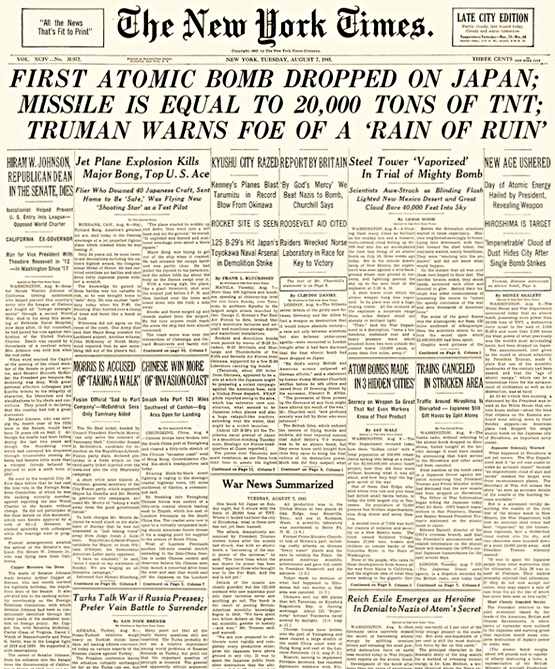
William L. Laurence earned the nickname “Atomic Bill” several times over. He was a Pulitzer-winning New York Times science reporter who became embedded with the Manhattan Project and followed its creation of the first atomic bombs at several sites around the United States. As the first use of the new weapon against Japan neared, seventy-five summers ago, he wrote several lengthy articles glorifying the Bomb and the men who made it, which were published, with overwhelming impact, by his newspaper (and others across the country) starting on August 7, 1945.

Then, on August 9, he observed the atomic bombing of Nagasaki from one of the support planes, another unique experience. Later he wrote about that for the Times – again, an account that required government clearance. It expressed wonderment and pride in the death-dealing device, without concern for the tens of thousands of civilians who died below. As always, Laurence provided colorful depictions of the bomb’s blast and visual effects with little focus on its startling radiation dangers.

Less well-known: Laurence continued his role as chief bomb cheerleader weeks after the Nagasaki bomb exploded.

To that point, U.S. officials had downplayed Japanese casualties in the two atomic cities and largely pooh-poohed Japanese “propaganda” claims on the lingering effects of radiation exposure and accounts of thousands perishing from some new “plague.”  A US general, Thomas Farrell, had toured the ruins in Hiroshima and wrongly claimed Japanese reports of at least 100,000 killed there were wildly inflated – and that only a handful died due to radiation effects.

It was the beginning of the decades-long official suppression of key evidence and falsifications, including the sabotaging – by President Truman and the military – of the first movie drama on the bomb, from MGM, the subject of my new book The Beginning or the End: How Hollywood – and America – Learned to Stop Worrying and Love the Bomb.

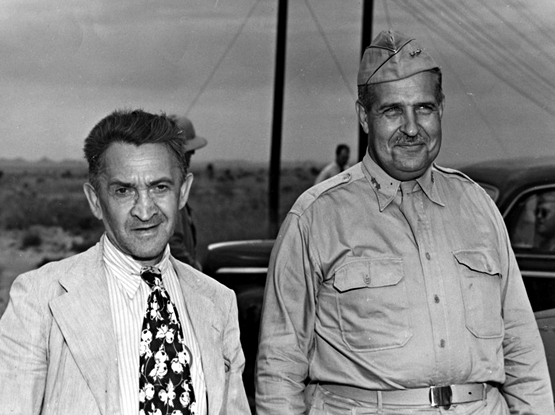
William L. Laurence and General Leslie Groves

On September 9, 1945, Laurence toured the Trinity test site, in New Mexico, where the United States tested its first atomic weapon on July 16, with General Leslie Groves and physicist J. Robert Oppenheimer. The top-secret area finally had been opened to journalists.

Two weeks earlier, President Truman’s secretary, Charles G. Ross, had sent a memo to the War Department urging the military to recruit a group of reporters to explore the test site. “This might be a good thing to do in view of continuing propaganda from Japan,” Ross wrote.

Now General Groves, who believed the reports of radiation disease from Japan were a “hoax,” was personally escorting some of the newsmen near ground zero. His driver, a young soldier named Patrick Stout, spent several minutes in the crater of the blast and was photographed, smiling.

Laurence’s account of this visit (delayed three days until September 12  due to a censorship review) disclosed quite frankly why he and thirty other journalists had been invited: to “give lie to” Japanese “propaganda” that ” radiations were responsible for deaths even after” the Hiroshima attack, as he wrote.   He quoted General Groves calling any deaths by radiation in Japan as “very small.” (In truth, the total was probably 20,000 or more in the two bombed cities.)

General Groves had expressly asked the reporters to assist him in this effort, and they did not disappoint him. (He was also in the process of securing script approval on that MGM movie about the bomb.) Geiger counters showed that surface radiation, after nearly two months, had “dwindled to a minute quantity, safe for continuous human habitation,” Laurence asserted. He did introduce one bit of contrary information: the reporters had been advised to wear canvas overshoes to protect against radiation burns.

But Laurence was keeping a lot to himself. Embedded with the Manhattan Project for months, he was the only reporter who knew about the fallout scare surrounding the Trinity test: scientists in jeeps chasing a radioactive cloud, Geiger counters clicking off the scale, a mule that became paralyzed. Here was the nation’s leading science reporter, severely compromised, not only unable but disinclined to reveal all he knew about the potential hazards of the most important scientific discovery of his time.   In his report he repeatedly used the word “propaganda” to describe Japan’s claims, the debunking of reported symptoms of radiation disease, the explicit claim that the bomb had to be dropped to end the war.

The press tour, in fact, had “an oddly reassuring effect,” the New York Times observed in an editorial. Still, a scientist informed the young soldier, Patrick Stout, who stood in the crater during the press tour, that he had been exposed to dangerous levels of radioactivity. Twenty-two years later Stout became ill and was diagnosed with leukemia. The military, apparently acknowledging radiation as the cause, granted him “service-connected” disability compensation. Stout died in 1969.

W.L. Laurence would win another Pulitzer for his Bomb-related reporting in 1945.

Be seeing you


Posted in Uncategorized | Tagged: , , , , , | Leave a Comment »