A lot of people in their eighties are sharp as a tack. Age slows you down, true. But if you’ve gained wisdom through many years of experience, you can still play the game. The problem with Biden isn’t so much that he’s decrepit and feeble—although those things are highly undesirable in a national leader. It’s that he lacks any semblance of ability, has no judgment, and is devoid of morality and ethics. The world is asking: How degraded are the American people that they could not just elect but are thinking of reelecting, such a pathetic shell?
Trump is only four years younger, but he appears hale and hardy. All this should be academic, however. It should, ideally, make little difference who the president is.
Switzerland is the most prosperous country in Europe, and nobody knows or cares who the president of Switzerland might be. It would be nice if the president of the US was nothing but a figurehead, someone respectable to set a moral tone and give a good example. Perhaps that’s the biggest reason Biden shouldn’t run. He’s almost the antithesis of a role model. Although admittedly superior to his thoroughly degenerate son, who he once identified as the most intelligent man he knew…
What’s your perspective on Trump this time around?
Doug Casey: I did an interview here in 2016 when he first talked of running—and nothing has changed.
He has absolutely no philosophical core; he flies by the seat of his pants. Trump is popular because he’s a traditionalist and a nationalist. He wants the US to return to the values of a kinder and gentler era. However, he’s not a libertarian. He has no understanding of economics, as evidenced by the fact that he wants massive duties on imports. He has no fear of gigantic deficits. He’s fine with borrowing even more money. He’s quite willing to put on regulations when he arbitrarily thinks it’s a good idea…
Kennedy, as I explained before, is basically an old-style “reasonable” Democrat. He believes in a “safety net” (i.e. welfare), regulation, the green agenda, and the rest of it. So does Trump, to a great extent. It’s not that Bannon’s wrong; it’s just that the two of them would always try to overshadow each other. But at least they’re not woke Democrats…
In my view, the Republicans are the stupid party, and the Democrats are the evil party. Given a chance between stupid and evil, you should probably go for stupid. They might be less destructive. Although perversely, since stupidity is amorphous, illogical, and unpredictable, they could be just dangerous in a different way. It’s a classic Hobson’s Choice….
U.S. – Former President Donald Trump has officially been indicted by the federal government on seven counts of not storing highly classified documents in his garage behind a corvette.
“Mr. Trump had these documents securely stored in a closet instead of strewn about the garage. Straight to jail,” said Merrick Garland. “Trump’s failure to haphazardly toss Top Secret documents behind a car is nothing short of treasonous.”
For his part, Mr. Trump has denied all wrongdoing. “I hide all my classified documents behind the best, most beautiful cars at Mar-A-Lago,” said Mr. Trump. “Corvettes are for the poors. Do I look like a poor? Ha! I would never put Top Secret documents behind anything cheaper than a McLaren! What a rube!”
At publishing time, the DOJ announced they would also indict Trump for making a deal with Ukraine without his son receiving millions of dollars in bribes.
Donald Trump and Ron DeSantis are ideologically aligned on most issues in their competition to win the Republican nomination for President of The United States. However, there are some key contrasts that provide a significant distinction between the two political rivals, and most of it has to do with the role of government in the economy.
Bitcoin
Ron DeSantis is unapologetically pro-Bitcoin and more broadly supports the rights of Americans to participate in a voluntary, market-based monetary system. In a Twitter Spaces Thursday evening, the Florida Governor made clear that he supports the use of bitcoin, and articulated why the Washington establishment disapproves of it. “I’ll protect the ability to do things like bitcoin,” he said, adding, “I don’t have an itch to control everything that people may be doing in this space.”
Moreover, Governor DeSantis has more broadly taken on the evolving digital space, drawing a distinction between distributed, decentralized assets like bitcoin, and government-backed tools for control and censorship. In Florida, he has implemented measures to forbid the use of any potential Central Bank Digital Currency (CBDC), warning that these tools can be used to implement a China-like Social Credit Score system in the United States. As governor, DeSantis has taken on the Davos ESG mafia, combatting the centralization of economic corporate and governmental power.
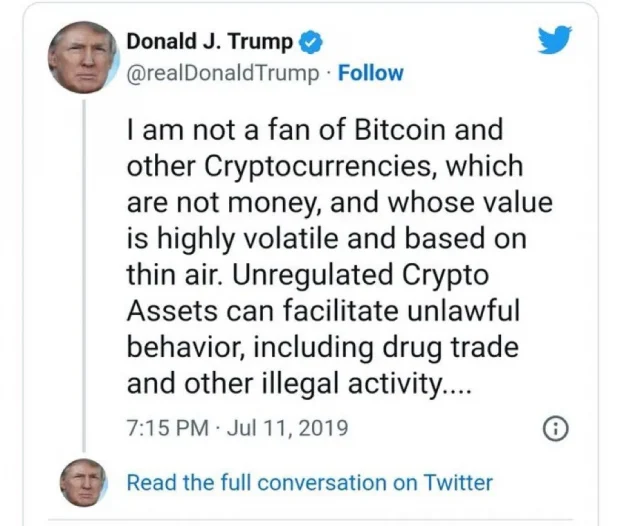
Trump, on the other hand, has long opposed bitcoin, claiming in a 2019 tweet that it is a tool of “unlawful behavior,” and that the government should take a more active role in regulating digital assets.
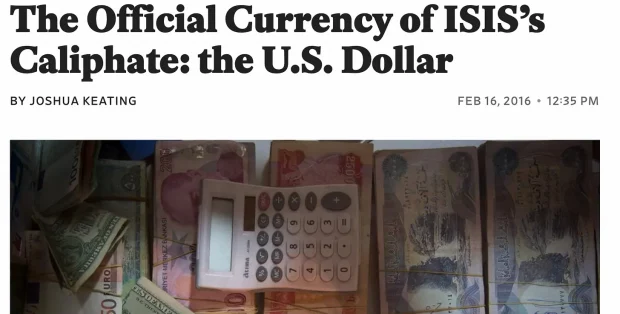
In a 2021 in an interview with Fox News, Trump doubled down on his anti-bitcoin stance, declaring, “Bitcoin just seems like a scam. I don’t like it because it’s another currency competing against the dollar. I want the dollar to be the currency of the world; that’s what I’ve always said.”
President Trump has not publicly spoken about the potential threat posed by a CBDC or any other centralized monetary measures.
The Money Printer/The Fed
The former president has forwarded a convoluted message on monetary policy. On the one hand, he’s called for a return to the gold standard, and even, to his credit, tried to appoint the pro-gold standard Judy Shelton to the Federal Reserve Board. However, for most of his tenure as commander in chief, Trump was heavily in favor of unchecked monetary expansion and the growth of government as a whole.
Trump infamously encouraged Congress to authorize pandemic “emergency” spending of over 2 trillion dollars, and routinely proposed record budgets. These policies led to soaring inflation and the rapid debasement of Americans’ wealth. He ruthlessly attacked Rep Thomas Massie for opposing the money printing fiasco, and later supported an unsuccessful campaign to wage a primary battle against the Kentucky Republican.
For all his righteous condemnation of the “deep state” and the nefarious corporate agenda in politics, Trump’s policies acted to bolster the very forces he publicly opposes.
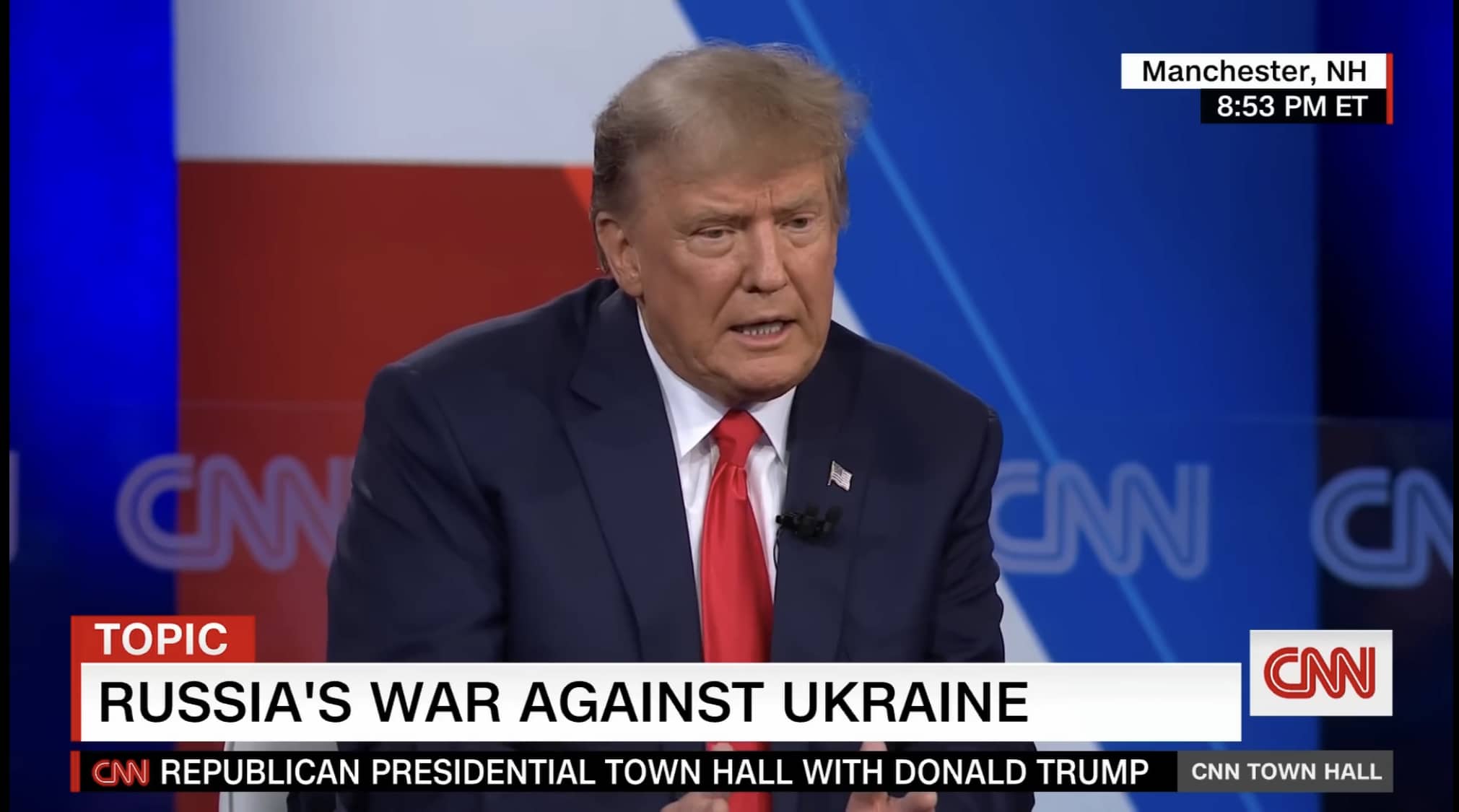
At a CNN town hall on Wednesday evening, the former president and current candidate announced:
“If I’m president, I will have that war settled in one day, 24 hours. I’ll meet with Putin, I’ll meet with Zelensky, they both have weaknesses and they both have strengths, and within 24 hours that war will be settled. It’ll be over…I don’t think in terms of winning or losing. I think in terms of getting it settled so we stop killing all these people and breaking them.”
When CNN anchor Kaitlan Collins asked Trump if he wanted Ukraine or Russia to win this war, he responded, “I want everybody to stop dying. They’re dying, Russians and Ukrainians. I want them stop dying. And I’ll have that done in 24 hours, I’ll have it done. You need the power of the presidency to do it.”
That’s a damn good answer. And a much better one than anyone in the Biden White House has presented for why we’ve spent over a hundred billion dollars to fight a war with Russia.
These corporate press stand-ins never explain what “victory” conditions look like for Ukraine. Volodymyr Zelensky has said his aims include the recapture of Crimea and the decapitation of the Russian state.
But should those be America’s war aims? Should America even be a participant in this Eastern European war? I don’t think so. And I doubt you think so either.
We are eighteen months away from the 2024 United States presidential election, and none of us can say with certainty who will win.
Will Donald Trump return to the Oval Office? Will Joe Biden receive a second term? Will Ron DeSantis or even Robert F. Kennedy Jr. tip over expectations?
My organization, Bring Our Troops Home, does not endorse or campaign for political candidates, so I don’t have a say in those results.
But I am confident, whomever is elected, that a president does not have the power to single-handedly defeat the War Party; the swamp is too deep, the DC bureaucracy too hostile.
The future of our Constitution will not be decided by a single election, but by a decentralized movement which can stop our next endless war before it starts.
WASHINGTON, D.C. — Democrat Congresswoman Nancy Pelosi is calling for a quick conviction of Trump so that we can all see what he’s being charged with.
“Just like we do with our spending bills, we should convict Donald Trump of these charges right away so that we can see what’s in them,” said Pelosi. “Trump has many pages of charges that are probably horrible and we just don’t have time to read them all. Doing it this way is much more efficient!” Pelosi’s statement was then interrupted by her teeth getting stuck in an ice cream bar she was eating.
Sources speculate the list of charges against Trump includes paying hush money to a stripper, colluding with Russia to overthrow the United States government and usher in 1000 years of darkness, and being really yucky and Trump-like. “We don’t need a list of charges to know that Trump is guilty of being Trump,” said Pelosi. “Let’s get this over with already.”
At publishing time Manhattan’s DA had announced 3,000 additional pages of charges were brought in at 1 AM in the morning.
Since he apparently understands the Armageddon possibilities, is it too late for Biden to overcome his Administrative State handlers and stop the situation by cutting off aid to Ukraine and twisting Zelenskyy’s arm hard enough that he’ll pledge not to join NATO?
I’m not a Trump fan — and I’m not fond of Biden either. In fact, following the advice of U.S. founding father James Madison – – – “All men having power ought to be mistrusted” – – – I mistrust all of ’em.
So, with that disclaimer in mind, would there be a war in Ukraine if Trump had been sworn in instead of Biden? I know you probably don’t want to, but the first thing is to try to understand the Russian perspective. The question is, when it comes to NATO, is Putin paranoid?
To save you the trouble of reading “Is Putin Paranoid,” yes, he almost certainly is. And while you may not agree with them, the Russians have their reasons.
In a nut shell, in 1990 when U.S. Secretary of State James Baker III and others — with the equivalent of a gentleman’s hand-shake — promised the Soviet Union’s Mikhail Gorbachov that “NATO would not take even one step closer to Russia’s western border, NATO was 1,000 miles west of Russia’s largest city, St. Petersburg. NATO is now less than 100 miles from St. Petersburg.
Also keep in mind, NATO is run by the only country in history to use nuclear weapons on population centers, having dropped one on Hiroshima and another, three days later, on Nagasaki.
Further, after a CIA engineered Ukranian coup, spearheaded by U.S. operative Victoria Nuland, ousted Russia-friendly Viktor Yanukovych, it became clear that the CIA planned to get Ukraine into NATO. That would put NATO missiles directly on Ukraine’s border with Russia and only 5 minutes travel time to Moscow.
That would automatically put Russian nuclear forces in “ launch on warn” mode, meaning no time to straighten out any mistakes or glitches. That means no brakes on Russia’s retaliation nukes and pretty much the end of the world.
I don’t care how evil the MIC ((Military-Industrial Complex) propaganda machine has convinced you Putin is, if only in the interest of self-preservation, that possibility alone has to give him sleepless nights.
And there are the American HIMARS rocket systems recently delivered to Russian neighbor Poland that could reportedly launch nuclear tipped missiles.
So, yes, he’s almost certainly paranoid.
It seems Mr. Biden understands the situation – – –
The “1962 Crisis” Biden refers to is the Cuban Missile Crisis when “we” came very close to wiping out all life on earth. So, why doesn’t he do something about it?
For example, once you understand, it’s clear this whole mess could have been quite easily avoided in the first place. And, while not nearly as easily, probably still wound-down even now.
Respected Weapons Inspector Scott Ritter put it something like this: “To avoid the whole Ukraine Fiasco, all Ukraine had to do was to agree not to join NATO.”
In retaliation for the hacking of John Podesta and the DNC, Barack Obama expelled 35 Russian diplomats and ordered closure of their country houses on Long Island and Maryland’s Eastern shore.
Foreign Minister Sergei Lavrov warned that 35 U.S. diplomats would be expelled. But Vladimir Putin stepped in, declined to retaliate at all, and invited the U.S. diplomats in Moscow and their children to the Christmas and New Year’s party at the Kremlin.
“A soft answer turneth away wrath, but grievous words stir up anger,” reads Proverbs 15:1. “Great move,” tweeted President-elect Trump, “I always knew he was very smart!”
Among our Russophobes, one can almost hear the gnashing of teeth.
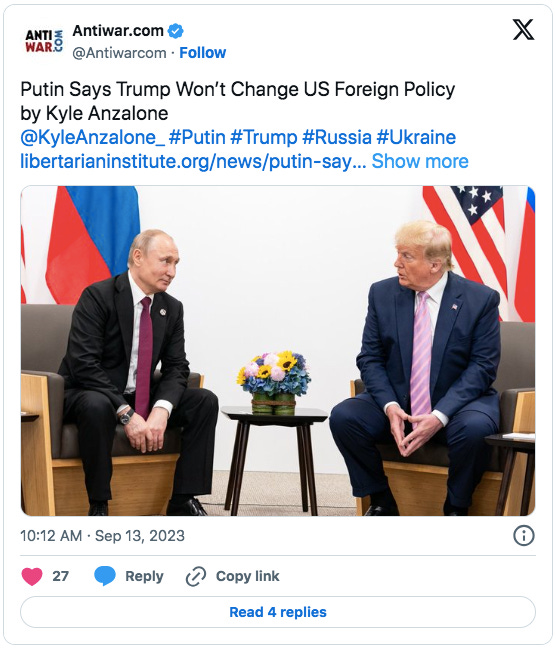
Clearly, Putin believes the Trump presidency offers Russia the prospect of a better relationship with the United States. He appears to want this, and most Americans seem to want the same. After all, Hillary Clinton, who accused Trump of being “Putin’s puppet,” lost.
Is then a Cold War II between Russia and the U.S. avoidable?
That question raises several others.
Who is more responsible for both great powers having reached this level of animosity and acrimony, 25 years after Ronald Reagan walked arm-in-arm with Mikhail Gorbachev through Red Square? And what are the causes of the emerging Cold War II?
Comes the retort: Putin has put nuclear-capable missiles in the Kaliningrad enclave between Poland and Lithuania.
True, but who began this escalation?
George W. Bush was the one who trashed Richard Nixon’s ABM Treaty and Obama put anti-missile missiles in Poland. After invading Iraq, George W. Bush moved NATO into the Baltic States in violation of a commitment given to Gorbachev by his father to not move NATO into Eastern Europe if the Red Army withdrew.
Russia invaded Georgia in 2008, says John McCain.
Russia did, after Georgia invaded its breakaway province of South Ossetia and killed Russian peacekeepers. Putin threw the Georgians out, occupied part of Georgia, and then withdrew.
Russia, it is said, has supported Syria’s Bashar Assad, bombed U.S.-backed rebels and participated in the Aleppo slaughter.
Was it not our Gulf allies, Turkey, and ourselves by backing an insurgency against a regime that had been Russia’s ally for decades and hosts Russia’s only naval base in the Mediterranean?
Did we not exercise the same right of assisting a beleaguered ally when we sent 500,000 troops to aid South Vietnam against a Viet Cong insurgency supported by Hanoi, Beijing and Moscow?
That’s what allies do.
The unanswered question: Why did we support the overthrow of Assad when the likely successor regime would have been Islamist and murderously hostile toward Syria’s Christians?
Russia, we are told, committed aggression against Ukraine by invading Crimea.
But Russia did not invade Crimea. To secure their Black Sea naval base, Russia executed a bloodless coup, but only after the U.S. backed the overthrow of the pro-Russian elected government in Kiev.
Crimea had belonged to Moscow from the time of Catherine the Great in the 18th century, and the Russia-Ukraine relationship dates back to before the Crusades. When did this become a vital interest of the USA?
As for Putin’s backing of secessionists in Donetsk and Luhansk, he is standing by kinfolk left behind when his country broke apart. Russians live in many of the 14 former Soviet republics that are now independent nations.
Has Putin no right to be concerned about his lost countrymen?
Unlike America’s elites, Putin is an ethnonationalist in a time when tribalism is shoving aside transnationalism as the force of the future.
Russia, it is said, is supporting right-wing and anti-EU parties. But has not our National Endowment for Democracy backed regime change in the Balkans as well as in former Soviet republics?
We appear to be denouncing Putin for what we did first.
Moreover, the populist, nationalist, anti-EU and secessionist parties in Europe have arisen on their own and are advancing through free elections.
Sovereignty, independence, a restoration of national identity, all appear to be more important to these parties than what they regard as an excessively supervised existence in the soft-dictatorship of the EU.
In the Cold War between Communism and capitalism, the single-party dictatorship and the free society, we prevailed.
But in the new struggle we are in, the ethnonational state seems ascendant over the multicultural, multiethnic, multiracial, multilingual “universal nation” whose avatar is Barack Obama.
Putin does not seek to destroy or conquer us or Europe. He wants Russia, and her interests, and her rights as a great power to be respected.
He is not mucking around in our front yard; we are in his.
The worst mistake President Trump could make would be to let the Russophobes grab the wheel and steer us into another Cold War that could be as costly as the first, and might not end as peacefully.
Reagan’s outstretched hand to Gorbachev worked. Trump has nothing to lose by extending his to Vladimir Putin, and much perhaps to win.
People across the political spectrum are recognizing multiple, growing threats: escalating Big Tech censorship of our political speech, the costs and corruption of Endless War, the spying of the US security state on American citizens, the dominance of neoliberal globalist institutions. Many believe that Bitcoin, by undermining the power of fiat money and enabling greater anonymity, can erode if not solve many of these problems. Glenn Greenwald speaks to one of the leading Bitcoin advocates, Alex Gladstein of the Human Rights Foundation, about the challenges and critiques of Bitcoin. (The part of their discussion about the environmental impact of Bitcoin will be published as a separate segment). Original Rumble video: https://rumble.com/vr9i0j-why-are-hil… Read Alex’s article: https://bitcoinmagazine.com/culture/b…
Sen Bernie Sanders (I., Vt.) came out against the Twitter ban of former president Donald Trump yesterday. Sanders expressed his discomfort with the role of Big Tech in censorship viewpoints, a sharp departure from his Democratic colleagues who have demanded more such corporate censorship. In an interview on Tuesday with New York Times columnist Ezra Klein, Sanders stated that he didn’t feel “particularly comfortable” with the ban despite his view that Trump is “a racist, sexist, xenophobe, pathological liar, an authoritarian … a bad news guy.” He stated “if you’re asking me do I feel particularly comfortable that the then president of the United States could not express his views on Twitter? I don’t feel comfortable about that.”
I would hope that Sanders would take the same view of a non-sitting president or an average citizen. They should all be able to speak freely. Sanders does not go as far as that “Internet originalist” position, but he at least is recognizing the danger of such censorship. He noted that “we have got to be thinking about, because if anybody who thinks yesterday it was Donald Trump who was banned and tomorrow it could be somebody else who has a very different point of view.” He stated that it is a danger to have a “handful of high tech people” controlling speech in America.
I have long praised Sanders for his principled take on many issues and this dissenting view is most welcomed by those in the free speech community. It is in sharp contrast to his Democratic colleagues who celebrated the ban and called for more censorship. One of the leading voices of censorship in the Senate is Sen. Richard Blumenthal (D., Conn.) chastised Big Tech for waiting so long to issue such bans: “The question isn’t why Facebook & Twitter acted, it’s what took so long & why haven’t others?”
As we have previously discussed, Democrats have abandoned long-held free speech values in favor of corporate censorship. They clearly has a different “comfort zone” than Sanders. What discomforts many Democratic members is the ability of people to speak freely on these platforms and spread what they view as “disinformation.”
When Twitter’s CEO Jack Dorsey came before the Senate to apologize for blocking the Hunter Biden story before the election as a mistake, senators pressed him and other Big Tech executive for more censorship.
In that hearing, members like Sen. Mazie Hirono (D., HI) pressed witnesses like Mark Zuckerberg and Jack Dorsey for assurance that Trump would remain barred from speaking on their platforms: “What are both of you prepared to do regarding Donald Trump’s use of your platforms after he stops being president, will be still be deemed newsworthy and will he still be able to use your platforms to spread misinformation?”
Rather than addressing the dangers of such censoring of news accounts, Senator Chris Coons pressed Dorsey to expand the categories of censored material to prevent people from sharing any views that he considers “climate denialism.” Likewise, Senator Richard Blumenthal seemed to take the opposite meaning from Twitter, admitting that it was wrong to censor the Biden story. Blumenthal said that he was “concerned that both of your companies are, in fact, backsliding or retrenching, that you are failing to take action against dangerous disinformation.” Accordingly, he demanded an answer to this question:
“Will you commit to the same kind of robust content modification playbook in this coming election, including fact checking, labeling, reducing the spread of misinformation, and other steps, even for politicians in the runoff elections ahead?”
“Robust content modification” has a certain appeal, like a type of software upgrade. It is not content modification. It is censorship. If our representatives are going to crackdown on free speech, they should admit to being advocates for censorship. Indeed, leading academics had the integrity recently to declare that they believe that “China is right” about censorship.
Sanders clearly does not believe “China was right,” as least as it applies to a sitting president. Hopefully, Sanders will continue to speak out on free speech and expand on this principled stand to oppose the unrelenting push from Blumenthal and others for corporate controls over speech on the Internet.