
MCViewPoint

Opinion from a Libertarian ViewPoint

Posts Tagged ‘warrants’

Government Agents Routinely Entering Private Land Without Warrants

Posted by M. C. on July 3, 2023

Emboldened by dangerous Supreme Court decision, agents even planting cameras on private property

Note the casual recklessness of that reasoning. The Supreme Court essentially declared that, since some private land is viewable from beyond its boundary — from a road or maybe a plane or hot air balloon — all private land apart from the “curtilage” surrounding a home is fair game for government trespasses and searches.

https://starkrealities.substack.com/p/government-agents-routinely-entering

BRIAN MCGLINCHEY

For many people, a central attraction of owning and living on a multi-acre expanse of land is the opportunity for complete privacy — to include freedom from the prying eyes of government.

While most Americans might understandably believe the Fourth Amendment’s protection against warrantless searches covers all their property, a little-known 1924 Supreme Court decision — Hester v United States — says otherwise. The case struck a major blow against privacy rights, and government agents of all stripes have been exploiting the ruling ever since.

Those exploitations have grown increasingly brazen. Just ask Josh Highlander, whose home sits on a wooded, 30-acre spread east of Richmond, Virginia.

In April, Highlander’s wife and 6-year-old son were playing basketball in their yard. When his wife went to retrieve a long rebound, she spotted a man in full camouflage walking among the trees. Alarmed, she and her son darted inside the house.

Josh Highlander’s wife was frightened when she spotted a fully-camouflaged man through this opening in the woods (Institute for Justice)

When Highlander went outside, he couldn’t locate the man, but did discover that a game camera he’d placed in his food plot was gone. When he called police, he learned the man on his property was an agent of Virginia’s Department of Wildlife Resources (DWR) — one of three who crossed another piece of private land to enter his property. Worse, the same trio had taken his camera, holding no warrant for that action either.

These incidents took place on the first day of turkey season. Before coming to Highlander’s property, DWR agents had also entered two other properties, belonging to his brother and to his father, issuing a citation to his brother for illegally hunting “over bait.” However, the alleged “bait” was seed for his brother’s own food plot, consistent with DWR’s instructions for managing such a plot.

DWR’s violation of Highlander’s liberties didn’t end that day. “For weeks, my son wouldn’t play outside in his own back yard because he was afraid of who might be in the woods,” says Highlander. “My camera was taken two months ago, and I’ve still never received a receipt, a warrant or a ticket.”
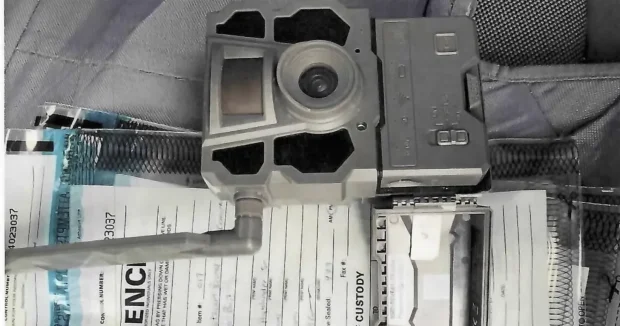
Highlander’s camera was seized by Virginia Department of Wildlife Resources agents acting without a search warrant (Institute for Justice)

This unsettling brand of government misconduct springs from the Supreme Court’s Hester decision.

In that 1924 case arising from the alcohol prohibition, revenue agents saw a man, Hester, exit his father’s house and hand another man a bottle. When the two men became aware of the agents’ presence, they both ran, each dropping a bottle on the Hester property. With no warrant, agents entered the property, examined the bottles and found they contained moonshine whisky.

Supreme Court opinions frequently span upwards of 70 pages or more. With Hester, however, the court took just two paragraphs to decimate the Fourth Amendment’s protection of landowners, with Justice Oliver Wendell Holmes declaring “the special protection accorded by the Fourth Amendment to the people in their ‘persons, houses, papers, and effects,’ is not extended to the open fields.”

And with that, he burdened his fellow citizens with the “open fields doctrine,” which allows warrantless searches and trespassing on land beyond the “curtilage,” a vague term referring to the outdoor area immediately surrounding a home.

Read the Whole Article

Be seeing you

Posted in Uncategorized | Tagged: , , , , | Leave a Comment »

No Warrant, No Problem; How Government Buys Its Way Around the 4th Amendment | The Libertarian Institute

Posted by M. C. on February 27, 2021

But since then, government agencies have devised a new surveillance method: instead of getting warrants to force companies to provide data, they simply purchase the information from brokers. Call it entrepreneurial innovation in the market for tyranny.

https://libertarianinstitute.org/articles/no-warrant-no-problem-how-government-buys-its-way-around-the-4th-amendment/

by Ken Silva

When the Supreme Court ruled in 2018 that law enforcement agencies need warrants before they can request geolocation data from cell phone companies, civil liberties advocates touted the judgment as a major win for privacy.

But since then, government agencies have devised a new surveillance method: instead of getting warrants to force companies to provide data, they simply purchase the information from brokers. Call it entrepreneurial innovation in the market for tyranny.

The scope of this activity has been slowly revealed over the last year, beginning with a February 2020 Wall Street Journal article, which reported that the Department of Homeland Security (DHS) has “bought access to a commercial database that maps the movements of millions of cellphones in American and is using it for immigration and border enforcement.” Later reports revealed that Customs and Border Protection (CBP) and Immigration and Customs Enforcement (ICE) purchase similar data.

Had the world not essentially collapsed about a month later, this might have been big news. Alas, government’s data purchases have gone largely unpublicized in the midst of pandemics, riots, elections, and so on.

Even though geolocation data purchases are a norm in government, there are some public officials who agree with civil libertarians that the programs are unconstitutional. For example, in a memo made public this week, the inspector general for the Department of Treasury criticized the IRS for purchasing location information.

According to the IG’s memo, the IRS subscribed to a geolocation database provided by the data broker Venntel. The inspector general shared his view that the IRS program likely violated the Fourth Amendment and the precedent set by the Supreme Court in Carpenter v. US.

However, the IG’s opinion is far from government consensus. In fact, the IG’s memo notes that the IRS shuttered its geolocation tracking program not because of concerns about its constitutionality, but only because it wasn’t useful—a similar fate to what happened with the NSA’s bulk metadata collection.

Other departments have also expressed the opinion that bulk data purchases are constitutional. The Defense Intelligence Agency said in a memo made public last month that it can buy bulk data because the Supreme Court’s Carpenter decision only applies to law enforcement—and not to intelligence agencies.

“The court did not consider ‘collection techniques involving…national security,’” the memo said. “By extension, the court did not address the process, if any, associated with commercial acquisition of bulk commercial geolocation data for foreign intelligence/counter-intelligence purposes.”

Nor does the Biden Administration seem interested in checking the geolocation tracking programs. When new National Intelligence Director Avril Haines was asked about the programs during her confirmation process, she played lip service to the importance that “American people have an understanding of when, and under what authorities, the government is buying their private data”—but she said nothing about curtailing such surveillance.

If it’s indeed important for Americans to know how they’re being tracked, then it’s unclear why the DSH, CBP and ICE are still contesting a lawsuit from the American Civil Liberties Union to produce records about their geolocation tracking programs. Again, this ACLU lawsuit isn’t even challenging the tracking programs— it’s only trying to wrangle records from them—and yet government is insistent on pursuing litigation that could last years.

By the time the Supreme Court would make any rulings on the geolocation tracking programs, it could be nearing the end of the decade, and government agencies will almost certainly have found another workaround by then.

“If law enforcement agencies can buy their way around the Fourth Amendment’s warrant requirement, the landmark protection announced by the Supreme Court in Carpenter will be in peril,” the ACLU said when announcing its lawsuit in December.

Unfortunately, it’s apparent that the Carpenter decision has long passed the point of peril, taking the entire Fourth Amendment with it.

Be seeing you

Posted in Uncategorized | Tagged: , , , , , | Leave a Comment »