MCViewPoint

Opinion from a Libertarian ViewPoint

Posts Tagged ‘Wind power’

Smart People Say Dumb Things: Bill Gates Edition – American Thinker

Posted by M. C. on May 21, 2021

You might think that having a lot of money frees one from the chains imposed by the need to please one’s employer, friends, family, and social group. But, rarely do rich people take unpopular positions. Trump is one of the few. Rich people are as much slaves to political fashion as anyone else.

The same applies to scientists. It is unusual for a scientist to question popular wisdom among his peers. As for global warming, an employed scientist risks being fired if he expresses skepticism. Global warming fear is the source of vast funding for science.

https://www.americanthinker.com/articles/2021/05/smart_people_say_dumb_things_bill_gates_edition.html

By Norman Rogers

Bill Gates has written a book: How to Avoid a Climate Disaster. Unfortunately, the book is a disaster. He doesn’t get past the introduction before making mistakes that negate the rest of the book. He claims Carbon Dioxide emissions must be reduced to zero to avoid a climate disaster. Assuming that CO2 can even cause a climate disaster, about half the CO2 emitted every year is reabsorbed by the Earth – by the oceans and by plants. Thus, you don’t need zero, a fifty percent reduction would stop the rise of CO2 in the atmosphere. It is vastly more difficult to cut out all emissions compared to cutting them in half.

Gates claims we have to deploy solar and wind faster and smarter. I wrote a book about wind and solar with the title: Dumb Energy. There is no smart deployment of wind and solar. They are very dumb and very, very expensive. It is routine for solar to cost five times more than electricity from natural gas. Heavy solar deployment makes it even more expensive due to the use of auxiliary batteries.

Gates says we need to create and roll out breakthrough technologies. That’s called the pie in the sky.

Bill Gates strikes me as a good guy, especially compared to the nasty guys running Apple, Facebook, and Twitter. He is sincerely trying to help the poor people of the world through his foundation. He is simply out of his depth on climate and is probably talking only to the promoters of climate disaster. There are plenty of scientists that are climate skeptics.

You might think that having a lot of money frees one from the chains imposed by the need to please one’s employer, friends, family, and social group. But, rarely do rich people take unpopular positions. Trump is one of the few. Rich people are as much slaves to political fashion as anyone else.

The same applies to scientists. It is unusual for a scientist to question popular wisdom among his peers. As for global warming, an employed scientist risks being fired if he expresses skepticism. Global warming fear is the source of vast funding for science. The hope is that giving money to the people that perpetrated the fraud can save us from it. Most of the scientists publicly skeptical of global warming are retired or otherwise independent of large institutions that hate dissent.

Gates repeats a fallacious theory that has been debunked many times.

“How do greenhouse gases (mostly CO2) cause warming? The short answer: They absorb heat and trap it in the atmosphere. They work the same way a greenhouse works—hence the name.”

Global warming theory is far more complicated than greenhouses. But we should note that the owners of greenhouses often install CO2 generators to make plants grow better and faster. CO2 greatly benefits agriculture.

Radiation has a central role in the Earth’s climate. Everything with a temperature above absolute zero radiates electromagnetic energy. The radiation from the sun that arrives as sunshine is a consequence of the extremely hot surface of the sun. But even objects at room temperature or even cold objects radiate invisible (to us) infrared radiation.

The considerable energy that is absorbed by the Earth from sunlight does not stay trapped on the Earth. It has to escape back into space or the Earth would heat up without limit. The outgoing radiation that balances the incoming radiation is infrared radiation that mostly originates in the cold upper atmosphere.

The removal of the heat energy from the Earth’s surface initially takes place by convection, hot air rising. Radiation to outer space from the surface of the earth is largely blocked because the atmosphere has limited transparency to infrared radiation. Convection carries the energy upward to a region called the tropopause that is the boundary between the lower atmosphere and the stratosphere – where jet planes fly.

At this high altitude, the atmosphere is thin enough and dry enough that radiation can escape to outer space. The height of the tropopause above the Earth’s surface varies by region and is a function of temperature and humidity. The temperature difference between the surface and the tropopause is controlled by the lapse rate, a measure of how fast the atmosphere cools with altitude. The lapse rate is sensitive to the amount of water vapor in the air. If the tropopause rises higher while the lapse rate remains the same, then the surface of the Earth must be hotter because the same rate of cooling is stretched over a greater distance. Adding CO2 to the atmosphere, particularly to the stratosphere, will make the tropopause rise enough for the thinning of the atmosphere to compensate for the infrared radiation blocking properties of CO2. There is little reason to believe that the average lapse rate is frozen at a certain level as global warming theory assumes.

That is the real, complicated theory of global warming. Global warming won’t happen unless a lot of conditions are satisfied. Something that is not likely.

See the rest here

Be seeing you

Posted in Uncategorized | Tagged: , , , , , , | Leave a Comment »

Wind Power Is a Disaster in Texas, No Matter What Paul Krugman Says | Mises Wire

Posted by M. C. on March 10, 2021

https://mises.org/wire/wind-power-disaster-texas-no-matter-what-paul-krugman-says

Robert P. Murphy

In the wake of February’s tragic power outages in Texas, during which 4.5 million households suffered service interruptions, partisans on both sides have been quick to interpret the events as confirmation of their preferred energy policies. With news images of helicopters deicing frozen turbines, conservatives lambasted Texas’s increasing reliance on wind power as the villain in the story.

Trying to temper this knee-jerk reaction, Reason.com columnist Ron Bailey argued that “[m]ost of the shortfall in electric power generation during the current cold snap is the result of natural gas and coal powered plants going offline.” And Paul Krugman for his part declared that it was a “malicious falsehood” to blame wind and solar power for what happened in Texas, as it was primarily a failure of natural gas.

In this article I’ll lay out the basic facts of which power sources stepped up to the plate during the crisis. Contrary to what you would have known from reading Ron Bailey (let alone Paul Krugman), when the Texas freeze hit, electricity from natural gas skyrocketed while wind output fell off a cliff. The people arguing that wind wasn’t to blame mean it in the same way Jimmy Olson wasn’t to blame when General Zod took over: wind is so useless nobody serious ever thought it might help in a crisis.

Krugman on Texas Electricity

In his February 18 column titled “Texas, Land of Wind and Lies,” Krugman declared that

Republican politicians and right-wing media … have coalesced around a malicious falsehood instead: the claim that wind and solar power caused the collapse of the Texas power grid, and that radical environmentalists are somehow responsible for the fact that millions of people are freezing in the dark …

In contrast to this dirty rotten lie from the right-wingers, Krugman instead explains:

A power grid poorly prepared to deal with extreme cold suffered multiple points of failure. The biggest problems appear to have come in the delivery of natural gas, which normally supplies most of the state’s winter electricity, as wellheads and pipelines froze.

A bit later in the article Krugman admits that wind was involved as well, but minimizes its role in this way:

It’s true that the state generates a lot of electricity from wind, although it’s a small fraction of the total. But that’s not because Texas—Texas!—is run by environmental crazies. It’s because these days wind turbines are a cost-effective energy source wherever there’s a lot of wind, and one thing Texas has is a lot of wind.

It’s also true that extreme cold forced some of the state’s insufficiently winterized wind turbines to shut down, but this was happening to Texas energy sources across the board, with the worst problems involving natural gas.

Incidentally, there are literally no numbers in Krugman’s article (except for numerals referring to dates), which is a signal that he’s pulling a fast one on his readers. From his qualitative (not quantitative) description, most people would have assumed that when the unusually cold weather hit Texas last month, electricity generation from various sources was down across the board, but that it mostly fell from natural gas, while the drop in wind was insignificant. As I’ll show in the next section, this is utterly false.

What Really Happened During Texas’s Power Crisis

Had I not seen the analysis from my former colleagues at the Institute for Energy Research (see their articles here and here), I might have believed the spin that the Texas crisis was really a failure of fossil fuels rather than renewables. Yet as we’ll see, the actual numbers tell a much different story from what most Americans probably “learned” from the media discussion.

The simplest way for me to communicate the relevant information is through three infographics, generated from the Energy Information Administration’s handy tool that shows the source mix for daily energy generation by state.

Before showing the numbers, I need to make an important clarification: the demand for electricity soared to unprecedented levels during the freeze. In particular, on February 14, peak demand on the electric grid surpassed sixty-nine gigawatts, breaking the previous winter record of (almost) sixty-six gigawatts set in 2018. It was in the early hours of the following morning (February 15) that the Electric Reliability Council of Texas (ERCOT) implemented rolling blackouts to prevent the entire grid from collapsing. So to be clear, the issue wasn’t that supply in an absolute sense fell, but rather that demand soared. (Texas typically uses more electricity in the summer to keep things cool, rather than in the winter to keep things warm.)

With that context in place, here are the stats for electricity output from various sources on February 15, 2021:

2021.03_texas_feb_15_2021.png

texas power feb 15 2021

Already we see something interesting. Of the total amount of electricity delivered on this first day of blackouts, 65 percent came from natural gas, while only 6 percent came from wind and 2 percent from solar.

But in fairness, maybe what guys like Krugman meant is that this is much lower than what we normally could expect from natural gas. (Remember Krugman had said that natural gas “normally supplies most of the state’s winter electricity.”)

To test this possibility, we can look at the situation one year prior, on February 15, 2020:

2021.03_texas_feb_15_2020.png

texas power feb 15 2020

Now, this is interesting. A year earlier, during a normal mid-February day, natural gas “only” supplied 43 percent of the total electricity, whereas wind accounted for 28 percent and solar was the same at 2 percent. Remember how Krugman said wind was only a “small fraction” of Texas generation? Overall for the year 2020, wind produced 22 percent of Texas’s electricity, a higher share than coal.

Yet besides the proportions, also look at the absolute quantity of electricity generated: on Feb. 15, 2020, natural gas produced 398,130 megawatt hours (compared to 759,708 MWh during the recent freeze), while wind produced 264,024 MWh (compared to 73,395 MWh during the freeze).

To sum up, compared with the same date a year earlier, during the first day of the blackouts in Texas, electricity from natural gas was 91 percent higher, while electricity from wind was 72 percent lower.

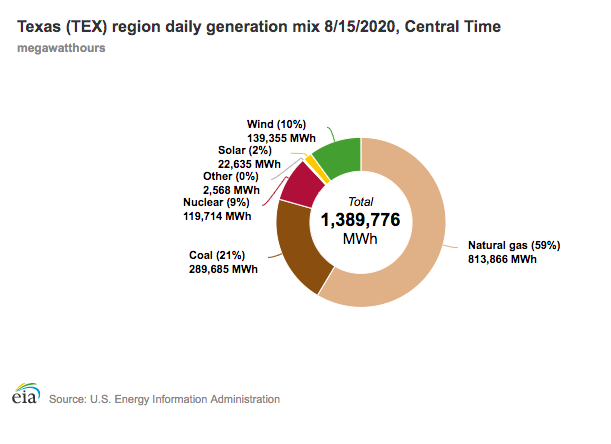
To reiterate the clarification I gave earlier, part of the confusion here is that electricity demand in February isn’t normally as high as it was because of the freeze. So to test whether natural gas is the culprit, we can compare the generation from various sources during the freeze to the situation back during the summer. For example, let’s look at how things stood on August 15, 2020:

2021.03_texas_aug_15_2020.png

texas power august 15 2020

As our date occurred in the dog days of summer, total electric demand was higher in mid-August 2020 than on February 15, 2021.

See the rest here

Author:

Contact Robert P. Murphy

Robert P. Murphy is a Senior Fellow with the Mises Institute. He is the author of many books. His latest is Contra Krugman: Smashing the Errors of America’s Most Famous KeynesianHis other works include Chaos Theory, Lessons for the Young Economist, and Choice: Cooperation, Enterprise, and Human Action (Independent Institute, 2015) which is a modern distillation of the essentials of Mises’s thought for the layperson. Murphy is cohost, with Tom Woods, of the popular podcast Contra Krugman, which is a weekly refutation of Paul Krugman’s New York Times column. He is also host of The Bob Murphy Show.

Be seeing you

Posted in Uncategorized | Tagged: , , , , | Leave a Comment »

What’s Wrong with Wind and Solar?

Posted by M. C. on February 3, 2021

Lots.

Be seeing you

Posted in Uncategorized | Tagged: , | Leave a Comment »

California’s Looming ‘Green New Car Wreck’ | Watts Up With That?

Posted by M. C. on October 3, 2020

And it isn’t just me saying this. The U.S. Environmental Protection Agency (EPA) agrees. In a letter sent by EPA Administrator Andrew Wheeler to Gavin Newsom on September 28, Wheeler wrote:

“[It] begs the question of how you expect to run an electric car fleet that will come with significant increases in electricity demand, when you can’t even keep the lights on today.

“The truth is that if the state were driving 100 percent electric vehicles today, the state would be dealing with even worse power shortages than the ones that have already caused a series of otherwise preventable environmental and public health consequences.”

https://wattsupwiththat.com/2020/10/02/californias-looming-green-new-car-wreck/

Anthony Watts

Governor Newsom announces major climate initiative, September 23, 2020. (Screenshot via California Gavin Newsom)

On September 23, California Gov. Gavin Newsom issued an executive order that will ban the sale of gasoline-powered cars in the Golden State by 2035. Ignoring the hard lessons of this past summer, when California’s solar- and wind-reliant electric grid underwent rolling blackouts, Newsom now adds a huge new burden to the grid in the form electric vehicle charging. If California officials follow through and enforce Newsom’s order, the result will be a green new car version of a train wreck.

Let’s run some numbers. According to Statista, there are more than 15 million vehicles registered in California. Per the U.S. Department of Energy, there are only 256,000 electric vehicles registered in the state—just 1.7 percent of all vehicles.

Using the Tesla Model3 mid-range model as a baseline for an electric car, you’ll need to use about 62 kilowatt-hours (KWh) of power to charge a standard range Model 3 battery to full capacity. It will take about eight hours to fully charge it at home using the standard Tesla NEMA 14-50 charger.

Now, let’s assume that by 2040, five years after the mandate takes effect, also assuming no major increase in the number of total vehicles, California manages to increase the number of electric vehicles to 25 percent of the total vehicles in the state. If each vehicle needs an average of 62 kilowatt-hours for a full charge, then the total charging power required daily would be 3,750,000 x 62 KWh, which equals 232,500,000 KWh, or 232.5 gigawatt-hours (GWh) daily.

Utility-scale California solar electric generation according to the energy.ca.gov puts utility-scale solar generation at about 30,000 GWh per year currently. Divide that by 365 days and we get 80 GWh/day, predicted to double, to 160 GWh /day. Even if we add homeowner rooftop solar, about half the utility-scale, at 40 GWh/day we come up to 200 GW/h per day, still 32 GWh short of the charging demand for a 25% electric car fleet in California. Even if rooftop solar doubles by 2040, we are at break-even, with 240GWh of production during the day.

Bottom-line, under the most optimistic best-case scenario, where solar operates at 100% of rated capacity (it seldom does), it would take every single bit of the 2040 utility-scale solar and rooftop capacity just to charge the cars during the day. That leaves nothing left for air conditioning, appliances, lighting, etc. It would all go to charging the cars, and that’s during the day when solar production peaks.

But there’s a much bigger problem. Even a grade-schooler can figure out that solar energy doesn’t work at night, when most electric vehicles will be charging at homes. So, where does Newsom think all this extra electric power is going to come from?

The wind? Wind power lags even further behind solar power. According to energy.gov, as of 2019, California had installed just 5.9 gigawatts of wind power generating capacity. This is because you need large amounts of land for wind farms, and not every place is suitable for high-return wind power.

In 2040, to keep the lights on with 25 percent of all vehicles in California being electric, while maintaining the state mandate requiring all the state’s electricity to come from carbon-free resources by 2045, California would have to blanket the entire state with solar and wind farms. It’s an impossible scenario. And the problem of intermittent power and rolling blackouts would become much worse.

And it isn’t just me saying this. The U.S. Environmental Protection Agency (EPA) agrees. In a letter sent by EPA Administrator Andrew Wheeler to Gavin Newsom on September 28, Wheeler wrote:

“[It] begs the question of how you expect to run an electric car fleet that will come with significant increases in electricity demand, when you can’t even keep the lights on today.

“The truth is that if the state were driving 100 percent electric vehicles today, the state would be dealing with even worse power shortages than the ones that have already caused a series of otherwise preventable environmental and public health consequences.”


California’s green new car wreck looms large on the horizon. Worse, can you imagine electric car owners’ nightmares when California power companies shut off the power for safety reasons during fire season? Try evacuating in your electric car when it has a dead battery.

Gavin Newsom’s “no more gasoline cars sold by 2035” edict isn’t practical, sustainable, or sensible. But isn’t that what we’ve come to expect with any and all of these Green New Deal-lite schemes?

I acknowledge the help of Willis Eschenbach in checking the numbers for this article.


Anthony Watts is a senior fellow for environment and climate at The Heartland Institute. He is also an owner of an electric vehicle in California.

Be seeing you

Posted in Uncategorized | Tagged: , , , , , | Leave a Comment »

The Real Cost of Wind and Solar – American Thinker

Posted by M. C. on September 30, 2020

Adding wind or solar to a grid does not mean that existing fossil fuel plants can be retired. Often, neither wind nor solar is working and at those times a full complement of fossil fuel plants, or sometimes nuclear or hydro plants, must be available.

No utility would buy $80 renewable electricity to replace $15 fossil fuel electricity. A stand-alone, enterprise wind or solar plant would be a huge economic failure because there would be no market for overpriced electricity. The entire renewable electricity industry is actually a government boondoggle. Neither, is renewable electricity an economic method for reducing CO2 emissions as has been made clear by the most important proselytizers for global warming such as Climate Scientists for Nuclear.

https://www.americanthinker.com/articles/2020/09/the_real_cost_of_wind_and_solar.html

By Norman Rogers

The main problem with either wind or solar is that they generate electricity erratically, depending on the wind or sunshine. In contrast, a fossil-fuel plant can generate electricity predictably upon request. Blackouts are very expensive for society, so grid operators and designers go to a lot of trouble to make sure that blackouts are rare. The electrical grid should have spare capacity sufficient to meet the largest demand peaks even when some plants are out of commission.  Plants in spinning reserve status stand by ready to take over if a plant trips (breaks down). Injecting erratic electricity into the grid means that other plants have to seesaw output to balance the ups and downs of wind or solar.

Adding wind or solar to a grid does not mean that existing fossil fuel plants can be retired. Often, neither wind nor solar is working and at those times a full complement of fossil fuel plants, or sometimes nuclear or hydro plants, must be available. Both wind and solar have pronounced seasonality. During low output times, as for summer wind, the fossil-fuel plants are carrying more of the load. Of course, solar stops working as the sun sets.

Wind behaves erratically hour to hour. Even though the Texas 18,000-megawatt system has thousands of turbines spread over a wide area, the net output is erratic changing by thousands of megawatts in a single hour. These shifts must be balanced by fossil-fuel plants slewing their output up and down to compensate and keep load matched to generation.

Even very sunny southwest cities have 50 or more cloudy days per year, stopping or reducing solar generation. Wind turbines are very sensitive to wind speed. A 10% change in wind speed will change power output by 30%, amplifying the erratic nature of wind.

The big picture is that when wind or solar is added to a grid it is supplemental power. No coal or gas plants are eliminated. Those plants have to stay in place to handle periods when wind and solar are not producing electricity. This does not stop claims that wind or solar is replacing fossil fuel, but it is fuel that is replaced, not fossil-fuel plants. When wind or solar is producing, the fossil fuel plants are throttled back and they use less fuel. If, for example, a coal plant was closed when wind was added to the grid, the safety margin would be compromised.

Viewed from the effect on the economy, adding wind or solar electricity provides the benefit of reduced fuel consumption in backup fossil fuel plants. This saving in fuel amounts to about $15 per megawatt hour, the cost of natural gas to generate a megawatt hour of electricity.  The cost of coal is similar. The backup fossil-fuel plant still has to have its full staff and may have more costly maintenance due to the up-down style of operation forced by the introduction of erratic energy. If the renewable energy costs more than $15 per megawatt hour, then it is not competitive. Wind or solar power actually costs around $80 per megawatt hour.

How can I claim that wind or solar cost $80 when power purchase agreements at $25 per megawatt hour are often touted in the press? Even at $25 the wind or solar is far from competitive. The gap between $80 and $25 is accounted for by subsidies. The $10 difference between $25 and $15 is also a subsidy because the purchaser is paying $25 for the electricity that could be generated in a backup fossil fuel plant, that already exists and that must exist, for $15. What are the subsidies that lower the $80 cost to the publicized $25?

The biggest and most important subsidy is not an explicit subsidy but a mandate. Thirty states have renewable portfolio standards. These are laws that require the utilities to supply a certain percentage of renewable power. For example, California has a law that 60% of its power must be renewable by 2030. The consequence of the mandate is that the utility has to grant whatever terms are required to convince investors to build the renewable power plants. In practice this results in the utility promising to purchase all the power generated for 25 years at a fixed rate. The contract is signed before a shovel of dirt is moved. Forcing utilities to buy renewable power puts the suppliers of renewable power in an advantageous position. The subsidy that reduces the cost from $80 to $25 are federal explicit subsidies, better financing, and lower required rate of return that results from having a 25-year contract in hand from a credit worthy utility. There is a federal tax credit that pays up to 30% of the plants cost. Additionally, there is a tax subsidy called tax equity financing that allows a highly taxed partner to the investor to divert money from the federal treasury to the project. This subsidy depends on special depreciation rules enacted by congress to subsidize renewable energy.

Wind or solar does not use fuel. The cost of the electricity is mostly determined by the capital cost amortized over the life of the plant. That in turn depends on the interest rate or discount factor. That factor is dramatically better due to the 25-year contract. If you take away the subsidies, renewable electricity, wind or solar, will cost about $80 per megawatt hour. Such comparisons are still dubious because there are no unsubsidized, utility-scale wind or solar plants. No utility would buy $80 renewable electricity to replace $15 fossil fuel electricity. A stand-alone, enterprise wind or solar plant would be a huge economic failure because there would be no market for overpriced electricity. The entire renewable electricity industry is actually a government boondoggle. Neither, is renewable electricity an economic method for reducing CO2 emissions as has been made clear by the most important proselytizers for global warming such as Climate Scientists for Nuclear.

Norman Rogers write often about renewable energy. His Inconvenient Facts About Dumb Renewable Energy is here.

Be seeing you


Posted in Uncategorized | Tagged: , , , | Leave a Comment »