MCViewPoint

Opinion from a Libertarian ViewPoint

Posts Tagged ‘World War I’

Woodrow Wilson

Posted by M. C. on April 2, 2025

And WW campaigned on a NON-intervention platform.

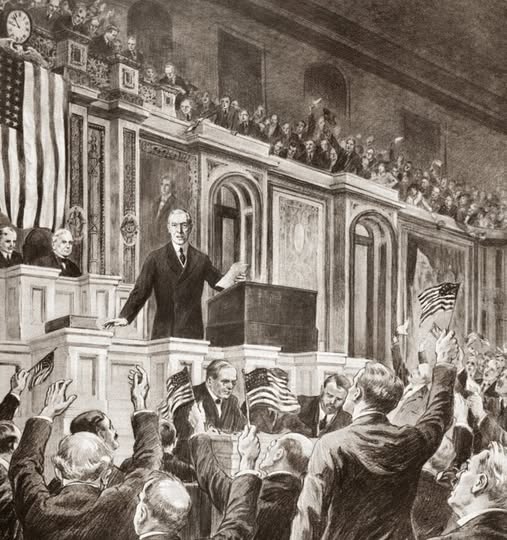
On this day, April 2, 1917, President Woodrow Wilson stood before Congress and urged a declaration of war against Germany, pulling the United States into World War I. He painted it as a moral imperative, but the U.S. had no vital interest in Europe’s brutal stalemate—submarine threats and alliances didn’t justify the cost. Over 116,000 Americans perished, millions more were wounded, and the nation racked up debt for a war that ended in a harsh treaty, planting seeds for WWII.

This wasn’t our fight; it was an unnecessary plunge into foreign chaos. The Libertarian Party of Pennsylvania condemns such interventions. Wars abroad don’t protect liberty—they expand government and squander lives. We thrive by staying out of distant battles, not by joining them.

Be seeing you

Posted in Uncategorized | Tagged: , | Leave a Comment »

Bankers, Fed Origins, and World War I

Posted by M. C. on December 2, 2024

Let me issue and control a nation’s money and I care not who writes the laws.—Rothschild

The American people are suckers for the word “reform.” You just put that into any corrupt piece of legislation, call it “reform” and people say “Oh, I’m all for ‘reform,’” and so they vote for it or accept it.”—G. Edward Griffin

The real truth of the matter is, as you and I know, that a financial element in the larger centers has owned the Government ever since the days of Andrew Jackson…—FDR

Of all people, FDR should know.

https://mises.org/mises-wire/bankers-fed-origins-and-world-war-i

Mises WireJoshua Mawhorter

Though there had been steady steps toward centralization of the monetary and financial system in the United States—especially since banking and the federal government were connected by the National Banking System during and after the Civil War (ca. 1863-1913)—the financial-banking elite, especially in New York, still had several complaints prior to the creation of the Fed.

New York Banks, Wall Street, and “Monopoly”

The movement toward central banking, the Federal Reserve System, in America was a keystone of the Progressive movement. Like all other regulations and reforms of the Progressive era—as perfectly encapsulated by G. Edward Griffin’s quote above—the movement toward the Fed was ironically presented publicly as fighting banking “monopoly,” “stabilizing” the system, curbing inflationism, and disciplining banks and financial elites. In fact, it would involve the establishing of a monopoly in the name of fighting monopoly. Consequently, this would furnish government a handy tool for greater inflationism and would allow the banks in the system to engage in unsound monetary practices with the promise of government bailouts. Remarks Rothbard in A History of Money and Banking,

Fortunately for the cartelists, a solution to this vexing problem lay at hand. Monopoly could be put over in the name of opposition to monopoly! In that way, using the rhetoric beloved by Americans, the form of the political economy could be maintained, while the content could be totally reversed.

Banker Complaints

Prior to the establishment of the Federal Reserve, however, the movement toward centralization of the monetary and financial system was incomplete from the bankers’ perspective. The financial interests were still missing a few key factors and still observed major “flaws.” In summary, their main complaint was “inelasticity,” that is, banks within the national banking system were not able to expand money and credit to the extent that they wanted. These financial elites disliked the lack of complete centralization provided through the halfway step of the National Banking System, the lack of cartelization, competitive pressures from non-national banks, and the threat to New York banks’ financial supremacy. Regarding the New York financial interests, Ron Paul and Lehrman, in their Case for Gold (1982), avow,

…the large banks, particularly on Wall Street, saw financial control slipping away from them. The state banks and other non-national banks began to grow instead and outstrip the nationals.

Similarly, Gabriel Kolko in The Triumph of Conservatism (1977), argues,

The crucial fact of the financial structure at the beginning of this century was the relative decrease in New York’s financial significance and the rise of many alternate sources of substantial financial power.

For example, throughout the 1870s and 1880s, most of the banks were national banks, with financial standards determined by Washington, but by 1896, non-national banks—state banks, savings banks, and private banks—made up 61 percent of the total number of banks, providing competitive pressure. By 1913, 71 percent of banks were non-national banks, again putting competitive pressure on Wall Street banks. This was unacceptable to the national banks, especially the New York financial-banking elite. Kolko writes that, “This diffusion and decentralization in the banking structure seriously undercut New York’s financial supremacy.” Regarding the fundamental changes brought about by Federal Reserve System, Kolko further explains,

The economy by 1910 had moved well beyond the control of any city, any group of men, or any alliance then existing in the economy. The control of modern capitalism was to become a matter for the combined resources of the national state, a political rather than an economic matter.

The Panic of 1907, in which major banks were allowed by the government to suspend specie payments and continue operations—being legally released from contractual obligations—led to calls for “reform,” naively agitating for central banking. Unfortunately, these so-called “reforms” would facilitate the most powerful banks engaging in similar inflationary practices, but on a greater scale, insulated from the consequences by the government. Rothbard explains,

Very quickly after the panic, banker and business opinion consolidated on behalf of a central bank, an institution that could regulate the economy and serve as a lender of last resort to bail banks out of trouble.

The banks plus the government partnered to create these boom-bust crises through their inflationary policies through the National Banking System. Then, when the inevitable consequences of these policies were realized, banks and governments would further “reform” the system toward a central bank, legally uniting them, and protecting them from competition and consequences. Problems caused by monetary policies of the government, allied with banks, were to be solved, Americans were told, by the government creating a “bank of banks” that could regulate the entire monetary system.

Central Banking & World War I

See the rest here

Be seeing you

Posted in Uncategorized | Tagged: , , , , , | Leave a Comment »

The Story of the Christmas Truce of 1914—and Its Eternal Message – Foundation for Economic Education

Posted by M. C. on December 24, 2022

https://fee.org/articles/the-story-of-the-christmas-truce-of-1914-and-its-eternal-message/

Jon Miltimore
Jon Miltimore

War had already been waging in Europe for months when Pope Benedict issued a plea from Rome on Dec. 7, 1914 to leaders of Europe: declare a Christmas truce.

Benedict saw how badly peace was needed, even if it was only for a day. The First Battle of Ypres alone, fought from October 19 to November 22, had resulted in some 200,000 casualties (mostly German and French soldiers, but also thousands of English and Belgians). The First Battle of the Marne was even worse

In light of this carnage, the pope asked “that the guns may fall silent at least upon the night the angels sang.” 

The European leaders ignored his plea. 

Then something miraculous happened on the eve of Christmas. From No Man’s Land—the area between the trench works of Allied and Central forces—German troops, in a spontaneous act, put down their weapons and invited English soldiers to celebrate Christmas with them. It’s remembered today as the Christmas Truce.

The British cartoonist Bruce Bairnsfather was one of many who chronicled the event. A machine gunner in the 1st Battalion of the Royal Warwickshire Regiment, Bairnsfather was shivering in the muck of a three-foot trench on a cold night, munching on stale biscuits and chain-smoking, when he heard a noise at about 10 p.m. Via History:

“I listened,” he recalled. “Away across the field, among the dark shadows beyond, I could hear the murmur of voices.” He turned to a fellow soldier in his trench and said, “Do you hear the Boches [Germans] kicking up that racket over there?” “Yes,” came the reply. “They’ve been at it some time!” 

The Germans were singing carols, as it was Christmas Eve. In the darkness, some of the British soldiers began to sing back. “Suddenly,” Bairnsfather recalled, “we heard a confused shouting from the other side. We all stopped to listen. The shout came again.” The voice was from an enemy soldier, speaking in English with a strong German accent. He was saying, “Come over here.”

After some back and forth talk, British troops laid down their weapons, climbed out of their trenches, crossed the barbed wire, and joined the Germans. They traded handshakes and songs; they chewed tobacco and drank wine and laughed together—these men who earlier that day had been doing their best to kill each other.

Some accounts describe German and British soldiers playing “football” (soccer) on makeshift fields. Others mention British soldiers setting up barbershops and offering haircuts in exchange for cigarettes. The one thing all the accounts have in common is a general feeling of merriment among the soldiers.

“There was not an atom of hate on either side,” Bairnsfather recalled.

Afterwards, not everyone was pleased with the gaiety. Some military leaders reportedly seethed over the Christmas truce. But Bairnsfather suggests the soldiers themselves cherished the moment, which they sorely needed.   

“For those who participated, it was surely a welcome break from the hell they had been enduring. When the war had begun just six months earlier, most soldiers figured it would be over quickly and they’d be home with their families in time for the holidays. Not only would the war drag on for four more years, but it would prove to be the bloodiest conflict ever up to that time.”

I’ve always found the Christmas Truce moving, and also telling. While the leaders of Europe may have loathed one another, the German and English people clearly did not, at least not once they met one another.

On that Christmas night, the nationalism that had divided German and British soldiers evaporated when they met face-to-face, traded, laughed, drank, and discovered their common humanity. 

I recently read Stille Nacht (Silent Night): The Story of the Christmas Truce—a new children’s book written by Rory Margraf—to my youngest son. He had many questions, but mostly he wanted to know why the soldiers were fighting in the place. (I suspect many soldiers—Belgians and Germans, French, Englishmen, and beyond—themselves wondered this very same thing many times during that war.)

I didn’t have a good answer for him. But I’ve thought on the matter some since, and I think the Christmas Truce holds a clue about why we fight.  

People who for weeks and months had been shooting and bombing one another found themselves laughing, singing, and trading—and they did so because they defied their orders. The sad truth is nation-states—which throughout history have done a magnificent job of convincing humans that people they never met are their enemy—often are not particularly interested in peace. 

“War is the health of the state,” the radical writer Randolph Bourne famously noted.  

The truth is waging war is what government does best, and the people who wage them and win are the ones lauded in the history books. The losers, of course, are not; which makes winning a war that has begun all the more important. (It’s also important to point out that the people who declare wars rarely see their own blood spilled during them.) 

I don’t wish to oversimplify something as serious and terrible as war, but I do wish to demonstrate there is another way. The Christmas Truce shows us that peace is achieved by rejecting statism and nationalism and collectivism in all forms; it is won by embracing our common humanity and the things that bring us together.

Even bitter enemies can become friends when we reject violence and see people as they truly are—as individuals. (Especially on Christmas, a holiday that celebrates the birth not of a conqueror, but of a lamb.)

The British and German troops who on Christmas Eve enjoyed one night of joy amid the carnage of 1914 could attest to that.

Be seeing you

Posted in Uncategorized | Tagged: , , | Leave a Comment »

World War I: The Great War Was also the Great Enabler of Progressive Governance

Posted by M. C. on November 19, 2022

While the war industries were poised to rake in record profits, Marine major general Smedley Butler, who was awarded his second Congressional Medal of Honor in 1917, provides details on the fighting men’s share in this bonanza:

https://mises.org/wire/world-war-i-great-war-was-also-great-enabler-progressive-governance

George Ford Smith

Commentaries about World War I frequently discuss causes and consequences but almost never mention the enablers. At best, they might mention them approvingly, as if we were fortunate to have had the Fed and the income tax, along with the ingenuity of the liberty bond programs, to finance our glorious role in that bloodbath.

Economist Benjamin Anderson, whose Economics and the Public Welfare has contributed greatly to our understanding of the period 1914–46 and is a book I highly recommend, nevertheless takes as a given that the Fed and the income tax had a job to do, and that job was supporting US entry into World War I. After citing figures purporting to show how relatively restrained bank credit expansion was during the war, Anderson writes:

We had to finance the Government with its four great Liberty Loans and its short-term borrowing as well. We had to transform our industries from a peace basis to a war basis. We had to raise an army of four million men and send half of them to France. We had to help finance our allies in the war, and above all, to finance the shipment of goods to them from the United States and from a good many neutral countries.

We had to do none of these things. Only the government made them necessary, and the government was not acting on behalf of its constituents when it formally entered the war in April 1917. The US was not under serious threat of attack. The population at large, Ralph Raico tells us, “acquiesced, as one historian has remarked, out of general boredom with peace, the habit of obedience to its rulers, and a highly unrealistic notion of the consequences of America’s taking up arms.” He reports:

In the first ten days after the war declaration, only 4,355 men enlisted; in the next weeks, the War Department procured only one-sixth of the men required.

Bored with peace they may have been, but it was hardly reflected in the number of volunteers.

Winners and Losers

See the rest here

Be seeing you

Posted in Uncategorized | Tagged: , , | 1 Comment »

[Essay] The Old Normal, by Andrew J. Bacevich | Harper’s Magazine

Posted by M. C. on July 8, 2020

For the United States today, the problem turns out to be similar to the one that beset the nation during the period leading up to World War II: not isolationism but overstretch, compounded by indolence. The present-day disparities between our aspirations, commitments, and capacities to act are enormous.

The core questions, submerged today as they were on the eve of U.S. entry into World War II, are these: What does freedom require? How much will it cost? And who will pay?

https://harpers.org/archive/2020/03/the-old-normal-united-states-addiction-to-war-andrew-bacevich/

Why we can’t beat our addiction to war

By

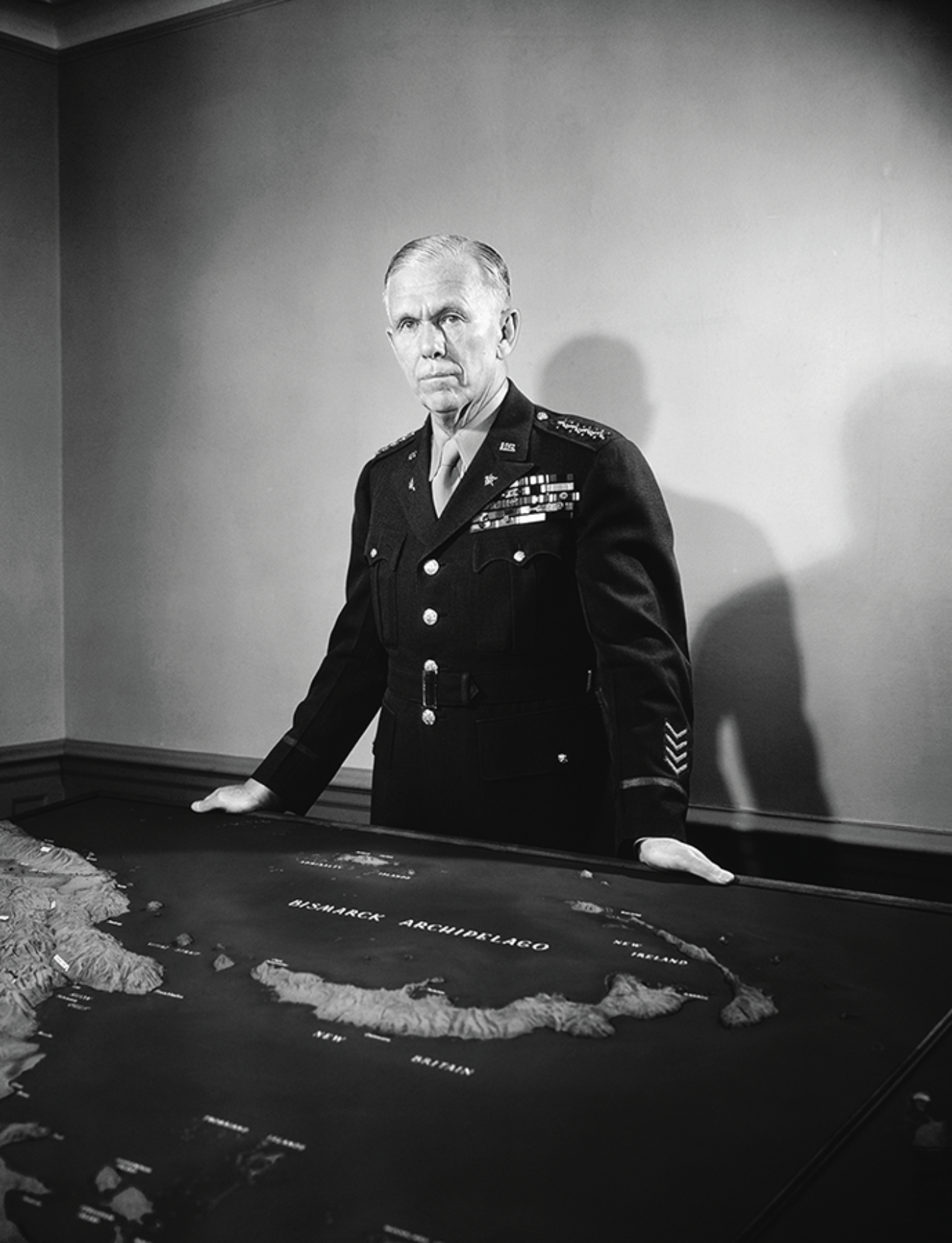
Addressing the graduating cadets at West Point in May 1942, General George C. Marshall, then the Army chief of staff, reduced the nation’s purpose in the global war it had recently joined to a single emphatic sentence. “We are determined,” he remarked, “that before the sun sets on this terrible struggle, our flag will be recognized throughout the world as a symbol of freedom on the one hand and of overwhelming force on the other.”

At the time Marshall spoke, mere months after the Japanese attack on Pearl Harbor, U.S. forces had sustained a string of painful setbacks and had yet to win a major battle. Eventual victory over Japan and Germany seemed anything but assured. Yet Marshall was already looking beyond the immediate challenges to define what that victory, when ultimately— and, in his view, inevitably—achieved, was going to signify.

This second world war of the twentieth century, Marshall understood, was going to be immense and immensely destructive. But if vast in scope, it would be limited in duration. The sun would set; the war would end. Today no such expectation exists. Marshall’s successors have come to view armed conflict as an open-ended proposition. The alarming turn in U.S.–Iranian relations is another reminder that war has become normal for the United States.

The address at West Point was not some frothy stump speech by a hack politician. Marshall was a deliberate man who chose his words carefully. His intent was to make a specific point: the United States was fighting not to restore peace—a word notably absent from his remarks—nor merely to eliminate an isolated threat. The overarching American aim was preeminence, both ideological and military: as a consequence of the ongoing war, America was henceforth to represent freedom and power—not in any particular region or hemisphere but throughout the world. Here, conveyed with crisp military candor, was an authoritative reframing of the nation’s strategic ambitions.1

Marshall’s statement captured the essence of what was to remain America’s purpose for decades to come, until the presidential election of 2016 signaled its rejection. That year an eminently qualified candidate who embodied a notably bellicose variant of the Marshall tradition lost to an opponent who openly mocked that tradition while possessing no qualifications for high office whatsoever.

Determined to treat Donald Trump as an unfortunate but correctable aberration, the foreign-policy establishment remains intent on salvaging the tradition that Marshall inaugurated back in 1942. The effort is misguided and will likely prove futile. For anyone concerned about American statecraft in recent years, the more pressing questions are these: first, whether an establishment deeply imbued with Marshall’s maxim can even acknowledge the magnitude of the repudiation it sustained at the hands of Trump and those who voted him into office (a repudiation that is not lessened by Trump’s failure to meet his promises to those voters); and second, whether this establishment can muster the imagination to devise an alternative tradition better suited to existing conditions while commanding the support of the American people. On neither score does the outlook appear promising.

General George C. Marshall at the headquarters of the War Department, 1943 © Bettmann/Getty Images

General Marshall delivered his remarks at West Point in a singular context. Marshall gingerly referred to a “nationwide debate” that was complicating his efforts to raise what he called “a great citizen-army.” The debate was the controversy over whether the United States should intervene in the ongoing European war. To proponents of intervention, the issue at hand during the period of 1939 to 1941 was the need to confront the evil of Nazism. Opponents of intervention argued in the terms of a quite different question: whether or not to resume an expansionist project dating from the founding of the Republic. This dispute and its apparent resolution, misunderstood and misconstrued at the time, have been sources of confusion ever since.

Even today, most Americans are only dimly aware of the scope—one might even say the grandeur—of our expansionist project, which stands alongside racial oppression as an abiding theme of the American story. As far back as the 1780s, the Northwest Ordinances, which created the mechanism to incorporate the present-day Midwest into the Union, had made it clear that the United States had no intention of confining its reach to the territory encompassed within the boundaries of the original thirteen states. And while nineteenth-century presidents did not adhere to a consistent grand plan, they did pursue a de facto strategy of opportunistic expansion. Although the United States encountered resistance during the course of this remarkable ascent, virtually all of it was defeated. With the notable exception of the failed attempt to annex Canada during the War of 1812, expansionist efforts succeeded spectacularly and at a remarkably modest cost to the nation. By midcentury, the United States stretched from sea to shining sea.

Generations of Americans chose to enshrine this story of westward expansion as a heroic tale of advancing liberty, democracy, and civilization. Although that story certainly did include heroism, it also featured brute force, crafty maneuvering, and a knack for striking a bargain when the occasion presented itself.

In the popular imagination, the narrative of “how the West was won” to which I was introduced as a youngster has today lost much of its moral luster. Yet the country’s belated pangs of conscience have not induced any inclination to reapportion the spoils. While the idea of offering reparations to the offspring of former slaves may receive polite attention, no one proposes returning Florida to Spain, Tennessee and Georgia to the Cherokees, or California to Mexico. Properties seized, finagled, extorted, or paid for with cold, hard cash remain American in perpetuity.

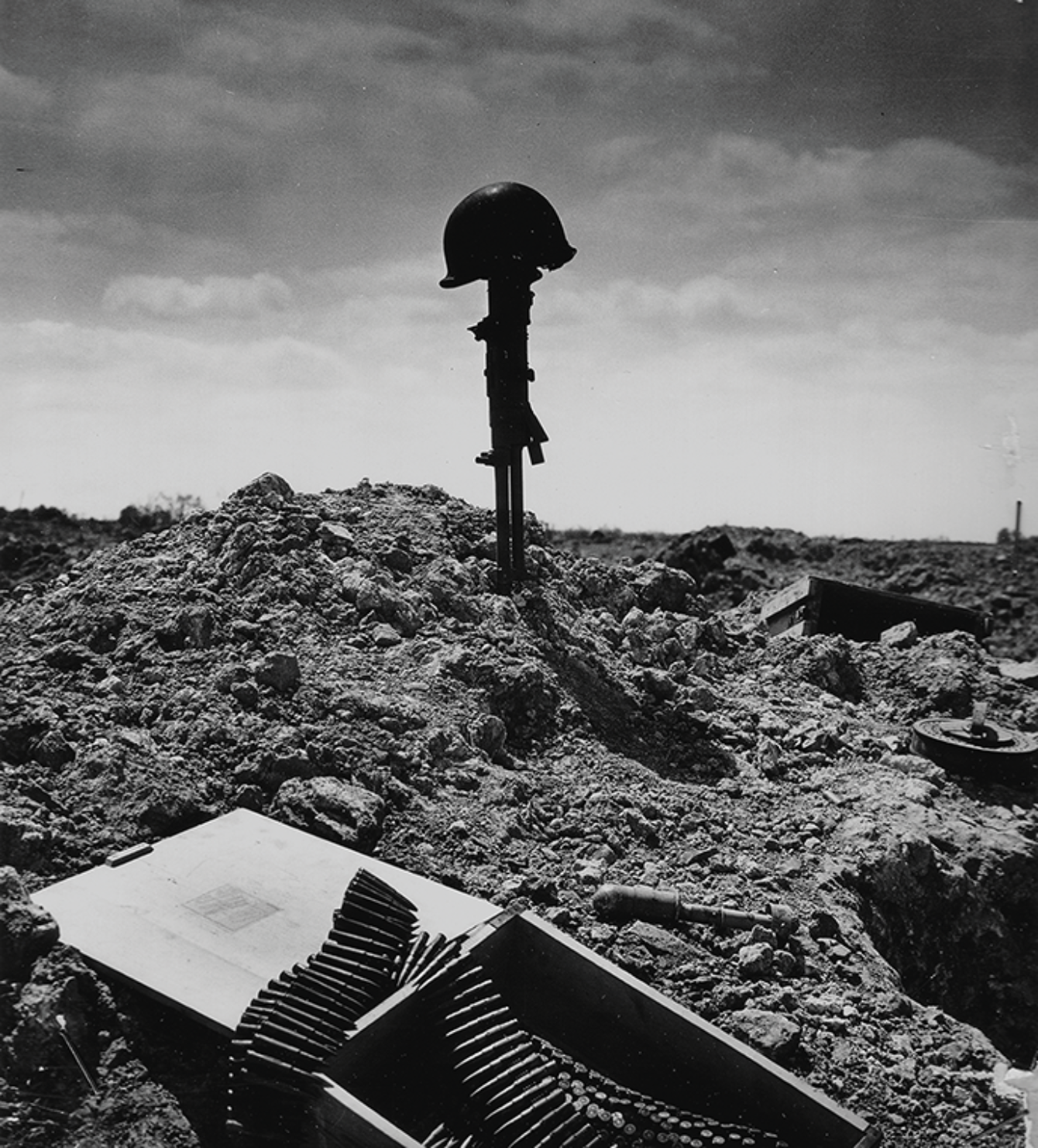
Battlefield memorial for a dead U.S. soldier, Normandy, France, 1944 (detail)

Back in 1899, the naturalist, historian, politician, sometime soldier, and future president Theodore Roosevelt neatly summarized the events of the century then drawing to a close: “Of course our whole national history has been one of expansion.” When T.R. uttered this truth, a fresh round of expansionism was under way, this time reaching beyond the fastness of North America into the surrounding seas and oceans. The United States was joining with Europeans in a profit-motivated intercontinental imperialism.

Read the rest of this entry »

Posted in Uncategorized | Tagged: , , , , , , | Leave a Comment »

The Tragedy of America’s Entry into World War I | Mises Wire

Posted by M. C. on November 26, 2019

Hence there were fervent supporters of American entry into the war from American industrial and financial quarters, as well as some voices in the political class, including former President Theodore Roosevelt, the “John McCain of his day” regarding his “all war, everywhere” bellicosity

https://mises.org/wire/tragedy-americas-entry-world-war-i

11/10/2018

This week some 80 world dignitaries including Presidents Putin, Trump, and Chancellor Merkel are gathering in France to mark the culmination of year-long remembrances of the centenary of the end of “the Great War” on November 11, 1918 – later labeled and known to every American high school history student as World War I. While at least 17 million people, including more than 116,000 Americans, died in this war — and millions more were wounded, gassed, or maimed — it’s a conflict widely misunderstood today. Indeed, because of World War II’s size and scope, cultural influence, and greater media coverage and capture, the First World War is often called “the forgotten war.”

Yet it was a cataclysmic event in its own right that both foreshadowed more intense and violent warfare in the 20th century, and fueled the growth of gargantuan central government in the United States. Most crucially, however, it was a war that should never have been fought — its causal origins and assignment of guilt for same are still a hot topic of debate a century later, a fact that alone attests to its superfluity — and one that, in any case, the United States should never have entered. These are disturbing theses about the war that will not be remembered by any of the global elites in Paris this weekend, but given the lessons for today, Americans should learn about them so as to demand of their Beltway solons wiser policy choices in the future. What follows is a short summary of America’s involvement in the war and lessons for today.

Origins of the Conflict in 1914

When the United States declared war on Germany following strong majority votes in both houses of Congress and the impassioned speech of President Woodrow Wilson to a joint session on April 2, 1917, he asserted that America must fight in the European war “to make the world safe for democracy.” This was a mere five months after Wilson had won re-election in 1916 via a slogan of “He kept us out of war.” 100 years later, though, there’s still no clearly-enunciated explanation of what it means to create safety for democracy. Later history would prove, however, that this goal — whatever it meant — was most certainly not achieved by the victorious Entente or their associated power and late entrant, the United States.

Nonetheless, when Count von Metternich convened the Congress of Vienna in November 1814 to settle long-simmering disputes in Europe following the  Napoleonic wars, little could he have guessed that precisely a century later his august project would crash forever upon the shoals of boiling Balkan nationalism. Metternich’s Concert of Europe had, in fact, been durable and substantial: after 1815 there had been only minor-but-contained skirmishes across Europe in the 19th century: the formation of the Second French Republic after the liberal revolution of 1848, the Franco-German War of 1871 that flipped Alsace-Lorraine, and the consolidation of German and Italian nation-states. The British, meanwhile, were extending their empire into the far reaches of Asia and Africa. But after victory over Napoleon at Waterloo in 1815, there would be no sizable war in the heart of Europe for another century.

Across the continent as a whole, then, the 19th century was one of general peace and ever-increasing material wealth for the masses, thanks to increasing economic integration and its attendant gains from trade.  The rule of law, protection of property rights, a sound monetary framework, and the unleashing of entrepreneurial energies, thanks to patient capital, had spread across the continent and built a civilized order. It was, said the Austrian economist Ludwig von Mises later, the Age of Liberalism , and marked by the broad cessation of warfare and its attendant impoverishing taxation and destruction.

The First World War that ended this widespread peace and prosperity was, therefore, an appalling tragedy. In the end, some 65 million troops were mobilized (including 4.7 million Americans), there were more than 20 million casualties including civilians, and the Austro-Hungarian, German, Ottoman, and Russian empires were destroyed. Meanwhile the victorious British and French empires peaked and were effectively bankrupted. The British needed a century to pay off its war loans. Many national boundaries were redrawn, and activist high-tax/interventionist governments replaced laissez-faire regimes everywhere.

American Entry into the War in 1917

However, initially with the advent of hostilities in 1914, President Wilson attempted to steer a neutral course. There was no discernible reason for America ever to become involved in a European land war, and the United States traded with — and had immigrants from — all countries in the conflict. Following a longstanding foreign policy that had first been enunciated by Wilson’s foremost predecessor, George Washington, the American position on the Great War remained, as always, “Friend of Liberty everywhere, Guarantor only of our own.” Critics called it “isolationist,” but the American people in near-unanimity sought to steer clear of the massive conflict across the Atlantic Ocean.

Tensions rose in May of 1915 with the sinking of the merchant cruiser Lusitania by a German U-boat, killing 128 Americans, among others. While there was an outcry against Germany over such unrestricted submarine warfare, the German government had in fact taken pains to warn American passengers via advertisements in major east coast media, and indeed the Lusitania was carrying contraband, and hence was a legitimate target of war. In any case Mr. Wilson was able to get the German government to restrict its operations and let a specified number and type of American ships pass through to England, and in spite of a few other minor incidents, the President cruised to re-election in November 2016 via the campaign war-cry of “He kept us out of war.”

By the end of 1916, however, things looked bleak for the Triple Entente (the alliance between Britain, France, and Russia). Russia was in trouble in the east and riddled with revolutionary fervor. The western front, while stabilized, would be bled by increased and more powerful German thrusts should Russia quit the war, as increasingly looked likely. The French and British, racked by losses in Turkey and higher casualties on their German front than the Germans, were beginning to fear an inability to continue to finance the war effort. The Italians were stalemated. The Allies increasingly saw one big solution to their plight, and it lay across the Atlantic.

Pressures thus were mounting on Mr. Wilson to join the fray. The British, as they were to do again after 1939, mounted a broad effort to entice America into their war via propaganda such as alleged German battlefront atrocities in Belgium. Further, tens of billions of (2018-equivalent) dollars had been loaned to Britain and France by New York banks such as Goldman Sachs and J.P. Morgan (which had major European offices in London and Paris, and thus led American capital raising efforts for these belligerents), in at least five times the amount lent to the Central Powers (Germany and Austria-Hungary): should Germany win the war, these loans to the western powers could not be recouped. American armaments makers and industrial producers such as Bethlehem Steel or DuPont, many of which had suffered during the 1913-14 recession in the United States, loved the advent of war. Exports to Britain and France quadrupled between 1914 and 1917.1

Hence there were fervent supporters of American entry into the war from American industrial and financial quarters, as well as some voices in the political class, including former President Theodore Roosevelt, the “John McCain of his day” regarding his “all war, everywhere” bellicosity….

Wartime Conduct of the Wilson Administration and the Advent of Big Government and Central Planning

Although most Americans were inflamed with a sense of patriotic fervor when reminded of the Lusitania (from 23 months earlier!) and then became enraged at news of the Zimmermann Telegram, U.S. entry into the war was not uncontroversial. Secretary of State William Jennings Bryan had already resigned his cabinet position in the aftermath of the Lusitania sinking, fearing a tilt toward the British via war finance. Bryan had recommended to Wilson right away in 1914 that American loans or exports to belligerents be forbidden as a way to shorten the war. This counsel was ignored. Well-known Leftist and progressive Randolph Bourne publicly broke with Wilson over the war. He was one of many who did so. And there were also critics from what would today be called small-government libertarian types, most prominently H.L. Mencken of the Baltimore Sun.

This is of interest today because while the war effort went well enough once American soldiers and Marines were on the ground fighting in France, there were pockets of protesters in the United States. The protestors saw no logic to our fighting wars on behalf of European belligerents, with all of whom we had friendly commercial relations before the war, and none of whom represented any threat to us. It is an historical parallel to current era American wars in the Muslim world, and earlier wars in east Asia.

Domestically, historian Ralph Raico reports that the war ushered in central planning on a massive scale not seen since the Civil War, whose controls and federal dictates were easily surpassed in 1917. Congress passed the National Defense Act, for example. It gave the president the authority, in a time of war “or when war is imminent,” to place orders with private firms which would “take precedence over all other orders and contracts.” If the manufacturer refused to fill the order at a “reasonable price as determined by the Secretary of War,” the government was “authorized to take immediate possession of any such plant and to manufacture therein such product or material as may be required” for the war effort. The private business owner, meanwhile, would be “deemed guilty of a felony.”

Once war was declared, the power of the federal government grew at a dizzying pace in all sorts of directions. The Lever Act, for example, passed on August 10, 1917, was a law that, among other things, created the United States Food Administration and the Federal Fuel Administration: this put the federal government in charge of the production and distribution of all food and fuel in the United States. President Wilson reached into all corners of American life for the sake of the war effort via price controls and monetary manipulation, as well as such direct actions as banning beer sales (and this right before Prohibition).

Some of the Wilson Administration’s conduct was shameful. For example, in an effort at control of public opinion that would make Josef Goebbels proud, some 850 citizens were prosecuted under the Espionage and Sedition Acts between 1917 and 1919, with many jailed for having the temerity to question the logic behind the war. Most famous of these was the former Socialist candidate for President Eugene V. Debs, who was fined and given a 10-year jail sentence – at age 63 – after a June 1918 speech in Canton, Ohio wherein he decried American involvement in a war that was of no consequence to us or our national security; Debs further criticized the use of a conscript/slave labor army to prosecute the war. He was given early release by President Harding at Christmas 1921 and met at the White House the next day. But in a cold, damp, dark federal penitentiary in Atlanta, Debs had contracted tuberculosis, sending him to perhaps an early death in 1926.

Further, Wilson set up a propaganda office immediately after the declaration of war, called the Committee on Public Information. This was a government-staffed propaganda agency charged with message control of the media (viz. putting “spin” on war news) to sustain morale in the U.S., to administer voluntary press censorship, and to develop propaganda abroad. This entity eventually comprised 37 distinct divisions. These included the Division of Pictorial Publicity which employed hundreds of artists to create graphics with patriotic themes, or to incite fear and hatred of Germans.

Mr. Wilson also had one of his cronies, Albert M. Briggs, set up the American Protective League (APL), an organization of 250,000 private citizens that worked with federal law enforcement agencies during World War I to identify suspected German sympathizers. Its mission was to “counteract the activities of radicals, anarchists, anti-war activists, and left-wing labor and political organizations.” In other words, it was a giant “army” of snitches, sort of a benign Gestapo. One victim was a man named Taubert in New Hampshire who received a sentence of three years in prison for saying out loud and in public that World War I was a war “for J.P. Morgan, and not for the people.” He meant the was was being fought to recoup Morgan’s war loans to the British and French, and pad the bottom line of the capitalist class…

Let us be starkly clear in our closing thought: America went to war 100 years ago for no good reason, and certainly not for the “general interest” of national security. Instead, President Wilson wanted war for the sake of narrow special interests contained in what President Eisenhower was to later call the “military-industrial- congressional complex.” This panoply of overlapping Beltway groups or individuals, coupled with the “ruling class elite” who toil in Manhattan boardrooms, is still alive and well today. These groups can all do great things on their own, legitimately on behalf of the American people, as the case may be. But never again should an American soldier or Marine be asked to die, face down in the mud, thousands of miles away from the borders he is paid to defend, for anything less than a lethal threat to our national security. Nor should hard-pressed American taxpayers foot the bill for the wars of others. THAT is the primordial lesson of World War I, which reverberates through time and still resonates today.

On the occasion of the centennial of the second most brutal human conflict of all time, we salute all who died on all sides, and as Americans express our respect to the American war-dead. Yet at the same time, knowing the history of this and similar conflicts, one feels nothing but contempt for Woodrow Wilson and his fellow politicians. The foreign policy of a free and great commercial republic should anywhere and everywhere be: champion of liberty for all; vindicator only of our own.

Be seeing you

The Christmas Truce | Jacobin

The Christmas Truce. Never to be repeated.



Posted in Uncategorized | Tagged: , , , , , , , , | Leave a Comment »

The Lies That Form Our Consciousness and False Historical Awareness – PaulCraigRoberts.org

Posted by M. C. on May 10, 2019

https://www.paulcraigroberts.org/2019/05/09/the-lies-that-form-our-consciousness-and-false-historical-awareness/

Paul Craig Roberts

My generation associated dystopias, such as George Orwell’s 1984, with the Soviet Union, a country in which explanations were controlled and criticism of Stalin would land a person in the Gulag.  We thought of the United States and our life here much differently. But with the passage of time the difference between life in the Soviet Union in the 20th century and life in the Western world today is disappearing.  Today, the journalist Julian Assange is undergoing the same kind of state terror and torture as any Soviet dissident, if not worse.  The Western media is as controlled as the Soviet media, with print, TV, and public radio serving as a propaganda ministry for government and the interest groups that control government.  Social media, such as Facebook and Twitter are systematically denying their platforms to those who express views not supportive of the ruling order and its agendas.  It has turned out to be easy to get rid of the First Amendment guarantee of free speech as the media have neither the ability nor the intention of exercising it.

It was a mistake for my generation to associate Orwell’s Memory Hole and falsified history only with fictional or real dystopias.  Falsified history was all around us.  We just didn’t know enough to spot it…

With few exceptions, English speaking historians have put the blame for both world wars on Germany.  This is false history.  The first real historian of World War I, or what was called at the time the Great War or the World War, was Harry Elmer Barnes. Barnes was Professor of Historical Sociology at Smith College and the William Bayard Cutting Fellow in History at Columbia University. His book, The Genesis of the World War, was published in 1926 by Alfred A. Knopf in New York.

Instead of covering up, as expected, the allied crimes and treachery against Germany, Barnes told the truth.  The German Kaiser, a relative of the British and Russian royal families, was known throughout the world as a peacemaker, praised by the New York Times for that role. It is a known and indisputable fact that the German government acted for peace until Germany, the last power to mobilize, had to mobilize or be overrun by Russia and France, who were allied with the British against Germany. Never before in history has the very last power to mobilize been blamed for starting a war.  But facts never get in the way of court historians.

The genesis of the war was the desire on the part of two of the Russian Tsar’s ministers for Constantinople and the French president for territory, Alsace-Lorraine, lost to Germany in the 1870 Franco-Prussian war.  These schemers used Austria’s response to the assassination of the Austrian archduke in Serbia, which they likely orchestrated, to declare war as Germany was the protector of the Austrian-Hungarian Empire.

American president Woodrow Wilson secured an armistice to the World War, which had senselessly destroyed  millions of lives, by promising Germany that if she agreed to an armistice, there would be no territorial losses for Germany and no reparations.  When Germany agreed to the armistice, it was Germany that occupied territories of the opposing camp. There were no foreign troops on German territory.

As soon as Germany disengaged, the British put into effect a food blockade that forced starving Germans to submit to the exploitative Versailles Treaty that violated every promise that President Wilson had made.

Some intelligent people, including the most famous economist of the 20th century, John Maynard Keynes, said that the Versailles Treaty, an exercise in coverup for who caused the war, guaranteed a future war.  And they, not the grasping corrupt establishment, were right.

For his truth-telling efforts, Harry Elmer Barnes was declared by the court historians to be a German agent paid to write a false history.  As Barnes’ voice was greatly outnumbered, the history of the Great War remained, for most, falsified throughout the 20th century…

But one hundred years after the war who is around to care?  All the people who died in the war as well as their bereaved families who suffered from the plot of three evil men are dead and gone. The consciousness of the world has already been distorted by a century of false history, a false history that set up Germany for blame again, this time for World War II…

Be seeing you

045-0613075528-msm-harmful-if-swallowed


Posted in Uncategorized | Tagged: , , , , , | 1 Comment »

The Christmas Truce of World War I – Foundation for Economic Education – Working for a free and prosperous world

Posted by M. C. on December 26, 2017

More about what we need more of.

https://fee.org/articles/the-christmas-truce-of-world-war-i/

[Christmas_Truce_5.jpg]
But there were souls on each side of that fratricidal conflict determined to preserve the decencies of Christendom, even amid the conflict. As Christmas dawned,
Read the rest of this entry »

Posted in Uncategorized | Tagged: , | Leave a Comment »

Woodrow Wilson legacy tainted by racism, attacks on Constitution – Washington Times

Posted by M. C. on April 22, 2017

http://www.washingtontimes.com/news/2017/apr/10/woodrow-wilson-legacy-tainted-by-racism-attacks-on/

Wilson, the first college president to occupy the White House, banned blacks from government restrooms, was the first president to openly attack the U.S. Constitution and eagerly support laws to prosecute and imprison those who disagreed with his policies. His hostility to black Americans was matched only by his antipathy toward Italian, German and Irish Americans and his desire to rid the nation of those he referred to dismissively as “hyphenated Americans” and against who he railed incessantly.

Here at home, Wilson’s war gave birth to a larger and larger role for government and regimentation. With the passage of the Espionage Act in 1917 and the Sedition Act a year later, Wilson had the power to ban dissent and shut up his critics. More than a hundred journalists including, most famously, socialist leader Eugene Debs, were indicted, tried and convicted for what they said and wrote rather than for anything they did. Even Mitchell Palmer, Wilson’s attorney general, who is remembered mainly for the Palmer raids launched as part of the “Red Scare,” felt after the war ended that his boss had gone too far. He went to the president and urged him to pardon Debs and the others lest history condemn him for his actions. Mr. Wilson tore up the pardon request, declaring, “This man was a traitor and he will never be pardoned during my administration.”

Wilson is taking a real beating in the alt-press on the centennial of our entry into the great war.

It is a well deserved beating. 

Be seeing you

Posted in Uncategorized | Tagged: , | Leave a Comment »