https://rumble.com/v37gwwo-system-update-130.html
Be seeing you

Enemy of the State-Read the Book-Know the Man
This is not a Safe Space but Baby, I don't care.

"I am not a number, I am a Free Man" - No. 6
 Information Liberation Alex Jones’ Prison Planet Gary North Specific Answers Antiwar The Daily Bell Tenth Amendment Center Economics Policy Journal The American Thinker The New American Lew Rockwell
Posted by M. C. on August 17, 2023
Posted in Uncategorized | Tagged: Biden, neocon, State Department, Victoria Nuland | Leave a Comment »
Posted by M. C. on August 17, 2023
What, then, was the proper government policy during the 1920s? What should government have done to prevent the crash? Its best policy would have been to liquidate the Federal Reserve System, and to erect a 100 percent gold reserve money; failing that, it should have liquidated the FRS and left private banks unregulated, but subject to prompt, rigorous bankruptcy upon failure to redeem their notes and deposits
https://mises.org/library/how-business-cycle-happens
Study of business cycles must be based upon a satisfactory cycle theory. Gazing at sheaves of statistics without “pre-judgment” is futile. A cycle takes place in the economic world, and therefore a usable cycle theory must be integrated with general economic theory. And yet, remarkably, such integration, even attempted integration, is the exception, not the rule. Economics, in the last two decades, has fissured badly into a host of airtight compartments—each sphere hardly related to the others. Only in the theories of Schumpeter and Mises has cycle theory been integrated into general economics.1
The bulk of cycle specialists, who spurn any systematic integration as impossibly deductive and overly simplified, are thereby (wittingly or unwittingly) rejecting economics itself. For if one may forge a theory of the cycle with little or no relation to general economics, then general economics must be incorrect, failing as it does to account for such a vital economic phenomenon. For institutionalists—the pure data collectors—if not for others, this is a welcome conclusion. Even institutionalists, however, must use theory sometimes, in analysis and recommendation; in fact, they end by using a concoction of ad hoc hunches, insights, etc., plucked unsystematically from various theoretical gardens. Few, if any, economists have realized that the Mises theory of the trade cycle is not just another theory: that, in fact, it meshes closely with a general theory of the economic system.2 The Mises theory is, in fact, the economic analysis of the necessary consequences of intervention in the free market by bank credit expansion. Followers of the Misesian theory have often displayed excessive modesty in pressing its claims; they have widely protested that the theory is “only one of many possible explanations of business cycles,” and that each cycle may fit a different causal theory. In this, as in so many other realms, eclecticism is misplaced. Since the Mises theory is the only one that stems from a general economic theory, it is the only one that can provide a correct explanation. Unless we are prepared to abandon general theory, we must reject all proposed explanations that do not mesh with general economics.
It is important, first, to distinguish between business cycles and ordinary business fluctuations. We live necessarily in a society of continual and unending change, change that can never be precisely charted in advance. People try to forecast and anticipate changes as best they can, but such forecasting can never be reduced to an exact science. Entrepreneurs are in the business of forecasting changes on the market, both for conditions of demand and of supply. The more successful ones make profits pari passus with their accuracy of judgment, while the unsuccessful forecasters fall by the wayside. As a result, the successful entrepreneurs on the free market will be the ones most adept at anticipating future business conditions. Yet, the forecasting can never be perfect, and entrepreneurs will continue to differ in the success of their judgments. If this were not so, no profits or losses would ever be made in business.
Changes, then, take place continually in all spheres of the economy. Consumer tastes shift; time preferences and consequent proportions of investment and consumption change; the labor force changes in quantity, quality, and location; natural resources are discovered and others are used up; technological changes alter production possibilities; vagaries of climate alter crops, etc. All these changes are typical features of any economic system. In fact, we could not truly conceive of a changeless society, in which everyone did exactly the same things day after day, and no economic data ever changed. And even if we could conceive of such a society, it is doubtful whether many people would wish to bring it about.
It is, therefore, absurd to expect every business activity to be “stabilized” as if these changes were not taking place. To stabilize and “iron out” these fluctuations would, in effect, eradicate any rational productive activity. To take a simple, hypothetical case, suppose that a community is visited every seven years by the seven-year locust. Every seven years, therefore, many people launch preparations to deal with the locusts: produce anti-locust equipment, hire trained locust specialists, etc. Obviously, every seven years there is a “boom” in the locust-fighting industry, which, happily, is “depressed” the other six years. Would it help or harm matters if everyone decided to “stabilize” the locust-fighting industry by insisting on producing the machinery evenly every year, only to have it rust and become obsolete? Must people be forced to build machines before they want them; or to hire people before they are needed; or, conversely, to delay building machines they want—all in the name of “stabilization”? If people desire more autos and fewer houses than formerly, should they be forced to keep buying houses and be prevented from buying the autos, all for the sake of stabilization? As Dr. F.A. Harper has stated:
This sort of business fluctuation runs all through our daily lives. There is a violent fluctuation, for instance, in the harvest of strawberries at different times during the year. Should we grow enough strawberries in greenhouses so as to stabilize that part of our economy throughout the year.3
We may, therefore, expect specific business fluctuations all the time. There is no need for any special “cycle theory” to account for them. They are simply the results of changes in economic data and are fully explained by economic theory. Many economists, however, attribute general business depression to “weaknesses” caused by a “depression in building” or a “farm depression.” But declines in specific industries can never ignite a general depression. Shifts in data will cause increases in activity in one field, declines in another. There is nothing here to account for a general business depression—a phenomenon of the true “business cycle.” Suppose, for example, that a shift in consumer tastes, and technologies, causes a shift in demand from farm products to other goods. It is pointless to say, as many people do, that a farm depression will ignite a general depression, because farmers will buy less goods, the people in industries selling to farmers will buy less, etc. This ignores the fact that people producing the other goods now favored by consumers will prosper; their demands will increase.
The problem of the business cycle is one of general boom and depression; it is not a problem of exploring specific industries and wondering what factors make each one of them relatively prosperous or depressed. Some economists—such as Warren and Pearson or Dewey and Dakin—have believed that there are no such things as general business fluctuations—that general movements are but the results of different cycles that take place, at different specific time-lengths, in the various economic activities. To the extent that such varying cycles (such as the 20-year “building cycle” or the seven-year locust cycle) may exist, however, they are irrelevant to a study of business cycles in general or to business depressions in particular. What we are trying to explain are general booms and busts in business.
In considering general movements in business, then, it is immediately evident that such movements must be transmitted through the general medium of exchange—money. Money forges the connecting link between all economic activities. If one price goes up and another down, we may conclude that demand has shifted from one industry to another; but if all prices move up or down together, some change must have occurred in the monetary sphere. Only changes in the demand for, and/or the supply of, money will cause general price changes. An increase in the supply of money, the demand for money remaining the same, will cause a fall in the purchasing power of each dollar, i.e., a general rise in prices; conversely, a drop in the money supply will cause a general decline in prices. On the other hand, an increase in the general demand for money, the supply remaining given, will bring about a rise in the purchasing power of the dollar (a general fall in prices); while a fall in demand will lead to a general rise in prices. Changes in prices in general, then, are determined by changes in the supply of and demand for money. The supply of money consists of the stock of money existing in the society. The demand for money is, in the final analysis, the willingness of people to hold cash balances, and this can be expressed as eagerness to acquire money in exchange, and as eagerness to retain money in cash balance. The supply of goods in the economy is one component in the social demand for money; an increased supply of goods will, other things being equal, increase the demand for money and therefore tend to lower prices. Demand for money will tend to be lower when the purchasing power of the money-unit is higher, for then each dollar is more effective in cash balance. Conversely, a lower purchasing power (higher prices) means that each dollar is less effective, and more dollars will be needed to carry on the same work.
The purchasing power of the dollar, then, will remain constant when the stock of, and demand for, money are in equilibrium with each other: i.e., when people are willing to hold in their cash balances the exact amount of money in existence. If the demand for money exceeds the stock, the purchasing power of money will rise until the demand is no longer excessive and the market is cleared; conversely, a demand lower than supply will lower the purchasing power of the dollar, i.e., raise prices.
Yet, fluctuations in general business, in the “money relation,” do not by themselves provide the clue to the mysterious business cycle. It is true that any cycle in general business must be transmitted through this money relation: the relation between the stock of, and the demand for, money. But these changes in themselves explain little. If the money supply increases or demand falls, for example, prices will rise; but why should this generate a “business cycle”? Specifically, why should it bring about a depression? The early business cycle theorists were correct in focusing their attention on the crisis and depression: for these are the phases that puzzle and shock economists and laymen alike, and these are the phases that most need to be explained.
The explanation of depressions, then, will not be found by referring to specific or even general business fluctuations per se. The main problem that a theory of depression must explain is: why is there a sudden general cluster of business errors? This is the first question for any cycle theory. Business activity moves along nicely with most business firms making handsome profits. Suddenly, without warning, conditions change and the bulk of business firms are experiencing losses; they are suddenly revealed to have made grievous errors in forecasting.
Be seeing you
Posted in Uncategorized | Tagged: business cycle, Federal Reserve System, gold reserve | Leave a Comment »
Posted by M. C. on August 16, 2023
Given the effects of the state on the family, it is highly unlikely that state intervention can fix a dying family. Churches and religion, civic organizations, mutual aid, and charity all must be turned to, not the state, if family flourishing is the goal. An active, managing state does not mean a thriving family. To help families grow and live happier lives, the role of the state must be drastically cut back, allowing families to take back the vital role that they serve.
https://mises.org/wire/family-flourishing-and-state-denigration
There is little doubt that the institution of the family in the West is in crisis. Birth rates have been declining in the USA, and most Western countries have fertility rates below replacement level. Abortions number over five hundred thousand per year, most of which are concentrated among low-income individuals. Famously, around half of all marriages in the USA end in divorce. Rather than ignoring these problems, it is important for all on the Right (conservatives, traditionalists, libertarians, etc.) to address these issues. But what means should be employed to combat a declining family institution?
Some individuals, especially national conservatives, have called for state intervention to solve these issues. Their proposals range from redistribution and welfare to banning bachelor’s degree requirements as hiring criteria. Rather than seeing the state as an obstacle to family flourishing, national conservatives tend to look to the state as a means of addressing family issues. However, the state is often the very creator of family denigration.
One policy that harms the family is state social insurance. Medicare and Social Security make up approximately one-third of the federal budget, costing around $2 trillion per year. This money is directly taken out of working people’s hands, making it harder to feed, clothe, and house families. State-sponsored social insurance policies create disincentives for individuals to form families. Because of the increased costs, individuals are pushed out of having an additional child, lowering birth rates.
Social insurance also replaces the family with the state in regard to the care of the elderly. Due to Medicare and Social Security, children do not have to aid their elderly parents. This yet again affects fertility. To put it bluntly, why would I have a child who is going to make me sacrifice decades of my own time and cost me hundreds of thousands of dollars only for them to not take care of me in my old age?
A similar case of the state subverting the role of families came with the advent of the welfare state. Historian David Beito writes, “A conservative estimate is that one-third of adult American males belonged to [mutual aid] lodges in 1910.” However, by the 1930s these societies started to fall out of favor due to the rise of the welfare state and American tax code. When it comes to the family, it is unlikely that state welfare programs will fix the problem of a falling birth rate and looser familial bonds. Rather, it is likely that social insurance proposals will subvert the family in the same way that mutual aid societies were subverted.
Be seeing you
Posted in Uncategorized | Tagged: birth rate, Churches, Family, Mutual Aid, religion, State Denigration | Leave a Comment »
Posted by M. C. on August 16, 2023
Impressive. Though, getting through NBC commentary is more difficult than space travel.
The future of space travel is with those like Branson and Musk.
Be seeing you
Posted in Uncategorized | Tagged: spaceflight, Virgin Galactic | Leave a Comment »
Posted by M. C. on August 16, 2023
The plan is to dehumanize us in advance of full-blown tyranny. The scary part is that the masses still think the “authorities” have their best interests at heart.
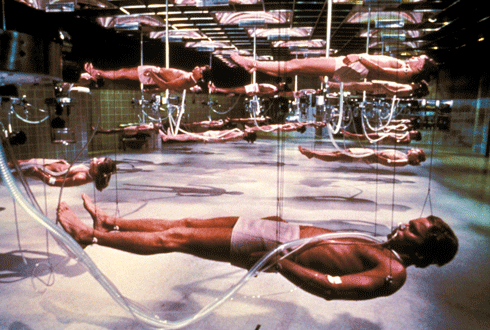
Give each of these people a smartphone and this image from the movie Coma describes our destiny: To be socially isolated except for our internet connection until finally, they pull the plug on our feeding tubes.
Extrapolating from the current trend.
Clearly, the COVID “pandemic” is not intended to be a passing emergency but a ruse to impose a “new normal” corresponding to the UN’s Agenda 30.
The dystopian future is taking shape. Mass gatherings have been canceled. We must experience the world on a TV screen. The NFL plays in front of a cardboard crowd to sound effects.
Millions are stuck at home, working “remotely,” or paid to do nothing. (Will they ever agree to work again?)
Restaurants and other businesses in urban centers are going bust.
Students are deprived of the society of their peers, forced to take their courses online. Many are confined to their dorms without proper provisions. Attending classes remotely is like ordering take-out from Hooters.
Everyone is required to wear filthy masks.
Locally, the Royal Winnipeg Ballet canceled their annual Nutcracker ballet, scheduled for Christmas. Imagine hundreds of artists out of jobs.

There is talk that Christmas gatherings may be canceled. Every source of solace or happiness is being shut down.
At the local Safeway, the lounge where old folk enjoyed their Timbits and coffee has been closed. They have nowhere to go.
Montreal residents won’t be allowed to visit friends or family at home for most of October or eat out at their favorite restaurant as the provincial government struggles to slow the surge of new coronavirus cases. All bars, casinos, and restaurants are closed (takeout only). Libraries, museums, cinemas, and theatres will also be closed. Being less than two meters apart will be prohibited. Masks will be mandatory during demonstrations. Houses of worship and venues for events, such as funerals and weddings, will have a 25-person limit. Hair salons, hotels, and other such businesses will stay open. Schools will remain open.”
For 16 million people in Northeast England, pubs and restaurants can stay open, but it will be illegal to go for a drink with a member of another household or visit them at their home from Wednesday.
Roughly 100 students at the University of Western Ontario were referred for investigation under the school’s code of conduct after campus police broke up parties in university residences on the weekend.
“At the University of Alabama in Tuscaloosa, with at least 1,889 virus cases since mid-August, and at the University of Notre Dame, with about 550 cases, students have reported their classmates for violating quarantine and wandering outside.”
Our social lives have moved to Facebook.
Be seeing you
Posted in Uncategorized | Tagged: Agenda 30, covid, new normal, pod people, UN | Leave a Comment »
Posted by M. C. on August 16, 2023
Be seeing you
Posted in Uncategorized | Tagged: Hawaii, money, Ukraine | Leave a Comment »
Posted by M. C. on August 16, 2023
Hunter Biden, like many powerful individuals and corporations, hired special consultants to edit Wikipedia without any fingerprints.
https://substack.com/inbox/post/136055027

Powerful individuals and corporations routinely tap specialized consultants to edit Wikipedia for more favorable entries, often through anonymous accounts designed to appear organic.
Emails from Hunter Biden’s laptop show that he made continuous efforts to airbrush his image and the Wikipedia articles associated with his Ukrainian benefactors.
The outreach by high-priced consultants making stealth edits to Wikipedia, for a period, paid off.
In 2014, working at the time with FTI Consulting, a major public relations and lobbying firm, Hunter sought changes to his personal Wikipedia entry.
“Ryan- below is a start. Eric is my partner and cc’d- he’s going to make additional edits,” wrote Hunter to FTI’s Ryan Toohey in May 2014, referring him to Eric Schwerin, the president of Hunter’s firm Rosemont Seneca. Hunter forwarded along edits seeking the deletion of unflattering lines in his Wikipedia biography, such as his ties to disgraced Ponzi scheme financier Allen Stanford.
Be seeing you
Posted in Uncategorized | Tagged: Hunter Biden, laptop, Wikipedia | Leave a Comment »
Posted by M. C. on August 16, 2023
From the people bringing you EVs and 15 minute cities
Be seeing you
Posted in Uncategorized | Leave a Comment »
Posted by M. C. on August 16, 2023
The well-rewarded bootlicker has always been the mainstream character of New York, exemplified in many, including New York hero Alexander Hamilton, so lauded that he has a play named for him and his bootlicking existence. I will take a gutsy John Kass any day.
By Allan Stevo
One day, Mike Royko was all done. Mike Royko was on the second page of The Chicago Tribune. Boy did he write some good politics. He cut down the Daleys in his writing like nobody’s business.
He played softball — 16 inch, like a true Chicagoan. 16 inch is the kind of softball you can play with no mitt on one hand and a can of Old Style beer in the other hand. The ball is soft. The home runs are fun. The thing just lobs off the bat through the air.
He was culturally of Chicago — a Polish mom and Ukrainian dad. Though he was a journalist, he was very much a working class man. And through a combination of playful characters, telling snapshots of life, and observations on Chicago corruption he wove together a world that his readers could enjoy.
There was a Saturday Night Live skit in the 1980s about a place they called the Olympia Cafe on the show. “Cheezborger. Cheezborger. Cheezborger! No fries, Cheeps! No Pepsi, Coke!”
Look it up and watch it if you don’t know what I’m talking about.
This skit was about the real life Billy Goat Tavern. It was (and still is) located on Lower Michigan Avenue, an underground street in Chicago, that I can’t imagine anyone wanting to open a business on. You had to step past bums in cardboard boxes to get there. It was steps away from the two headquarters of the two rival newspapers in town, so the Billy Goat was where the rough-around-the-edges Chicago journalists would often hang out.
Saturday Night Live has a history of being a New York City show that relied on edgy Chicago talent. Wealthy Manhattanites have a long history of slumming it in Chicago when they want a truthful slice of life. They just couldn’t get that the same way from their fellow New York bootlickers, which gets to the heart of why Saturday Night Live has become unwatchable — no guts, all bootlicking.
Before Saturday Night Live’s writers got wind of the Billy Goat and made it famous, it was Mike Royko who wrote about it and made it the thing of legends: that place, its owner Bill Sianis, “the curse of the Billy Goat” (which gave the Chicago Cubs one nightmare of a losing streak), and a lot more.
Royko knew how to write politics, but he also knew how to grab you by the heart.
Royko wrote a brutal book, called The Boss. It introduced me to a side of Chicago I never knew I was part of, but I always had a feeling I was a part of. “The best book ever written about an American city by the best journalist of his time,” said Jimmy Breslin, a New York columnist. In it Royko describes Chicago’s culture of corruption and absolutely ridicules the corrupt mayor and his henchman.
The unapologetic ridicule is the best part.
Though few today have heard of it, the book is so powerfully effective, that just this past Saturday, during a class I was teaching to about fifty conservative activists in California, a woman brought up the book to me during the question and answer session. She said it taught her so much.
Ridicule, truth, guts, and good writing is a hard combination to beat.
Royko left his job in 1984 when Rupert Murdoch bought the paper. Tokyo commented at the time “No self-respecting fish would want to be wrapped in a Murdoch paper”, and said about Murdoch, “His goal is not quality journalism. His goal is vast power for Rupert Murdoch, political power.” Royko switched to a rival newspaper to continue his writing — The Chicago Tribune.
Boy was he a writer and one who so exposed the corruption of Chicago, shining an uncomfortable light in the dark places. But he wasn’t my guy. My guy is named John Kass. That is the best journalist you’ve never heard of.
John Kass was awarded the coveted place Royko once held, on the second page of the The Chicago Tribune, the top third of the page. For many Chicagoans, that was Royko’s place and for me that was John Kass’s place. He wrote powerful, revealing articles about Chicago culture and Chicago politics, and he did so with intelligence, bluster, humor, and working class sensibility.
And to this day, I’m not sure why someone has not yet killed the guy for some of the things he wrote — such as observations he would write while attending mob funerals. Bad enough he was even at the mob funeral taking notes in his little journalist notepad during such a private moment, observing who came to pay their respects — but he went further. He would write about it in the newspaper.
The man understood the weapon he had and used it. He continues to do so.
Far from being a Mike Royko understudy who lives in the shadow of a great man, Kass is in a category all his own. Kass is not just a political columnist, but a brilliant, hardly-known, literary figure, in an era that would never call him such a thing as literary, but that he is.
Politically, he is too far on the fringes for him to win literary accolades, but on the fringes is where the best thought and experimentation can take place. The lack of relationship with the fringes of acceptable thought is, again, exactly why Saturday Night Live has grown stale.
John Kass wrote an article one day in the late 1990s, or early 2000s, that set him in stone as my favorite newspaper writer for life. Because the era of the print journalist is behind us, I suspect he will forever hold that spot.
That article he wrote was in the style of Ring Lardner, a classic columnist of the past, a style probably not 1-in-10,000 readers of his column could appreciate, and boy did he get it spot-on. It was like an Easter egg. He didn’t overtly state that he was writing in the style of Ring Lardner, but to anyone who knew Ring Lardner, it was evident and so well done — a wonderful little surprise for the right readers. This was in the days before comments under online articles were the norm. It was in the days before internet searches were the norm. A journalist takes a lot less risk today writing such an article, because someone in the comments will inevitably explain what the writer was doing.
It wasn’t like that then.
Be seeing you
Posted in Uncategorized | Leave a Comment »
Posted by M. C. on August 15, 2023
On the surface, quite a few governments – most notably First World governments – have been passing a plethora of laws for which there is no victim but for which the government is the recipient of damages. (Emphasis MCViewPoint)
As if coincidentally, these same governments have been going in precisely the opposite direction with regard to crimes in which there most definitely is a victim.
by Jeff Thomas
“Do not encroach against others or their property.”
The above principle is a simple one, yet it’s the basis for all criminal law. In turn, criminal law is the basis for Common Law, the legal system for English-speaking peoples and much of the rest of the world.
The idea is a simple one: If party A aggresses against party B, party B is entitled under the law to restitution or compensation to be paid by party A to party B.
Well, that seems straightforward enough. But at some point along the way, two fundamental changes have been made that don’t reflect the original principle.
First, convicted offenders started to be ordered by the court to pay the court as punishment. Of course, the offense was not against the court, but the government of the day wanted to get in on the action. Surely, if a crime against a given party had been committed, the state was entitled to dip its beak, so to speak.
Over time, fines payable to the state became the norm. And for those who couldn’t pay the state, jail time.
Along the way, another extension to the concept came into use: victimless crimes. Increasingly, laws were passed by governments to make actions unlawful when there was no harm to an individual or his property.
Be seeing you
Posted in Uncategorized | Tagged: Crimes, Crimes Against the State, victimless crimes | Leave a Comment »
 MCViewPoint