Recent surveys have shown that a majority of Americans could not afford to cover a sudden $1,000 emergency. Will Americans connect the dots and realize that the reason they can’t find that $1,000 for an emergency is because the neocons have already sent it to Ukraine?
Ukraine has long been known as among the most corrupt countries on earth and not long ago investigative journalist Seymore Hersh wrote that Ukrainian president Vladimir Zelensky has embezzled at least $400 million in aid from the American people.
I am not a big fan of Federal Government disaster relief. Too much of the time the money never gets to those who need it most, and too often Washington’s armies of disaster “experts” are more interested in pushing people around than helping them.
Nevertheless, it’s hard to look at recent footage of the devastation in Maui and then hear President Biden tell Congress that he needs another $24 billion for Ukraine. How can this Administration continue to justify tens of billions of dollars for this losing war that is not in our interest while the rest of the United States disintegrates?
After ninety-nine years in business, Yellow, one of the nation’s biggest trucking companies, shut down. The company has more than twelve thousand trucks and employed thirty thousand, with twenty-two thousand of those jobs held by Teamsters.
If you are a taxpayer, you know all this, your government being a 29.6 percent shareholder of Yellow and all. The Trump administration’s Coronavirus, Aid, Relief, and Economic Security (CARES) Act dished out $500 billion to businesses, states and municipalities as a result of the coronavirus. Yellow Corporation received $700 million of the $735.9 million set aside for national security loans.
The loan had two tranches, tranche A was $300 million to cover union healthcare and pension liabilities, plus lease and interest payments. Tranche B was for tractors and trailers. Interest for tranche A was the London interbank offered rate (LIBOR) plus 3.5 percent (1.5 percent of it to be paid in cash and 2.0 percent in kind) and interest for tranche B was LIBOR plus 3.5 percent (all cash). These attractive terms are the reason the government required equity in the firm as a condition of the loan.
“Since the CARES Act did not define the term ‘business critical to maintaining national security,’ the Treasury had virtually unfettered discretion to define this term,” says a special report of the Congressional Oversight Commission that investigated the loan.
Back in 2020, the Defense Department figured other trucking companies could replace Yellow’s government work should the company go out of business, so the department was going to recommend a no to issuing the loan. But “one day after Defense Department officials notified the Treasury that the Defense Department would likely not certify Yellow as critical to maintaining national security, the Treasury requested an urgent call with Secretary Esper, which took place on June 26, 2020.” After Treasury secretary Steven Mnuchin called the defense secretary, “Esper certified Yellow as critical to maintaining national security the same day as the call, June 26, 2020, and the Treasury finalized the loan to Yellow on July 7, 2020.”
According to the Wall Street Journal, “Esper declined to comment. He has previously said he made the certification at the recommendation of Pentagon staff.”
According to the special report, Yellow spent $570,000 on lobbying in 2020 but nothing the year before. The company had been in close touch with the White House and “had discussed how the company employs 24,000 drivers who are part of the International Brotherhood of Teamsters (“Teamsters”) union.”
Teamsters president Jimmy Hoffa allegedly “had reached out to the Trump administration and . . . was seeking a meeting with the Secretary of Defense to advocate for Yellow’s national security loan application.”
Magical thinking is all around us. It is difficult to escape from it, wherever we turn.
Wokesters who favor the minimum wage can typically be relied upon to also champion foreign aid. But this is a downright self-contradiction. For if they were correct in the first of these positions, there would simply be no justification for the latter. People in poor countries, “developing” ones too, could simply be told that the foreign aid spigot was being turned off, and that they should all implement a minimum wage law, and keep raising its level until poverty was eradicated.
There is the fact that nations such as Cuba, Venezuela, several in Africa and south Asia, are commonly characterized as “developing.” In some cases, this is an accurate description as to what is really going on. Others of them are stuck in a rut, neither improving nor worsening. Life goes on there as it always has. But in all too many examples, this appellation is the very opposite of the truth: they are actually retrogressing.
Thanks for reading Walter’s Newsletter! Subscribe for free to receive new posts and support my work.
Why, then, call them “developing?” The hope, presumably, is that this nomenclature will affect reality. One might as well call a rainy day “sunny” in the expectation that the weather will change. If there is a dry spell, one might as well do a rain dance in order to impact the climate in that direction.
Ms.
Nor can we ignore “Ms.” in this context. At one time in our past women were referred to as Miss or Mrs. What was this distinction based upon? Marital status, of course. The former were married, the latter, not. But this distinction was seen as invidious by the forces of political correctness. Women should not be defined by marital status. Marriage, presumably, exploited women, and this was one way of reducing the sway of that evil institution.
In any case, no such distinction was made for men. Well, there was Mister for married men, Master for the unmarried ones but very few people even knew about this. The latter had to go, for obvious reasons (as are, now, grandmaster in chess, master bedroom, etc., now under attack).
First of all we should point out the irony of an outlet like The New York Times publishing an article accusing anyone of being involved in propaganda. The New York Times has supported every US war and has been run by the same wealthy family since the late 1800s, and it has an extensive history of peddling McCarthyite red scare propaganda throughout the years.
Apparently Rubio has no probs with AIPAC not being registered. In Rubio’s defense neither does anyone on the AIPAC dole (most of congress).
Citing a recent McCarthyite smear piece by The New York Times, Senator Marco Rubio published a letter on Wednesday that he’d sent to Attorney General Merrick Garland calling for the investigation of American leftist antiwar groups, claiming they are “tied to the Chinese Communist Party (CCP) and operating with impunity in the United States.”
Rubio listed nine organizations that he said should be investigated “for potential violations of the Foreign Agents Registration Act.” Included in Senator Rubio’s blacklist of suspected Chinese foreign agents is the renowned peace activism group Code Pink, which has been drawing attention to the destructiveness of US warmongering, militarism and economic warfare for decades.
“According to the New York Times, many progressive organizations have received funding from Neville Roy Singham, a leftist U.S. citizen who lives in Shanghai and has ties to the Chinese Communist Party (CCP),” Rubio writes. “Yet, none of the entities tied to Singham have registered under the Foreign Agents Registration Act (FARA). The U.S. must enforce its laws more fiercely in the face of foreign adversaries who abuse our open system to advance their malign interests.”
Rubio’s letter is just the latest in the rapidly escalating push within the US government to use FARA to persecute antiwar activists, Chinese nationals in the United States, and those deemed insufficiently hostile toward China. As Amanda Yee recently observed with Liberation News:
“Under Biden, FARA has been invoked to target Black liberation activists like the African People’s Socialist Party for criticizing U.S. involvement in the Ukraine war and Chinese American hotel worker and organizer Li Tang ‘Henry’ Liang for advocating peaceful relations between the United States and China.”
It’s worth taking a close look at the New York Times piece referenced by Rubio, because the ridiculousness of its arguments and the hypocrisy it accidentally exposes are worth drawing attention to.
The main difference between US presidents often comes down to the narratives that the empire managers who they surround themselves with will use to explain why they need to advance the interests of the empire. Progressive president? You need to kill Syrians to advance human rights. Conservative president? You need to kill Syrians to protect national security.
One has to be careful on their uptake from a Wikipedia entry. The same with NYT, but you already knew that.
Neville Roy Singham’s Wikipedia page is now a mirror of the NYT piece.
None of this was accidental. This was a blatant imperial narrative management operation. There will be more. The New York Times is a shitty militarist propaganda rag that somehow wound up setting the news agenda for the entire western world.
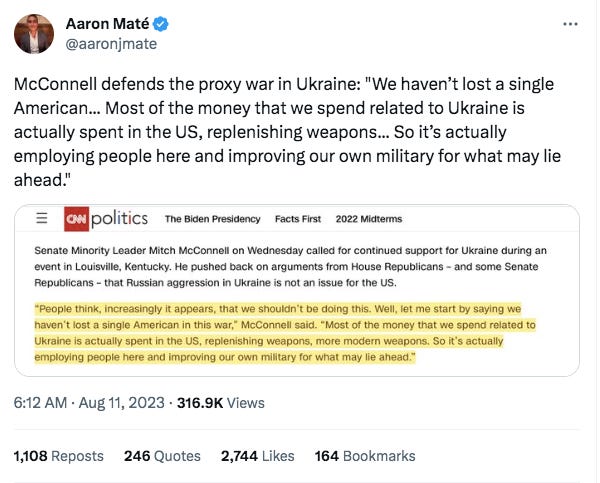
McConnell defends the proxy war in Ukraine: "We haven’t lost a single American… Most of the money that we spend related to Ukraine is actually spent in the US, replenishing weapons… So it’s actually employing people here and improving our own military for what may lie ahead." pic.twitter.com/xjd3RcVoRb
If people really understood just how much suffering and destruction is unleashed by US foreign policy, they’d stop making such a big deal about the minor differences between two political parties who always come together to support the most destructive US foreign policy decisions.
The human suffering caused by the minor differences in domestic policy between Democrats and Republicans is dwarfed by the suffering caused by foreign policy bipartisanship by orders of magnitude. The ways they are the same are vastly more significant than the ways in which they differ.
The main misconception about US presidents is that they are proactive leaders when they’re really reactive facilitators. They’re not proactively leading the government in accordance with their vision and ideology, they’re responding to and facilitating the various needs of the empire from year to year. That’s what the empire managers in their administrations are doing with their daily intelligence and national security briefings: explaining to them what the needs of the empire are on that day and what must be done to facilitate those needs, using whatever language will make a given president receptive.
The main difference between US presidents often comes down to the narratives that the empire managers who they surround themselves with will use to explain why they need to advance the interests of the empire. Progressive president? You need to kill Syrians to advance human rights. Conservative president? You need to kill Syrians to protect national security.
As resources are depleted and climate change disrupts the few breadbaskets of the world, which nations will have the foundations of values, organization, resources, human capital and wealth to survive polycrises?
No nation clinging to the current “waste is growth / landfill economy” will survive the emergent global polycrisis.
Identifying why the western Roman Empire collapsed in 476 AD has been a parlor game for at least two centuries, since Edward Gibbon published his monumental The History of the Decline and Fall of the Roman Empire (Abridged). Gibbon concluded Christianity had a major role in weakening the Empire, a view few today share.
Part of the fun of the parlor game is trying to identify the one thing that pushed it over the cliff: poisoning from lead pipes and wine goblets being a famous example that has been discounted by modern historians.
New research is more holistic, considering factors that were ignored or dismissed in the past, such as climate change and pandemics.
The word polycrisis captures this basic view: there wasn’t just one thing that toppled the empire, it was a confluence of crises that together nudged the empire to the breaking point. The empire was still robust and adaptive enough to handle any one crisis, but the onslaught of multiple, mutually reinforcing crises overwhelmed the resources of the empire.
Another approach is that of Peter Turchin and other historians, who look at social and economic cycles. Turchin holds that the overproduction of elites leads to elite conflicts that weaken the leadership and soaring wealth-power inequality undermines the social coherence of the state/empire. Ages of Discord: A Structural-Demographic Analysis of American History (2016)
Historian Michael Grant makes the case for moral rot unraveling social coherence in his classic The Fall of the Roman Empire.
Having read all these works and many others on the subject, it seems clear that all of these factors were part and parcel of the polycrisis that brought down Rome. Each factor added to the empire’s already immense burdens while reducing its wealth and resources.
I would highlight three such consequential factors among many:
1. The depletion of the silver mines in Spain, fatally reducing Rome’s money supply.
2. The Vandals conquering the North African breadbasket of Rome in 435 AD. The loss of this major wheat supply doomed Rome to scarcities that could not be made up elsewhere.
The view substantiated by Peter Heather argues that the Roman Empire was neither on the brink of social or moral collapse, nor fatally weakened by resource depletion. What brought it to an end were the barbarian invasions from what is now Germany and Eastern Europe. The fall of the Roman Empire: a new history of Rome and the Barbarians.
Heather argues Rome’s great success eventually led to its undoing, as the small, loosely organized Barbarian tribes learned from the Romans how to form larger, more cohesive and thus more powerful social and military organizations. Rome’s immense wealth was a magnet that attracted the Barbarians in two ways:
1. They wanted a piece of the rich Roman pie
2. In order to get that slice, they adopted Roman values and methodologies.
As a result of what they learned from Rome, the Barbarians became so formidable that Rome could no longer defeat them militarily, as they could when the tribes were smaller-scale and less cohesive.
Heather points out that late-era Rome faced multiple existential military threats, especially from the resurgent Persian Empire that Rome had battled for centuries. Despite its unwieldy size and bureaucracy, Rome managed effective adaptations that resolved the Persian threat.
Heather notes what other authors have focused on: Rome weakened itself by drawing an artificial distinction between “Barbarians” and “Romans.” Barbarians were anyone not within the Imperial borders, which were well-defined and defended, a point made by Edward N. Luttwak in his classic study, The Grand Strategy of the Roman Empire: From the First Century CE to the Third.
This distinction discounted the Barbarians and elevated the Romans, generating a fatal hubris in the Roman elites and squandering an opportunity to recruit the Barbarian tribes as stable allies. As with all human groups, if the rewards of alliance outweigh the risky gains of conquest, then leaders and their followers will pick alliance over conquest, the success of which is far from guaranteed.
So-called Barbarians became the core of the Roman army, and many of the most competent generals were either from the Roman hinterlands or they were Barbarians.
Rome had long exercised a military-diplomatic policy of defeating the Barbarians when they invaded Roman territories, but then making treaties with the Barbarian leaders that allowed the Barbarians to trade (and thus share the wealth) with Rome and settle within its borders.
In effect, Rome Romanized many Barbarian tribes over the centuries, mostly with “soft power” (diplomacy, sharing the wealth, cultural absorption) rather than “hard power” (military force).
DNA, Health Records, Blood, saliva, urine…and oh yah, it is all kept private says the government funded school working for the government health agency.
I am fairly certain the government gets all your health records, as soon as something new is added, from your “health provider”. It probably takes some effort to dig it out so why not kill 2 birds. Make you do the work and in the process get you (more) used to doing what you are told.
The cicadas were kicking up their usual racket, and I thought of La Fontaine’s fable. In it, the cicada has spent the whole summer singing, but when the north wind begins to bite has nothing left to eat. She asks her neighbor, the ant, for food, which she, the ant, has spent the summer accumulating for wintertime. “You sang all the summer, though,” replies the ant. “Very well, now you can dance.”
Chekhov says somewhere that a writer—a real writer, that is—ought to be able to write a story about anything, an ashtray for example.
Actually, I don’t think that that would be so difficult a task: Ashtrays in the old days would have witnessed quite a lot, if they had been sentient and observant. And then, of course, cigarette ends might have quite a lot to say before their demise. The only problem is that readers these days might not know what an ashtray is, for they are seldom put out anywhere for fear of encouraging people to smoke. Gone are the days when every gentleman, whether he smoked or not (though mostly he did), carried an elegant cigarette lighter that he whisked out of his pocket assiduously to light the cigarette of his female interlocutor. Almost certainly, many affairs began this way. Of course, the world must have smelled dreadfully of cigarette smoke, stale and throat-catching—except that, used to it as we were, our throats did not catch. But now I find even a single cigarette smoked on an outdoor terrace intolerable.
To return, however, to the possibility of writing about small things: I am very fond of idly observing the wildlife on the terrace of my tiny additional house in France that I use as my library. There is, for example, a large green lizard (large, that is, by European standards, not by those of the Komodo dragon) that seems to live in the pile of kindling by the disused bread oven of ancient stone. During the season—I am not sure what season, but I suppose it must have something to do with sex—he has a sky-blue head. He is very shy, however, at least with humans, and the slightest movement on my part sends him scuttling back into the sticks.
Then there is a sweet little vole that sticks his head out of a hole in the wall. He, too, is very shy, and he sniffs the air as if the world were full of enemies that he can smell. Of course, there are weasels, badgers, foxes, kites, and owls about, not to mention the one-eyed ginger-and-white moth-eaten feral cat that always slinks away guiltily like a politician being asked a difficult question, so I suppose the vole is only being reasonable. Health and safety come first.