

Be seeing you

Enemy of the State-Read the Book-Know the Man
This is not a Safe Space but Baby, I don't care.

"I am not a number, I am a Free Man" - No. 6
 Information Liberation Alex Jones’ Prison Planet Gary North Specific Answers Antiwar The Daily Bell Tenth Amendment Center Economics Policy Journal The American Thinker The New American Lew Rockwell
Posted by M. C. on April 5, 2025
Be seeing you
Posted in Uncategorized | Tagged: hot poker, Taxes | Leave a Comment »
Posted by M. C. on April 4, 2025
Be seeing you
Posted in Uncategorized | Tagged: Government, lp.org, money | Leave a Comment »
Posted by M. C. on April 2, 2025
And WW campaigned on a NON-intervention platform.
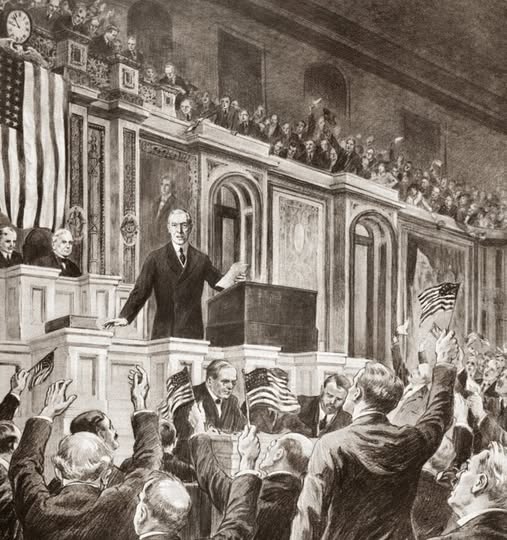
On this day, April 2, 1917, President Woodrow Wilson stood before Congress and urged a declaration of war against Germany, pulling the United States into World War I. He painted it as a moral imperative, but the U.S. had no vital interest in Europe’s brutal stalemate—submarine threats and alliances didn’t justify the cost. Over 116,000 Americans perished, millions more were wounded, and the nation racked up debt for a war that ended in a harsh treaty, planting seeds for WWII.
This wasn’t our fight; it was an unnecessary plunge into foreign chaos. The Libertarian Party of Pennsylvania condemns such interventions. Wars abroad don’t protect liberty—they expand government and squander lives. We thrive by staying out of distant battles, not by joining them.
Be seeing you
Posted in Uncategorized | Tagged: Woodrow Wilson, World War I | Leave a Comment »
Posted by M. C. on March 31, 2025

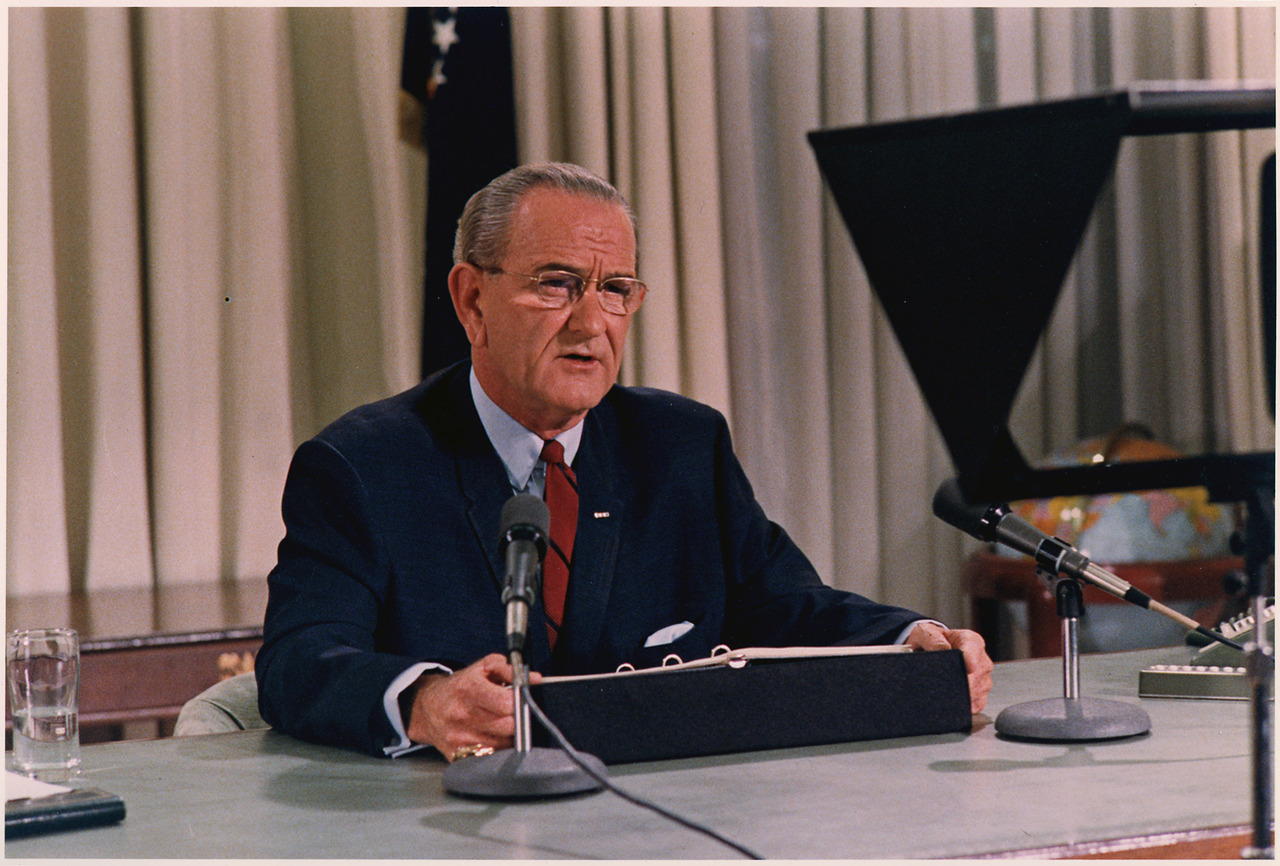
On this day, March 31st, 1968, President Lyndon Johnson addressed the nation about Vietnam, outlining “Steps to Limit the War.” But the bombshell came at the end: “I shall not seek, and I will not accept, the nomination of my party for another term as your president.” LBJ’s war—a grinding, costly slog—had tanked his approval. Over 16,000 Americans were dead by ’68, with billions spent and no victory in sight. The public turned on him, and he knew it.
Time after time, candidates who pledge peace—like LBJ’s rival Eugene McCarthy—gain ground over war hawks.
The Libertarian Party of Pennsylvania gets it: peace wins. Foreign adventurism bleeds us dry and sours the people. Prosperity and morality lie in non-intervention—bringing troops home, cutting war budgets, and letting nations sort themselves out. It’s the bold, popular path. Who’s ready to walk it?
Posted in Uncategorized | Tagged: Lyndon Johnson, Vietnam | Leave a Comment »
Posted by M. C. on March 31, 2025
What is said between the lines here is there is little difference liberals and so-called conservatives on war.
And planetary interventionism, empire building, spending, social programs, the Constitution, individual rights, privacy…
https://www.caitlinjohnst.one/p/liberals-believe-in-nothing-and-remember

The other day I shared a short post about a video that was going around showing a father in Gaza tearfully cradling the head of his son who was decapitated in an Israeli airstrike, and some guy responded with the comment “Good thing you helped get TRUMP ELECTED!!”
And I must admit I was actually, truly shocked. I mean, what exactly did this fellow think was happening under Biden that whole time?
I saw a post on Twitter where a leftist responded to a liberal who was acting like ICE just suddenly transformed into a modern gestapo under Trump, saying, “Liberals believe in nothing and remember even less.”
And it’s just so true. They don’t believe in anything. They don’t stand for anything. It’s just a team sport for these people. Politics for the mainstream liberal is not about advancing values or building a better world, it’s about their team winning solely for the sake of winning. And because they have no real values or causes beyond winning for its own sake, what their team does when it’s in office doesn’t matter to them.
A Democrat president can be as tyrannical and murderous as he wants and liberals will just brunch away in cheerful obliviousness, content with their knowledge that their team is holding the trophy.

You see this in the way our friend believes that I “helped get Trump elected” by criticizing the people who were perpetrating an active genocide. He just automatically took it as a given that it was my responsibility to stay silent on Gaza because the person in charge was a Democrat and his veep was running for president. The fact that it was a genocide which needed to be ferociously opposed never entered into the equation for him. All he cared about was winning.
See the rest here
Be seeing you
Posted in Uncategorized | Tagged: empire building, Privacy, liberals, Gaza, Interventionism, Individual Rights, Spending, the Constitution, social programs | 1 Comment »
Posted by M. C. on March 30, 2025
| Walter Block News Letter |
Every fiber of my economic being cries out against tariffs. If they are so good, why doesn’t each state in the US have one against the products of all of the other 49? That is, Ohio could “protect” its industries against the incursions from Arizona. This is obviously silly. One of the important reasons America is so prosperous is that we have a gigantic, internal, free trade area.
Donald Trump supports them on the ground that the McKinley administration was prosperous, and relied upon tariffs. But this is to commit the post hoc ergo propter hoc logical fallacy: that since A precedes B, A must be the cause of B. No, America did indeed become rich during this epoch, but that was in spite of tariffs, not due to their benign influence. If you are looking for a historical episode to shed light on this matter, the Smoot-Hawley Tariff of 1930 will do far better: it greatly worsened an already bad recession, plunging our economy into a deep depression.
Our President also claims that the US is victimized by a negative balance of trade: we buy more from Canada and other countries than they purchase from us. However, I have a horrid balance of trade with McDonald’s and Wal-Mart. I acquire several hundreds of dollars’ worth of their products every year, and neither has yet seen fit to reciprocate with any of my economic services (hint, hint!). On the other hand, I have a very strong positive balance of trade with my employer, Loyola University New Orleans. They pay me a decent salary; apart from a few lunches in their cafeteria, my expenditures to them fill their coffers to a zero degree. Should anyone worry about this sort of thing? Of course not. Ditto for international trade. If Country A buys more from B than it sells to it, money will flow from the former to the latter, reducing prices in the former and raising them in the latter, until matters balance out.
Everyone realizes the foolishness of tariffs when it comes to absolute advantage. No Canadian objects to the importation of bananas from Costa Rica. Producing this tropical product in the frozen North would be financially prohibitive (gigantic hothouses). Ditto for maple syrup in the country to the south. The only way they could produce this item would be to place maple trees in gigantic refrigerators. Ludicrous and prohibitively expensive.
But when it comes to comparative advantage, all too many people are out to lunch insofar as the teachings of Economics 101 are concerned. They fear that other countries might be more efficient than we are; with free trade, they would produce everything, we, nothing, and we would all starve to death from massive unemployment.
To dispel this myth, let’s consider a thought experiment. A lawyer is as good a typist as his secretary. He can produce $1,000 per day by practicing his profession. But for every such day, he needs a certain amount of typing. He can produce $200 worth each day. In two days, he can thus earn $1200 on his own. If he hires a typist, he can earn $2,000 from lawyering in two days, but must pay his secretary $200 daily for a total of $400. If he trades with her, he will come out with $2,000-$400=$1,600, an appreciable gain for him.
So is there any economic case for tariffs, given the foregoing? Yes, paradoxically, there is—in a way, if the alternative is a tax that’s even worse.
At the start of his second term, President Trump initially fired 6% of the employees of the Internal Revenue Service. He is now looking to end the employment of some 50% of them. Suppose he follows this up by getting rid of all of the rest of the IRS bureaucrats, eliminating the dreaded income tax, and achieving revenue neutrality with tariffs. His motto might be: “Let’s turn back the clock to 1912,” the year before this tax was implemented (when it ranged from 1% to 7%!).
What would the benefits be thereof? First of all, there are many intelligent, productive people who work for the IRS. There are some 90,000 of them. If dismissed by their employer, they would be freed up to produce goods and services desired by the populace. Ditto for the many accountants and tax lawyers who devote all or part of their time to helping their clients wrestle with complicated IRS regulations. Further, many of us fill out our own tax forms. This takes hours, days in some cases, time that could be better spent on leisure or productivity.
The benefit here is that it takes relatively little labor to run a tariff system. Hey, we already have tariffs in place. An increase in their level would hardly call for much more manpower, likely hardly any more at all.
Halfway measures will avail us little. But if Mr. Trump completely eliminates the IRS and the hated income tax along with it, there may be a reasonable case for increasing tariff rates. Not to present punitive levels, though.
To put it another way, if we accept that there has to be a government, and it therefore needs some revenue to function, this might be the least-bad option.
Should we worry about so many people becoming unemployed? Not at all. A similar sort of thing occurred when the car replaced the horse and buggy, when the cell phone substituted for Kodak, when we switched from typewriters to computers, etc. We are all the richer for this sort of thing, and will be in this case too.
Originally published here.
Walter’s Newsletter is free today. But if you enjoyed this post, you can tell Walter’s Newsletter that their writing is valuable by pledging a future subscription. You won’t be charged unless they enable payments.
Be seeing you
Posted in Uncategorized | Tagged: income tax, Tariffs | Leave a Comment »
Posted by M. C. on March 30, 2025
The US was great until it started invading the world.
Be seeing you
Posted in Uncategorized | Tagged: U.S. government | Leave a Comment »
Posted by M. C. on March 29, 2025
Bernanke was troubled that the prices of mortgages were rising. But that is exactly what needed to happen. They were way out of whack, and the US economy production structure was distorted. Indeed, in 2005, nearly 1.3 million new houses were sold, fully double the levels seen in the 1990s. Prices must change to reallocate resources; to freeze or further distort them by intervention is to perpetuate the discoordination. Prices are never arbitrary. True, they may be distorted, but even if they are distorted, they remain the best signals of underlying economic realities, especially when the market is attempting to clear the prior distortion in the pricing mechanism by correcting the imbalance in relative prices.
The metaphor highlights the hubris—crises are not “fires” to be extinguished by a heroic state, but symptoms of prior distortions that only the market can unwind. Taking his fatal conceit even further, and into the realm of the political, Bernanke goes so far to say (with much irony) that,
Henri de Saint-Simon (1760-1825), a French intellectual, was one of the founding fathers of socialism. Saint-Simon wanted to forge a “scientific understanding of society” which he would use to eliminate poverty and inequality by centrally planning the economy through the Parisian Banking Houses.
In this article, I argue that Ben Bernanke—along with his other two musketeers, Hank Paulson and Timothy Geithner—are Saint-Simonians par excellence, expressed particularly fervently in their views towards the financial system during and after the Great Financial Crisis. In the following article, we shall look at Bernanke’s The Courage to Act and Bernanke, Paulson, and Geithner’s Firefighting. If the conventional prescription to the Great Financial Crisis could be boiled down to a single word, it would be control.
The case of the shadow banks is paradigmatic. It is true that shadow banks were less regulated than commercial banks. And it is this very reason as to why they were so easily blamed for the crisis. They were just acting more freely than those financial institutions that were heavily regulated and under guarantee by the government. When the freer market (the shadow banks) functioned by stopping the supply of money—or liquidity—to firms that had taken heavy losses on their subprime positions, hence had very high credit risk, they went bankrupt, and the crisis began.
But we are being myopic if we so quickly blame the pulling of credit by the shadow banking system as the cause for the panic. Nevertheless, as Johnson and Santor write, the conventional view, then, is that,
…it is clear that central banks need to continue to ensure that core funding markets remain functional at all times. This means that central banks should…assume a key role in core funding markets in times of severe financial stress.
This is a classic case of Mises’s and Hayek’s insight that prior intervention makes necessary more intervention, unless the intervener is willing to give up the initial intervention. In other words, shadow banks had to come under tighter regulation and join the commercial banks under the watchful yoke of the state. Indeed, they did.
The trio start by claiming the crisis was caused because the government let businesses do things, as they write: “the government let major financial institutions take on too much risky leverage without insisting that they retain enough capital” (Firefighting, ch. 1). The trio are not wrong that the financial system was over-leveraged, but there are simple reasons as to why this was the case (e.g., excessively cheap credit and faulty “scientific,” “quantitative” risk models, etc.). The trio claims that the government, if it just increased its control, could have avoided the crisis entirely. Moreover, the use of the phrase “let” is particularly concerning. It reduces entrepreneurs to children that need to be ordered around. This is a quintessential Saint-Simonian reversal of the truth: the natural order of free exchange is supposedly disorderly, and the solution to such disorder is found in the iron—as opposed to the “invisible”—hand of the enlightened state.
During the crisis, Bernanke recalls how he was dismayed with prices on the markets. He asserts that the “fire-sale price (of assets) may be much less than the hold-to-maturity price,” (Courage, p. 315) suggesting, as he continues elsewhere, that prices fell to “artificially low levels” (p. 264). To posit, as Bernanke does, that prices were “artificial” because “financial institutions … were actively dumping MBS on the market—pushing up mortgage rates,” (p. 372) and to decry this as a problem requiring intervention, is to misunderstand the market’s corrective mechanism.
Bernanke was troubled that the prices of mortgages were rising. But that is exactly what needed to happen. They were way out of whack, and the US economy production structure was distorted. Indeed, in 2005, nearly 1.3 million new houses were sold, fully double the levels seen in the 1990s. Prices must change to reallocate resources; to freeze or further distort them by intervention is to perpetuate the discoordination. Prices are never arbitrary. True, they may be distorted, but even if they are distorted, they remain the best signals of underlying economic realities, especially when the market is attempting to clear the prior distortion in the pricing mechanism by correcting the imbalance in relative prices. Prices during the GFC merely reflected the dispersed knowledge and judgments of countless actors, and their violent and erratic reversals were merely the market undergoing the Misesian counter-movements to clear the distortion in relative prices.
Indeed, as Norbert Michel shows in his book, the credit markets never entirely “froze.” Those firms who could raise liquidity and capital did do so. Those who couldn’t—because they had taken so many losses—couldn’t, they therefore failed (or were bailed out). Those assets that had positive risk-adjusted value continued to trade. Those that didn’t, didn’t.
The trio contend (Firefighting, ch. 3) that “the U.S. government still had no way to inject capital into a struggling firm, buy its assets, or guarantee its liabilities,” and that “if we had started the crisis with that authority…we could have acted more forcefully, more swiftly, and more comprehensively” (Firefighting, conclusion). Again, we see the implicit point: if we had just had more power earlier, we could have prevented the crisis. But a musing of the evidence finds that, even in 2007 and 2008, when the crisis had already begun and the chaos of late 2008 was staring at them in the face, Bernanke declared—and believed—that “the impact on the broader economy and financial markets of the problems in the subprime market seems likely to be contained” (Courage, p. 135). Indeed, the Bernanke Fed even thought about raising interest rates in 2008 to quell inflation! They had no idea what was going on. Nevertheless, taking Bernanke’s revisionist history at face value, we find the Saint-Simonian ideal in full bloom: the belief that problems can be pre-empted and/or ironed out only if the state had more power over the economy.
Bernanke’s justification for his approach is telling: “It was in everyone’s interest, whether or not they realized it, (for the Fed) to protect the economy from the consequences of a catastrophic failure of the financial system” (Courage, p. 261). Like Saint-Simon, who presumed to know what was good for all the people better than they knew it themselves, the trio dismissed the market’s decentralized wisdom in favor of their own. He writes that “the Fed had pushed the limits of its powers, and the ad hoc rescue had exposed the inadequacy of those powers,” (Firefighting, ch. 3), yet, rather than question the premise of intervention, the trio plead for more: “the next time a financial fire breaks out, America may well wish it had a better-prepared firehouse with better-equipped firefighters” (Firefighting, conclusion).
Be seeing you
Posted in Uncategorized | Tagged: Ben Bernanke, GFC, Great Financial Crisis, Saint-Simonians | Leave a Comment »
Posted by M. C. on March 27, 2025
It took 4 years to get the law passed
20 years later only half the population (according to TSA data, bet your life on that) have it
May 2025 is the final date, except for the 2 year extension for the confusion caused by those those that still don’t have RealID which will distract TSA employees from hassling and powering tripping…err…ensuring travel security
27 years and counting for this VITAL!!! security project
25 years later we have advanced to the point where we are flooding 9/11 perps with US tax dollars to create mayhem (kill people) in Middle East countries that never attacked US.
BOTTOM LINE: Ditch DOGE and make government bigger.
Be seeing you
Posted in Uncategorized | Tagged: bio-weapon, REAL ID, tsa | Leave a Comment »
Posted by M. C. on March 26, 2025
50 years of (government) decline. There are a ton of homeschooling options.
The Ron Paul Liberty Report
Be seeing you
Posted in Uncategorized | Tagged: Homeschooling | Leave a Comment »
 MCViewPoint