
Take it in stride

Enemy of the State-Read the Book-Know the Man
This is not a Safe Space but Baby, I don't care.

"I am not a number, I am a Free Man" - No. 6
 Information Liberation Alex Jones’ Prison Planet Gary North Specific Answers Antiwar The Daily Bell Tenth Amendment Center Economics Policy Journal The American Thinker The New American Lew Rockwell
Posted by M. C. on November 8, 2020
Take it in stride
Posted in Uncategorized | Tagged: Marcus Arelius, stoicism | Leave a Comment »
Posted by M. C. on November 7, 2020
Perhaps what’s more important for Americans is to focus more of their time and energy on activities they can actually control, namely taking charge of children’s education and not handing them over to the state for roughly seven hours a day, or even ten hours a day, if Kamala Harris had her way.
There might not be a lot to cheer about in 2020. With rioting, looting, and draconian lockdowns, America seems to be on the precipice of social unraveling thanks to misguided policy decisions and the culture of divisiveness fomented by political elites and the media class.
But in any moment of crisis, there are always new avenues for innovation that make people better off. Yes, private individuals can take advantage of precarious situations and turn them around for good purposes. Just look at homeschooling.
In a previous article, I noted that Americans should use the current lockdown mania to explore distinct educational options as opposed to clamoring for schools to be reopened. Americans might actually be getting the memo.
According to certain estimates from Gallup, the percentage of children participating in homeschooling is expected to double based on figures from 2019 to 2020. Further, public schooling has witnessed a concomitant drop in enrollment, with enrollment rates going from 83 percent in 2019 down to 76 percent in 2020.
Parents have every reason to pull their children out of public schools. These institutions are not exactly safe learning environments, nor are they run on a fiscally sound basis. A study from the Manhattan Institute found US per pupil spending has surged in the last fifty years, going from $4,720 in 1966 to $13,847 (in 2018 dollars) in 2016.
Private education is usually viewed as a luxury for the rich. While posh private options such as the Exeter Academy exist, many religious schools provide budget alternatives for families disenchanted with the current school system. The average Catholic school only charges about $8,000 per student, while private schools of other religious denominations charge roughly $10,000. Just like any service available in the private sector, there are diverse choices for families of all economic standings. The same cannot be said about one-size-fits-all public schools, which continue to have money thrown at them regardless of performance.
The education preferences of Americans vary from family to family. Not all parents will turn to private schooling, so many pursue the homeschooling route. Nevertheless, the reasons parents decide to exit the public school system tend to be similar irrespective of which alternative education model they choose. Some parents are sick of the political indoctrination their children receive at public schools. Others have become concerned about the viability of virtual education in addition to the uncertainty of school schedules. For many parents, jumping into the homeschooling realm seems like a risk, but it’s perhaps well worth it after weighing other options.
While the chaotic nature of the current lockdowns and the social unrest across the nation will make many Americans shudder, trying times are when entrepreneurs begin to shine. We must remember that nothing in our world is static. No matter the obstacles that the government and other institutions place in front of us, history has repeatedly shown that enterprising individuals find ways to satisfy the desires of the masses and improve their living standards. Change is the natural order, and the state does an excellent job of propping up moribund institutions that are in need of a facelift.
In one of his more underrated works, Bureaucracy, economist Ludwig von Mises acknowledged the inexorability of change and observed why it’s important for societies to embrace it if they desire to make economic progress:
The actual world is a world of permanent change. Population figures, tastes, and wants, the supply of factors of production and technological methods are in a ceaseless flux. In such a state of affairs there is need for a continuous adjustment of production to the change in conditions.
Public schools have functioned as taxpayer-subsidized daycares where parents can take the easy way and drop their kids off for eight hours a day to receive a subpar education. Nowadays, you can add in a large dose of cultural radicalism thanks to the introduction of the 1619 Project historical revisionism to numerous schools’ curricula. The public schooling skeptics, who have insisted for years that public schools serve as indoctrination centers, don’t look so crazy once people become aware of how ensconced political correctness is in schools. Handing young people over to the state was always a risky proposition. Countless families are starting to see firsthand how far the radicalization rabbit hole has gone. A good portion likely doesn’t want to take the risk of having their children completely brainwashed and will pull them out of modern-day indoctrination centers. Better to do so late than never.
A pivot to nonstate education is not a radical concept by any stretch of the imagination. There are strong residual instincts for alternative education methods among Americans. It’s usually forgotten that compulsory public education has not always dominated American education. Private schooling, homeschooling, and localized forms of public education have been used by Americans throughout their history. It wasn’t until mass public education entered the picture during the Progressive Era—the very period that gave birth to the administrative state—that mass compulsory education began its viral spread nationwide.
The current pandemic environment has opened up new approaches to schooling such as co-ops, learning pods, and unschooling. Despite what critics say, homeschooling is not as uniform as advertised. Parents have lots of choices at their disposal during a time when public schooling is becoming exceedingly cumbersome (as if it weren’t so in the first place).
There is reason to believe the recent wave of first-time homeschoolers may not be a temporary development but rather a budding sign of an educational realignment that is unfolding before our very eyes. The path toward any semblance of economic sanity or limited government is not going to be linear, frankly. When we look at the way markets work, it involves humans recognizing problems and muddling through with solutions that satisfy people’s desires. Oftentimes it takes external shocks to the system to effect change.
Given how the modern-day administrative state has rendered most political elections nothing more than political theater, the very act of exiting the public school system is a much more decisive expression of political action. Forget casting ballots—which will usually ends up favoring candidates who do nothing of substance to roll back public administration—the fact that more Americans are looking for other education options could yield much larger profreedom results than conventional politics.
It’s still up in the air whether Americans will completely follow through with their public school exodus. But if there’s a high-yield form of political activity that can be undertaken now, it’s getting children out of the public education system altogether. Doing so is a much more effective way of bringing about political change than punching a ballot every four years in what’s constantly marketed “as the most important election of our lifetime.”
Perhaps what’s more important for Americans is to focus more of their time and energy on activities they can actually control, namely taking charge of children’s education and not handing them over to the state for roughly seven hours a day, or even ten hours a day, if Kamala Harris had her way. Much more could be achieved by giving public education the cold shoulder than by putting all the eggs in the electoral politics basket. Author:
José Niño is a freelance writer based in Austin, Texas. Sign up for his mailing list here. Contact him via Facebook or Twitter. Get his premium newsletter here.
Be seeing you
Posted in Uncategorized | Tagged: 1619 Project, Homeschooling, Kamala Harris, lockdowns | Leave a Comment »
Posted by M. C. on November 6, 2020
You could say the Republicans broadly represent the military and police state, and the Democrats are in line with the woke mob.
In other words, the Republicans are the Attilas who will physically punish you for victimless crimes like drugs, and illegal immigration. And the Democrats are the Witch Doctors who control the media, the Twitter mobs, and the Facebook/ Google/ Youtube censorship.
And as many commenters have pointed out, the politicians are not truly in charge.
So you could say politics in general is akin to the Witch Doctor, keeping people believing they need to submit to this government for safety and prosperity. Meanwhile the monetary system controls our physical reality.
Be seeing you
Posted in Uncategorized | Tagged: Attila, Elite, Witch Doctor | Leave a Comment »
Posted by M. C. on November 6, 2020
If a return to “normalcy” means having the same old politicians that are responsible for endless wars, that work for the corporate elite, that lack the courage to implement real structural change required for major issues such as healthcare and the environment, then a call for “normalcy” is nothing more than a call to return to the same deprived conditions that led to our current crisis.
https://original.antiwar.com/?p=2012341309
“Let’s bring decency and integrity back to the White House.” I can’t count the number of times I have heard and read this phrase uttered by U.S. expats here in Paris, France. As one of many American expats living here, of course I share in the desire for an end to a Donald Trump presidency. But at what cost? And will a Biden presidency – which promises a return to “normalcy” – really merit the sigh of relief that so many think it will? Below I summarize some of the most troubling information I have uncovered about some of the most likely foreign policy picks for key positions in a Biden cabinet.
Susan Rice for Secretary of State
Susan Rice, who was also reportedly being considered for the role of Biden’s Vice President, served as United States Ambassador to the United Nations and as National Security Advisor, both under the Obama administration.
While Benghazi has been the focus of much criticism of Rice, she has received virtually no scrutiny for her backing of the invasion of Iraq and claiming that there were WMDs there. Some of her statements:
“I think he [then Secretary of State Colin Powell] has proved that Iraq has these weapons and is hiding them, and I don’t think many informed people doubted that.” (NPR, Feb. 6, 2003)
“It’s clear that Iraq poses a major threat. It’s clear that its weapons of mass destruction need to be dealt with forcefully, and that’s the path we’re on. I think the question becomes whether we can keep the diplomatic balls in the air and not drop any, even as we move forward, as we must, on the military side.” (NPR, Dec. 20, 2002)
“I think the United States government has been clear since the first Bush administration about the threat that Iraq and Saddam Hussein poses. The United States policy has been regime change for many, many years, going well back into the Clinton administration. So it’s a question of timing and tactics. … We do not necessarily need a further Council resolution before we can enforce this and previous resolutions.” (NPR, Nov. 11, 2002; requests for audio of Rice’s statements on NPR were declined by the publicly funded network.)
She has also been criticized extensively for her record on the African continent, which judging by the following quote at the beginning of the 1994 Rwandan genocide seems to have been to adopt a “laissez faire” attitude : “If we use the word ‘genocide’ and are seen as doing nothing, what will be the effect on the November [congressional] election?”
Susan Rice’s past rhetoric also includes choice generous words for African dictators. One great example is former prime minister of Ethiopia, Meles Zenawi, a man who ordered security services to open fire on protesters during its controversial 2005 election, has a track record of imprisoning journalists, used food aid as a political tool and stole land in south Ethiopia. In her speech at his funeral, Susan Rice described him as “brilliant” and a “close friend“.
Although Rice has often been portrayed as someone who is anti-Israel, her mild criticisms pale in comparison to her staunch record and discourse on the Israeli-Palestinian issue.
In a speech given at the AIPAC Synagogue Initiative Lunch back in 2012, Rice boasted about vetoing a UN resolution that would deem Israeli settlements on occupied Palestinian land as illegal, and further characterized the Goldstone Report as “flawed” and “insisted on Israel’s right to defend itself and maintained that Israel’s democratic institutions could credibly investigate any possible abuses.” Her position has changed little since then, as recently as 2016, she proclaimed that “Israel’s security isn’t a Democratic interest or a Republican interest—it’s an enduring American interest.”
Tony Blinken for National Security Adviser
Tony Blinken is also an old member of the Obama administration, having served first as VP Biden’s National Security Advisor from 2009 to 2013, Deputy National Security Advisor from 2013 to 2015 and then as United States Deputy Secretary of State from 2015 to 2017.
Blinken had immense influence over Biden in his role as Deputy National Security Advisor, helping formulate Biden’s approach and support for the wars in Iraq and Afghanistan.
“For Biden…”, he argued, “and for a number of others who voted for the resolution, it was a vote for tough diplomacy.” He added “It is more likely that diplomacy will succeed, if the other side knows military action is possible.”
The two of them were responsible for delivering on Obama’s campaign promise to get American troops out of Iraq, a process so oversimplified and poorly handled that it led to even more chaos than the initial occupation and insurgency.
Blinken seems to be of the view that it is up to the US, and only the US, to take charge of world affairs : “On leadership, whether we like it or not, the world just doesn’t organize itself. And until this [Trump] administration, the US had played a lead role in doing a lot of that organizing, helping to write the rules, to shape the norms and animate the institutions that govern relations among nations. When we’re not engaged, when we don’t lead, then one or two things is likely to happen. Either some other country tries to take our place – but probably not in a way that advances our interests or values – or no one does. And then you get chaos or a vacuum filled by bad things before it’s filled by good things. Either way, that’s bad for us.”
Blinken also appears to be steering Biden’s pro-Israel agenda, recently stating that Biden “would not tie military assistance to Israel to any political decisions that it makes, period, full stop,” which includes an all out rejection of BDS, the Boycott, Divestment & Sanctions Movement against Israel’s occupation of Palestine.
Michèle Flournoy for Secretary of Defense
Michele Flournoy was Under Secretary of Defense for Policy from 2009 to 2012 in the Obama administration under Secretaries Robert Gates and Leon Panetta.
Flournoy, in writing the Quadrennial Defense Review during her time as Assistant Secretary of Defense for Strategy under President Clinton, has paved the way for the U.S.’s endless and costly wars which prevent us from investing in life saving and necessary programs like Medicare for All and the Green New Deal. It has effectively granted the US permission to no longer be bound by the UN Charter’s prohibition against the threat or use of military force. It declared that, “when the interests at stake are vital, …we should do whatever it takes to defend them, including, when necessary, the unilateral use of military power.”
While working at the Center for Strategic and International Studies (CSIS), a “Top Defense and National Security Think Tank” based in Washington D.C., in June 2002, as the Bush administration was threatening aggression towards Iraq, she declared, that the United States would “need to strike preemptively before a crisis erupts to destroy an adversary’s weapons stockpile” before it “could erect defenses to protect those weapons, or simply disperse them.” She continued along this path even in 2009, after the Bush administration, in a speech for the CSIS : “The second key challenge I want to highlight is the proliferation – continued proliferation of nuclear weapons and other weapons of mass destruction, as these also pose increasing threats to our security. We have to respond to states such as Iran, North Korea, who are seeking to develop nuclear weapons technologies, and in a globalized world there is also an increased risk that non-state actors will find ways to obtain these materials or weapons.”
It is extremely important to note that Flournoy and Blinken co-founded the strategic consulting firm, WestExec Advisors, where the two use their large database of governmental, military, venture capitalists and corporate leader contacts to help companies win big Pentagon contracts. One such client being Jigsaw, a technology incubator created by Google that describes itself on its website as “a unit within Google that forecasts and confronts emerging threats, creating future-defining research and technology to keep our world safer.” Their partnership on the AI initiative entitled Project Maven led to a rebellion by Google workers who opposed their technology being used by military and police operations.
Furthermore, Flournoy and Blinken, in their jobs at WestExec Advisors, co-chaired the biannual meeting of the liberal organization Foreign Policy for America. Over 50 representatives of national-security groups were in attendance. Most of the attendees supported “ask(ing) Congress to halt U.S. military involvement in the (Yemen) conflict.” Flournoy did not. She said that the weapons should be sold under certain conditions and that Saudi Arabia needed these advanced patriot missiles to defend itself.
Conclusion
If a return to “normalcy” means having the same old politicians that are responsible for endless wars, that work for the corporate elite, that lack the courage to implement real structural change required for major issues such as healthcare and the environment, then a call for “normalcy” is nothing more than a call to return to the same deprived conditions that led to our current crisis. Such a return with amplified conditions and circumstances, could set the stage for the return of an administration with dangers that could possibly even exceed those posed by the current one in terms of launching new wars.
Mariamne Everett is an intern at the Institute for Public Accuracy currently living in France.
Be seeing you
Posted in Uncategorized | Tagged: Joe Biden, Michèle Flournoy, Susan Rice, Tony Blinken, War Cabinet | Leave a Comment »
Posted by M. C. on November 6, 2020
“Never blame a legislative body for not doing something. When they do nothing, they don’t hurt anybody. When they do something is when they become dangerous.”
https://www.abbevilleinstitute.org/blog/a-fool-and-his-money-are-soon-elected/
Will Rogers had a quip for just about any situation, but he loved to talk politics. Rogers was born on a Cherokee reservation in Oklahoma. His father was a Confederate veteran and political leader in the Cherokee nation. At the height of his career, Will Rogers had the number one radio program in America and was the highest paid actor in Hollywood.
His folksy style and unassuming demeanor veiled a sharp wit and keen political insight. He understood the charade better than most. Rogers despised the Republican Party, but more than anything he hated career politicians and government waste.
Our current infatuation with the American civic religion could use a little dose of Will Rogers. He also serves as a reminder that Washington D.C. has been a cesspool for decades.
“We always want the best man to win the election. Unfortunately, he never does.”
“If you ever injected truth into politics you have no politics.”
“I don’t know who started the idea that a President must be a Politician instead of a Business man. A Politician can’t run any other kind of business. So there is no reason why he can run the U.S. That’s the biggest single business in the World.”
“America has the best politicians money can buy.”
“Congress is so strange; a man gets up to speak and says nothing, nobody listens, and then everybody disagrees.”
“Congress meets tomorrow morning. Let us all pray: Oh Lord, give us strength to bear that which is about to be inflicted upon us. Be merciful with them, oh Lord, for they know not what they’re doing. Amen.”
“We all joke about Congress but we can’t improve on them. Have you noticed that no matter who we elect, he is just as bad as the one he replaces?”
“Never blame a legislative body for not doing something. When they do nothing, they don’t hurt anybody. When they do something is when they become dangerous.”
“Our president delivered his State of the Union message to Congress. That is one of the things his contract calls for — to tell congress the condition of the country. This message, as I say, is to Congress. The rest of the people know the condition of the country, for they live in it, but Congress has no idea what is going on in America, so the president has to tell ’em.”
“It’s getting so if a man wants to stand well socially, he can’t afford to be seen with either the Democrats or the Republicans.”
“Everything is changing. People are taking their comedians seriously, and the politicians as a joke, when it used to be vice versa.”
“It looks to me like any man that wants to be President in times like these lacks something.”
“Lord, the money we do spend on Government and it’s not one bit better than the government we got for one-third the money twenty years ago.”
Brion McClanahan is the author or co-author of six books, How Alexander Hamilton Screwed Up America (Regnery History, 2017), 9 Presidents Who Screwed Up America and Four Who Tried to Save Her (Regnery History, 2016), The Politically Incorrect Guide to the Founding Fathers, (Regnery, 2009), The Founding Fathers Guide to the Constitution (Regnery History, 2012), Forgotten Conservatives in American History (Pelican, 2012), and The Politically Incorrect Guide to Real American Heroes, (Regnery, 2012). He received a B.A. in History from Salisbury University in 1997 and an M.A. in History from the University of South Carolina in 1999. He finished his Ph.D. in History at the University of South Carolina in 2006, and had the privilege of being Clyde Wilson’s last doctoral student. He lives in Alabama with his wife and three daughters. More from Brion McClanahan
Be seeing you
Posted in Uncategorized | Tagged: Fool and His Money, Will Rogers | Leave a Comment »
Posted by M. C. on November 6, 2020
We’re told to protect them, as if they were a valuable and endangered species. I say, “A pox upon stakeholders.” If they want a vote in what a company does, then they ought to become shareholders. Stakeholders are a class of being created out of nothing by Cultural Marxists for the purpose of shaking down shareholders.
https://internationalman.com/articles/doug-casey-on-the-end-of-western-civilization/
by Doug Casey
International Man: The decline of Western Civilization is on a lot of people’s minds.
Let’s talk about this trend.
Doug Casey: Western Civilization has its origins in ancient Greece. It’s unique among the world’s civilizations in putting the individual—as opposed to the collective—in a central position. It enshrined logic and rational thought—as opposed to mysticism and superstition—as the way to deal with the world. It’s because of this that we have science, technology, great literature and art, capitalism, personal freedom, the concept of progress, and much, much more. In fact, almost everything worth having in the material world is due to Western Civilization.
Ayn Rand once said “East minus West equals zero.” I think she went a bit too far, as a rhetorical device, but she was essentially right. When you look at what the world’s other civilizations have brought to the party, at least over the last 2,500 years, it’s trivial.
I lived in the Orient for years. There are many things I love about it—martial arts, yoga, and the cuisine among them. But all the progress they’ve made is due to adopting the fruits of the West.
International Man: There are so many things degrading Western Civilization. Where do we begin?
Doug Casey: It’s been said, correctly, that a civilization always collapses from within. World War 1, in 1914, signaled the start of the long collapse of Western Civilization. Of course, termites were already eating away at the foundations, with the writings of people like Jean-Jacques Rousseau and Karl Marx. It’s been on an accelerating downward path ever since, even though technology and science have been improving at a quantum pace. They are, however, like delayed action flywheels, operating on stored energy and accumulated capital. Without capital, intellectual freedom, and entrepreneurialism, science and technology will slow down. I’m optimistic we’ll make it to Kurzweil’s Singularity, but there are no guarantees.
Things also changed with the creation of the Federal Reserve in 1913. Before that, the US used gold coinage for money. “The dollar” was just a name for 1/20th of an ounce of gold. That is what the dollar was. Paper dollars were just receipts for gold on deposit in the Treasury. The income tax, enacted the same year, threw more sand in the gears of civilization. The world was much freer before the events of 1913 and 1914, which acted to put the State at the center of everything.
The Fed and the income tax are both disastrous and unnecessary things, enemies of the common man in every way. Unfortunately, people have come to believe they’re fixtures in the cosmic firmament. They’re the main reasons—there are many other reasons, though, unfortunately—why the average American’s standard of living has been dropping since the early 1970s. In fact, were it not for these things, and the immense amount of capital destroyed during the numerous wars of the last 100 years, I expect we’d have already colonized the moon and Mars. Among many other things…
But I want to re-emphasize that the science, the technology, and all the wonderful toys we have are not the essence of Western Civilization. They’re consequences of individualism, capitalism, rational thought, and personal freedom. It’s critical not to confuse cause and effect.
International Man: You mentioned that the average American’s standard of living has dropped since the early 1970s. This is directly related to the US government abandoning the dollar’s last link to gold in 1971. Since then, the Federal Reserve has been able to debase the US dollar without limit.
I think the dollar’s transformation into a purely fiat currency has eroded the rule of law and morality in the US. It’s similar to what happened in the Roman Empire after it started debasing its currency.
What do you think, Doug?
Doug Casey: All the world’s governments and central banks share a common philosophy, which drives these policies. They believe that you create economic activity by stimulating demand, and you stimulate demand by printing money. And, of course, it’s true, in a way. Roughly the same way a counterfeiter can stimulate a local economy.
Unfortunately, they ignore that, and completely ignore that the way a person or a society becomes wealthy is by producing more than they consume and saving the difference. That difference, savings, is how you create capital. Without capital you’re reduced to subsistence, scratching at the earth with a stick. These people think that by inflating—which is to say destroying—the currency, they can create prosperity. But what they’re really doing, is destroying capital: When you destroy the value of the currency, that discourages people from saving it. And when people don’t save, they can’t build capital, and the vicious cycle goes on.
This is destructive for civilization itself, in both the long term and the short term. The more paper money, the more credit, they create, the more society focuses on finance, as opposed to production. It’s why there are many times more people studying finance than science. The focus is increasingly on speculation, not production. Financial engineering, not mechanical, electrical, or chemical engineering. And lots of laws and regulations to keep the unstable structure from collapsing.
What keeps a truly civil society together isn’t laws, regulations, and police. It’s peer pressure, social opprobrium, moral approbation, and your reputation. These are the four elements that keep things together. Western Civilization is built on voluntarism. But, as the State grows, that’s being replaced by coercion in every aspect of society. There are regulations on the most obscure areas of life. As Harvey Silverglate pointed out in his book, the average American commits three felonies a day. Whether he’s caught and prosecuted is a subject of luck and the arbitrary will of some functionary. That’s antithetical to the core values of Western Civilization.
International Man: Speaking of ancient civilizations like Rome, interest rates are about the lowest they’ve been in 5,000 years of recorded history. Trillions of dollars’ worth of government bonds trade at negative yields.
Of course, this couldn’t happen in a free market. It’s only possible because of central bank manipulation.
How will artificially low interest rates affect the collapse of Western Civilization?
Doug Casey: It’s really, really serious. I previously thought it was metaphysically impossible to have negative interest rates but, in the Bizarro World central banks have created, it’s happened.
Negative interest rates discourage saving. Once again, saving is what builds capital. Without capital you wind up as an empty shell—Rome in 450 A.D., or Detroit today—lots of wonderful but empty buildings and no economic activity. Worse, it forces people to desperately put their money in all manner of idiotic speculations in an effort to stay ahead of inflation. They wind up chasing the bubbles the funny money creates.
Let me re-emphasize something: in order for science and technology to advance you need capital. Where does capital come from? It comes from people producing more than they consume and saving the difference. Debt, on the other hand, means you’re living above your means. You’re either consuming the capital others have saved, or you’re mortgaging your future.
Zero and negative interest rate policies, and the creation of money out of nowhere, are actually destructive of civilization itself. It makes the average guy feel that he’s not in control of his own destiny. He starts believing that the State, or luck, or Allah will provide for him. That attitude is typical of people from backward parts of the world—not Western Civilization.
International Man: What does it say about the economy and society that people work so hard to interpret what officials from the Federal Reserve and other central banks say?
Doug Casey: It’s a shameful waste of time. They remind me of primitives seeking the counsel of witch doctors. One hundred years ago, the richest people in the country—the Rockefellers, the Carnegies, and such—made their money creating industries that actually made stuff. Now, the richest people in the country just shuffle money around. They get rich because they’re close to the government and the hydrant of currency materialized by the Federal Reserve. I’d say it’s a sign that society in the US has become quite degraded.
The world revolves much less around actual production, but around guessing the direction of financial markets. Negative interest rates are creating bubbles, and will eventually result in an economic collapse.
International Man: Negative interest rates are essentially a tax on savings. A lot of people would rather pull their money out of the bank and stuff it under a mattress than suffer that sting.
The economic central planners know this. It’s why they’re using negative interest rates to ramp up the War on Cash—the push to eliminate paper currency and create a cashless society.
The banking system is very fragile. Banks don’t hold much paper cash. It’s mostly digital bytes on a computer. If people start withdrawing paper money en masse, it won’t take much to bring the whole system down.
Their solution is to make accessing cash harder, and in some cases, illegal. That’s why the economic witch doctors at Harvard are pounding the table to get rid of the $100 bill.
Take France, for example. It’s now illegal to make cash transactions over €1,000 without documenting them properly.
Negative interest rates have turbocharged the War on Cash. If the central planners win this war, it would be the final deathblow to financial privacy.
How does this all relate to the collapse of Western Civilization?
Doug Casey: I believe the next step in their idiotic plan is to abolish cash. Decades ago they got rid of gold coinage, which used to circulate day to day in people’s pockets. Then they got rid of silver coinage. Now, they’re planning to get rid of cash altogether. So you won’t even have euros or dollars or pounds in your wallet anymore, or if you do, it will only be very small denominations. Everything else is going to have to be done through electronic payment processing.
This is a huge disaster for the average person: absolutely everything that you buy or sell, other than perhaps a candy bar or a hamburger, is going to have to go through the banking system. Thus, the government will be able to monitor every transaction and payment. Financial privacy, even what’s left of it today, will literally cease to exist.
Privacy is one of the big differences between a civilized society and a primitive society. In a primitive society, in your little dirt hut village, anybody can look through your window or pull back the flap on your tent. You have no privacy. Everybody can hear everything; see anything. This was one of the marvelous things about Western Civilization—privacy was valued, and respected. But that concept, like so many others, is on its way out…
International Man: You’ve mentioned before that language and words provide important clues to the collapse of Western Civilization. How so?
Doug Casey: Many of the words you hear, especially on television and other media, are confused, conflated, or completely misused. Many recent changes in the way words are used are corrupting the language. As George Orwell liked to point out, to control language is to control thought. The corruption of language is adding to the corruption of civilization itself. This is not a trivial factor in the degradation of Western Civilization.
Words—their exact meanings, and how they’re used—are critically important. If you don’t mean what you say and say what you mean, then it’s impossible to communicate accurately. Forget about transmitting philosophical concepts.
Take for example shareholders and stakeholders. We all know that a shareholder actually owns a share in a company, but have you noticed that over the last generation shareholders have become less important than stakeholders? Even though stakeholders are just hangers-on, employees, or people who are looking to get in on a shakedown. But everybody slavishly acknowledges, “Yes, we’ve got to look out for the stakeholders.”
Where did that concept come from? It’s a recent creation, but Boobus americanus seems to think it was carved in stone at the country’s founding.
We’re told to protect them, as if they were a valuable and endangered species. I say, “A pox upon stakeholders.” If they want a vote in what a company does, then they ought to become shareholders. Stakeholders are a class of being created out of nothing by Cultural Marxists for the purpose of shaking down shareholders.
Editor’s Note: The economic, political, and social volatility in the days and weeks ahead promises to be extreme. The impact on your savings, retirement funds, and personal freedoms could be unlike anything we’ve ever seen.
Do you want to know exactly what you should be doing differently with your portfolio and in your personal life? Then you need to see this urgent video.
EXCLUSIVE VIDEO: The Day After—How to Prepare for What Comes Next
It reveals what you can do to prepare so that you can avoid getting caught in the crosshairs. Click here to watch it now.
Be seeing you
Posted in Uncategorized | Tagged: economic collapse, Karl Marx, Western Civilization | Leave a Comment »
Posted by M. C. on November 6, 2020
We can still be Americans. If Americans’ right to govern themselves is respected. If it is not, we have two Americas – under one consolidated boot.
https://www.ericpetersautos.com/2020/11/05/when-your-vote-doesnt-matter/
By eric
I spoke yesterday with Bill Meyer, who hosts the Bill Meyer Show in Oregon. We talked, among other things, about the explosive fact that in states like VA and CA, a geographically tiny canker sore of urban density has achieved almost unassailable political control over the entire state.

For example, in my state – Virginia – 85 percent of the state, by geography, voted for the Orange Man but because of Northern Va and Richmond, which are hives of government workers (which means government-lovers) the state fell to the Hair Plugged Man.
The majority of the state is controlled politically by a minority of the state. It’s the same in CA and a number of other states, too.
The people no longer have a voice.
Because some people control the state.
What happens when the people of a state are disfranchised? When they come to know that their vote doesn’t matter? Is it equitable that a geographically and proportionately tiny part of a state dictates to the rest of the state?
By what right does a Beltway bureaucrat autocratically govern the lives of farmers who live hundreds of miles away? The Coonman is the governor of Northern Virginia. He is loathed in most of Virginia. But the people of the rest of the state cannot vote him out of their lives because their votes don’t matter. Northern Virginia decides the politics of Virginia.
Do we not adhere to the idea of the consent of the governed? How can there be consent when there is no choice? This is not about red vs. blue. It is about right vs. wrong.
It is time for a parting of the ways.
Before it comes to blows.
The people of Northern Virginia have the right to govern themselves – and so do the people of the rest of the state. The state should be recognized in law what it is in fact, which is two states. The same applies to the people of other states, who have the right to govern themselves but not the right to lord it over everyone else in the state.
This is a natural evolution.
People change – and with them, politics. It is unnatural to force them to pretend to be the same people when they are manifestly so different.

They must be allowed to separate.
It is the only peaceful way to relieve the tensions which are nearing the flash point. The flash isn’t necessary – because it isn’t necessary that the states as they are remain as they are.
Many of the western states were once much larger.
They became smaller by division.

There is a North Carolina and a South Carolina. Why not a Northern Virginia and a Southern Virginia? West Virginia was once part of Virginia. It is now a separate state. (Ironically, at the behest of the man who claimed to revile separation, Abraham Lincoln, who cut West Virginia away from “rebellious” Virginia, which no longer wished to be governed by the alien people of the north.)
There is no intrinsically necessary reason for any state to remain a single geographic and political bloc in perpetuity – and some very sound reasons for separation when the people of a consolidated state have become so divided, politically and geographically, as to make them separate people.
It does not mean they are not still Americans. But it does mean that a Northern Virginian is not a Southern Virginian. The two can coexist in the same country, perhaps. But not in the same state, under the consolidated rule of one of them.
If it weren’t for cognitive dissonance, these irreconcilable political differences would be acknowledged and acted upon – peacefully.
Before it becomes impossible to act upon them peacefully.
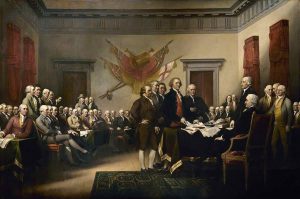
Kids are taught – or were – that the American colonies rightfully separated from Britain because they were not represented. Because they were justly tired of being under the political thumb of people unlike themselves, who lived far away and either knew nothing of their concerns or didn’t care about them. No one questions the legitimacy of the colonists’ argument nor the propriety of their actions.
They tried redress. They begged for representation. All they got was the royal boot.
And so they redrew political and geographic lines in such a way as to be represented and to consent to their government.
Are things any different in our time?
In states like Virginia and California and Oregon? Is it not a fact that the people of most of these aren’t represented?
That the geographic majority live under the boot of the cities and politicians of those cities, who not only rule them like royal governors but mulct them to finance their pleasure?
It is all too obvious – which is why it is so very dangerous. When elections no longer matter, as they no longer do, people will eventually take matters into their own hands.
The time has come to discuss going our separate ways before it gets to that.
We can still be Americans. If Americans’ right to govern themselves is respected. If it is not, we have two Americas – under one consolidated boot.
And then it will come to blows.
. . .
Got a question about cars, Libertarian politics – or anything else? Click on the “ask Eric” link and send ’em in!
Be seeing you
Posted in Uncategorized | Tagged: Northern Virginia, representation, separation, vote doesn’t matter | Leave a Comment »
Posted by M. C. on November 6, 2020
The media can’t blame the next black man killed by cops on Trump and they can’t turn off the coronavirus panic. Does the virus suddenly go away because someone new is in the White House? The toughest job for the media is going to be coming up with an excuse to put Trump on the front page once he’s gone.
Have they thought about what happens next?
https://www.takimag.com/article/what-now/print
This may be the strangest election in history in that there is no evidence that any sizable group of people want Biden for president.
It’s his fourth time running for that office. This year, Biden lost three primaries in a row, coming in fourth in the Iowa caucus, fifth in New Hampshire a distant second in Nevada. At the end of February, he had accumulated a paltry 14 delegates — compared to 45 for Bernie Sanders and 26 for Pete Buttigieg.
Then James Clyburn said, Vote for Biden and African Americans in South Carolina voted for Biden. (Although the black vote is NOT monolithic, they decided to make an exception this one time and vote monolithically.)
Democrats never looked back.
Biden has nothing going for him — no constituency, no fanatical supporters, just a career in politics that stretches back 50 years.
Bill Clinton had Southern Democrats and baby boomers. Gore had the global warming zealots. George Bush had conservative Christians and Texans. Even Hillary had fanatical supporters. Remember the PUMAs (Party Unity My A$$)? How about the weeping loons at the Javits Center on election night 2016?
Will anyone weep that Biden lost? No, they’ll weep because Trump won. Yes, much of Trump’s vote hated Hillary, but surely at least 70% of them actually supported Trump. Ninety-nine percent of Biden’s vote is: “I Hate Trump.”
How did Joe Biden become the nominee? Because he was the candidate most acceptable to black people. Why? Because he was Obama’s vice president. There’s a coalition built on rock.
Combine the empty suit from Delaware with Kamala Harris, who was polling at about 2% among Democrats before she dropped out of the primaries. Harris added nothing to the ticket — except Biden’s ridiculously narrow, self-imposed requirement that his vice president be a woman of color.
Unfortunately for him, there just aren’t a lot of massively impressive black women who are elected Democrats right now. Barbara Jordan is dead. Shirley Chisholm is dead. Either of them would have been chosen over Kamala. “But this election was entirely a referendum on Trump. “
When Harris’ campaign crashed and burned, I thought I’d embarrassed myself by predicting she would be the Democrats’ 2020 presidential nominee back in 2016 before I’d ever heard her speak — before she’d even won her Senate race.
But on this, I was right: She strokes all the media’s erogenous zones.
— She’s got the Hollywood glamour!
Why, I think she’s even better looking than Michelle Obama! Not as gorgeous as Beyonce, but beauty like THAT only happens once a century.
(Harris will be in a dozen Vogue fashion shoots.)
— She’s so cool!
She wears sneakers, and cited Tupac as the “best rapper alive.” (Wait, what? Oh, we didn’t know Tupac was murdered in Las Vegas 20 years ago, either.)
— She’s presentable in Hollywood and the Hamptons.
Poor Al Sharpton has been lurking around for 30 years, but Kamala is someone we can invite to our apartments.
Harris isn’t a huge hit with the Democratic base. She’s a hit with the people who make decisions for the party. My prediction is redeemed.
If voters had been forced to focus on Harris, Trump would’ve won in a landslide. But this election was entirely a referendum on Trump. It’s irrelevant who he’s running against. Maybe if they had dug up Hitler to run against him other issues would have come up, but even that’s not a sure thing.
Harris sent out a tweet the day before the election saying, “There’s a big difference between equality and equity,” along with a video demanding that “we all end up at the same place.”
Is anyone listening? She’s not saying everyone should have an equal opportunity, but that everyone should get the same stuff.
Hello? Suburban women? Harris wants to move poor people next door to you whether they can afford the house or not. It’s as if Harris was running a test: Do people even care what we’re running on?
Democrats could come out for vivisection of little children. No one cares! A significant share of the electorate was voting for Anyone But Trump.
The media had whipped enough of the population into such a blind Trump hatred that the Democrats’ vetting process for Biden was: “What’s your name? OK, you’ll do.”
What happens if this bland, place-holding figurehead is sworn in as president? Assume on Jan 20th, Trump’s gone. Now what?
The media can’t blame the next black man killed by cops on Trump and they can’t turn off the coronavirus panic. Does the virus suddenly go away because someone new is in the White House? The toughest job for the media is going to be coming up with an excuse to put Trump on the front page once he’s gone.
Have they thought about what happens next?
Be seeing you
Posted in Uncategorized | Tagged: Joe Biden | Leave a Comment »
Posted by M. C. on November 5, 2020
According to Joseph Schumpeter, Marxism is a sort of religion whereby goods are distributed to believers by an all-knowing state. This differs from capitalism, where each individual in a society is held as absolute end in himself. Marxism, like Nazism, fascism, tribalism, communism, and all other socialist theories of nationalism, is based on the principle of collectivism that overrides the free decisions of individuals.
“As far as I am concerned, I am in the knowledge that death can never extinguish the torch which I have lit in Ghana and Africa. Long after I am dead and gone, the light will continue to burn and be borne aloft, giving light and guidance to all people.” ~ Dr. Kwame Nkrumah
September 21 marks the birthday of Kwame Nkrumah, Africa’s Marxist revolutionary and first president of the republic of Ghana. The day is celebrated as a public holiday in Ghana to commemorate the significant role Nkrumah played to free the Gold Coast from colonial rule. Nkrumah was born on September 21, 1909, at Nkroful, in what was then the British-ruled Gold Coast, the son of a goldsmith. After his graduation from Achimota College in 1930, he traveled to the United States to pursue his master’s degrees at Lincoln University and the University of Pennsylvania, where he was influenced by Marxist ideologies and pan-Africanist ideas, and especially Marcus Garvey, the black American nationalist leader of the 1920s. Eventually, Kwame Nkrumah came to describe himself as a socialist and a Marxist, a leading proponent of African socialism, the offshoot of pan-Africanism.
He returned to Ghana in late 1947 under invitation of the United Gold Coast Convention (UGCC), the first political party in Ghana. Nkrumah served as the general secretary to the party but due to his Marxist tendencies broke away from the conservative UGCC party to form his own socialist political party, the Convention People’s Party (CPP), which won the 1951 general elections. Kwame Nkrumah became prime minister of Ghana and later president of the new republic in 1960. He was the winner of Lenin Peace Prize in 1962. Nkrumah founded numerous state-run companies, launched the construction of a huge dam for the generation of hydroelectric power, built schools and universities, and backed liberation movements in African colonies that had yet to achieve independence.
In 1964, faced with economic crises caused largely by his Marxist economic policies, Nkrumah’s proposed solution was to tighten government control. He declared Ghana a one-party communist state with himself as president for life. Nkrumah was accused of actively promoting a cult of his own personality (Nkrumahism), which eventually led to his overthrow in 1966 by military coup d’état. He died in Bucharest, Romania, after six years in exile in Guinea, at age sixty-two. In the year 2000, Nkrumah was voted Africa’s “Man of the Millennium” by BBC listeners as a “Hero of Independence” and an “international symbol of freedom as the leader of the first African country to shake off the chains of colonial rule.”
“Nkrumah’s primary concern really was the good of the nation,” noted German political scientist Christian Kohrs, but the path he chose was dangerous both for himself and for the people of independent Africa. Like Nkrumah, many other African leaders—namely Julius Nyere of Tanzania, Modibo Keita of Mali, Léopold Senghor of Senegal, and Sékou Touré of Guinea, among others—also took the socialist path in the struggle for African independence. This resulted in the rise of despots and a series of military coups d’état in most African countries and had a devastating effect on the social and economic life of Africa. Though some of these African socialists did not align themselves with Marxism like Nkrumah did, their brand of socialism was not different from the collectivist principles of Marxism. Senghor, for example, claimed that “Africa’s social background of tribal community life not only makes socialism natural to Africa but excludes the validity of the theory of class struggle.” On the surface, socialism might appear natural to African tribal community life, as with many other economies of the world, but according to America-based Ghanaian economist professor George Ayittey, “Africa has had a long history of free market economies dating back to precolonial times.”
According to Joseph Schumpeter, Marxism is a sort of religion whereby goods are distributed to believers by an all-knowing state. This differs from capitalism, where each individual in a society is held as absolute end in himself. Marxism, like Nazism, fascism, tribalism, communism, and all other socialist theories of nationalism, is based on the principle of collectivism that overrides the free decisions of individuals. It is only capitalism that allows the individual to be free and pursue his interests, which at the end will serve the common good.
The brutal rejection of capitalism in favor of socialism by African politicians at independence was largely due to a deep-seated misconception that equates capitalism to colonialism. In fact, according to Lenin, capitalism was the extension of colonialism and imperialism. For this reason, African leaders at the time of independence didn’t want anything to do with capitalism. Nkrumah said, for example, “We need socialism to fight off the imperialists.” Nyere said: “Capitalism encourages individual acquisitiveness and competition. We don’t want that. We need socialism.” This led African leaders to adopt the socialist ideology of Marxism. By that they mean complete ownership of all the means of production by the state. In the end, the socialist experiment was economic failure.
Insanity is said to be the inability to correlate causes and effects. Wherever Marxism/socialism has been practiced, it has meant slavery and death for the majority. It’s no surprise that Marxism failed in Africa just as it has done in many other nations. Throughout history, there has been a lot of evidence showing that capitalism works and socialism is a failure. The results of socialism are poverty and tyranny. Despite all these failures and atrocities committed under national socialism by Marxist dictators, there is a majority that still believes socialism is the way to African social and economic prosperity. The truth is that socialism is not about economics. Socialism is about competition for political power that results in the destruction of wealth and prosperity.
Unfortunately, Africa currently is largely under the influence of Marxism because of the political ideologies of its founding fathers, learned from anticapitalist intellectuals in the West, especially in the United States. As I am writing this article, many African nations are starving and deeply in debt as a result of the socialist programs that have been pursued by their governments. According to the World Bank, 416 million Africans still live in extreme poverty, 210 million of whom are in fragile and conflict-affected countries. African development partners continue to think the solution to these challenges is more political than economic, so they keep on pouring money to support big government programs in Africa as a way of reducing poverty and social injustice. The only real solution to Africa’s long-standing challenges is economic freedom. Africa needs less and less government control and more capitalistic control of the economy. This will make competition for political power unattractive and give people more freedom to exercise their right to individual initiatives, which is the only way to peace and prosperity. Author:
Eric Coffie is the founder and president of the Economic Freedom Institute in Ghana. Email him at email ecoffie@efighana.org.
Be seeing you
Posted in Uncategorized | Tagged: African Economies, Free Market, Kwame Nkrumah, Marxism | Leave a Comment »
Posted by M. C. on November 5, 2020
The USPS know which side of their bread is buttered.
The Postal Service ignored a federal judge’s order to sweep processing plants on Tuesday after more than 300,000 scanned ballots could not be traced.
Be seeing you
Posted in Uncategorized | Tagged: deadlines, mailed ballots, USPS | Leave a Comment »

