MCViewPoint

Opinion from a Libertarian ViewPoint

Archive for the ‘Uncategorized’ Category

‘Humanitarianism’ As an Excuse for Colonialism and Imperialism

Posted by M. C. on January 23, 2024

by Ryan McMaken

By the early twentieth century, the idea of the civilizing mission became a dominant mode of thinking for imperialists. The British imagined they were civilizing the backward Catholic Irish. The Russian colonizers in Siberia saw themselves as the “benevolent civilizer[s] of Asia.” British colonies in Africa and Asia were cast as outposts of civilized European culture in a sea of primitives. The Americans, not content with their own civilizing mission in North America, did the same in Puerto Rico where American reformers sought to replace Puerto Rico’s “backward” and “patriarchal” culture with a “‘rational’ North American one.”3

https://libertarianinstitute.org/articles/humanitarianism-as-an-excuse-for-colonialism-and-imperialism/

imperialism on a usa flag background, 3d rendering. united state

Spreading civilization and human rights has long been used as an excuse for state-building through colonialism and imperialism. This idea dates back at least to early Spanish and colonial efforts in the New World, and the rationale was initially employed as just one of many. The importance of the conquest-spreads-civilization claim increased, however, as liberalism gained ground in Europe in the nineteenth century. Liberals were more skeptical of the benefits of imperialism, so, as political scientist Lea Ypi notes: “During the late nineteenth century and early twentieth century, the purpose of colonial rule was declared to be the ‘civilizing mission’ of the West to educate barbarian peoples .” The residents of these colonies were deemed to be “unsuited to setting up or administering a commonwealth both legitimate and ordered in human and civil terms.” The implied conclusion was that it was necessary that the European rules “take over [the natives’] administration, and set up new officers and governors on their behalf, or even give them new masters, so long as this could be proved to be in their interest.”1

That last caveat would become important to late colonial rationales: colonial rule was said to be in the interests of the natives themselves, who were incapable of proper and legitimate self-government. The British adopted these Spanish notions as their own in later centuries, and by the nineteenth century, we find John Stuart Mill claiming that “barbarians” were incapable of administering a respectable legal regime, and thus “nations which are still barbarous have not got beyond the period during which it is likely to be for their benefit that they should be conquered and held in subjection by foreigners.”2

The old empires have largely disappeared but this thinking has certainly not disappeared. Today, the same thinking takes the form of support for humanitarian intervention both internationally and domestically. Just as the traditional imperialists assumed the residents of the colonies were too “backward” to be capable of enlightened self-government, modern internationalists and progressives assume that the old colonial metropoles still must serve as enforcers of human rights across the globe. Moreover, at the domestic level, the same rationale is employed to oppose decentralization or secession for separatist groups. The old imperialist mentality still prevails: self-determination and political independence must be opposed in the name of protecting human rights.

The “Civilizing Mission” of Empire

By the early twentieth century, the idea of the civilizing mission became a dominant mode of thinking for imperialists. The British imagined they were civilizing the backward Catholic Irish. The Russian colonizers in Siberia saw themselves as the “benevolent civilizer[s] of Asia.” British colonies in Africa and Asia were cast as outposts of civilized European culture in a sea of primitives. The Americans, not content with their own civilizing mission in North America, did the same in Puerto Rico where American reformers sought to replace Puerto Rico’s “backward” and “patriarchal” culture with a “‘rational’ North American one.”3 In Algeria, the ultimate goal was to bring the blessings of French culture and government to all Algerians via government schools. The locals who embraced French culture were labeled the évolués—literally, the “evolved ones.”

Among the imperial powers, rule by the metropole’s central state became intimately intertwined with what the elites saw as humanitarianism. Imperialists warned that without the metropole’s oversight, residents of the colonies would slaughter each other, or be constantly at war. Imperialists thus cast themselves as instruments of peace and safety for vulnerable minority populations. Ann Laura Stoler describes how, “appeals regarding moral uplift, compassionate charity, appreciation of cultural diversity, and protection” of women and children from aggressive men “were woven into the very weft of empire. —[they were] how control over…markets, land, and labor were justified…”4 Alleged humanitarian efforts thus often consisted of the imperial powers protecting the colonized populations from themselves. Alan Lester and Fae Dussart note: “Appeals for the protection of indigenous peoples against white and even British men…were also intrinsic to the legitimation of Britain’s governance of newly colonized spaces.”5

Imperialists developed informal litmus tests designed to “prove” that various groups of barbarians were ripe for colonization.

See the rest here

Be seeing you

Posted in Uncategorized | Tagged: , , | Leave a Comment »

The World Doesn’t Owe You a Thing

Posted by M. C. on January 23, 2024

by Tom Woods

What I know is this: Nature doesn’t care what you “deserve.” Nature alone doesn’t simply hand you things to sustain you. You have to go out and acquire them for yourself, sometimes at the cost of great physical exertion and sacrifice. And if you do manage, by a direct reckoning with nature, to produce everything you need entirely on your own and without interacting with other human beings, your standard of living will be almost unimaginably low.

https://libertarianinstitute.org/articles/the-world-doesnt-owe-you-a-thing/

depositphotos 246483220 s

A huge drawback to social media is this: I’m not sure I really want everybody’s opinions on every last thing, and it’s frankly demoralizing to realize just how far gone so many people are.

For example, one of my own Twitter followers wrote this: “The idea of having to ‘earn a living’ implies that, by default, you don’t actually deserve to be alive.”

He thinks this is profound.

I don’t even know what it means to say somebody “deserves” to be alive.

What I know is this: Nature doesn’t care what you “deserve.” Nature alone doesn’t simply hand you things to sustain you. You have to go out and acquire them for yourself, sometimes at the cost of great physical exertion and sacrifice. And if you do manage, by a direct reckoning with nature, to produce everything you need entirely on your own and without interacting with other human beings, your standard of living will be almost unimaginably low.

So the way to achieve the kind of living standards we have come to enjoy necessarily involves, at the very least, integrating oneself into the division of labor, such that everybody’s unique specializations combine to multiply output manyfold.

The division of labor, in turn, involves human beings. Since the goods we need to survive are not generated automatically but have to be produced by someone, then if you are going to live on this earth without “making a living” (the expression that the original post finds so offensive), the only way to do so is by forcing other people to make a living for you. And then what happens to the life those people “deserve”? Don’t those people deserve a life in which they’re not required to do forced labor for strangers?

Confusion like this is why it’s important to understand that when in the American tradition we speak of the right to life, liberty, and property, we really mean, in the case of life, the right not to have your life taken away. You do not have a positive right to life in the sense that if you needed it you would have an abstract right to a kidney dialysis machine. You do have a right to pay for the use of such a machine, since that’s a subset of property rights, but your “right to life” doesn’t include a right to demand that somebody else build that machine and let you use it.

See the rest here

Be seeing you

Posted in Uncategorized | Tagged: , , | Leave a Comment »

Biden Has Started Another US War

Posted by M. C. on January 22, 2024

Caitlin Johnstone

This bizarre refusal to just call a war a war also appeared in a recent press conference with Pentagon spokesperson Sabrina Singh, who acted shocked and aghast that reporters would even ask if repeatedly bombing a country would qualify as being at war with them.

https://substack.com/inbox/post/140915473

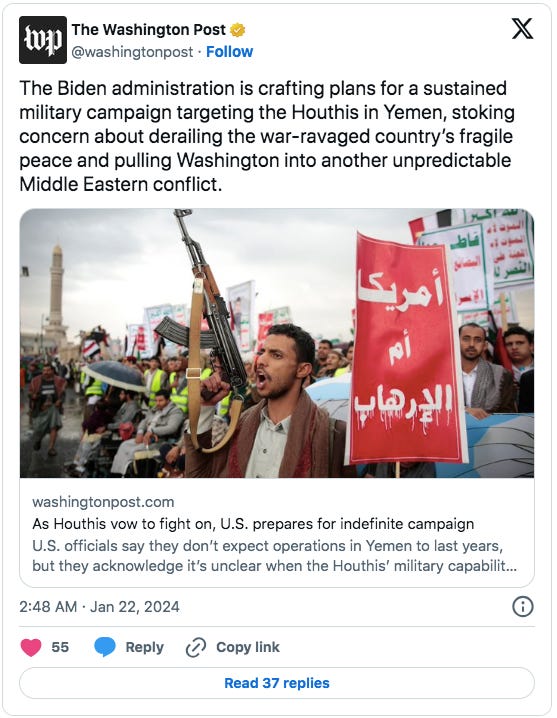
The Washington Post has an article out titled “As Houthis vow to fight on, U.S. prepares for sustained campaign,” with “sustained campaign” being empire-speak for a new American war. 

“The Biden administration is crafting plans for a sustained military campaign targeting the Houthis in Yemen after 10 days of strikes failed to halt the group’s attacks on maritime commerce, stoking concern among some officials that an open-ended operation could derail the war-ravaged country’s fragile peace and pull Washington into another unpredictable Middle Eastern conflict,” the Post reports.

The Post acknowledges that “sustained military campaign” means “war” in the ninth paragraph of the article, saying the anonymous US officials cited in the report “don’t expect that the operation will stretch on for years like previous U.S. wars in Iraq, Afghanistan or Syria.” Which is about as reassuring as a pyromaniac saying he doesn’t expect he’ll be burning down any more houses like all those other houses he’s burned down.

This bizarre refusal to just call a war a war also appeared in a recent press conference with Pentagon spokesperson Sabrina Singh, who acted shocked and aghast that reporters would even ask if repeatedly bombing a country would qualify as being at war with them.

“Is it now fair to say that the U.S. is at war in Yemen?” Singh was asked by a Reuters reporter on Thursday.

“No, we don’t seek war,” Singh replied. “We don’t think that we are at war. We don’t want to see a regional war. The Houthis are the ones that continue to launch cruise missiles, antiship missiles at innocent mariners, at commercial vessels that are just transiting an area that sees, you know, 10 to 15 percent of world’s commerce.”

In a follow-up several questions later, Singh was asked by a reporter from Politico, “You said that we are not at war with the Houthis, but if — you know, this tit-for-tat bombing — we’ve bombed them five times now. So if this isn’t war, can you just explain this a little — a little bit more to us? If this isn’t war, what is war?”

“Sure, Lara, sure, great question, I just wasn’t expecting it phrased exactly that way,” Singh replied with a laugh and a smirk. “Look, we are — we do not seek war. We are — we do not — we are not at war with the Houthis. In terms of a definition, I think that would be more of a clear declaration from the United States. But again, what we are doing and the actions that we are taking are defensive in nature.”

See the rest here

Be seeing you

Posted in Uncategorized | Tagged: , , , , | Leave a Comment »

Capitalism—A New Idea

Posted by M. C. on January 22, 2024

by Jeff Thomas

New wealth comes from the bottom up—it’s as simple as someone building a better mousetrap, or building the old one more cheaply. In such a market, both the producer and the consumer benefit.

In a fascist system, the wealth gravitates to the top, eventually choking out the middle class and expanding the poorer class, and that’s just what we’re witnessing today. The solution is not to go further in this direction, but rather to try something new… or at least new to anyone living under the fascist system. Although it still retains some capitalist overtones, it is unquestionably not capitalism.

Capitalism, whether praised or derided, is an economic system and ideology based on private ownership of the means of production and operation for profit.

Classical economics recognises capitalism as the most effective means by which an economy can thrive. Certainly, in 1776, Adam Smith made one of the best cases for capitalism in his book, An Inquiry Into the Nature and Causes of the Wealth of Nations (known more commonly as The Wealth of Nations). But the term “capitalism” actually was first used to deride the ideology, by Karl Marx and Friedrich Engels, in The Communist Manifesto, in 1848.

Of course, whether Mister Marx was correct in his criticisms or not, he lived in an age when capitalism and a free market were essentially one and the same. Today, this is not the case. The capitalist system has been under attack for roughly 100 years, particularly in North America and the EU.

A tenet of capitalism is that, if it’s left alone, it will sort itself out and will serve virtually everyone well. Conversely, every effort to make the free market less free diminishes the very existence of capitalism, making it less able to function.

Today, we’re continually reminded that we live under a capitalist system and that it hasn’t worked. The middle class is disappearing, and the cost of goods has become too high to be affordable. There are far more losers than winners, and the greed of big business is destroying the economy.

This is what we repeatedly hear from left-leaning people and, in fact, they are correct.

See the rest here

Be seeing you

Posted in Uncategorized | Tagged: , , , , | Leave a Comment »

Great Books for the Young Reader

Posted by M. C. on January 21, 2024

LewRockwell.com readers are supporting LRC and shopping at the same time. It’s easy and does not cost you a penny more than it would if you didn’t go through the LRC link. Just click on the Amazon link on LewRockwell.com’s homepage and add your items to your cart. It’s that easy!

If you can’t live without your daily dose of LewRockwell.com in 2024, please remember to DONATE TODAY! 

  1. The Adventures of Tom Sawyer and Adventures of Huckleberry Finn
  2. The Three Musketeers
  3. The Story of a Bad Boy
  4. Old Yeller
  5. In Freedom’s Cause: A Story of Wallace and Bruce (Dover Children’s Classics)
  6. Around the World in Eighty Days
  7. Ludwig the Builder
  8. The Broken Window
  9. Economics in One Lesson
  10. Out of the Silent Planet: Ransom Trilogy
  11. Father Brown
  12. All Things Wise and Wonderful (All Creatures Great and Small)
  13. Robinson Crusoe
  14. Mr. Midshipman Hornblower
  15. Hitty Her First Hundred Years

Be seeing you

Posted in Uncategorized | Leave a Comment »

The Guitars of George Harrison

Posted by M. C. on January 21, 2024

Be seeing you

Posted in Uncategorized | Tagged: , | Leave a Comment »

Defending Big Oil, MIC, Israel and 9/11 instigators Saudi Arabia

Posted by M. C. on January 20, 2024

You? Not so much.

Be seeing you

Posted in Uncategorized | Tagged: , , , | Leave a Comment »

Americans Are Fighting for Control of Federal Powers That Shouldn’t Exist

Posted by M. C. on January 20, 2024

Today’s federal government is almost entirely unconstitutional

By Brian McGlinchey
Stark Realities

https://starkrealities.substack.com/p/americans-are-fighting-for-control

It’s no secret that politics in the United States is growing increasingly acrimonious — to the point that a 2022 poll found 43% of Americans think a civil war is a least somewhat likely in the next decade.

But here’s what few people realize: The intensity of our division springs from a federal government operating far beyond the limits of the Constitution — fueling a fight for control over powers that were never supposed to exist at the national level.

To put it another way, if the federal government were confined to its actual granted authorities, federal elections would be of little interest to the general public, because the outcome would be largely irrelevant to their everyday lives.


America’s founders drafted the Constitution with great trepidation. Having just escaped British tyranny, the people of the separate states that would comprise the proposed union were wary of centralizing too much power at the federal level, and thus sowing the seeds of a new tyranny.

They therefore set out to create a federal government to which the states delegated only certain limited powers, with all other subjects of governance reserved to the states.

Those powers — only 18 of them — are listed, one by one, in Article I, Section 8 of the Constitution. They include such things as the power to raise armies, maintain a navy, declare war, borrow money, coin money, establish punishments for counterfeiters and pirates, set standards of weights and measures, secure patents and establish post offices.

Reassuring those who were considering the enormously consequential decision of whether to ratify the Constitution, James Madison wrote,

“The powers delegated by the proposed Constitution to the federal government are few and defined. Those which are to remain in the State governments are numerous and indefinite. [Federal powers] will be exercised principally on external objects, as war, peace, negotiation, and foreign commerce…The powers reserved to the several States will extend to all the objects, which, in the ordinary course of affairs, concern the lives, liberties and properties of the people.”

To win over those would-be ratifiers who still feared the proposed federal government would undercut state sovereignty and infringe individual liberties, ten amendments were drafted — the Bill of Rights. The 10th Amendment codified Madison’s previous assurance about the division of authorities between the federal and state governments:

“The powers not delegated to the United States by the Constitution, nor prohibited by it to the States, are reserved to the States respectively, or to the people.”

We arrive then at a hard fact: Today’s sprawling federal government, which involves itself in almost every aspect of daily American life, is almost entirely unconstitutional.

See the rest here

Be seeing you

Posted in Uncategorized | Tagged: , | Leave a Comment »

EVs In Chicago Are No Match For Polar Vortex

Posted by M. C. on January 20, 2024

What happens when you let government do your homework.

Tyler Durden's Photo

by Tyler Durden

Average temperatures across the Chicago metro area plunged below zero this week. 

Resulting in a double whammy for electric vehicle owners: paralyzed charging networks and battery degradation because of the cold blast. 

“This is crazy. This is a disaster.”

Electric Vehicle owners find out the hard way what it means to go electric during Chicago’s harsh winter.

Can’t imagine why the EV market isn’t taking off.pic.twitter.com/1jRbsFX5L8 — Citizen Free Press (@CitizenFreePres) January 17, 2024

One woman complained she was stranded because one charging station “was all broken.”

POV: Owning an EV in Chicago… pic.twitter.com/420Q1X2tq1 — Chief Nerd (@TheChiefNerd) January 19, 2024

“When it’s cold like this, cars aren’t functioning well, chargers aren’t functioning well, and people don’t function so well either,” Javed Spencer, an Uber driver, told The New York Times. He said he’s worried about being stranded again with his Chevy Bolt. 

For years, the Davos elites have pitched to the masses about a ‘green’ new world of EVs and how nothing could go wrong. But these elites are not fortune tellers and are sometimes very wrong in their predictions, as EVs are no match for a polar vortex. 

Be seeing you

Posted in Uncategorized | Tagged: , , | Leave a Comment »

Drinking Buddies

Posted by M. C. on January 19, 2024

Dutch Beer rough style

Daniel McAdams

https://substack.com/inbox/post/140822607


The year was 2010 and my idea was to create a “dry creek bed” from the front porch extending “downstream” to curve around a circular planter I installed a few months beforehand at the corner of the house (with a juniper to hide cables “climbing” the structure in an unnatural way).

The functionality of the dry creek bed was to raise the elevation at the level of the east-facing external wall (with a small brick retainer extended vertically around the basement window to eliminate any low spot while preserving precious morning sunlight) so that water would not pool near the house and percolate its way into the basement, which was damp when we bought the house (the actual cause of which we did not find out until at least a year later and was – hilariously but expensively – totally unrelated to the elevation at the corner of the house).

The aesthetic of the dry creek bed was to provide something of non-grass visual interest in that small quadrant near the house and also to provide additional planting space for vegetables. In those days everything in this middle-class neighborhood was grass and lawnmowers and the usual stuff all around. We put in a garden in the front yard and could hear the clicking tongues of the passers-by that first year. Gypsies, to be sure, had moved into the neighborhood. But we only had good sun in the front, especially after the twin massive oaks fell on the house the year before. It was not a political statement, but rather a solar statement.

As it turned out, in the dry creek bed we had at least two large, heavily-producing tomatillo plants, some plucky and determined grape tomato bushes, and a very robust Japanese eggplant that fired off dozens of green torpedoes that one glorious summer.

***
On the appointed day the dump truck arrived with our dirt and two sizes of river rock. I saved money by combining them in one load. I lost money by being forced to spend valuable days separating two sizes of river rock from dirt.

In those days I had the added physical fortitude of a hearty daily commute importantly including several mad dashes to each leg of the journey. House down the hill to 17L bus stop. Pentagon Station rushing down to Metro. Change trains and run to catch the Orange line at L’Enfant. Finally…dash over from the Capitol Hill station to 203 Cannon. It seemed just like a daily routine, but in retrospect it was the kind of cardio workout that people pay for.

Still, when it came to extracting the sod and digging the channel for the dry creek bed I felt the exhaustion of one flaccidly thrusting behind a desk rather than a plow. As usual, I was out there alone as she cared for the small children. They popped their heads out a few times. Alas, the heat and the work digging sod produced a flame that could only be extinguished with a very cold half-liter can of Dutch Pilsner-style beer. From the photograph you can see one already discarded in what might soon become a pile. She came out, the youngest, with her sippy-cup to watch daddy with his sippy can. Cordless drill. Family man.

You spend part of your life building and another part of your life looking at what has been built. But there are no cues as to when one begins and ends and another takes its place. Sometimes when you look back you see yourself exhausted with a Dutch pilsner beer in your hand and a pile of dirt on your driveway. And that which you once cursed becomes a kind of savior.

Death comes as a shocking stranger, upsetting the order that you thought you have created. Upsetting your plan, which is anachronism. Holding a timetable, a ledger balancing what you have given and what has been given you. But at the same time brooking no argument or discussion.

Be seeing you

Posted in Uncategorized | Leave a Comment »