But while Ukraine can receive over $100 billion to fight a war they can’t win and let their oligarchs line their pockets with our money so they can go on vacations like Biden, FEMA has promised the wildfire victims a one-time $700 check.
$700 to rebuild your life from scratch, and Joe Biden is holding every extra penny hostage until Kiev gets its cut of the federal budget.
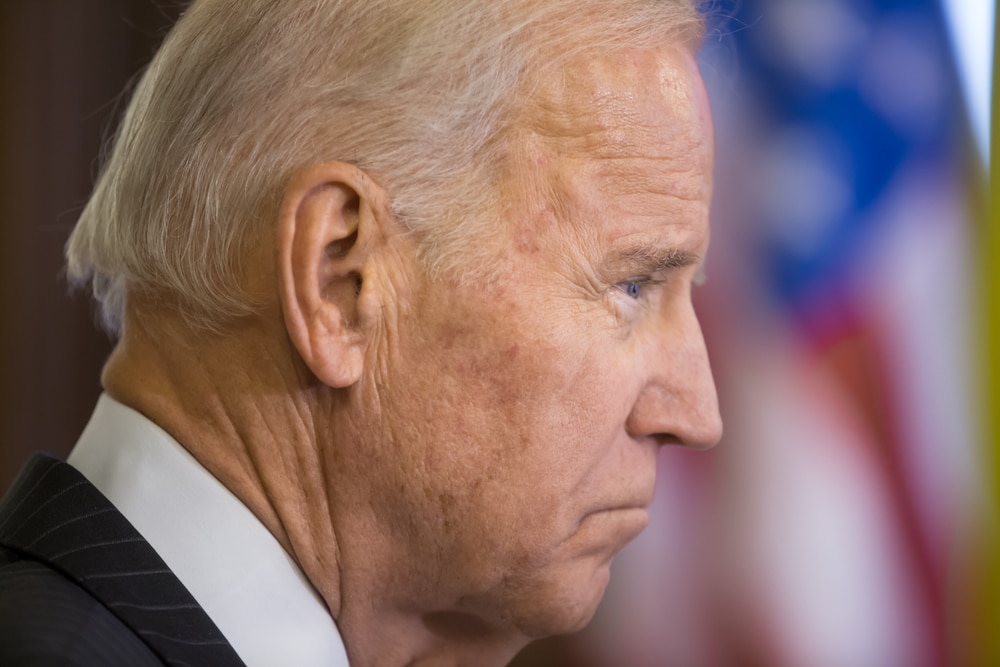
KIEV, UKRAINE – Jan 16, 2017: Vice president of USA Joe Biden during his visit to Kiev and meeting with President of Ukraine Petro Poroshenko
Less than two weeks ago a devastating wildfire engulfed the Hawaiian island of Maui, particularly the historic city of Lahaina.
Over one hundred people are confirmed dead, and more than a thousand are still missing. Blackened earth and soot scar what was once a beautiful and tropical paradise.
Error has compounded error in disaster response, with people on the ground still unable to return and discover what remains of their homes.
A lack of transparency, and the stonewalling of outside observers has led to appropriate suspicion about how high the blame goes.
I’ll let former Hawaii Rep. Tulsi Gabbard, who is currently activated on reserve duty, explain more. She told Glenn Beck on The Blaze:
“It’s unfortunate there has been so little communication going through official channels…there’s been a vacuum of communication and as you know in that vacuum a lot of questions and a lot of fears and concerns arise.”
Furthermore, she told Laura Ingraham on Fox News:
“I’m in constant touch with these community members and leaders, they are still not seeing response from the county, the state, the federal government to be able to go out and help them. The community support hubs that they have are 100% community led, volunteer supply collections, conducting all of these coordinations on their own. They feel like the government doesn’t care about them.”
My entire team at Bring Our Troops Home is praying for recovery in Maui and for the wonderful people of Hawaii.
The Biden administration slammed Turkey’s collaborators for anti-Kurdish crimes in Syria — including raping and torturing civilians.
The U.S. State Department publicly rebuked Turkey in 2021 for the child soldier recruitment. A few weeks later, the U.S. Treasury announced sanctions against Ahrar al-Sharqiya for abuses against Kurdish civilians.
This time around, the Biden administration is not pointing the finger at the Turkish government. U.S.-Turkish relations have warmed in recent months, as the West courts Turkey’s support against Russia. The White House is also looking to sell F-16 fighter jets to the Turkish military.
Apparently we haven’t won their hearts and minds so we must burn their village. Just a glitch in the continuing oil and pipeline control …err…foreign policy success story.
The Biden administration has imposed human rights sanctions on the Hamza Division, a formerly U.S.-backed rebel group in Syria that now fights against Kurds alongside the Turkish army. The sanctions, announced last week, also apply to the Suleiman Shah Brigade, a Turkish-backed militia whose leader has ties to CIA-backed rebels.
The two militias are accused of crimes including pillage, rape, kidnapping, and torture in Afrin, a Kurdish-majority district of Syria.
The Syrian Interim Government, which represents the two militias, said in a statement that the sanctions were “a result of deliberate defamation campaigns…based on reports issued by non-neutral organizations.” It claimed to be investigating any allegations of abuse internally. Militia members reportedly held a rally in Afrin and shouted, “may America fall and may Biden fall!”
In the space of a decade, Washington has gone from training the Hamza Division to blacklisting it. The sanctions are also part of a mixed message to U.S. ally Turkey. Less than a month ago, the U.S. State Department had denied that Turkey was committing ethnic cleansing against Syrian Kurds. Now the Biden administration is targeting the Hamza Division and the Suleiman Shah Brigade, both of which have a close relationship to the Turkish intelligence services.
The United States first levied sanctions against one Turkish backed militia in 2021. However, those sanctions targeted Ahrar al-Sharqiya, a group that had never received U.S. support and had a notoriously bad relationship with American troops. The Hamza Division and Suleiman Shah Brigade, on the other hand, have a long history of cooperation with Washington.
The U.S. military had once provided training and $8.8 million in cash to the Hamza Division, as part of an effort to enlist Syrian rebels in the fight against the Islamic State. Hamza Division leader Sayf Abu Bakr and Suleiman Shah Brigade founder Mohammad Abu Amsha had both moved through the ranks of rebel groups that received American weapons through a parallel CIA program to undermine the Syrian government.
U.S. support for the Syrian uprising dried up during the Trump administration. In the years since, some rebels have gone from trusted U.S. partners to “thugs, bandits and pirates” in the eyes of U.S. officials.
In early 2018, the Turkish military recruited several Syrian rebel groups to participate in the invasion of Afrin, a Kurdish-majority district of Syria. Turkey launched a second invasion of Syria in October 2019, using the same Syrian militias to once again take territory from Kurdish-led rebels.
The Trump administration had publicly shrugged its shoulders at Turkey’s 2018 invasion, and initially gave a green light to the 2019 invasion. After members of Congress accused the Trump administration of “betraying” the Kurds — who had also received U.S. military support — the White House helped negotiate a ceasefire.
The Turkish military stayed in the areas it had conquered. So did the Hamza Division, the Suleiman Shah Brigade, and Ahrar al-Sharqiya, who have all earned a reputation for brutality against Kurdish civilians. These militias reportedly extort civilians, pillage property, kidnap women, and commit sexual abuses. Abu Amsha, leader of the Suleiman Shah Brigade, is accused of raping one of his subordinates’ wives.
Turkish president Recep Tayyip Erdoğan has made the purpose of the occupation clear. At the outset of the 2018 invasion, he declared that Kurds are an alien presence in Afrin, which must be given back to its “rightful owners.” Speaking to the UN General Assembly in September 2019, he held up a map of Syria and laid out a plan to resettle 1 to 2 million refugees — mostly non-Kurds — in Kurdish-majority areas.
Finally, Kates makes another intriguing point: that a society where peaceful citizens are armed is far more likely to be one where Good Samaritans who voluntarily go to the aid of victims of crime will flourish. But take away people’s guns, and the public — disastrously for the victims — will tend to leave the matter to the police. Before New York State outlawed handguns, Good Samaritan instances were far more widespread than now.
Gun prohibition is the brainchild of white middle-class liberals who are oblivious to the situation of poor and minority people living in areas where the police have given up on crime control. Such liberals weren’t upset about marijuana laws, either, in the fifties when the busts were confined to the ghettos.
If, as libertarians believe, every individual has the right to own his person and property, it then follows that he has the right to employ violence to defend himself against the violence of criminal aggressors. But for some odd reason, liberals have systematically tried to deprive innocent persons of the means for defending themselves against aggression. Despite the fact that the Second Amendment to the Constitution guarantees that “the right of the people to keep and bear arms shall not be infringed,” the government has systematically eroded much of this right. Thus, in New York State, as in most other states, the Sullivan Law prohibits the carrying of “concealed weapons” without a license issued by the authorities. Not only has the carrying of guns been grievously restricted by this unconstitutional edict, but the government has extended this prohibition to almost any object that could possibly serve as a weapon — even those that could only be used for self-defense. As a result, potential victims of crime have been barred from carrying knives, tear-gas pens, or even hat pins, and people who have used such weapons in defending themselves against assault have themselves been prosecuted by the authorities. In the cities, this invasive prohibition against concealed [p. 115] weapons has in effect stripped victims of any possible self-defense against crime. (It is true that there is no official prohibition against carrying an unconcealed weapon, but a man in New York City who, several years ago, tested the law by walking the streets carrying a rifle was promptly arrested for “disturbing the peace.”) Furthermore, victims are so hamstrung by provisions against “undue” force in self-defense that the criminal is automatically handed an enormous built-in advantage by the existing legal system.
It should be clear that no physical object is in itself aggressive; any object, whether it be a gun, a knife, or a stick, can be used for aggression, for defense, or for numerous other purposes unconnected with crime. It makes no more sense to outlaw or restrict the purchase and ownership of guns than it does to outlaw the possession of knives, clubs, hatpins, or stones. And how are all of these objects to be outlawed, and if outlawed, how is the prohibition to be enforced? Instead of pursuing innocent people carrying or possessing various objects, then, the law should be concerned with combatting and apprehending real criminals.
There is, moreover, another consideration which reinforces our conclusion. If guns are restricted or outlawed, there is no reason to expect that determined criminals are going to pay much attention to the law. The criminals, then, will always be able to purchase and carry guns; it will only be their innocent victims who will suffer from the solicitous liberalism that imposes laws against guns and other weapons. Just as drugs, gambling, and pornography should be made legal, so too should guns and any other objects that might serve as weapons of self-defense.
One of the most brilliant propaganda maneuvers the managers of the US empire have pulled off lately is splitting the debate over US military policy along partisan lines, with one side supporting aggressions against Russia and the other preferring to focus aggressions on China. In this way they’ve ensured that mainstream discourse remains an argument over how US warmongering should occur, rather than if it should.
Senator Bernie Sanders has a new article out in The Guardian titled “The US and China must unite to fight the climate crisis, not each other,” in which he argues in favor of de-escalation measures comparable to those reached between Washington and Moscow after the Cuban Missile Crisis.
“Instead of spending enormous amounts of money planning for a war against each other, the US and China should come to an agreement to mutually cut their military budgets and use the savings to move aggressively to improve energy efficiency, move toward sustainable energy and end our reliance on fossil fuels,” Sanders argues.
Which is a fine sentiment as far as it goes, and it’s not the first time Sanders has expressed this view; last month in The Guardian he argued that the US government should be focused on resolving the climate crisis “instead of fomenting a new cold war with China.” But it’s worth noting that while acting as a dovish detente proponent with regard to China, Sanders has for years been acting as a hawkish cold warrior with regard to Russia.
Naturally, law enforcement officers rarely face any sanctions for their failures to bother themselves with private property, life, or limb. The federal courts have made it clear that law enforcement officers are not obligated to actually protect the public. In other words, the taxpayers must always pay taxes to hold up their end of the imagined “social contract” or face fines and imprisonment. But the other side of that “contract,” the state, has no legal obligation to make good on its end. This, of course, is not how real contracts work.
In all the media and regime frenzy over the Janaury 6 riots and the Pentagon Leaker in recent months, it is interesting to examine the contrast between how the regime treats “crimes” against its own interests, and real crime committed against ordinary private citizens.
Witness, for example, how the Biden administration and corporate media have treated the January 6 riot as if it were some kind of military coup, demanding that draconian sentences be handed down even to small-time vandals and trespassers. Regime paranoia has led the Justice Department to ask for a 30-year sentence for Enrique Tarrio, a man who was convicted of the non-crime of “seditious conspiracy” even though he wasn’t even in Washington on January 6. In recent months, Jacob Chansley, the “QAnon Shaman,” received a sentence of three-and-a-half years, even though prosecutors admit he did nothing violent. Riley Williams was given three years for simply trespassing in Nancy Pelosi’s office. Members of the Capitol Police force have been lionized in the media as great protectors of “sacred” government buildings, and any threat to the property or persons of Washington politicians has been equated with an assault on “democracy.”
Profit’s bad reputation is unearned, But it’s not true that only sellers can make a profit. Buyers do also, though in a non-financial sense, because they prefer the thing they obtain to the money’s alternative use. Moreover, to the extent that they pay less for an item than they were willing to pay, buyers make an additional profit.
P&G, the maker of popular household brands like Tide and Downy laundry products, is giving away $10,000 in college scholarships. That’s $1.5 million and 150 scholarships in all. My problem, aside from its encouraging college attendance, is with how the company is promoting the program. The television ads proclaim that the company sees the scholarships as a way of “giving back.” I’ve written about this before, but some further thoughts might be useful.
So, to whom does P&G wish to give back? Not to existing customers exclusively. The only eligibility requirements are U.S. residency, a minimum age of 16, enrollment in or acceptance by an undergraduate program, and free registration at P&G’s website. The online application does ask applicants if they are first-generation college students and where they do their laundry, which sounds creepy. The program is called a “sweepstakes”, and multiple entries are apparently allowed, so the winners are apparently picked randomly. The winners’ checks will be sent to the schools.
The “payback” angle that P&G touts will sound good to many people. (“Aw, that’s so nice.”) I suppose P&G never even considered entries by saying:
Because we at P&G are always looking for ways to increase our profits by creating goodwill, keeping our current customers from looking at rival products, and luring new customers from our competitors, we are giving away 150 scholarships worth $10,000 each. We’d prefer you to just buy our great products, but if that’s what it takes to get good publicity, so be it. Enter today!
That would offend too many people, though pro-market and pro-free-enterprise people like me would be approvingly amused. Why call it “giving back”? Unearned guilt, what’s why.
Adam Smith famously wrote that we do not believe the grocer puts food on the shelves because they are nice people (which of course they may well be). They do it because that’s how they earn a living. Smith wasn’t being pedantic. He was acknowledging that shoppers already know this. He writes, “We address ourselves, not to their humanity but to their self-love, and never talk to them of our own necessities but of their advantages.” (Sometimes we talk of our own necessities, for instance, when we can’t find what we want. But we know the grocer doesn’t help us out because he loves us.)
The “logic” of payback addresses the matter from the seller’s, not the buyer’s, side. Smith could have addressed grocers by writing:
It is not from the benevolence of the customers that you expect your income but from their regard to their own interest. You address yourselves, not to their humanity but to their self-love, and never talk to them of our own necessities but of their advantages.
Telling this to merchants would hardly be necessary. No merchant thinks his customers are doing him a favor by shopping in his store.
As the Biden administration continues to pursue a normalization deal with Israel and Saudi Arabia, supporters of a U.S. security guarantee for the Saudis have started making their case in public.
The Israeli foreign minister, Eli Cohen, took to the opinion page of The Wall Street Journal earlier this week to sell a U.S. defense commitment to Riyadh as “the foundation upon which true regional harmony can be built” and used the example of Washington’s treaty with South Korea as a model.
A new formal security commitment is one of the biggest Saudi demands as part of their steep price for normalizing relations with Israel, and recentreports suggest that the Biden administration is seriously entertaining the idea.
President Biden should shut this down now. The U.S. does not need and cannot afford any additional security commitments. It certainly shouldn’t be pledging to send its soldiers to fight on behalf of a despotic monarchy that has been waging an aggressive war against its poorer neighbor for most of the last ten years. The U.S. has already put its military personnel in harm’s way too many times on behalf of the Saudis, and there should be no guarantee to do so in the future.
A formal defense commitment to Saudi Arabia is unacceptable and contrary to U.S. interests, and it is far too large of a bribe to give Riyadh just so that it will establish relations with Israel.
The case for a U.S. commitment to fight for the Saudis is weak on the merits. The U.S. does not have vital interests at stake that would warrant making a pledge to defend the kingdom. It is also unnecessary. Iran isn’t about to invade or even attack Saudi Arabia. Aside from the strikes on the ARAMCO facility at Abqaiq in 2019, which were themselves a reaction to the Trump administration’s economic war, Iran and Saudi Arabia have no history of direct clashes.
Cohen’s comparison with Korea is bizarre. For one thing, the animosity between Iran and Saudi Arabia is nothing like the decades-long hostility between North and South Korea. Iran has no interest in conquering the kingdom, and it lacks the means to do it even if it wanted to try. Unlike North Korea, Iran does not have nuclear weapons, and despite the best efforts of the U.S. and Israeli governments in the last few years their government has still not decided to pursue them.
Creating a stronger U.S.-Saudi security relationship in opposition to Iran would likely make regional tensions worse and might encourage hardliners in Iran to pursue more confrontational policies. Far from fostering “true regional harmony,” this would stoke conflict by expanding the U.S. role in the Persian Gulf.
In 1864 Lincoln wrote in a letter that “if slavery is not wrong, nothing is wrong.” (I know about Lincoln’s faults.) Here’s the logical corollary to that truth: if self-ownership is not right, nothing is right. That’s the libertarian philosophy in concentrated form.
Why does liberty matter? It’s a fair question because, after all, not everyone thinks it matters very much, perhaps beyond some very basic point. If that’s an overstatement, we can safely say that for many people on the left and right, liberty is a lower priority than it is for libertarians and classical liberals. Most pundits and politicians, even most anti-war types, have plans for how to spend your money.
What can we libertarians say? We have lots to say. It’s a multifront operation. Some libertarians press the case in terms of moral consequentialism, either utilitarian or egoist. Others take a duty-oriented, or deontological, route, stressing a rule-boundedness that may look like a rights theory. (Rule-consequentialism, as opposed to act-consequentialism, ends up looking like this.)
A third approach is eudaimonia, or virtue ethics, which has been inherited from the ancient Greeks, for example in Aristotle’s NichomacheanEthics. In this approach, consequences are not irrelevant — in fact, they are baked into the conception of features (virtues) that tend toward the perfection of the individual person as a rational social being. In brief, respecting other people as ends in themselves is integral to respecting oneself. I like this approach.
The problem with persuading others about all this is that proof is difficult. It’s not like mathematics or physics. Aristotle wrote that the quality of proof in one area of knowledge, say, mathematics, is not to be expected in other areas, say, ethics. You have to play the hand that reality has dealt.
Modern libertarians have been debating among themselves the proper foundation of the freedom philosophy for decades. I can recall a libertarian scholars conference nearly 50 years ago when Murray Rothbard and historian friends expressed frustration over yet another panel of philosophers arguing the fine details of their respective approaches. The philosophical debate is important, but it’s easy to get lost in the weeds. Does it matter to the public? Most nonlibertarians are not philosophers or interested in philosophy.
Leaving all that aside (and to people more qualified than I am), what can libertarians say to regular people? The general public often takes positions and attitudes based on cultural and media signals, but that doesn’t mean we should not try to win regular people over directly, say, through the internet. Lots of opinion-makers have an incentive to ignore us.






 MCViewPoint