MCViewPoint

Opinion from a Libertarian ViewPoint

Progressives Have Corrupted Not Only Money, but Its History as Well | Mises Wire

Posted by M. C. on July 27, 2023

So not only was silver already an internationally recognized money, but the earliest recorded states were already corrupting domestic money markets. Just as more modern governments would do thousands of years later with gold and silver, these Sumerian authorities mandated a fixed exchange rate between the two commodities, leading people to use the artificially overvalued one—in this case, barley—while the government hoarded the other.

https://mises.org/wire/progressives-have-corrupted-not-only-money-its-history-well

Connor O’Keeffe

As modern monetary theory (MMT) gains prominence in the political sphere, it has revitalized interest in some older theories about the origin of money—namely, the state and credit theories of money.

The credit theory of money says that money is simply a unit for measuring debt. And the state theory of money, or chartalism, as it is often known, says that this measurement was created by the state. These days, the two theories are often combined and championed by proponents of MMT who argue that most of the economic constraints put on government are imaginary because the government can simply create money.

The MMT debate is about the nature of money itself, and these theories about the origin of money are central to understanding this alternative way of thinking that’s gaining popularity on the progressive left. However, when one looks, it’s clear that both the theory and history presented as evidence for the state and credit theories of money don’t hold up, especially when compared to the Austrian alternative.

Readers of this website are likely familiar with the Austrian theory of the origin of money, developed by Carl Menger and synthesized by Ludwig von Mises. But to review it quickly, money developed as a way to make trade easier. At some point in the past, humans began using their property to produce goods beyond what the natural environment had provided.

Certain goods became valued, not just for direct consumption but also because of their salability. In other words, people started wanting certain goods because they knew others would trade for them. A good used in this way is called a medium of exchange. Thanks to the network effect, one or a small number of media of exchange would become nearly universally accepted among a society. That’s when it becomes a money.

Historically, precious metals became monies. Currencies were simply a unit of weight in a precious metal. Once a money had been established, people could specialize their labor, and the number of prices—that is, records of past exchange ratios—to keep track of was greatly reduced. That makes entrepreneurship, production, and therefore civilization as we know it possible.

The important insight here is that money gets its value as a money from what it’s able to buy and that it, therefore, must have originated out of a good or commodity produced for some other purpose that was then found to be particularly saleable.

The state and credit theorists reject this entirely as bad theory disproven by the historical record. They instead frame money as a unit of debt.

Debt, credit theorists say, is something that has been around far longer than money. It’s the obligations people have to one another. If a person gives a neighbor some livestock, that neighbor is then obligated to repay the benefactor in kind at some point in the future. They are in debt. Similarly, if one assaults someone else or destroys their property, they are obligated to pay restitution to the victim—or the victim’s family—and are therefore in debt.

Credit theorists argue that money is simply a unit that governments invented to quantify debt. Some say it arose as early states attempted to quantify restitution payments for violent crimes. This unit of debt is then imposed on everyone by the government through taxes. Only then are these state-created IOUs used as a medium of exchange.

In contrast to the Austrians, these theorists see money not as a social institution developed through cooperation but as a state institution imposed on people through violence. It’s not only a disturbing and rather sad view of people and society, it’s also bad theory.

See the rest here

Be seeing you

Posted in Uncategorized | Tagged: , , , , , | Leave a Comment »

Joe Biden Triggers Paralysis in the Production of Strategic Semiconductor Chips. Worldwide Collapse of the Automobile Industry?

Posted by M. C. on July 26, 2023

Joe Biden’s decision to transfer TSMC to Arizona has essentially led to the paralysis of the Arizona plant which is now slated to start production in 2025, while also destabilizing TSMC’s revenues and productive capabilities in Taiwan.

The political standoff between Biden and TSMC, affects supply lines of semiconductors in the US and Worldwide. It potentially destabilizes large sectors of the global economy. 

https://www.globalresearch.ca/worldwide-collapse-of-the-automobile-industry-joe-biden-orders-the-paralysis-of-the-production-of-strategic-semi-conductors-chips/5826665

By Prof Michel Chossudovsky

Global Research

Semiconductors constitute a strategic commodity, used in a variety of sectors including electronics, medical devices, electronic and communications networks etc. 

There is evidence of manipulation, which has led to artificial shortages of semiconductors affecting a number of key sectors of the global economy.

There are geopolitical implications: US Confrontation with China engineered by the White House. 

The Automobile Industry

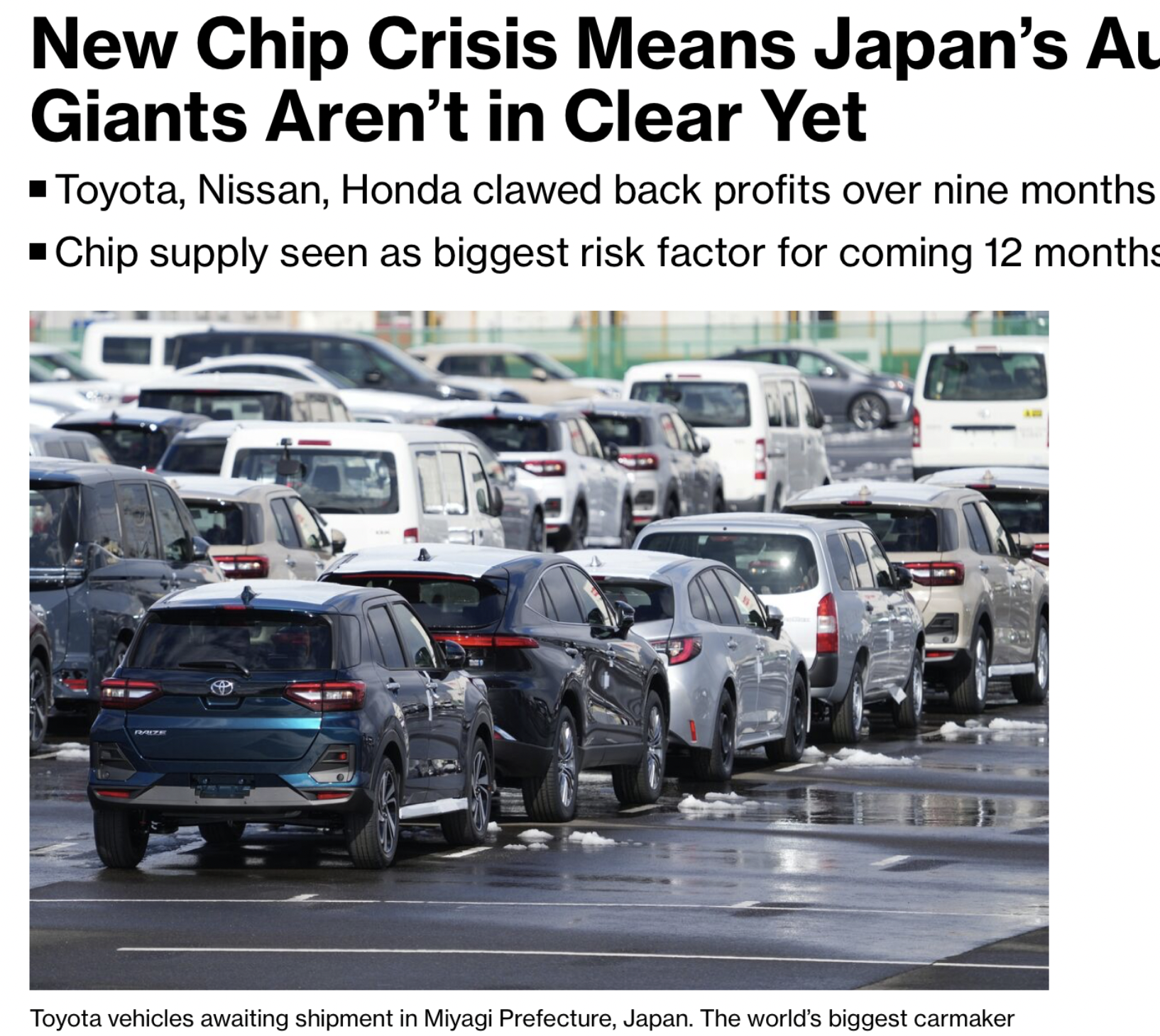
From one day to the next starting in 2020, Japan’s automobile industry enters a period of prolonged crisis.

The automobile industry experienced a decline in production of 15% in 2020 largely due to an engineered shortage of semi-conductorsA much larger decline was experienced in 2021, affecting production in Japan, South Korea, China Western Europe and North America. 

“Automakers, which rely on dozens of chips to build a single vehicle, have been particularly hard hit, forced to halt production lines globally as they await chip supplies. The debacle is likely to cost the auto industry $450 billion in global sales … In September 2021 Toyota was forced to slash production at 14 factories in Japan over a lack of semiconductors. Some of the cuts will continue into October due to a lack of components from Southeast Asia, Toyota has said.” (Washington Post, September 2021)

A recent report confirms that all automobile companies have been affected:

Across the entire industry, an estimated 7.7 million fewer vehicles were produced in the same year-on-year period. This corresponds to a monetary value of about 210 million USD. Due to the complexity of the production chains described above, it will take time even after production capacities have recovered until output in the automotive industry is at pre-crisis level once again.

Semiconductor Chips

The World’s largest semiconductor producer –which over the years has been routinely trading and collaborating with China–  is Taiwan Semiconductor Manufacturing Company (TSMC).

Joe Biden’s intent is to paralyze Taiwan’s trade and investment relations with the PRC. In what amounts to a strategic decision, the White House ordered Taipei to implement the Relocation of the TSMC plant to Arizona. 

According to the NYT:

As the biggest maker of chips that power everything from phones to cars to missiles, the company is strategically important with highly coveted technical know-how. But caught in a deepening battle between the United States and China over technological leadership

In fact there is also an unspoken battle between the Biden Administration and the Taiwan owners of TSMC which started  manufacturing in mainland China in 2004.

“Two out of 18 TSMC plants are located in China — the vast majority of the factories are still in Taiwan.”

TSMC is not intent upon reducing its activities in Mainland China. 

See the rest here

Be seeing you

Posted in Uncategorized | Tagged: , , , | Leave a Comment »

UN Warns Brain Chips Like Elon Musk’s Neuralink Could be Used as ‘Personality-altering’ Weapons — as FDA Approves Tech for Human Trials

Posted by M. C. on July 26, 2023

Maybe the UN/Soros are upset at Musk beating them at their own game. Good thing Musk has his own security.

https://www.globalresearch.ca/un-warns-brain-chips-like-elon-musk-neuralink-could-used-personality-altering-weapons-fda-approves-tech-human-trials/5826361

By Matthew Phelan

Global Research, July 20, 2023

Daily Mail Online

All Global Research articles can be read in 51 languages by activating the Translate Website button below the author’s name.

To receive Global Research’s Daily Newsletter (selected articles), click here.

A United Nations panel has warned that brain chip technology being pioneered by Elon Musk could be abused for ‘neurosurveillance’ violating ‘mental privacy,’ or ‘even to implement forms of forced re-education,’ threatening human rights worldwide. 

Elon Musk’s Neuralink Could be Trialed in Humans in 2023. Here’s What You Need to Know

The UN’s agency for science and culture (UNESCO) said neurotechnology like Musk’s Neuralink, if left unregulated, will lead to ‘new possibilities of monitoring and manipulating the human mind through neuroimaging’ and ‘personality-altering’ tech.

UNESCO is now strategizing on a worldwide ‘ethical framework’ to protect humanity from the potential abuses of the technology  — which they fear will be accelerated by advances in AI.

See the rest here

Be seeing you

Posted in Uncategorized | Tagged: , , , , , | Leave a Comment »

A Constantly Shifting Array of Official Enemies

Posted by M. C. on July 26, 2023

After terrorists retaliated for the U.S. government’s interventionist antics in the Middle East, the “terrorists” (or the Muslims) became the new official enemy. The “war on terrorism” became as lucrative as the 45-year “war on the Reds.”

by Jacob G. Hornberger

I entered Virginia Military Institute as a freshman in 1968. By that time, the Vietnam War was in full swing. During the four years that I was at the school, VMI graduates were among the tens of thousands of U.S. soldiers who were being killed or injured for nothing.

Everyone at VMI was required to be in the corps. Naturally, as a military school, we would periodically have field training exercises, which usually were supervised and run by military officers in the military-science department.

Since I was going into army infantry, my field training exercises were based on hypothetical situations entirely involving Vietcong or North Vietnamese forces. 

For example, we would be told that a North Vietnamese unit was known to use a particular path through the jungle. Our mission, as platoon leaders, was to prepare an ambush of the unit employing our three squads. (We were trained to align all three squads on the same side so that they wouldn’t be firing at each other.)

This went on for four years. All of the field training exercises — without exception — were based on hypothetical situations involving Vietcong and North Vietnamese forces.

During the year I graduated — 1972 — President Nixon began withdrawing U.S. troops from Vietnam. I was offered the option of trading a two-year active-duty commitment for an 8-year commitment in the Reserves, which included 3 months of active duty attending infantry school at Ft. Benning, Georgia. I readily accepted the offer.

In 1974, I temporarily dropped out of law school to fulfill my 3-month commitment. By this time, it was clear that the U.S. government was completely leaving the Vietnam War behind. 

Of course, I was wondering what they were going to do with those field-training exercises. They didn’t skip a beat. From Day 1 of infantry school, they had a brand new official enemy that became the subject of infantry training. That new official enemy was the Russians.

See the rest here

Be seeing you

Posted in Uncategorized | Tagged: , , , , | Leave a Comment »

Uber Russia-hawk Victoria Nuland rises to acting deputy secretary of state

Posted by M. C. on July 26, 2023

She’s done as much as anyone to sour US-Russia ties; now, she is one of Washington’s top diplomats.

Written by
Connor Echols

In a little-remarked move, the Biden administration announced Monday that Victoria Nuland will take over as the acting second-in-command at the State Department. She replaces Wendy Sherman, who plans to retire at the end of this week.

Nuland’s appointment will be a boon for Russia hawks who want to turn up the heat on the Kremlin. But, for those who favor a negotiated end to the conflict in Ukraine, a promotion for the notoriously “undiplomatic diplomat” will be a bitter pill.

A few quick reminders are in order. When Nuland was serving in the Obama administration, she had a now-infamous leaked call with the U.S. ambassador to Ukraine. As the Maidan Uprising roiled the country, the pair of American diplomats discussed conversations with opposition leaders, and Nuland expressed support for putting Arseniy Yatseniuk into power. (Yatseniuk would become prime minister later that month, after Russia-friendly former President Viktor Yanukovych fled the country.) At one memorable point in the call, Nuland said “Fu–k the EU” in response to Europe’s softer stance on the protests.

See the rest here

Be seeing you

Posted in Uncategorized | Tagged: , , | Leave a Comment »

Democrats Use RFK Censorship Hearing to Again Strengthen Their Censorship Regime. Plus: Cornel West on His Insurgent Campaign | SYSTEM UPDATE #116

Posted by M. C. on July 26, 2023

Be seeing you

Posted in Uncategorized | Tagged: , , | Leave a Comment »

The U.S. Illegally Occupies 30% of Syria — It Should Leave & Bring The Troops Home

Posted by M. C. on July 26, 2023

Be seeing you

Posted in Uncategorized | Tagged: , | Leave a Comment »

Anheuser-Busch Lobbyists Sell Access to Democratic Congressional Staff

Posted by M. C. on July 26, 2023

The Bud Light maker owns a secret bar in Washington, D.C. for political insiders.

The most important point is missed. That stuff isn’t BEER!

https://substack.com/inbox/post/135444109

Lee Fang


Carefully hidden inside an otherwise nondescript office tower in the middle of Washington, D.C., with a sweeping view of Pennsylvania Avenue, there’s a secret bar just for political insiders.

Last Thursday, I was promptly kicked out of it.

The lobbying division of Anheuser-Busch, the beer-making conglomerate that produces Bud Light, Michelob, and other brands, owns the bar. The invitation-only pub is off-limits to the public, and the event I briefly attended was an ethically-dubious influence-peddling operation. 

While fundraisers for lawmakers are everyday occurrences across the luxurious bars and restaurants that line Capitol Hill and Penn Quarter, this event was slightly different. 

Political operatives desperate for cash are turning to brazenly pitching access to congressional staffers that manage the day-to-day work of members of Congress.

Such was the case last week. The lobbyists at Anheuser-Busch offered their private bar to Elect Democratic Women PAC, a group that raised $7.8 million for the Democrats last year. The event was billed as a “Chiefs of Staff Happy Hour,” with tickets ranging from $500 to $5,000.

At the event, I took a picture of the sign-in list of the legislative staff for the event, which showed many Democratic staffers participating in the event:

– Rebecca Walldorff, the chief of staff to Rep. Lucy McBath, D-Ga.
– Caitlin-Jean Juricic, the legislative counsel to Rep. Jasmine Crockett, D-Tex.
– Serena Gobbi, the legislative director to Rep. Norma Torres, D-Calif.
– Sean Gard, chief of staff to Rep. Gwen Moore, D-Wisc.
– Becky Salay, chief of staff to Rep. Rosa DeLauro, D-Conn.
– John Gorczynski, chief of staff to Rep. Sylvia Garcia, D-Tex.
– Sarah Curtis, chief of staff to Rep. Kathy Manning, D-N.C.

See the rest here

Be seeing you

Posted in Uncategorized | Tagged: , , , , | Leave a Comment »

The Immorality of Occupational-Licensure Laws

Posted by M. C. on July 25, 2023

Be seeing you

Posted in Uncategorized | Tagged: , | Leave a Comment »

Why Government Pollution Control Fails | Mises Wire

Posted by M. C. on July 25, 2023

As Art Carden succinctly put it, “The information needed to know whether a particular regulation ‘works’ quite literally does not exist, and the key difference between firms and governments is that firms . . . have market tests for their decisions. Governments do not.”

As we have seen, the government doesn’t have the information it would need to identify what level of pollution is efficient for an entire society, and government officials don’t have the incentives to be particularly interested in efficiency anyway.

https://mises.org/wire/why-government-pollution-control-fails

Timothy D. Terrell

In over twenty-five years of teaching undergraduate students, I have heard the same refrain countless times: free markets have many problems that government has to step in to solve. Indeed, students expect government to “step in” so much that markets occupy a peripheral role in their idealized economic system. Even students with an ideological predilection toward markets will be quick to argue that certain problems, such as pollution, require extensive government regulation and probably copious spending of tax dollars.

This is not surprising, given that college students have been bombarded by tales of government fixes for social problems from media, teachers, and parents from elementary school onward. By the time they hear about “market failure” in their first economics class, it doesn’t take much convincing that free markets are impractical at best and a weak rationale for capitalist exploitation at worst. The best-selling economics textbooks at the university level do little to counter these perceptions, and most instructors won’t deviate much from the mainstream books.

Most principles of microeconomics and intermediate microeconomics textbooks devote at least one chapter to market failure, which typically includes “market power” (think monopoly), inadequate provision of “public goods” (goods that the private sector allegedly won’t produce enough of because of an inability to make the users pay), and “externalities” (the unintended side effects of human activity on bystanders, like pollution). While textbooks usually contain some acknowledgment of the fact that governments don’t live up to idealized models of efficiency, it is rare for proportional space to be devoted to “government failure” and easy for students to conclude that government intervention is the answer to these nearly ubiquitous shortcomings of markets.

The Apologists for Environmental Regulation

The problems with monopoly theory and the errors of mainstream thinking about public goods have been dealt with elsewhere. In my experience, externalities—typically, environmental problems—have proven one of the most difficult challenges for students trying to understand markets and government. Don’t pollution problems require government intervention?

Typically, the section on externalities contains a few diagrams showing the difference between private costs (or benefits) and social costs (or benefits). The diagram for negative externalities usually looks something like figure 1, with the marginal private cost (MPC), marginal social cost (MSC), and marginal private benefit (MPB). Students are then directed to observe the difference between the optimal quantity of output (Q*) of the good that results in the negative externality and the quantity of output produced in the market (QM). Any production in excess of Q* adds more to costs than to benefits, creating a net loss labeled “deadweight loss.” The presence of this deadweight loss is deemed evidence of market failure, and the authors normally proceed to evaluate various ways government can push the market toward Q*.

Figure 1: The difference between costs and benefits of the quantity of output resulting in negative externalities

terrell_graph_1.png

Terrell Graph 1

Walter Block has argued that there are problems with the usual treatment of externalities as market failure. If the recipient of pollution is unable to collect damages or procure an injunction from a court—the typical remedy prior to around the mid-nineteenth century—then this is not market failure, but the government’s failure to uphold property rights. Once reasonably diligent in their protection of property rights, the courts began weakening these protections in the mid-1800s. An example is the 1866 case Ryan v. New York Central Railroad Co. (35 N.Y. 210), in which a railroad was not held liable for the loss of a house that had been set on fire by sparks from the railroad’s nearby woodshed, which had burned down due to the company’s negligence. Even so, court protection retained some force long after. As Jonathan Adler pointed out, in a famous 1913 case in New York, Whalen v. Union Bag and Paper Co. (208 N.Y. 1), “the state’s highest court upheld an injunction shutting down a $1 million pulp mill employing several hundred workers in order to protect the riparian rights of a single farmer.”

As court-made law to settle conflicts over nuisances like pollution has been increasingly regarded as inadequate to deal with externalities, government interventions have typically taken three forms: (1) command-and-control regulation, (2) emissions taxes, and (3) cap-and-trade (tradable permit) systems.

Command-and-control regulation is unpopular with many economists because of its tendency to require emissions reductions in ways that are inflexible and therefore likely to be more costly. It is also particularly susceptible to “crony capitalism,” since industry lobbyists can push regulatory bureaucracies to mandate technologies that keep competitors out. Far more attractive to economists are emissions taxes and tradable permits.

Emissions taxes (sometimes called Pigovian taxes after the Cambridge economist Arthur Cecil Pigou, a student of Alfred Marshall) have gained new attention as a part of climate policy. Numerous proposals for a federal carbon tax have appeared in the last several years, including the “Green New Deal,” and even some who claim to be libertarians have proposed them. Tradable permit systems have been in use in the United States for decades, notably with the Environmental Protection Agency’s Acid Rain Program that began auctioning off sulfur dioxide permits in 1993. Tradable permit systems have a superficial appeal to market-friendly economists because, after all, the permits trade in a market. Unfortunately, it’s only a quasi market, with the supply of permits dictated by regulators.

Most economists seem to favor one or the other of these policies. However, both emissions taxes and tradable permit schemes suffer from fatal problems.

The Pollution Calculation Problem

First, the government has no way to determine the costs inflicted by the pollution, whether for the purposes of setting a tax or creating a cap on emissions. Referring to the diagram in figure 1, there is no way to find the MSC, which means that the government can’t know how high to set the tax, and a tradable permit system won’t have useful information about how many permits should be created.

This calculation problem has long been recognized. James Buchanan explained the problem in Cost and Choice:

Consider, first, the determination of the amount of the corrective tax that is to be imposed. This amount should equal the external costs that others than the decision-maker suffer as a consequence of decision. These costs are experienced by persons who may evaluate their own resultant utility losses. . . . In order to estimate the size of the corrective tax, however, some objective measurement must be placed on these external costs. But the analyst has no benchmark from which plausible estimates can be made. Since the persons who bear these “costs”—those who are externally affected—do not participate in the choice that generates the “costs,” there is simply no means of determining, even indirectly, the value that they place on the utility loss that might be avoided.

As Art Carden succinctly put it, “The information needed to know whether a particular regulation ‘works’ quite literally does not exist, and the key difference between firms and governments is that firms . . . have market tests for their decisions. Governments do not.”

See the rest here

Be seeing you

Posted in Uncategorized | Tagged: , , , | Leave a Comment »