MCViewPoint

Opinion from a Libertarian ViewPoint

Why Marx Loved Central Banks | Mises Wire

Posted by M. C. on October 20, 2021

The fiat money system, the creation of money through circulation credit expansion, has brought about a new kind of debt slavery on a grand scale. Consumers, corporations and, of course, governments, too, have become highly dependent on central banks continuously churning out ever greater amounts of credit and money, provided at ever lower interest rates. In numerous countries, central banks have de facto become the real centers of power: Their monetary policy decisions effectively determine the weal and woe of economies and whole societies.

https://mises.org/wire/why-marx-loved-central-banks

Thorsten Polleit

In his “Manifesto of the Communist Party” (1848), published together with Frederick Engels, Karl Marx calls for “measures” — by which he means “despotic inroads on the rights of property” –, which would be “unavoidable as a means of entirely revolutionising the mode of production,” that is, bringing about socialism-communism. Marx’s measure number five reads: “Centralisation of credit in the hands of the state, by means of a national bank with State capital and an exclusive monopoly.” This is a rather perspicacious postulation, especially as at the time when Marx formulated it, precious metals — gold and silver in particular — served as money.

As is well known, the quantity of gold and silver cannot be increased at will. As a result, the quantity of credit (in terms of lending and borrowing money balances) cannot easily be expanded according to political expediency. However, Marx might have fantasized already, what would be possible once the state is put in a position where it can create money through credit expansion; where it has usurped and monopolized the production of money. Long before Marx, the English churchman and historian Thomas Fuller had elaborately expressed the power of money: “Money is the sinew of love as well as war.”

The Origins of Modern Central Banking

The idea of central banking has a long history. For instance, the Swedish central bank, the Sveriges Riksbank, was founded in 1668, and the English central bank, the Bank of England, was formed in 1694. The fraudulent operations of such institutions came to light soon, at the latest with the writing of the British economist David Ricardo. In his 1809 essay “The High Price of Bullion” he pointed out that it was the increase in the quantity of money — in the form of banknotes not backed by gold — that caused a general rise in prices, an effect we know as (price) inflation.

Unfortunately, however, the political-economic insight that central banks holding the money production monopoly would misuse their power time and again, engage in cronyism, and cause an anti-social debasement of the currency has not — to this very day — sufficed to discredit the monstrous idea of central banking. It seems that as far as monetary affairs are concerned, Marx’s concept of Dialectical Materialism has made quite an impression: What is appears to form peoples’ consciousness (not vice versa). This has certainly helped in creating central bank Marxism on a world-wide scale.

Cutting the Last Ties with Commodity Money

On 15 August 1971 Marx’s vision became true: The US administration single-handedly terminated the redeemability of the US dollar into physical gold – and so gold, the currency of the civilized world, was officially demonetized. Through this coup de main, in the United States of America, as well as all other countries in this world, an unbacked paper money — or fiat money system was established. Since then, all currencies around the globe represent fiat currencies: representing money creation by circulation credit expansion, not backed by real savings or deposits, monopolized by central banks.

The fiat money system, the creation of money through circulation credit expansion, has brought about a new kind of debt slavery on a grand scale. Consumers, corporations and, of course, governments, too, have become highly dependent on central banks continuously churning out ever greater amounts of credit and money, provided at ever lower interest rates. In numerous countries, central banks have de facto become the real centers of power: Their monetary policy decisions effectively determine the weal and woe of economies and whole societies.

By issuing fiat currencies, created out of thin air, a rather small clique of central bankers, together with their staffers, causes — to borrow from Friedrich Nietzsche — a “revaluation of values.” Chronic monetary inflation, for instance, discourages savings; running into ever greater amounts of debt gets cultivated; by central banks’ downward manipulation of the interest rate, the future needs get debased compared to present needs; the favoring of a sort of monetary “Deep State” comes at the expense of demolishing civil and entrepreneurial liberties.

A Supranational Central Bank

In Europe, central bank Marxism has accomplished a rather astounding feat: 19 nation states with a total of around 337 million people have given up their right to self-determination in monetary affairs, submitting to the monetary policy dictate of a supra-national central bank entirely beyond effective Parliamentary control that issues a single fiat currency, the euro. While central bank Marxism has been reasonably successful in Europe, however, its true spearhead has always been the US central bank: The Federal Reserve (Fed).

Today’s world depends on the fiat US dollar issued by the Fed more than ever. Effectively all other major currencies are built upon the Greenback, and it is the Fed that determines the credit and liquidity conditions in international financial markets. It effectively presides over a world central bank cartel which, if it is allowed to continue unimpededly, will eventually steer and control the world economy through its unassailable money production monopoly, effectively removing one of the most critical roadblocks against unrestricted state tyranny.

Ideas Have Consequences

So those favoring a free society can only hope that something will get in the way of central bank Marxism. This is by no means impossible. Socialism-communism is not the inevitable destiny of social life and historical evolution, as Marxists would like to make us believe. What truly matters are ideas or theories, if you will, as ideas — whatever their specific content, wherever they come from, whether they are right or wrong — underlie and drive human action.1Ludwig von Mises was acutely aware of this indisputable insight:

Human society is an issue of the mind. Social co-operation must first be conceived, then willed, then realized in action. It is ideas that make history, not the “material productive forces”, those nebulous and mystical schemata of the materialist conception of history. If we could overcome the idea of Socialism, if humanity could be brought to recognize the social necessity of private ownership of the means of production, then Socialism would have to leave the stage. That is the only thing that counts.2

Against the backdrop of Mises’s words one may add: Once people understand that Marxism (and all its particular forms of socialism) does not guarantee a higher living standard and that it does make a better or more just and reasonable world, it would usher in the end of central banking and fiat money. In other words: whether or not central bank Marxism and fiat money will prevail or be thrown out of the window (or flushed down the drain) will be determined by the outcome of the “battle of ideas.” So there remains reason for hope!

  • 1. For a detailed explanation see Mises, L. v. (1957), Theory and History, Ludwig von Mises Institute, Auburn, US Alabama, Part Two, esp. Chapter 7, pp. 102 – 158.
  • 2. Mises, L. v. (1981), Socialism. An Economic and Sociological Analysis, Liberty Fund, Indianapolis, p. 461.

Author:

Thorsten Polleit

Dr. Thorsten Polleit is Chief Economist of Degussa and Honorary Professor at the University of Bayreuth. He also acts as an investment advisor.

Be seeing you

Posted in Uncategorized | Tagged: , | Leave a Comment »

‘Needlessly Provocative’: Austin Rebuked for Again Opening NATO Door to Ukraine and Georgia – Antiwar.com Original

Posted by M. C. on October 20, 2021

“The Biden administration now faces a stark choice: commit to fight for Ukraine, creating a serious risk of war with Russia, or admit that NATO expansion has come to an overdue end.”

https://original.antiwar.com/?p=2012344249

by Brett Wilkins

Anti-war advocates on Monday warned that U.S. Secretary of Defense Lloyd Austin would be making a dangerous strategic blunder if he suggests that Ukraine and Georgia have a welcome mat toward full integration into the NATO military alliance – a move critics say would dramatically increase the risk of war between Washington, D.C. and Moscow.

According to The Washington Times, Austin will signal that NATO is holding an “open door” for Georgia and Ukraine as he visits the two nations and Romania this week.

“We are reassuring and reinforcing the sovereignty of countries that are on the front lines of Russian aggression,” a senior US defense official told reporters ahead of Austin’s trip.

Critics like Matt Duss, foreign policy to Sen. Bernie Sanders (I-Vt.), renewed long-standing warnings against potential NATO membership for the two former Soviet republics.

Duss, writing on his personal Twitter account, categorized the move as “needlessly provocative,” one that “will almost certainly receive wall to wall applause in DC.”

According to Antiwar.com contributing editor Daniel Larison:

Encouraging Ukraine and Georgia to believe that NATO membership is still in the cards for them is a serious mistake. It is not surprising that the Biden administration is maintaining the status quo on this issue, but it is a missed opportunity to reverse some of the damage that was done back in 2008 when this dangerous promise was first made to these aspirant states.

Keeping the “door” open to NATO expansion antagonizes Russia, and it strings Ukraine and Georgia along for no good reason. Many European allies will not support bringing these states into the alliance, and there is no compelling reason to add them.

Both countries would be extremely difficult if not impossible to defend in the event of a conflict, and they already have Russian or Russian-backed forces on their territory. Even if they were model democracies, which they most certainly are not, they would be poor candidates for the alliance.

Under Article 5 of the NATO charter – also known as the “collective defense” clause – the United States and other alliance members would be treaty-bound to fight Russia should war break out with Georgia or Ukraine. Russian troops invaded and occupied Abkhazia and South Ossetia in Georgia in 2008, and Ukraine’s Crimean Peninsula in 2014. Ukraine is also widely considered the ancient cradle of Russian civilization.

Critics have long argued that NATO, formed in 1949 as a mutual defense pact against the Soviet Union, is a provocative anachronism in the absence of any threat from a long-defunct Warsaw Pact, and should be dissolved.

Peace advocates have greeted each actual or proposed enlargement of NATO – which currently counts 10 former Soviet or Warsaw Pact republics as members, and which has crept steadily eastward since its inception – by warning that such expansion threatens world peace.

My view remains: “After decades of overreach, the Biden administration now faces a stark choice: commit to fight for Ukraine [and Georgia], creating a serious risk of war with Russia, or admit that NATO expansion has come to an overdue end.” https://t.co/zovAz4K82u — Stephen Wertheim (@stephenwertheim) October 18, 2021

“After decades of overreach, the Biden administration now faces a stark choice,” writes Stephen Wertheim of the Quincy Institute for Responsible Statecraft, “commit to fight for Ukraine, creating a serious risk of war with Russia, or admit that NATO expansion has come to an overdue end.”

Austin’s trip comes as Russian Foreign Minister Sergei Lavrov announced Monday that his country’s government was suspending its diplomatic mission to NATO and closing the alliance’s Moscow office. The move follows last week’s expulsion of eight Russian staff members from Russia’s mission in Brussels amid espionage allegations.

Brett Wilkins is is staff writer for Common Dreams. Based in San Francisco, his work covers issues of social justice, human rights and war and peace. This originally appeared at CommonDreams

Be seeing you

Posted in Uncategorized | Tagged: , , , | Leave a Comment »

To Avoid Armageddon, Don’t Modernize Missiles – Eliminate Them – Antiwar.com Original

Posted by M. C. on October 20, 2021

https://original.antiwar.com/?p=2012344241

by Daniel Ellsberg and Norman Solomon

Reprinted from The Nation

The single best option for reducing the risk of nuclear war is hidden in plain sight. News outlets don’t mention it. Pundits ignore it. Even progressive and peace-oriented members of Congress tiptoe around it. And yet, for many years, experts have been calling for this act of sanity that could save humanity: Shutting down all of the nation’s intercontinental ballistic missiles.

Four hundred ICBMs dot the rural landscapes of Colorado, Montana, Nebraska, North Dakota, and Wyoming. Loaded in silos, these missiles are uniquely – and dangerously – on hair-trigger alert. Unlike the nuclear weapons on submarines or bombers, the land-based missiles are vulnerable to attack and could present the commander in chief with a sudden use-them-or-lose-them choice. “If our sensors indicate that enemy missiles are en route to the United States, the president would have to consider launching ICBMs before the enemy missiles could destroy them. Once they are launched, they cannot be recalled,” former Defense Secretary William Perry warns. “The president would have less than 30 minutes to make that terrible decision.”

The danger that a false alarm on either side – of the sort that has occurred repeatedly on both sides – would lead to a preemptive attack derives almost entirely from the existence on both sides of land-based missile forces, each vulnerable to attack by the other; each, therefore, is kept on a high state of alert, ready to launch within minutes of warning. The easiest and fastest way for the US to reduce that risk – and, indeed, the overall danger of nuclear war – is to dismantle entirely its Minuteman III missile force. Gen. James E. Cartwright, a former vice chair of the Joint Chiefs of Staff, who had been commander of the Strategic Command, teamed up with former Minuteman launch officer Bruce G. Blair to write in a 2016 op-ed piece: “By scrapping the vulnerable land-based missile force, any need for launching on warning disappears.”

But rather than confront the reality that ICBMs – all ICBMs – are such a grave threat to human survival, the most concerned members of Congress have opted to focus on stopping new ones from taking the place of existing ones. A year ago, the Air Force awarded Northrop Grumman a $13.3 billion “engineering and manufacturing development” contract for replacing the current Minuteman III missiles with a new generation of ICBMs named the Ground Based Strategic Deterrent. Current projections peg the overall cost over the next five decades at $364 billion. Northrop Grumman calls the GBSD “the modernization of the ground-based leg of the nuclear triad.” But if reducing the dangers of nuclear war is a goal, the top priority should be to remove the triad’s ground-based leg – not modernize it.

Many arms-control advocates, while understanding the inherent dangers of ground-based nuclear missiles, have largely stuck to opposing the GBSD. Instead of challenging ICBMs outright, a coalition of organizations has concentrated on aiming a fiscal argument at Capitol Hill, calling the GBSD program a “money pit” that would squander vast amounts of taxpayer dollars. But the powerful chair of the House Armed Services Committee, Adam Smith, executed a deft end run around that strategy in early summer when he declared that “Minuteman extension, as it is currently being explained to us, is actually more expensive than building the GBSD.”

The same Congressman Smith said less than a year earlier, “I frankly think that our [ICBM] fleet right now is driven as much by politics as it is by a policy necessity. You know, there are certain states in the union that apparently are fond of being a nuclear target. And you know, it’s part of their economy. It’s what they do.”

Senators from several of the states with major ICBM bases or development activities – Montana, North Dakota, Wyoming, and Utah – continue to maintain an “ICBM Coalition” dedicated to thwarting any serious scrutiny of the land-based weaponry. Members of the coalition have systematically blocked efforts to reduce the number of ICBMs or study alternatives to building new ones. They’re just a few of the lawmakers captivated by ICBM mega-profiteers. In a report issued this year by the Center for International Policy, nuclear weapons expert William Hartung gives readers a detailed look “Inside the ICBM Lobby,” showing how ICBM contractors get their way while throwing millions of dollars at politicians and deploying battalions of lobbyists on Capitol Hill. As the recipient of the sole-source contract to build the proposed new ICBMs, Northrop Grumman has joined with other top contractors to block efforts to reduce spending on these dangerous and unnecessary systems – or even simply to pause their development.

When opponents of the GBSD decline to challenge the currently deployed Minuteman III missiles, the effects are counterproductive if their ultimate goal is to get rid of ICBMs. Tacit acceptance of the Minuteman missile force while attempting to block the GBSD sends a message that the ICBM status quo isn’t so bad. Such a tactical path might seem eminently pragmatic and realistic. But sooner or later, the extraordinary dangers of keeping any ICBMs in place must be faced, exposed, explained to the public – and directly challenged.

Getting trapped in an argument about the cheapest way to keep ICBMs operational in their silos is ultimately no-win. The history of nuclear weapons in this country tells us that people will spare no expense if they believe that spending the money will really make them and their loved ones safer – we must show them that ICBMs actually do the opposite. Unless arms-control and disarmament groups, along with allied members of Congress, change course and get serious about addressing the fundamentals of why ICBMs should be eliminated, they’ll end up implicitly reinforcing the land-based part of the triad.

“First and foremost,” former Defense Secretary Perry wrote five years ago, “the United States can safely phase out its land-based [ICBM] force, a key facet of Cold War nuclear policy. Retiring the ICBMs would save considerable costs, but it isn’t only budgets that would benefit. These missiles are some of the most dangerous weapons in the world. They could even trigger an accidental nuclear war.”

Contrary to uninformed assumptions, discarding all ICBMs could be accomplished unilaterally by the United States with no downside. Even if Russia chose not to follow suit, dismantling the potentially cataclysmic land-based missiles would make the world safer for everyone on the planet. Frank von Hippel, a former chair of the Federation of American Scientists and a cofounder of Princeton’s Program on Science and Global Security, wrote this year: “Eliminating launch on warning would significantly reduce the probability of blundering into a civilization-ending nuclear war by mistake. To err is human. To start a nuclear war would be unforgivable.”

Better sooner than later, members of Congress will need to face up to the horrendous realities about intercontinental ballistic missiles. They won’t do that unless peace, arms-control, and disarmament groups go far beyond the current limits of congressional discourse – and start emphasizing, on Capitol Hill and at the grassroots, the crucial truth about ICBMs and the imperative of eliminating them all.

Daniel Ellsberg is a former American military analyst employed by the RAND Corporation who precipitated a national uproar in 1971 when he released the Pentagon Papers, the US military’s account of activities during the Vietnam War, to The New York Times. The release awakened the American people to how much they had been deceived by their own government about the war. Ellsberg has continued as a political activist, giving lecture tours and speaking out about current events.

Norman Solomon is is the executive director of the Institute for Public Accuracy, the author of War Made Easy, and a cofounder of RootsAction.org.

Be seeing you

Posted in Uncategorized | Tagged: , , | Leave a Comment »

Recordings vs playback equipment

Posted by M. C. on October 19, 2021

The original recording makes all the difference.

Be seeing you

Posted in Uncategorized | Tagged: , | Leave a Comment »

The Ron Paul Institute for Peace and Prosperity : A Desperate Biden Administration Turns to Terrorism

Posted by M. C. on October 19, 2021

The problem is you. You unwashed vermin who refuse to have a cocktail of experimental goop jabbed into your arm. 

Threat: You will eat nothing and you will be happy.
Political objective: Get the shot!

http://www.ronpaulinstitute.org/archives/peace-and-prosperity/2021/october/16/a-desperate-biden-administration-turns-to-terrorism/

Written by Daniel McAdams

For Americans watching the shocking re-Nazification of Germany – where once again the ability to even buy food depends on a person’s physiological/medical status – it may be tempting to downplay the re-emergence of a nasty German political virus and scoff that, “it can’t happen here!” But it is happening here. 

The Biden Administration is sinking under the weight of its feeble figurehead, who is clearly living in a world of his own creation rather than living on planet reality. As Biden’s approval ratings plummet to near-historic depths, the people who run his administration – some say it’s really led by demon Susan Rice – are not backing off their hyper-authoritarian approach to…well, everything.

In fact they’re doubling down. 

Nurse shortage? Tough – get your shot. Billions of containers waiting to be unloaded and trucked to fill empty shelves? Tough – get your shot. Murder alley Chicago facing 50 percent less cops because those who don’t want the vax are being fired? Tough – get your shot. No one to fly the plane? Tough – get your shot. No teachers? Tough – get your shot!

Into this explosion of malevolent incompetence staggers US Deputy Secretary of the Treasury Department Wally Adeyemo – second-highest ranker in the entire Department. The Nigerian-born Adeyemo, who previously served as director of African American outreach for the inspiring John Kerry 2004 presidential campaign and as a senior advisor to corrupt “woke” multi-gazillionaire Larry Fink, should be given credit for at least being honest about the intentions of his bosses in the Biden Administration.

Sometimes they tell the truth by accident.

Interviewed on ABC News on Thursday, Adeyemo was asked about the thousands of container ships anchored offshore in California and elsewhere as US store shelves begin to look like Bulgaria circa 1975 – and even Santa Claus is sweating “supply chain” strangulation as Christmas quickly approaches. 

It’s not because Newsom’s California is a Marxist hellhole, where the religious fundamentalism of the Green New Deal fanatics has taken massive numbers of truckers off the road. Nope.

It’s not Biden’s vax mandate which has unleashed a massive outflux of workers from their jobs – quitting or fired – at a time of severe labor shortages. Nope.

The problem is you. You unwashed vermin who refuse to have a cocktail of experimental goop jabbed into your arm. 

In the ABC interview Adeyemo admitted what we all know: inflation is beating the hell out of middle America (though Biden’s multi-millionaire chief-of-staff laughed it off as “high class problems“). 

“We are seeing high prices for some of the things that people have to buy,” Adeyemo told ABC’s Stephanie Ramos. But it’s not the Administration’s fault. Shelves bare? Treasury’s Number Two tells America it’s all the fault of those who have not yet succumbed to his boss’s demand that you take the jab:

The reality is that the only way we’re going to get to a place where we work through this transition is if everyone in America and everyone around the world gets vaccinated.

There is a word for this and it’s not actually blackmail. It’s terrorism. Until that part of America which has to this point decided that it does not want to take an unproven medical treatment is browbeaten – or worse – into submission to Fauci’s needle, the rest of the country will continue to suffer through empty shelves and a crappy Christmas.

Too strong a word? Here’s how the dictionary defines terrorism:

undefined

Threat: You will eat nothing and you will be happy.
Political objective: Get the shot!

It’s terrorism plain and simple and the Biden Administration’s “War on Us” is taking a dangerous turn. The millions who have taken the shot are being baited to attack those who have for whatever reason – including the medically sound acquisition of natural immunity through contracting and defeating the virus – declined to take the medical procedure. In reality both groups should unite against the past two Administrations which have lied and intimidated Americans over the virus from nearly day one. But that would threaten the elites, who rule by divide-and-conquer tactics.

It’s not hyperbole to – after having closely watched the dark cloud of propaganda-induced hysteria descend on what many of us retrospectively incorrectly believed was a more-or-less a freedom-loving American spirit – start worrying about them mobilizing the boxcars and heating up the ovens…


Copyright © 2021 by RonPaul Institute. Permission to reprint in whole or in part is gladly granted, provided full credit and a live link are given.
Please donate to the Ron Paul Institute

Posted in Uncategorized | Tagged: , , , | Leave a Comment »

Daniel Ellsberg On The CIA Plan To Kidnap And Possibly Kill Julian Assange, The End Of The Afghanistan Occupation, And The Ongoing Us Drone War – CounterPunch.org

Posted by M. C. on October 19, 2021

So, I think we have to accept that if Biden’s appeal is successful and Assange is brought back here and tried, that will not be the last, and we won’t have to wait for a Republican either or for Trump. Even under Biden it will not be the last, and yes, the New York Times itself will find that it has to defend and maybe a little late because the precedent will have been set.

https://www.counterpunch.org/2021/10/11/daniel-ellsberg-on-the-cia-plan-to-kidnap-and-possibly-kill-julian-assange-the-end-of-the-afghanistan-occupation-and-the-ongoing-us-drone-war/

by Dennis Bernstein

There are many things to say about Legendary Whistleblower, Daniel Ellsberg. First and foremost of course is that he blew the whistle on the big lies behind the US Justification for the Vietnam war. Indeed, in 1967 while at the Rand Institute Daniel Ellsberg worked on the top-secret McNamara Study, US Decision Making in Vietnam, which later came to be known as the Pentagon Papers. In 1969 he photocopied the 7,000-page study and gave it to the Senate Foreign Relations Committee. In 1971 he gave it to the New York Times, the Washington Post and 17 other newspapers.

Ellsberg’s subsequent trial on 12 felony counts posing a possible sentence of some 115 years was dismissed in 1973 on the grounds of governmental misconduct against him, leading to the convictions of several White House aides and figuring in the impeachment proceedings against President Richard Nixon. Now in his 90’s, Dan Ellsberg is front and center in the battle to free Wikileaks founder Julian Assange. We spoke to Ellsberg on the heels of the troubling revelations that the US CIA was considering kidnapping and even killing Assange.

Dennis: Good to speak to you again Dan. Let’s start with this: Why do you think the former CIA Director under Donald Trump thought that it might be necessary not only to kidnap, to maybe kill, Julian Assange? Why did they find him so dangerous?

Dan: You know, the – I notice on the news, on Wiki, Google News, a couple headlines that I haven’t seen yet about why did the CIA want to kill Assange. I’m interested in those stories. I haven’t been able to read them yet. Actually, it’s on a podcast. I’ll have to listen to it in England, because that isn’t self-evident why at that point they would want to kill him, except that yes, they wanted him to come into trial, they wanted to kidnap him, and get him back here. Or now they’re still trying to extradite him under Biden and get him for trial.

But on the other hand, a trial isn’t actually perfect for them because that will certainly bring up two kinds of problems, the crimes that he revealed, the war crimes, the things that Chelsea Manning had given to him about Afghanistan and Iraq revealing enormous numbers of civilians killed which had not been reported, a major program of torture by our Iraqi allies which continued into the Biden – into the, I’m sorry, Obama Administration when Biden was Vice President, and definitely would have constituted war crimes. So, these are not things they wanted discussed in open-ended trial all that much, although they do want to make an example of Julian.

I really think that in one – I’ve always thought that to some extent the best thing for him is just to keep him there in a prison without having to go through a trial and reveal any of this stuff, or have him even in Sweden on that. But since they don’t want to concede that what he did was not criminal, as I would say was not under any constitutional reading of the Espionage Act, they want to continue that and have to at least go through the motions of trying to expedite him.

But of course, assassinating him would cut that short, just keep him silent, keep him out of the way, certainly form a good example, counter, to people who might be tempted to follow in his footsteps as to what to expect if you take on not only the world’s richest and strongest imperial power, the United States, but really this was a challenge to secrecy in all governments in the world. And I doubt if he has very many admirers within state governments, practically anywhere in the world, although there were many countries where he’s extremely popular.

Germany, for example, being one for various reasons. But their – and even their Bundestag has tried to get him to come as a witness about the secrecy system. But governments that want to be tight in hand with their rich uncle here, Uncle Sam, do not want to antagonize America, and that turns out to be Biden as well as Trump. So, he’s challenged all of them, and that puts you by way of a lot of retribution.

Dennis: How would you – how do you consider Julian Assange? Do you see him as a publisher and poet and journalist? People call him lots of different things. And apparently he’s been, although he’s helped a great deal in publishing a number of incredible stories in various news organizations, he’s been sort of betrayed, set aside, forgotten. How do you see him? Is he – is his work important in terms of journalism, and what role does it play in the public knowledge?

Dan: Well first take the position that the government – that he’s put himself in as government, our government, has put him in of being under charges as a publisher, as a journalist. He’s the first actually to be indicted in this country in a way that is blatantly in contradiction to the First Amendment, “Congress shall pass no law abridging freedom of the press, freedom of speech.” There could hardly be a more clear-cut denial of the protection to the press, that the First Amendment author than to be indicting and prosecuting Julian Assange.

See the rest here

Be seeing you

Posted in Uncategorized | Tagged: , , , | Leave a Comment »

Fully Vaccinated Former SecState Colin Powell Dies From COVID Complications | ZeroHedge

Posted by M. C. on October 19, 2021

https://www.zerohedge.com/markets/former-secstate-colin-powell-dies-covid-complications

Tyler Durden's Photoby Tyler Durden

Colin Powell, the first Black US secretary of state , has died from complications from COVID-19, his family said on Facebook.

“General Colin L. Powell, former U.S. Secretary of State and Chairman of the Joint Chiefs of Staff, passed away this morning due to complications from COVID-19,” read a statement posted to his official Facebook page.

“He was fully vaccinated. We want to thank the medical staff at Walter Reed National Medical Center for their caring treatment. We have lost a remarkable and loving husband, father, grandfather and a great American.”

Powell’s leadership in several Republican administrations helped shape American foreign policy in the last years of the 20th century and the early years of the 21st.

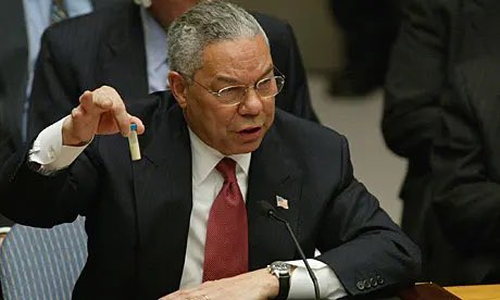
As CNN reports, his national popularity soared in the aftermath of the US-led coalition victory during the Gulf War, and for a time in the mid-90s, he was considered a leading contender to become the first Black President of the United States. But his reputation would be forever stained when, as George W. Bush’s first secretary of state, he pushed faulty intelligence before the United Nations to advocate for the Iraq War, which he would later call a “blot” on his record.

He was 84.

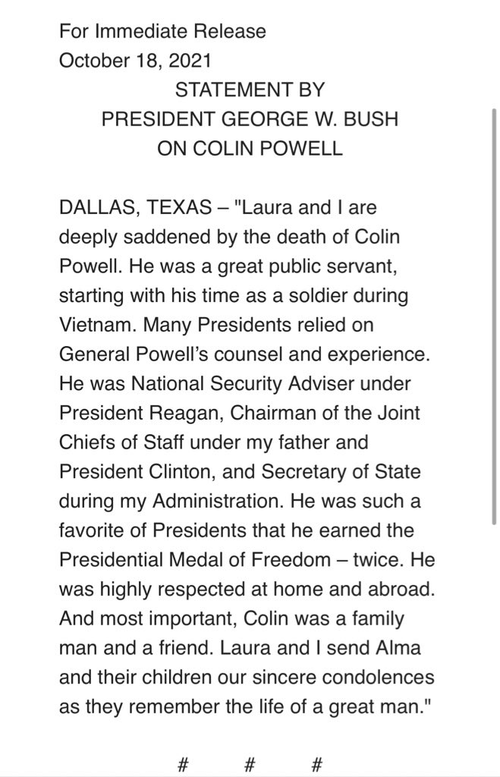
Former president Bush has issued a statement:

Of course, what the MSM wants to know is – had he received his booster?

Be seeing you

Posted in Uncategorized | Tagged: , , | Leave a Comment »

Who Will Build the Roads? Anyone Who Stands to Benefit from Them. | Mises Wire

Posted by M. C. on October 19, 2021

But even if private businesses would remain content with their customers hiking through unpaved terrain to visit them, the history of early America demonstrates that residents of a community do not have to be coerced to finance road construction. The appropriate question is not “Who will build the roads?” but rather “Who will pay for them without taxation?” And the answer, historically speaking, seems to be anybody who stands to benefit from them.

https://mises.org/wire/who-will-build-roads-anyone-who-stands-benefit-them

Chris Calton

Any freshman economics major can attest that nobody gets through their introductory economics courses without learning the theory of public goods and the so-called free-rider problem. As espoused by Paul Samuelson in the 1950s, public goods are consumed collectively, therefore making them nonrivalrous and nonexcludable—or, putting aside economic jargon, consumers do not compete against each other for such goods and producers cannot regulate access to them. In consequence, “free riders” can enjoy public goods without contributing to the cost of production.

This doctrine is invoked to justify government provision of public goods, which flies in the face of another of the first lessons young economists are taught: that economic science should be value neutral. The theory of public goods asserts that without government provision or subsidization, public goods will be underproduced, which is a normative judgment resting on assumptions about how much of a good constitutes the “correct” amount in a given economy. But as this fallacy has already been detailed elsewhere, my goal is to consider the free rider problem in historical perspective.

When students are taught about public goods, roads and highways serve as the default example in virtually every economics class. The cliché question every libertarian has encountered—“Who will build the roads?”—is predicated on the idea that without the state, private actors will have no incentive to construct or finance roadways because they will be unable to monetize them (or, at least, unable to do so sufficiently to meet the needs of the community). This assumption is accepted with such a degree of faith that few scholars have seen fit to even question whether and to what degree private roads have been constructed historically.

But in the early years of the new republic, Americans underwent what some historians have described as a “turnpike craze.” The term “turnpike” specifically refers to roadways constructed and operated privately. Early Americans, wanting to connect their communities to the developing market economy, eagerly subscribed to turnpike corporations for local roads. In fact, turnpike corporations were among the first for-profit corporations in the country, and dramatically widened the population of shareholders at a time when corporate stock was rarely available to the public.

For the first few decades of the United States, as markets rapidly integrated and industrialization took off, most roads were privately financed and constructed. It is worth acknowledging that this was rarely an example of purely private enterprise. As with any corporate endeavor in the early republic, states granted certain privileges and often purchased shares in public utility companies (which originally referred primarily to transportation and infrastructure companies). This practice was hardly due to the inadequacy of private financiers, but rather the desire of state and local governments (as well as political cronies) to reap some of the potential profits.

By the second quarter of the nineteenth century, state and local governments had started to become more reluctant to purchase corporate stock. This was partially the result of political controversies in which some businesses were favored over others, which was greatly stigmatized by the democratic Jacksonians. Another reason for government withdrawal was that turnpike corporations were proving to be unprofitable ventures, rarely paying dividends and often going bankrupt. But before one pounces on the unprofitability of these companies to reaffirm the need for governments to provide public goods, we should ask why private investors continued to eagerly finance these disastrous investments.

Historian John Majewski, in his research on turnpike corporations, provides an answer to this question. “Stockholders,” he writes, “hoped to reap rewards for their investment not so much through direct returns (such as dividends and stock appreciation), but from indirect benefits (increased commerce and higher land value).”1 What’s crucial to note here is that modern public goods theory suggests that only the state, in their obligation to provide the “public good” (the cornerstone of early republic theory from which the modern economic theory is derived), has any motive to construct anything that provides only “indirect benefits” to a community. The bulk of economists overwhelmingly ignore the facts of history, which suggest the opposite.

But even this doesn’t explain the free-rider problem, which Majewski addresses as well:

Consider the following scenario: Farmer Smith, after patiently listening to boosters discuss the great benefits of a turnpike, decides that the project would raise the value of his land by $500. Farmer Smith also knows that any initial investment in the turnpike company would be lost—a share purchased for $100 would quickly become worth only a few dollars. While $400 is undoubtedly a tidy profit on a single share, Farmer Smith knew how to get an even bigger return: Let Farmer Jones or another neighbor invest in the turnpike. According to public goods theory, every farmer in the neighborhood should have thought like Farmer Smith, and the turnpike should never have been built. Economic logic, ironically enough, demonstrates the inadequacy of theories of development built around “profit maximization.”2

Austrian economics is practically the only school of economics today that consciously avoids equating self-interest with profit maximization, which is likely why Austrians are less skeptical of the private sector’s ability to provide roadways. As Majewski acknowledges, “nonpecuniary motivations did not mean that self-interest was absent.” Self-interest included indirect benefits in land values and access to markets where farmers could profitably unload their surplus.

However, self-interest was not the only motivator behind private investment in unprofitable turnpike corporations. people were also incentivized by an interest in their community—what Alexis de Tocqueville referred to as “self-interest rightly understood.” Perfect economic rationality may demand investors avoid subscribing to unprofitable corporations (as state and local government increasingly did, irrespective of the “public good” that roads provided), but Mises’s view of rationality explains what neoclassical rationality cannot. For Mises, “rationality” referred to the use of reason—or “ratiocination”—in deciding the most suitable means to a desired end, and the “desired end” need not be pecuniary profit.

If the purpose of theory is to explain observable phenomena, the Misesian theory of rationality seems far superior to that taught in standard economics courses. To the question of “Why did people invest in unprofitable turnpike corporations?” we can deduce the answer Mises would give: they valued the personal and communal benefits the roads provided more than the dividends of a profitable company.

The implications of this history are relevant to contemporary analysis as well. Privately constructed roads are not merely a thing of the past. Even today, many neighborhood roads are privately maintained, often further combatting free riders by adding clauses to mortgages obligating homeowners to contribute to the cost of road maintenance. Some commercial leases have similar clauses, and we might wonder why they aren’t more common. Most businesses rent the buildings they operate from, and commercial real estate is unmarketable if not connected to a roadway. Even for highways and interstates, entrepreneurs have developed innovative means of monetizing roadways without the free-rider problems, as anybody who has seen a billboard should already be aware. Government-provided roads, in essence, serve as de facto subsidies for private businesses (often large, national corporations) at the expense of local taxpayers.

But even if private businesses would remain content with their customers hiking through unpaved terrain to visit them, the history of early America demonstrates that residents of a community do not have to be coerced to finance road construction. The appropriate question is not “Who will build the roads?” but rather “Who will pay for them without taxation?” And the answer, historically speaking, seems to be anybody who stands to benefit from them.

  • 1. John Majewski, A House Dividing: Economic Development in Pennsylvania and Virginia before the Civil War (New York: Cambridge University Press, 2000), p. 13.
  • 2. Majewski, A House Dividing, p. 13.

Author:

Chris Calton

Chris Calton is an economic historian and a former Mises Research Fellow. He was the writer and host of the Historical Controversies podcast.

Be seeing you

Posted in Uncategorized | Tagged: , , , | Leave a Comment »

Watch “Fauci To Americans: ‘Enjoy Christmas…If You’re Vaccinated!'” on YouTube

Posted by M. C. on October 19, 2021

Fauci made the mainstream media rounds again over the weekend, this time “granting his permission” for Americans to celebrate Halloween, Thanksgiving, and Christmas…but only if they are vaccinated. Will Americans continue to heed his demands? Also today: 40% of California’s public workers are not vaccinated, Colin Powell passes from Covid, and new footage from the “insurrection…”

https://youtu.be/Q5LjldCv4O8

Be seeing you

Posted in Uncategorized | Tagged: , , | Leave a Comment »

‘Pro-Life, Pro-Liberty’ – Ron Paul’s 18 Oct Column

Posted by M. C. on October 19, 2021

Roe contributed to the decline in respect for rights and the rise in public and private immorality. These changes have led to violent crimes, people believing they have a moral claim — that must be enforced by the government — to the property of their neighbors, and acceptance of torture and “preemptive” war. The way to reverse these developments is to restore respect for the inalienable right to life, liberty, and property of all human beings, both born and unborn. The cause of life is inseparable from the cause of liberty.

https://mailchi.mp/ronpaulinstitute/school-115694?e=4e0de347c8

Oct 18 – Abortion has returned to the headlines thanks to Texas’ “heartbeat law.” As the name suggests, this law outlaws abortions performed after doctors can detect a fetal heartbeat. This is one of several recently passed state laws restricting abortion.

The US Supreme Court will soon consider a challenge to a Mississippi law banning abortions after 15 weeks. A court majority may use this case as a vehicle to limit or even overturn Roe v. Wade, the 1973 decision in which the court declared a federal abortion right.

All who support limited, constitutional government should support overturning Roe. The Constitution does not give any branch of the federal government authority to decide what does, and does not, constitute murder. Therefore, federal courts — including the Supreme Court — have no jurisdiction to decide what the penalty should be for performing an abortion.
Overturning Roe would not create a nationwide abortion ban. Instead, it would return to the individual states responsibility for deciding what, if any, restrictions to place on abortion.

If supporters of abortion “followed the science,” they would have to admit that abortion is the taking of human life. A fetus with a heartbeat is developing, but is also still a human with a right to life.

The Biden Justice Department is supporting efforts to overturn the Texas heartbeat law in federal court. President Biden is also supporting the repeal of the Hyde Amendment, which forbids the use of federal funds for abortions. If Biden and Congress are going to use tax dollars to support abortions, then they should allow anti-abortion taxpayers to withhold the percentage of their taxes that would be used to support abortion. The same should go for those with moral objections to America’s militaristic foreign policy that forces US taxpayers to subsidize the killing of innocent men, women, and even children.

The Hyde Amendment does not completely protect pro-life taxpayers from subsidizing abortions. The amendment does not forbid organizations that promote or perform abortions from receiving federal money; it just forbids them from using for abortions the funds received from the federal government. Since money is fungible, a federal dollar going to a group that performs abortions to spend on their non-abortion-related activities frees up another dollar that can be used for abortions.

To ensure pro-life Americans are not forced to subsidize abortions — either directly or indirectly, it could be forbidden for organizations that promote or perform abortions to receive any federal funds. Denying federal funds to international organizations that promote or perform abortions might help reduce resentment of the US in other countries.

It is no coincidence that Roe v. Wade came at a time when respect for natural rights of life, liberty, and property was on the decline. Roe contributed to the decline in respect for rights and the rise in public and private immorality. These changes have led to violent crimes, people believing they have a moral claim — that must be enforced by the government — to the property of their neighbors, and acceptance of torture and “preemptive” war. The way to reverse these developments is to restore respect for the inalienable right to life, liberty, and property of all human beings, both born and unborn. The cause of life is inseparable from the cause of liberty.

—

Read more great articles on the Ron Paul Institute website.
Subscribe to free updates from the Ron Paul Institute.
Copyright © 2021 by Ron Paul Institute. Permission to reprint in whole or in part is gladly granted, provided full credit and a live link are given.

Be seeing you

Posted in Uncategorized | Tagged: , , , | Leave a Comment »