


Be seeing you
Final Nail in America’s Coffin?
Posted by M. C. on April 24, 2024
Posted in Uncategorized | Tagged: America, Coffin, Nail | Leave a Comment »
Exposing Ukraine’s Secret Police and Mission to Exterminate Christianity
Posted by M. C. on April 24, 2024
Posted in Uncategorized | Tagged: Christianity, Exterminate, secret police, Ukraine | Leave a Comment »
Debunking All the Main Arguments for Antitrust Laws
Posted by M. C. on April 24, 2024
Antitrust laws are built on nothing but poor reasoning and misguided apprehensions.
No. The only way companies can succeed under free-enterprise rules is by making better offers, not worse ones, to employees, customers, and suppliers. The moment they get “uppity,” if ever they do, and stop providing better goods and services at lower prices, they get smashed down by the logic of the free-enterprise system: the supposed “victims” go elsewhere; new entrepreneurs spring up.
https://substack.com/inbox/post/143892051
It does not take too much upstairs to see through the Biden administration’s rejection of the JetBlue-Spirit Airlines merger. The latter is on the verge of bankruptcy. It is $1.1 billion in debt. It faces the headwinds of a new labor agreement raising pilot pay by 34% and has trouble with its Pratt & Whitney engines. JetBlue offered Spirit a $3.8 billion buyout. Together the two of them would account for a 10.5% market share, fifth in this industry.
It is exceedingly difficult to see the logic behind this antitrust refusal, unless it is to protect the market share of the “big four”: Delta (17.7%), American (17.2%), Southwest (16.9%), and United (16.1%).
Nor was this the only recent interference with free enterprise on the part of the Biden administration. Another took place with its kibosh on biotech giant Illumina’s $7.1 billion reacquisition of Grail. These bureaucrats have also put paid to deals between air carriers Alaska and Hawaiian, between grocery chains Kroger and Albertsons, and between amusement park giants Six Flags and Cedar Fair. They have been busy little bees ruining the US economy.
A more important consideration is to ask why we need antitrust law in the first place. After all, the entire ethos of competition is to outdo your rivals in terms of providing consumers with a better and more reliable product at a lower price. The better you perform that task, the larger your base of operations becomes… and the more likely you are to run afoul of antitrust law. Here is a public policy that explicitly, knowingly, and purposefully clamps down on entrepreneurship, profits, earnings, and customer satisfaction, the very ideals of the free-enterprise system.
The Rotten Roots of Antitrust Law
The justifications for this set of laws are several. From an academic point of view, it stems from a diagram in microeconomics which has been crammed down the throats of aspiring economics students for lo these many decades. On the basis of it, four indictments of so-called “monopoly” have emerged.
Be seeing you
Posted in Uncategorized | Tagged: Antitrust Laws, JetBlue-Spirit Airlines, merger | Leave a Comment »
U.S./EU Lobby Against Georgian Law That Would Reveal Their Secret Influence
Posted by M. C. on April 24, 2024
For most of its existence, FARA was relatively obscure and rarely invoked; since 2017, the law has been enforced with far greater regularity and intensity, particularly against officials connected to the Trump administration.
Last I knew AIPAC is not subject to FARA. Whodathunkit?
The government of Georgia has tried for some time to implement a law “On transparency of foreign influence”. Its aim is to publicly identify organizations and parties who receive a significant amount of their budget from abroad:
The draft law “In order to ensure transparency”, initiated for the second time by the Georgian Dream faction, envisages the registration of such non-entrepreneurial (non-commercial) legal entities and media outlets, whose income – more than 20% – is received from abroad as an organization carrying out the interests of a foreign power. According to the project, everyone who is considered an “organization carrying the interests of a foreign power” must be registered in the public register under the same name in a mandatory manner. At the time of registration, it will be necessary to reflect the received income. At the same time, the organizations will have the obligation to fill in the financial declaration every year.
Those organization who currently receive money from the various U.S. or EU government or non-government organizations are of course not amused that they will have to reveal their association with such sources. They want to lobby for foreign positions without being identified as foreign influencers.
They have therefore launched protests against their country’s government and parliament which has passed the law in the first reading. Two further readings will be required to finalize the law.
The protesters against the law claim that it is a “Russian law” against “foreign agents”.
Since 2012 Russia does have a law that is somewhat similar to what Georgia is attempting to implement but such type of laws are certainly not a Russian intervention:
Supporters of the [Russian version of the] law have likened it to similar legislation in the US that requires lobbyists employed by foreign governments to reveal their financing.
The U.S. equivalent to the Russian and Georgian law is of course the much older Foreign Agents Registration Act:
The Foreign Agents Registration Act (FARA) (22 U.S.C. § 611 et seq.) is a United States law that imposes public disclosure obligations on persons representing foreign interests. It requires “foreign agents”—defined as individuals or entities engaged in domestic lobbying or advocacy for foreign governments, organizations, or persons (“foreign principals”)—to register with the Department of Justice (DOJ) and disclose their relationship, activities, and related financial compensation.
…
FARA was enacted in 1938 primarily to counter Nazi propaganda, with an initial focus on criminal prosecution of subversive activities; since 1966, enforcement has shifted mostly to civil penalties and voluntary compliance.For most of its existence, FARA was relatively obscure and rarely invoked; since 2017, the law has been enforced with far greater regularity and intensity, particularly against officials connected to the Trump administration.
Be seeing you
Posted in Uncategorized | Tagged: AIPAC, FARA, Georgian Law, Secret Influence, U.S./EU | Leave a Comment »
Is the ‘Housing Shortage’ the Result of Housing-Hoarding by the Wealthy?
Posted by M. C. on April 23, 2024
Would a deep recession incentivize an increase in the number of occupants per dwelling and a corresponding decline in demand for rentals? Would a collapse of The Everything Bubble prompt some selling of hoarded housing? As painful as these might be, these dynamics would correct the destabilizing distortions wrought by the Fed’s easy-money bubble blowing and concentration of wealth in the hands of the few at the expense of the many.
https://www.oftwominds.com/blogapr24/housing-shortage4-24.html
Those seeking to buy a house as shelter for their household can’t compete with the wealthy seeking assets to snap up and hoard for appreciation.
Longtime readers know I’ve been addressing housing issues from the start of the blog in 2005. Let’s start with the general context of housing in the US, courtesy of the US Census Bureau, which tracks occupancy and the number of housing units nationally: Quarterly Residential Vacancies and Homeownership, 4th Quarter 2023
All housing units 145,967,000
Occupied 131,206,000
Owner 86,220,000 59%
Renter 44,985,000 31%
Vacant 14,761,000 10%
Non-seasonal (i.e. not second homes owned by the wealthy for their recreational use) 11,177,000
Units vacant because they’re in the process of being rented or sold:
For rent 3,224,000
For sale only 757,000
Rented or Sold 783,000
Held off Market (occasional use, temporarily occupied, other) 6,414,000
Seasonal (i.e. second homes owned by the wealthy for their recreational use) 3,583,000
TOTAL Held off Market and Seasonal / Recreational: 9,997,000
In summary: there are 14.7 million vacant dwellings in the US, of which 10 million are not available for year-round rentals or sale. Those 10 million dwellings are comparable to the total number of dwellings in entire nations, for example, Australia (11 million housing units, population of 27 million).
There are many complexities not specified or included in these statistics. For example, vacant dwellings located in rural locales with few jobs might be empty because there is little demand due to a declining population. Other dwellings may no longer be habitable without renovation or repair.
On the other side of the equation, non-permitted dwellings (granny flats, etc.) may also be uncounted as those answering Census Bureau questionnaires might hesitate to report units added without official approval. This can include everything from RVs parked alongside homes to converted garages to living rooms partitioned off and rented out as quasi-bedrooms.
The vagarities of self-reported data are potentially major factors in counting short-term vacation rentals, a.k.a. AirBnB / VRBO-type rentals. Data remains sketchy on exactly how many housing units are being “held off the market” as short-term vacation rentals. As of 2023, there were 2,459,260 available vacation rental listings in the U.S., but this may not include informal rentals, rentals listed outside of the major platforms, etc.
The Census Bureau offers several estimates of seasonal units: 3.6 million in the above link, and 4.3 million vacant seasonal units in this post: See a Vacant Home? It May Not be For Sale or Rent. These are traditionally second or third homes of wealthy households. but many such properties are now being offered as short-term vacation rentals for periods when the owners aren’t using the property.
What these statistics don’t tell us is how many housing units have been snapped up by wealthy households as investments, nominally as “second homes” but solely as safe places to park excess capital / credit, not for recreational use. The wealthy may have joined the rush to cash in on the short-term vacation rentals boom, but they don’t need positive cash flow to afford the costs of ownership; the Airbnb rental income was mostly to defray the costs of ownership.
Too Many Rich People Bought Airbnbs. Now They’re Sitting Empty
In other words, one factor in the “housing shortage” is the pressure on the wealthiest households to find places to park their excess capital and exploit their low-cost lines of credit. This can be understood as a second-order effect of the Federal Reserve’s policy of inflating asset bubbles in which 90% of the gains flowed to the top 10% households. This new wealth could then be tapped to buy real estate, a long-favored asset class of the wealthy that has risen to new heights as the wealthy compete with other wealthy households to snap up housing.
There’s not much in the pockets of the bottom 50% to compete with the top 5% for housing: we can expand this to say there isn’t enough in the pockets of the bottom 90% to compete with the top 10% who collected 90% of the gains of the Fed’s credit-asset bubbles:
Be seeing you
Posted in Uncategorized | Tagged: easy-money, Fed, hoarding, Housing Shortage | Leave a Comment »
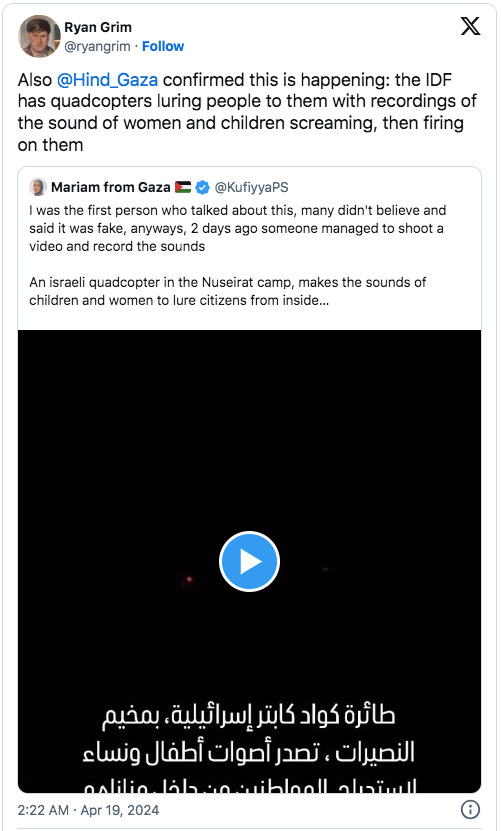
In Gaza The Sniper Drones Are Crying Like Babies
Posted by M. C. on April 23, 2024
This baby-crying-sniper-drone story is something else, though. It’s like something out of a weird post-apocalyptic horror movie or something.

They’re hunting civilians with armed quadcopters in Gaza.
The drones play recordings of crying babies and women screaming in distress in order to lure people out into the open, and then shoot them.
This is reportedly happening at the Nuseirat refugee camp in central Gaza, where people live in total darkness at night and have no connection to the outside world.
Other times the drones play the sounds of explosions and gunshots and rolling tanks, and sometimes songs in Hebrew or Arabic, all to terrorize these refugees hiding in the darkness afraid for their lives.
This is the sort of report that a critical thinker would normally dismiss as absurd atrocity propaganda if it was being made about any other military power, but this is the IDF we’re talking about, and this specific allegation is pretty well-supported now.
When the destruction of Gaza first began I used to read the jarring claims about the horrific things the IDF were doing and often think, “No, no way. That can’t be the whole story. It’s too cartoonishly evil. There must be some information missing.” Then a few days or weeks later confirmation would come out, showing it’s even worse than I thought before.
I don’t experience that kind of dubiousness when reading such stories anymore. There are only so many atrocities you can see documented, so many videos of IDF troops recording themselves gleefully behaving like monsters, so many hospitals you can see attacked, so many journalists you can see assassinated, before you read a new report about new unfathomable acts of depravity and find yourself saying “Yeah, that sounds about right.”
Be seeing you
Posted in Uncategorized | Tagged: crying babies, Gaza, Sniper Drones | Leave a Comment »
CIA To Zelensky: ‘Please Stop Stealing So Much.’
Posted by M. C. on April 23, 2024
Posted in Uncategorized | Tagged: CIA, stealing, Zelensky | Leave a Comment »
Government Documents- You can now be considered a “potential terrorist” just because of your religious or political beliefs.
Posted by M. C. on April 22, 2024
1. “Those that talk about “individual liberties”
6. “Those that believe “that the interests of one’s own nation are separate from the interests of other nations or the common interest of all nations”
7. “Anyone that holds a “political ideology that considers the state to be unnecessary, harmful,or undesirable”
21. Members of the Christian Action Network
22. Anyone that is “opposed to the New World Order”
Uh Oh!
Be seeing you
Posted in Uncategorized | Tagged: political beliefs, religious, terrorist | Leave a Comment »
Tariffs Are Taxes on Americans—But Protectionists Pretend Otherwise
Posted by M. C. on April 22, 2024
Taxes benefit the regime while impoverishing the rest of us. To favor “free trade” is to favor lowering taxes on Americans and depriving the regime of funds. To favor protectionism, whether it be for some foreign-policy crusade, or to “create jobs” is to simply be in favor of raising taxes and handing over more Americans’ wealth to the state.
https://mises.org/mises-wire/tariffs-are-taxes-americans-protectionists-pretend-otherwise

04/18/2024 • Mises Wire •Ryan McMaken
During the 2016 and 2020 campaigns, Trump’s opponents in the Democratic party (and elsewhere) often pointed out that Trump’s protectionism hobbles private markets and the economy overall. Yet, the allegedly anti-protectionist Biden administration has done virtually nothing to end Trump’s protectionists policies put in place from 2017 to 2020. The motivation is unclear, but it is possible that the Biden administration realized that protectionism is a useful political tool. These policies offer a way of punishing opponents, rewarding allies, and pandering to voters.
Now that it’s election season, the pandering side of the equation is in full swing. Biden this week called for “sharply higher U.S. tariffs on Chinese metal products.” Appropriately, Biden included this new spate of protectionism in what Reuters calls “a package of policies aimed at pleasing steelworkers in the swing state of Pennsylvania.”
Biden’s pandering will likely bear some fruit, politically speaking. Protectionism remains popular. But, as Henry Hazlitt put it, voter support for raising tariffs is “the result of looking only at the immediate effects of a single tariff rate on one group of producers, and forgetting the long-run effects both on consumers as a whole and on all other producers.” Those who are incapable or unwilling to examine policies beyond their most short-term effects are easy targets for protectionist rhetoric.
The reason there are so many negative effects, of course, is that tariffs are nothing more or less than taxes and they produce the same effects as any other type of tax: when Country A imposes tariffs, Country A’s government is enriched while both producers and consumers living in Country A must endure higher prices and a less productive economy.
Even those voters who imagine themselves as opposed to taxes and “big government” often embrace tariffs—apparently fooled by the misconception that tariffs aren’t taxes or that they are only paid by foreigners. Many conservatives and protectionist “libertarians” create a wide variety of ornate theories with big words designed to distract from the fact that American tariffs are taxes on Americans. Ultimately, however, these people are simply pushing for tax increases.
It’s Not that Complicated: Tariffs Are Taxes
A tariff is a tax that is collected when a good crosses an international border. In the United States, as with any country that imposes tariffs, any good that is subject to tariff can only enter the country when the extra tax is paid upon entry. (This tax is in addition to any other taxes that must be paid down the line, such as sales taxes.) As with any similar transactional tax (e.g., sales taxes) the result is higher prices and fewer choices for consumers. It must also be noted that the “consumer” of imported goods need not be the retail consumer or end consumer. A great many imported goods are intermediate goods that are used in the creation and production of other goods produced and sold within the United States. That is, tariffs are often taxes on materials used by American entrepreneurs and business owners to produce American goods.
Raising taxes (i.e., tariffs) raises costs for all these American producers and consumers. Yes, it is true that Americans do not suffer the full consequences of taxes on foreign goods. As with a sales tax, a tariff imposes some costs on the seller by raising prices and thus reducing total sales. But it is simply wrong to portray tariffs are taxes primarily on foreigners, since, as Murray Rothbard notes, “Tariffs injure the consumers within the ‘protected’ area, who are prevented from purchasing from more efficient competitors at a lower price.
Yet, protectionists have long been in the business trying to explain that tariffs are not actually taxes on Americans at all. Or, as Rothbard puts it:
Tariffs have inspired a profusion of economic speculation and argument. The arguments for tariffs have one thing in common: they all attempt to prove that the consumers of the protected area are not exploited by the tariff. These attempts are all in vain.
Old habits die hard, however. Even among readers of mises.org, one finds plenty of readers involved in the quest to convince others that raising taxes is a good thing. One such claim is that since other countries impose high import taxes on their own citizens, the US government must do the same. Consider this response to a recent mises.org article on trade. The reader states: “Baloney. Horse manure. ‘Free trade’ is a meaningless slogan. The issue of trade is much more complex than slogans. You can’t have free trade with Japan and China, which uses massive protectionist policies to help its own workers and industries. The wages are not comparable!!!”
Be seeing you
Posted in Uncategorized | Tagged: protectionists, Tariffs, Taxes | Leave a Comment »
Why Would He Do This? — Speaker Johnson Is Really Hurting America
Posted by M. C. on April 22, 2024
Posted in Uncategorized | Tagged: Speaker Johnson | Leave a Comment »
 MCViewPoint