
The MIC likes her as well as the dems.
Be seeing you

Enemy of the State-Read the Book-Know the Man
This is not a Safe Space but Baby, I don't care.

"I am not a number, I am a Free Man" - No. 6
 Information Liberation Alex Jones’ Prison Planet Gary North Specific Answers Antiwar The Daily Bell Tenth Amendment Center Economics Policy Journal The American Thinker The New American Lew Rockwell
Posted by M. C. on January 26, 2024
Posted in Uncategorized | Tagged: Deranged, Nikki Haley | Leave a Comment »
Posted by M. C. on January 25, 2024
It’s uneconomic to fight primitive people with modern weapons. Our million-dollar missiles blow up huts in the sand. At some point, some of their $10,000 missiles are going to get through and destroy a billion-dollar warship.
It’s almost always a mistake for foreigners to get involved in another country’s civil war, especially when it has religious overtones. It doesn’t matter which side you back; the people that you’re backing are not your friends, and the people on the other side will really hate you. It’s a no-win situation for the US. None of our business, with no upside. Except for US Government operatives who get to play bigshot.
by Doug Casey

International Man: Yemen has sometimes been called “the Afghanistan of the Middle East” because it is an impoverished tribal society that is well-armed, situated on mountainous terrain, and generally inhospitable to foreign invaders and a central government.
What are your impressions of this country?
Doug Casey: Regrettably, I haven’t been to Yemen and have no plans on going—partly because I’ve seen enough similar flyblown Islamic hellholes. But it’s well known that the country is extremely primitive, poor, tribal, and very religious.
Yemenis take their Mohammedanism quite seriously. No offense to believers, but the more primitive, poorer, and more tribal a place is, the greater the tendency for their lives to revolve around religion. It binds them together and gives their lives meaning. It is not a good place for foreigners of a different race, religion, or culture to invade. This begs the question, why would anybody want to invade it? There’s nothing there of any real value. Maybe there are some undeveloped resources, but the natural resource business is high risk/high cost under even the best circumstances.
You certainly don’t want to invest in a place with unfriendly natives. So, it’s entirely insane for outsiders to care about Yemen.
It has been said that war is nature’s way of teaching Americans geography. That’s true. Not one American in a thousand even knew the place existed until a few weeks ago; now, they all have opinions on what “we” should do, even if they still can’t find it on a map. But fear not. Even as we speak, plenty of reasons why we should care about Yemen are being fabricated in DC.
International Man: Yemen has long been a difficult place for foreign invaders.
Most recently, the Houthis, an Iran-backed group that controls most of Yemen, frustrated the military coalition of Saudi Arabia and its allies.
Though most people are unaware of this war or its details, it is remarkable that the Saudis, who are among the wealthiest in the Middle East and backed by the military and political support of the US, could not defeat the Middle East’s most impoverished people in Yemen.
What is your take on the Houthi–Saudi Arabian conflict and its implications?
Doug Casey: I doubt if one American out of 10,000, or even 100,000, had even heard the word Houthi before last year, but now it’s everywhere in the news. And for some reason, they’ve become our problem.
There used to be two Yemens—North Yemen and South Yemen—that were quite different politically and sociologically. They fought each other, then united in 1990. Now, the Houthis, who are Shia (hence the relations with Iran), are fighting a civil war with other locals. But it doesn’t seem to me Yemen is or has ever been a real nation-state. It’s impoverished, with no industry to speak of or the prospect of getting any. The income it has is from some oil production, and it all goes to corruption and paying the army. It has a large foreign trade deficit and debt. And the population is very young and exploding in numbers. It is, by any and every measure, one of the very most dysfunctional and essentially worthless places in the world.
It’s almost always a mistake for foreigners to get involved in another country’s civil war, especially when it has religious overtones. It doesn’t matter which side you back; the people that you’re backing are not your friends, and the people on the other side will really hate you. It’s a no-win situation for the US. None of our business, with no upside. Except for US Government operatives who get to play bigshot.
Be seeing you
Posted in Uncategorized | Tagged: Middle East, Mohammedanism, Yemen | Leave a Comment »
Posted by M. C. on January 24, 2024
Posted in Uncategorized | Leave a Comment »
Posted by M. C. on January 24, 2024

Pay less attention to people’s words about wanting “peace” and focus instead on what actions they are supporting to accomplish that end. This will show you the truth about what they really want.
https://substack.com/inbox/post/140985557
Everyone says they want peace, but they mean different things by this. To an anti-imperialist, peace means the end of violence, oppression and exploitation. To a Zionist, peace means Palestinians lie down and accept their fate and neighboring nations cease disobeying Israel. To a supporter of the US empire, peace means all nations around the world submit to US unipolar hegemony. Many say they want peace when what they really want is tyranny.
If “peace” to you means other populations bow down and submit to your will, then it makes perfect sense for you to believe that your wars are being waged to attain peace, because those wars are being used to violently bludgeon those populations into obedience. If your definition of peace means the cessation of all violence and abuse, then you will support ceasefires, peace negotiations, diplomacy, the de-escalation of tensions, the cessation of imperialist extraction, and the end of apartheid and injustice.
Pay less attention to people’s words about wanting “peace” and focus instead on what actions they are supporting to accomplish that end. This will show you the truth about what they really want.
❖

❖
Someone asked “Can we all agree that our world would be better without a Hamas?”
This is the sort of question that can only make sense to you if you view Hamas as some kind of invasive alien presence that was imposed upon Palestine from the outside instead of a natural emergence from the material circumstances that have been forced upon Palestinians. If you’ve got a group of people being sufficiently oppressed and violently persecuted by the ruling power, you’re going to start seeing violent opposition to that ruling power as sure as you’ll see blood arise from a wound.
Be seeing you
Posted in Uncategorized | Leave a Comment »
Posted by M. C. on January 23, 2024
Posted in Uncategorized | Tagged: Biden, Indispensable Nation, Yemen | Leave a Comment »
Posted by M. C. on January 23, 2024
Every Expatriate of an Idiocracy is a dreamer.

To save the Consitution, it must first be destroyed.
To save anything revered it must first be eradicated, rewritten, reprogrammed, debauched: History, the constitution, elections, rule of law, justice, minds, families, children.
https://substack.com/inbox/post/139714467

Good Citizen in Prague (2007-2011)
The hidden hands of manipulation have been at it for centuries with no plans to stop. The dream of escaping their unfolding nightmares of problem-reaction-solution, and abandoning the farce of an Idiocracy is no less valid whether for Hemingway in 1921 or any disillusioned American man in the twenty-first century because every Expatriate is at his core a dreamer. He will insist otherwise with an air of outrage, but he is lying.
Historically all Empires decayed into tragedy.
This rise of an Idiocracy within an Empire of Lies dances into the twilight as if it’s winning, always winning, ending the historical run of tragedies with a monopoly on comedic acts of deprivation and demoralization that usher in the permanent farce.
The farce is a unique subgenre of comedy. It is represented as absurdity, exaggeration, nearly improbable, and unfathomable circumstances expressed through slapstick comedy that rises to a crescendoed climax:
Eight million illegals are invited across the U.S. border with Mexico in three years with the help of something called “Border Control” and are given new phones, $5000 debit cards, and one-way plane tickets on major airlines to the city of their choice with Department of Homeland Security paperwork that assigns their first court date for 2029. The illegals are given their dedicated security lines at airports while citizens have to go through long lines, and are patted down and molested by regime foot soldiers in purple gloves with sub-90 IQs. Soon the illegals with slightly lower IQs, capable of speaking rudimentary English will be able to work as Police Officers in some states and cities, policing the behavior of the legal citizens who pay their salaries. Illegals now get free taxpayer citizen-subsidized healthcare in California.
The paralysis sets in slowly while witnessing a failing empire spinning off an axis at maximum velocity away from common sense. The triteness of pretending along with others that this isn’t happening nudges the Expatriate on a mission to seek out new frontiers free from madness and anguish—free from the cultural insanity, the political insanity, and the social rot that nurtures despondency.
The quest is born.
The dreamer knows he cannot change others who are either barely literate or barely conscious, and incapable of even seeing the farce. So he must seek to change only himself, to end the paralysis and stasis borne of playing his role in the farce.
He starts with a different theatre—fresh surroundings.
At the risk of sounding elusive and general, or implying that this farce only recently manifested, let us embrace specifics from this century alone.
Be seeing you
Posted in Uncategorized | Tagged: Farce, Idiocracy | Leave a Comment »
Posted by M. C. on January 23, 2024
by Ryan McMaken
By the early twentieth century, the idea of the civilizing mission became a dominant mode of thinking for imperialists. The British imagined they were civilizing the backward Catholic Irish. The Russian colonizers in Siberia saw themselves as the “benevolent civilizer[s] of Asia.” British colonies in Africa and Asia were cast as outposts of civilized European culture in a sea of primitives. The Americans, not content with their own civilizing mission in North America, did the same in Puerto Rico where American reformers sought to replace Puerto Rico’s “backward” and “patriarchal” culture with a “‘rational’ North American one.”3

Spreading civilization and human rights has long been used as an excuse for state-building through colonialism and imperialism. This idea dates back at least to early Spanish and colonial efforts in the New World, and the rationale was initially employed as just one of many. The importance of the conquest-spreads-civilization claim increased, however, as liberalism gained ground in Europe in the nineteenth century. Liberals were more skeptical of the benefits of imperialism, so, as political scientist Lea Ypi notes: “During the late nineteenth century and early twentieth century, the purpose of colonial rule was declared to be the ‘civilizing mission’ of the West to educate barbarian peoples .” The residents of these colonies were deemed to be “unsuited to setting up or administering a commonwealth both legitimate and ordered in human and civil terms.” The implied conclusion was that it was necessary that the European rules “take over [the natives’] administration, and set up new officers and governors on their behalf, or even give them new masters, so long as this could be proved to be in their interest.”1
That last caveat would become important to late colonial rationales: colonial rule was said to be in the interests of the natives themselves, who were incapable of proper and legitimate self-government. The British adopted these Spanish notions as their own in later centuries, and by the nineteenth century, we find John Stuart Mill claiming that “barbarians” were incapable of administering a respectable legal regime, and thus “nations which are still barbarous have not got beyond the period during which it is likely to be for their benefit that they should be conquered and held in subjection by foreigners.”2
The old empires have largely disappeared but this thinking has certainly not disappeared. Today, the same thinking takes the form of support for humanitarian intervention both internationally and domestically. Just as the traditional imperialists assumed the residents of the colonies were too “backward” to be capable of enlightened self-government, modern internationalists and progressives assume that the old colonial metropoles still must serve as enforcers of human rights across the globe. Moreover, at the domestic level, the same rationale is employed to oppose decentralization or secession for separatist groups. The old imperialist mentality still prevails: self-determination and political independence must be opposed in the name of protecting human rights.
By the early twentieth century, the idea of the civilizing mission became a dominant mode of thinking for imperialists. The British imagined they were civilizing the backward Catholic Irish. The Russian colonizers in Siberia saw themselves as the “benevolent civilizer[s] of Asia.” British colonies in Africa and Asia were cast as outposts of civilized European culture in a sea of primitives. The Americans, not content with their own civilizing mission in North America, did the same in Puerto Rico where American reformers sought to replace Puerto Rico’s “backward” and “patriarchal” culture with a “‘rational’ North American one.”3 In Algeria, the ultimate goal was to bring the blessings of French culture and government to all Algerians via government schools. The locals who embraced French culture were labeled the évolués—literally, the “evolved ones.”
Among the imperial powers, rule by the metropole’s central state became intimately intertwined with what the elites saw as humanitarianism. Imperialists warned that without the metropole’s oversight, residents of the colonies would slaughter each other, or be constantly at war. Imperialists thus cast themselves as instruments of peace and safety for vulnerable minority populations. Ann Laura Stoler describes how, “appeals regarding moral uplift, compassionate charity, appreciation of cultural diversity, and protection” of women and children from aggressive men “were woven into the very weft of empire. —[they were] how control over…markets, land, and labor were justified…”4 Alleged humanitarian efforts thus often consisted of the imperial powers protecting the colonized populations from themselves. Alan Lester and Fae Dussart note: “Appeals for the protection of indigenous peoples against white and even British men…were also intrinsic to the legitimation of Britain’s governance of newly colonized spaces.”5
Imperialists developed informal litmus tests designed to “prove” that various groups of barbarians were ripe for colonization.
Be seeing you
Posted in Uncategorized | Tagged: Colonialism, Humanitarianism, imperialism | Leave a Comment »
Posted by M. C. on January 23, 2024
by Tom Woods
What I know is this: Nature doesn’t care what you “deserve.” Nature alone doesn’t simply hand you things to sustain you. You have to go out and acquire them for yourself, sometimes at the cost of great physical exertion and sacrifice. And if you do manage, by a direct reckoning with nature, to produce everything you need entirely on your own and without interacting with other human beings, your standard of living will be almost unimaginably low.
https://libertarianinstitute.org/articles/the-world-doesnt-owe-you-a-thing/

A huge drawback to social media is this: I’m not sure I really want everybody’s opinions on every last thing, and it’s frankly demoralizing to realize just how far gone so many people are.
For example, one of my own Twitter followers wrote this: “The idea of having to ‘earn a living’ implies that, by default, you don’t actually deserve to be alive.”
He thinks this is profound.
I don’t even know what it means to say somebody “deserves” to be alive.
What I know is this: Nature doesn’t care what you “deserve.” Nature alone doesn’t simply hand you things to sustain you. You have to go out and acquire them for yourself, sometimes at the cost of great physical exertion and sacrifice. And if you do manage, by a direct reckoning with nature, to produce everything you need entirely on your own and without interacting with other human beings, your standard of living will be almost unimaginably low.
So the way to achieve the kind of living standards we have come to enjoy necessarily involves, at the very least, integrating oneself into the division of labor, such that everybody’s unique specializations combine to multiply output manyfold.
The division of labor, in turn, involves human beings. Since the goods we need to survive are not generated automatically but have to be produced by someone, then if you are going to live on this earth without “making a living” (the expression that the original post finds so offensive), the only way to do so is by forcing other people to make a living for you. And then what happens to the life those people “deserve”? Don’t those people deserve a life in which they’re not required to do forced labor for strangers?
Confusion like this is why it’s important to understand that when in the American tradition we speak of the right to life, liberty, and property, we really mean, in the case of life, the right not to have your life taken away. You do not have a positive right to life in the sense that if you needed it you would have an abstract right to a kidney dialysis machine. You do have a right to pay for the use of such a machine, since that’s a subset of property rights, but your “right to life” doesn’t include a right to demand that somebody else build that machine and let you use it.
Be seeing you
Posted in Uncategorized | Tagged: division of labor, living standards, Social media | Leave a Comment »
Posted by M. C. on January 22, 2024
This bizarre refusal to just call a war a war also appeared in a recent press conference with Pentagon spokesperson Sabrina Singh, who acted shocked and aghast that reporters would even ask if repeatedly bombing a country would qualify as being at war with them.
https://substack.com/inbox/post/140915473
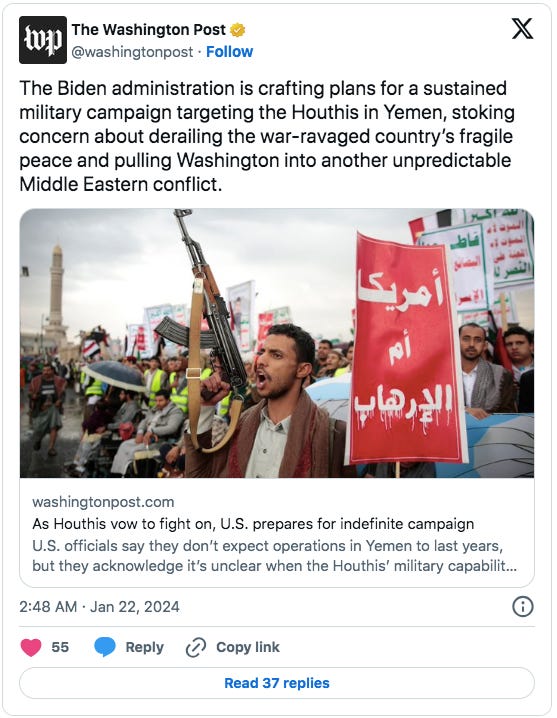
The Washington Post has an article out titled “As Houthis vow to fight on, U.S. prepares for sustained campaign,” with “sustained campaign” being empire-speak for a new American war.
“The Biden administration is crafting plans for a sustained military campaign targeting the Houthis in Yemen after 10 days of strikes failed to halt the group’s attacks on maritime commerce, stoking concern among some officials that an open-ended operation could derail the war-ravaged country’s fragile peace and pull Washington into another unpredictable Middle Eastern conflict,” the Post reports.
The Post acknowledges that “sustained military campaign” means “war” in the ninth paragraph of the article, saying the anonymous US officials cited in the report “don’t expect that the operation will stretch on for years like previous U.S. wars in Iraq, Afghanistan or Syria.” Which is about as reassuring as a pyromaniac saying he doesn’t expect he’ll be burning down any more houses like all those other houses he’s burned down.
This bizarre refusal to just call a war a war also appeared in a recent press conference with Pentagon spokesperson Sabrina Singh, who acted shocked and aghast that reporters would even ask if repeatedly bombing a country would qualify as being at war with them.
“Is it now fair to say that the U.S. is at war in Yemen?” Singh was asked by a Reuters reporter on Thursday.
“No, we don’t seek war,” Singh replied. “We don’t think that we are at war. We don’t want to see a regional war. The Houthis are the ones that continue to launch cruise missiles, antiship missiles at innocent mariners, at commercial vessels that are just transiting an area that sees, you know, 10 to 15 percent of world’s commerce.”
In a follow-up several questions later, Singh was asked by a reporter from Politico, “You said that we are not at war with the Houthis, but if — you know, this tit-for-tat bombing — we’ve bombed them five times now. So if this isn’t war, can you just explain this a little — a little bit more to us? If this isn’t war, what is war?”
“Sure, Lara, sure, great question, I just wasn’t expecting it phrased exactly that way,” Singh replied with a laugh and a smirk. “Look, we are — we do not seek war. We are — we do not — we are not at war with the Houthis. In terms of a definition, I think that would be more of a clear declaration from the United States. But again, what we are doing and the actions that we are taking are defensive in nature.”
Be seeing you
Posted in Uncategorized | Tagged: Biden, Pentagon, Sabrina Singh, war, Yemen | Leave a Comment »
Posted by M. C. on January 22, 2024
by Jeff Thomas
New wealth comes from the bottom up—it’s as simple as someone building a better mousetrap, or building the old one more cheaply. In such a market, both the producer and the consumer benefit.
In a fascist system, the wealth gravitates to the top, eventually choking out the middle class and expanding the poorer class, and that’s just what we’re witnessing today. The solution is not to go further in this direction, but rather to try something new… or at least new to anyone living under the fascist system. Although it still retains some capitalist overtones, it is unquestionably not capitalism.

Capitalism, whether praised or derided, is an economic system and ideology based on private ownership of the means of production and operation for profit.
Classical economics recognises capitalism as the most effective means by which an economy can thrive. Certainly, in 1776, Adam Smith made one of the best cases for capitalism in his book, An Inquiry Into the Nature and Causes of the Wealth of Nations (known more commonly as The Wealth of Nations). But the term “capitalism” actually was first used to deride the ideology, by Karl Marx and Friedrich Engels, in The Communist Manifesto, in 1848.
Of course, whether Mister Marx was correct in his criticisms or not, he lived in an age when capitalism and a free market were essentially one and the same. Today, this is not the case. The capitalist system has been under attack for roughly 100 years, particularly in North America and the EU.
A tenet of capitalism is that, if it’s left alone, it will sort itself out and will serve virtually everyone well. Conversely, every effort to make the free market less free diminishes the very existence of capitalism, making it less able to function.
Today, we’re continually reminded that we live under a capitalist system and that it hasn’t worked. The middle class is disappearing, and the cost of goods has become too high to be affordable. There are far more losers than winners, and the greed of big business is destroying the economy.
This is what we repeatedly hear from left-leaning people and, in fact, they are correct.
Be seeing you
Posted in Uncategorized | Tagged: capitalism, Communist Manifesto, fascist, Karl Marx, Wealth of Nations | Leave a Comment »
 MCViewPoint