


Further, the al-Qaeda-led insurgency was sparked as a result of the efforts of U.S. planners, who worked with their British, Saudi and Lebanese allies to unleash these groups in Syria. They did so in the hope of triggering a sectarian civil war that would topple the Syrian government, destroy Syria’s delicate religious co-existence, and open the way for U.S. military intervention in the country. Tragically, hundreds of thousands of Syrians have died, and millions become refugees or displaced during the more than 10-year conflict their actions sparked.
Introduction
In the mainstream view, al-Qaeda did not play a role in the Syria conflict until Islamic State of Iraq (ISI) leader Abu Bakr al-Baghdadi dispatched his deputy, Abu Muhammad al-Jolani, to Syria in August 2011 to establish a wing of the group there, called Jabhat al-Nusra, or the Nusra Front. Additionally, al-Qaeda allegedly did not carry out any military operations until December 2011 and did not announce its establishment until January 2012.
However, there is evidence that al-Qaeda affiliated militants were involved in the Syrian conflict much earlier. Saudi intelligence chief Prince Bandar bin Sultan, former Syrian Vice President Abd al-Halim Khaddam, and Lebanese Prime Minister Saad Hariri all played key roles in dispatching al-Qaeda affiliated militants to Syria in the early stages of the conflict. They did so at the direction of U.S. and UK planners, who hoped to spark a sectarian civil war that would lead to regime change in Damascus.
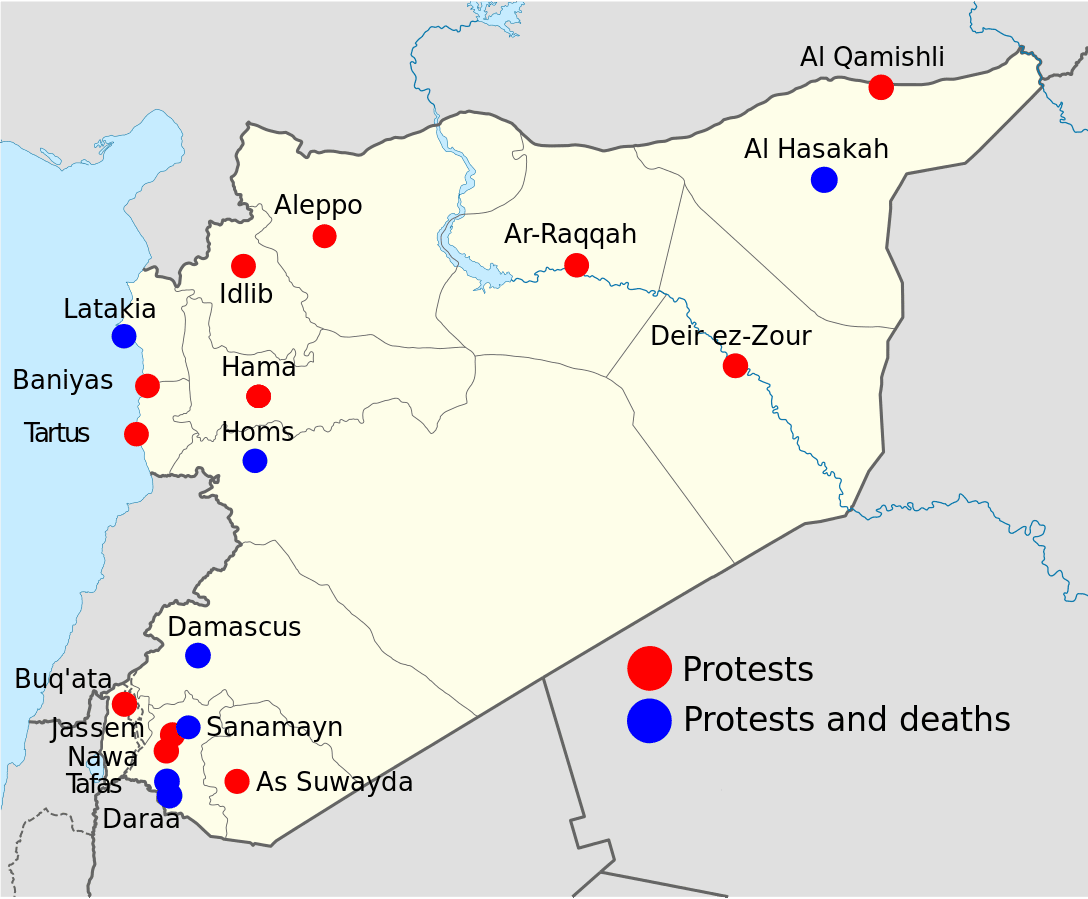
Militants from the Islamic State of Iraq (ISI) were dispatched to Syria from neighboring Iraq starting in late 2010. Starting in March 2011, they began attacking Syrian security forces, police, and soldiers under the cover of anti-government protests. Militants from Fatah al-Islam were dispatched from Lebanon to Syria for the same purpose as early as April 2011. Militants from the Libyan Islamic Fighting Group (LIFG) began fighting in Syria in October 2011, after successfully toppling the Libyan government under the cover of NATO airpower. Additionally, there is evidence that the first protestors killed in Deraa on March 18, 2011 were killed by Salafist militants as part of a false flag attack, rather than by Syrian government security forces, as is commonly assumed.
In this essay, I review U.S. and UK efforts to partner with al-Qaeda affiliated groups to topple the Syrian government, and the role played by such militants in the first weeks and months of the 2011 Syrian conflict.
Regime Change Coming Your Way
U.S. planners have long sought to topple the government of Syrian president Bashar al-Assad. U.S. General Wesley Clark famously revealed that the 2003 U.S. invasion of Iraq was part of a larger plan developed by U.S. Secretary of Defense Donald Rumsfeld’s office “to take out seven countries in five years,” including Iran, Libya, and Syria.
In December 2005, the Wall Street Journal reported that within U.S. government circles, the “Pressure for regime change in Damascus is rising,” and that according to prominent neoconservative and architect of the U.S. invasion of Iraq, Richard Perle, “Assad has never been weaker, and we should take advantage of that.” Perle, a member of the U.S. Defense Policy Board, made his comments in the context of a U.S.-sponsored effort to blame the Syrian government for the assassination of Lebanese Prime Minister Rafiq Hariri.
In March 2006, former Syrian vice president Abd al-Halim Khaddam partnered with Syrian Muslim Brotherhood leader Ali al-Bayanouni to form a new opposition group in exile, the National Salvation Front (NSF). In October 2006, several NSF members met with Michael Doran of the U.S. National Security Council, who was a close associate of prominent neoconservative and Bush administration official Elliott Abrams to discuss the possibility of regime change in Syria. Representatives of the NSF were also given a meeting with Saudi King Abdullah bin Abdul Aziz the same month.
The Wall Street Journal reported that Elliott Abrams warmed to the idea of partnering with the Brotherhood after Iranian-backed Lebanese Hezbollah fought Israel to a standstill in the summer of 2006, which caused Washington to become “increasingly concerned about Syria’s military alliance with Iran, and the threat it posed to U.S. interests in the region.”
Hezbollah’s surprisingly strong performance during the 2006 war, coupled with the rise of Iranian influence in U.S.-occupied Iraq, prompted what journalist Seymour Hersh described as a “redirection” in U.S. policy in the Middle East. This massive shift in policy was led by then Vice President Dick Cheney, Abrams, and Saudi national security advisor and former ambassador to the U.S., Prince Bandar bin Sultan.
The redirection involved working with Washington’s Sunni regional client states “to counteract Shiite ascendance in the region.” As part of this effort, the “Saudi government, with Washington’s approval, would provide funds and logistical aid to weaken the government of President Bashir [sic] Assad, of Syria.” Hersh notes further, “There is evidence that the Administration’s redirection strategy has already benefitted the Brotherhood,” and that according to a former high-ranking CIA officer, Abd al-Halim Khaddam and the NSF were receiving both financial and diplomatic support from the Americans and Saudis. Hersh notes further that Vice President Dick Cheney had been advised by Lebanese politician, Walid Jumblatt, that “if the United States does try to move against Syria, members of the Syrian Muslim Brotherhood would be ‘the ones to talk to.’”
Salafis Throwing Bombs
Hersh details further that the U.S. effort to topple the Syrian government would involve not only the Muslim Brotherhood, but also Salafist militant groups controlled by Saudi intelligence. According to a U.S. government consultant, “Bandar and other Saudis have assured the White House that ‘they will keep a very close eye on the religious fundamentalists. Their message to us was ‘We’ve created this movement, and we can control it.’ It’s not that we don’t want the Salafis to throw bombs; it’s who they throw them at—Hezbollah, Moqtada al-Sadr, Iran, and at the Syrians, if they continue to work with Hezbollah and Iran.”
In December 2006, the Charge d’Affaires of the U.S. embassy in Damascus, William Roebuck, had already acknowledged the possibility of exploiting Salafist militants to promote regime change in Syria. Roebuck wrote that, “We believe Bashar’s weaknesses are in how he chooses to react to looming issues, both perceived and real,” including “the potential threat to the regime from the increasing presence of transiting Islamist extremists. This cable summarizes our assessment of these vulnerabilities and suggests that there may be actions, statements, and signals that the USG can send that will improve the likelihood of such opportunities arising. These proposals will need to be fleshed out and converted into real actions and we need to be ready to move quickly to take advantage of such opportunities. [emphasis mine].”
We Have a Liberal Attitude
One reservoir of al-Qaeda-affiliated militants to be leveraged by U.S. planners was in the northern Lebanese city of Tripoli. Seymour Hersh notes that according to a 2005 International Crisis Group (ICG) report, pro-Saudi Lebanese politician, Saad Hariri (son of the assassinated Prime Minister Rafiq Hariri) had helped release four Salafist militants from prison who had previously trained in al-Qaeda camps in Afghanistan and were arrested in Lebanon while trying to establish an Islamic state in the north of the country. Hariri also used his influence in parliament to obtain amnesty for another 29 Salafist militants, including seven suspected of bombing foreign embassies in Beirut a year prior. Hersh notes as well that according to a senior official in the Lebanese government, “We have a liberal attitude that allows Al Qaeda types to have a presence here.”
Charles Harb of the American University of Beirut similarly observed in May 2007 that Saad Hariri was giving “political cover” to “radical Sunni movements.” Harb explains that to attract Sunni voters in the 2005 national parliamentary elections, Hariri had “pardoned jailed Sunni militants involved in violence in December 2000.” Harb also warned that “Courting radical Sunni sentiment is a dangerous game. Fear of Shia influence in Arab affairs has prompted many Sunni leaders to warn of a ‘Shia crescent’ stretching from Iran, through Iraq, to south Lebanon.” Harb also noted the involvement of Saudi intelligence in cultivating these groups. He explained that “Several reports have highlighted efforts by Saudi officials to strengthen Sunni groups, including radical ones, to face the Shia renaissance across the region. But building up radical Sunni groups to face the Shia challenge can easily backfire.”
Harb was writing in response to the eruption of violence in the Nahr al-Bared Palestinian refugee camp on May 19, 2007. The camp, located in northern Lebanon, had been occupied by militants from the al-Qaeda-affiliated group, Fatah al-Islam. Fighting had erupted between the militants and members of the Lebanese security forces, allegedly after an attempted bank robbery. The fighting left the camp almost entirely flattened and its Palestinian refugee population homeless.
Two months before the outbreak of violence in Nahr al-Bared, the New York Times had interviewed Fatah al-Islam’s leader, Shakir al-Abssi, a former associate of notorious al-Qaeda in Iraq leader Abu Musab al-Zarqawi. The NYT reports that, “Despite being on terrorism watch lists around the world, he has set himself up in a Palestinian refugee camp where, because of Lebanese politics, he is largely shielded from the government.” Major General Achraf Rifi, general director of Lebanon’s Internal Security Forces told the NYT that to enter the camp and detain al-Abssi, “We would need an agreement from other Arab countries.” In other words, al-Abssi was being shielded by Saad Hariri and Saudi intelligence.
America’s Jihadi University
Be seeing you
 MCViewPoint