


What would have happened if Kennedy had lived? The national-security establishment would have immediately become irrelevant and immaterial. They would have been left twiddling their thumbs, with nothing to do. Remember, after all, that the supposed threat from the Russian Reds was why the federal government was converted to a national-security state in the first place. Peaceful coexistence with the communist world would have meant no more justification for a national-security state. The Pentagon, the CIA, and the NSA would have been dismantled and America’s founding system of a limited-government republic would have been restored.
Three days ago — June 10 — was the 60th anniversary of President Kennedy’s Peace Speech at American University. Reading or listening to the speech today, it is not difficult to see why the U.S. national-security establishment deemed Kennedy to be a grave threat to national security, just as it did with certain foreign leaders, such as Prime Minister Mohammad Mossadegh of Iran, Congo leader Patrice Lumumba, Guatemalan President Jacobo Arbenz and, later, President Salvador Allende of Chile.
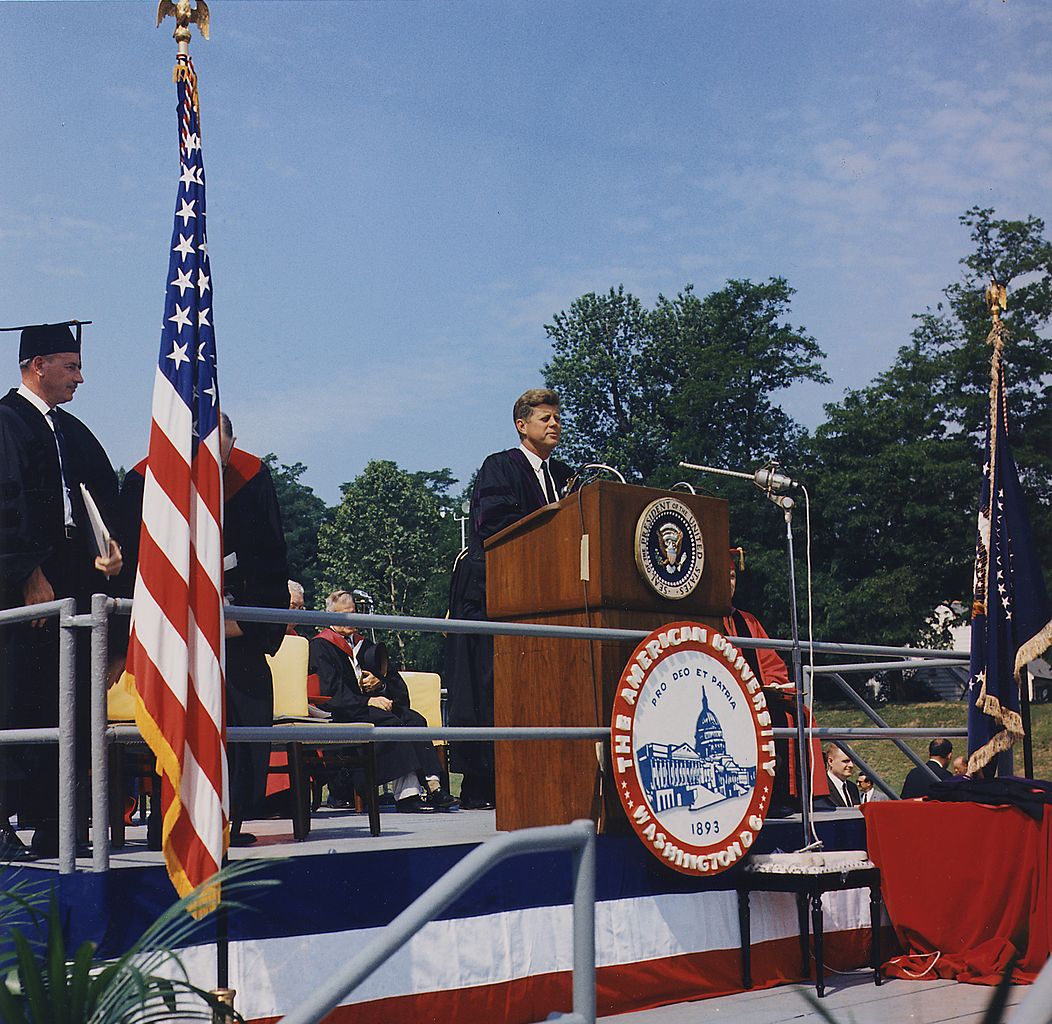
For some 150 years, the federal government had been a limited-government republic. After World War II, however, the federal government was converted to a national-security state.
The difference was day and night.
With a limited-government republic, there was openness and transparency in governmental operations. Moreover, there was only a relatively small, basic military force. No Pentagon, no vast military-industrial complex, no CIA, no NSA, and no empire of foreign military bases. Governmental powers were limited and tightly constrained. No power to assassinate, kidnap, torture, or indefinitely detain people. No power to initiate coups or regime-change operations in foreign countries. No power of mass secret surveillance.
With a national-security state, dark-side secrecy became everything. “National security” became the two most important words in the American political lexicon. A large, permanent military establishment, along with the CIA and the NSA, came into existence. This vast national-security establishment vested itself with omnipotent, totalitarian-like powers, including assassination, torture, coups, secret surveillance, kidnapping, and indefinite detention. It established a vast empire of military bases, both foreign and domestic, and initiated a program of regime change in foreign nations. Foreign wars in faraway lands, such as Korea and Vietnam, became the norm.
The Cold War was actually one great big racket, one that became a cash cow for the vast military-intelligence complex and its ever-growing army of “defense” contractors who loved feeding at the public trough. This enormous racket was justified under the rubric of keeping America safe from a supposed vast communist conspiracy that supposedly was based in Moscow, Russia. Yes, that Russia!
There was no possibility whatsoever of a peaceful resolution of the forever war between the United States and Russia, U.S. oficials said. There could never be peaceful coexistence, they maintained. The war against the Russian Reds, U.S. national-security officials held, was a war to the death. That was why the Joint Chiefs of Staff recommended to Kennedy that the United States initiate a surprise nuclear attack against the Russians, a recommendation that Kennedy indignantly rejected.
Having achieved a “breakthrough” after the Cuban Missile Crisis, Kennedy had decided that he was going to lead America in an entirely different direction from that of the national-security establishment. In his Peace Speech, Kennedy threw down the gauntlet against what had now become his enemy — the national-security establishment. Kennedy essentially declared an end to the Cold War racket and announced that henceforth Russia and the United States would live in peaceful coexistence. He declared an end to to the extreme anti-Russia hostility that the national-security establishment had inculcated in the American people, and he even praised the Soviet Union.
The very next night — June 11 — Kennedy delivered a nation-wide speech expressing support for the civil-rights movement, which the national-security establishment was convinced was controlled by the Russian Reds. That’s why the FBI wiretapped Martin Luther King and used blackmail with the aim of inducing him to commit suicide.
Kennedy then followed up his words with actions.
Be seeing you


 MCViewPoint