MCViewPoint

Opinion from a Libertarian ViewPoint

Posts Tagged ‘NSA’

Is the Government Running a Dragnet on VPN Users?

Posted by M. C. on April 7, 2026

This senator is read into classified surveillance programs. When he says “look here,” we should look.

“So when Wyden asked whether the NSA was collecting data on millions of Americans, he was asking whether the wall between foreign and domestic surveillance, one of the foundational lines in how the American security state is allowed to operate, had quietly been taken down.

“Clapper said, “No, sir.”

Three months later, Edward Snowden’s leaks revealed that the NSA was, in fact, collecting phone metadata on essentially every call placed in the United States. Clapper had lied to Congress under oath

NBTV Media

In March 2013, something interesting happened that almost nobody noticed at the time, but became enormous news three months later.

Senator Ron Wyden was questioning James Clapper, the Director of National Intelligence, in an open hearing of the Senate Intelligence Committee. Wyden asked him a simple question: “Does the NSA collect any type of data at all on millions or hundreds of millions of Americans?”

To understand why this question mattered, you have to understand what the NSA is supposed to be. The National Security Agency is a foreign intelligence agency. Its job is to spy on foreign governments, foreign militaries, and foreign nationals abroad. This kind of work would be flatly unconstitutional if pointed inward. Domestic investigations are supposed to belong to the FBI, which has to play by Fourth Amendment rules and requires warrants, probable cause, and judicial oversight.

The wall between the NSA and FBI exists for a reason: we have built all kinds of powerful tools for foreign surveillance, like bulk collection, warrantless interception, and dragnet monitoring. But the Constitution was written to expressly prohibit the government from turning this machinery of war and broad surveillance powers against its own citizens.

So when Wyden asked whether the NSA was collecting data on millions of Americans, he was asking whether the wall between foreign and domestic surveillance, one of the foundational lines in how the American security state is allowed to operate, had quietly been taken down.

Clapper said, “No, sir.”

Wyden pressed. Clapper added: “Not wittingly.”

Three months later, Edward Snowden’s leaks revealed that the NSA was, in fact, collecting phone metadata on essentially every call placed in the United States. Clapper had lied to Congress under oath. He later apologized for what he called his “clearly erroneous” testimony, claiming he’d given the “least untruthful” answer he could think of. He was never charged; the statute of limitations expired in 2018.

But let’s focus on the most relevant part of this story: Why did Wyden ask the question in the first place?

Wyden already knew the answer

Wyden sits on the Senate Intelligence Committee. It’s one of two committees (the other is in the House) whose members get read in to classified intelligence programs. It’s their job to make sure the intelligence community is operating above board. These committees are small, and the rest of Congress and the public stay in the dark, on a need-to-know basis.

So when Wyden asked Clapper whether the NSA was collecting data on millions of Americans, Wyden already knew the answer was yes. He’d been briefed. And when Clapper said “no,” Wyden knew, in real time, that the Director of National Intelligence was lying to Congress.

But Wyden couldn’t just stand up and tell the country what he knew. He was bound by classification rules. Asking the question in open session, with the answer pre-submitted to Clapper’s office a day in advance, was one of the only tools he had to let Congress know that he believed the intelligence community was running an illegal program.

He turned out to be right. In 2015, the Second Circuit ruled in ACLU v. Clapper that the NSA’s bulk phone records program exceeded what Congress had authorized under the Patriot Act. In 2020, the Ninth Circuit went further, holding that the program had violated federal surveillance law and was likely unconstitutional as well.

In fact, the 2015 court was pointed about why this mattered.

Congress, the judges wrote, “cannot reasonably be said to have ratified a program of which many members of Congress — and all members of the public — were not aware.”

Only a small circle of lawmakers on the intelligence committees knew. The rest of Congress, voting to reauthorize the Patriot Act, did not. Neither did the public. You cannot meaningfully consent to a program whose existence has been deliberately hidden from you.

But back to Wyden’s question: It’s a pattern worth remembering.

When Senator Wyden goes out of his way to ask a pointed question about a surveillance program, it’s usually because he already knows something he can’t say out loud.
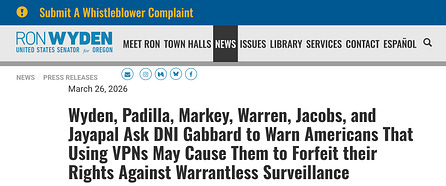
Wyden: “Pay Attention To VPNs”

Which brings us to last week.

On March 26, 2026, Wyden (along with a handful of other Senators) sent a letter to the current Director of National Intelligence, Tulsi Gabbard. The letter asks Gabbard to publicly warn Americans that using a VPN may cause them to forfeit their Fourth Amendment rights against warrantless surveillance.

The mechanism is explained in Wyden’s press release: Under Section 702 of FISA and Executive Order 12333, when the U.S. government can’t tell what country a person is in, it’s allowed to assume that person is a foreigner. Foreigners outside the United States have no Fourth Amendment rights, and a VPN hides where you are.

So while these tools are used as a privacy protection, the intelligence community might be quietly stripping you of constitutional protections against your own government.

We don’t know exactly what Wyden has been briefed on. But the pattern from 2013 is clear: when he asks a pointed question in public, it’s usually because of something he can’t say out loud.

And then there’s the third-party doctrine

This Section 702 loophole is bad enough on its own. But there’s a second legal mechanism worth raising.

Under the third-party doctrine, U.S. law enforcement currently takes the position that it doesn’t need a warrant to obtain information you’ve voluntarily handed to a third party, such as your bank, your phone company, and your ISP. The doctrine traces back to the Katz “reasonable expectation of privacy” test: the Fourth Amendment kicks in only where you have a reasonable expectation of privacy, and the government’s argument is that once you’ve given data to someone else, that expectation disappears.

Now apply that to a VPN. A VPN routes 100% of your internet traffic through a third party. Under the government’s theory, that traffic is fair game without a warrant.

Which produces a genuinely absurd result: the legal system says you have no reasonable expectation of privacy in data you handed to a service whose entire purpose is privacy. The tool you bought specifically to assert a privacy interest is recharacterized as the act of waiving it.

In Carpenter v. United States (2018), the Supreme Court carved an exception into the third-party doctrine, holding that the government does need a warrant to obtain historical cell-site location data, on the theory that some kinds of third-party data are too revealing to fall under the old rule. VPN traffic seems like an even stronger candidate. It might be time for someone who uses a VPN to sue the government.

Ludlow Institute’s NBTV Newsletter is funded by community support. Consider becoming a free or paid subscriber.

Upgrade to paid

What Now?

So should we, or should we not, be using a VPN? The honest answer is that there’s no clean solution, because the problem isn’t really VPNs. The problem is that the entire modern internet is built on handing your data to third parties, such as your ISP, your DNS resolver, your email provider, the ad networks embedded in every website you visit, and so on. And the third-party doctrine turns every one of those interactions into a warrantless surveillance opportunity. A VPN just shifts which third party holds your traffic, it doesn’t change the underlying legal theory that says the government can help itself to it without a warrant.

That said, I still use a VPN, and I’m going to keep using one. I don’t want my IP address handed to every website I interact with, and the protection a VPN offers against that is real, even if it’s narrower than the marketing suggests. But it’s really important to be careful about which one. As I covered in a previous video, an overwhelming number of VPN providers are just data-collection shells, and some are outright malware. “Use a VPN” isn’t the advice. “Use a VPN you’ve actually vetted” is closer.

Longer term, it’s time to explore the tools that can’t aggregate your data in the first place. I’ve been digging into decentralized VPNs and mixnets lately, and if you’ve used any, I’d love to hear about your experience.

But the deeper fix is actually legal: The third-party doctrine is a relic of a world where “data you gave to someone else” meant a very narrow scope of information. It does not belong in a digital age that turns everything we do into data held by someone else.

As long as the third-party doctrine stands, we lose one of the most important protections we have against the government’s ability to surveil its own citizens: the warrant requirement. It’s a loophole the size of the entire internet. Closing that loophole is how we get the Fourth Amendment back.

Yours In Privacy,
Naomi

Consider supporting our nonprofit so that we can fund more research into the surveillance baked into our everyday tech. We want to educate as many people as possible about what’s going on, and help write a better future. Visit LudlowInstitute.org/donate to set up a monthly, tax-deductible donation.
Posted in Uncategorized | Tagged: , , , , | Leave a Comment »

No One Is Coming to Get Us

Posted by M. C. on November 2, 2024

In a national-security state, fear is the coin of the realm.

Today, it is safe to say that while Americans live under the most powerful government in history, they are also among the most frightened people in the world. That’s not a coincidence. The bigger and more powerful the government, the smaller and more frightened the citizenry.

by Jacob G. Hornberger

In a national-security state, fear is the coin of the realm. The United States is no exception. In order to justify its continued existence and its ever-growing power and tax-funded largess, the U.S. national-security establishment — i.e., the Pentagon, the CIA, and the NSA — must keep the American people afraid, tense, agitated, and nervous. That necessarily means presenting us with a constant array of official “enemies,” “adversaries,” “competitors,” or “opponents” who are coming to get us.

The Cold War racket was a perfect demonstration of this phenomenon. For 44 years, Americans were inculcated with the mindset that the Reds were coming to get us, especially the Russian Reds. As the title of a popular Cold War movie put it, “The Russians Are Coming! The Russians Are Coming!” Most every American citizen was made to be deathly afraid of the Russians.

Licensed under the Creative Commons Attribution 2.0 Generic license.

But the Russian Reds were not the only ones who were supposedly coming to get us. There was also the Chinese Reds, the North Korean Reds, the North Vietnamese and Vietcong Reds, the Cuban Reds, the Nicaraguan Reds, the Guatemalan Reds, the Iranian Reds, the Chilean Reds, and other Reds.

There were also the internal Reds who were already here. The civil-rights Reds, including Martin Luther King, the Reds in the Army, the Reds in Congress, and the Reds in Hollywood, including Dalton Trumbo. Some even suggested that President Eisenhower was a Red.

Let’s face it — the Reds were everywhere, even under our beds. And they were all coming to get us.

And then suddenly and unexpectedly, the Cold War ended in 1989. Those dastardly Russians! How dare them to put an end to the fear racket that had proven so lucrative to the U.S. national-security establishment and its ever-growing army of “defense” contractors.

No problem. Just come up with a new official enemy who is coming to get us. For the next 11 years, the daily mantra became “Saddam! Saddam! Saddam!” Iraqi ruler Saddam Hussein, who was billed as the “new Hitler,” and who, Ironically, had been a loyal U.S. partner during the 1980s, was now coming to get us. Through the power of indoctrination and propaganda, Americans were made to transfer their fear of the Reds to their fear of Saddam Hussein. Saddam was now coming to get us — and with his supposed weapons of mass destruction.

At the same time, knowing that people in the Middle East would ultimately retaliate, the U.S. national-security state went on a massive killing spree in the Middle East, not only with its war on Iraq but also with its deadly system of economic sanctions against the Iraqi people, which were killing multitudes of children.

The predictable retaliation came in the form of terrorist attacks, such as the bombing of the USS Cole, the bombings of U.S. Embassies in East Africa, the killings of CIA officials in Virginia, and others. And then the big ones came — the  9/11 attacks on the World Trade Center and the Pentagon.

The U.S. national-security state was off to the races again,

See the rest here

Be seeing you

Posted in Uncategorized | Tagged: , , , , | Leave a Comment »

The Worries of a Retiring NSA Chief

Posted by M. C. on February 15, 2024

by Jacob G. Hornberger

Fear (and worry) is the coin of the realm in every national security state. The more people are afraid, the more they will look to the national-security establishment to keep them safe. That ensures the continued existence of the national-security establishment as well as ever-increasing taxpayer-funded largess.

Gen. Paul M. Nakasone, who recently retired as director of the National Security Agency, is worried. He’s worried about terrorism, drug cartels, Russia, China, hackers, spies, and other scary things. His many worries are detailed in an op-ed he has in the Washington Post today entitled, “What Worries Me Most After Five Years as Leader of the NSA.”

Surprisingly, for some unknown reason, Nakasone expressed no worry whatsoever about the “invasion” of illegal immigrants on our southern border. Wouldn’t you think that a career military man and the head of the NSA would be worried about an ongoing “invasion” of our nation? Sounds like a grave case of military malpractice to me.

Nakasone’s role as a military general helps to remind us of the gigantic military-intelligence establishment that controls our country. It’s easy to view the Pentagon, the CIA, and the NSA as three separate and distinct entities. In actuality, they are three parts of an overall entity known as the national-security establishment. It is one gigantic military-intelligence entity that is simply divided into three parts — the Pentagon, the CIA, and the NSA.

Longtime readers of my work know that I have long recommended a book entitled National Security and Double Government by Michael J. Glennon, who is a professor of law at Tufts University and former legal counsel to the Senate Foreign Relations Committee. Glennon’s thesis, to which I subscribe, is an ominous one: The national-security establishment — not the president, Congress, or Supreme Court — runs the federal government, especially when it comes to foreign affairs.

The federal government was not always a national-security state. For more than 150 years, Americans lived under a type of governmental structure known as a limited-government republic.

The difference between a limited-government republic and a national-security state is day and night. The powers of a limited-government republic are limited to those enumerated in the Constitution and are also restricted by the Bill of Rights. The powers of a national-security state are omnipotent and unrestricted by anything, including the powers of torture, assassination, and indefinite detention, not to mention coups, invasions, occupations, and wars of aggression.

Fear (and worry) is the coin of the realm in every national security state. The more people are afraid, the more they will look to the national-security establishment to keep them safe. That ensures the continued existence of the national-security establishment as well as ever-increasing taxpayer-funded largess.

See the rest here

Be seeing you

Posted in Uncategorized | Tagged: , , , , | Leave a Comment »

Why They Hated Kennedy, and Why They Killed Him

Posted by M. C. on December 21, 2023

by Jacob G. Hornberger

Equally important, the Cold War brought ever-increasing taxpayer-funded largess flowing into the coffers of the “defense” industry, along with the ever-increasing power and influence of the Pentagon, the CIA, and the NSA within the overall federal structure.

After the Cuban Missile Crisis, Kennedy achieved a breakthrough, one that threatened not only the ever-increasing power, money, and influence of the national-security branch, but also its very existence. Kennedy came to realize that the Cold War was just one great big racket — and a highly dangerous one at that.

While the decision to eliminate President Kennedy undoubtedly took place after his resolution of the Cuban Missile Crisis, it was without a doubt solidified when Kennedy ambushed his enemies within the U.S. national-security establishment with his Peace Speech at American University on June 10, 1963. With his Peace Speech, JFK was upsetting the Cold War apple cart that the Pentagon and the CIA were convinced would last forever. 

What was so significant about that speech?

After the end of World War II, the U.S. government was converted from its founding system of a limited-government republic to a governmental structure called a national-security state. The justification for this radical change, which was accomplished without even the semblance of a constitutional amendment, was that the United States now faced an enemy that was said to be even more threatening than Nazi Germany. That new enemy was “godless communism” as well as a supposed international communist conspiracy to take over the United States and the rest of the world — a conspiracy that was supposedly based in Moscow, Russia — yes, that Russia!

With the conversion to a national-security state, the U.S. government acquired many of the same totalitarian powers that were being wielded by the totalitarian communist states, such as the Soviet Union and Red China — powers that had been prohibited when the government was a limited-government republic. Such powers included state-sponsored assassinations, torture, kidnapping, indefinite detention, and coups.

Equally important, the Cold War brought ever-increasing taxpayer-funded largess flowing into the coffers of the “defense” industry, along with the ever-increasing power and influence of the Pentagon, the CIA, and the NSA within the overall federal structure. Over time, the national-security branch of the federal government would become the most powerful branch, the one to which the other three would inevitably defer. 

After the Cuban Missile Crisis, Kennedy achieved a breakthrough, one that threatened not only the ever-increasing power, money, and influence of the national-security branch, but also its very existence. Kennedy came to realize that the Cold War was just one great big racket — and a highly dangerous one at that.

That danger was manifested during the Cuban Missile Crisis. U.S. officials and their loyalists in the mainstream press have always maintained that the crisis was brought on by the Soviet Union and Cuba. Not so! It was brought on by the Pentagon and the CIA. It was those two entities that brought the world to within an inch of all-out nuclear war. 

The Soviets and the Cubans knew that the Pentagon and the CIA wanted to invade Cuba and effect a regime-change operation there, one that would oust Cuban leader Fidel Castro from power and replace him with another pro-U.S. dictator, similar to Fulgencio Batista, the corrupt pro-U.S. brute that ruled Cuba before the revolutionaries ousted him in 1959.

That was why the Soviets installed those nuclear missiles in Cuba — to deter U.S. officials from attacking or, if deterrence failed, to enable Soviet and Cuban forces to defend themselves from a U.S. attack.

See the rest here

Be seeing you

Posted in Uncategorized | Tagged: , , , , , | Leave a Comment »

Husband Reaches Out To NSA To See If They Know What His Wife Wants For Christmas

Posted by M. C. on December 10, 2023

https://babylonbee.com/news/husband-reaches-out-to-nsa-to-see-if-they-know-what-his-wife-wants-for-christmas

Article Image

FAYETTEVILLE, AR — As the December days began to tick away, a local man grew so desperate in his attempt to buy his wife a great Christmas gift that he decided to reach out to the National Security Agency to find out what she wants.

“I figured it’s my best shot,” said Willard McBane. “She’s always so difficult to buy for, and she doesn’t ever give me any hints, so I knew I needed to bring the NSA in on this one.”

At first, Willard’s attempts to ask for help were subtle. “I just started speaking out loud whenever I was around my phone or near our Amazon Alexa,” he said. “I’d just wonder aloud to myself ‘Gee, I wonder what Margaret wants for Christmas this year.’ It didn’t seem to yield any results, so I decided I needed to contact the NSA directly.”

A spokesman for the NSA acknowledged that the agency began receiving phone calls and emails from McBane last week. “Yes, I can confirm that we were contacted by a Mr. Willard McBane,” said Agent Dan Henry. “I am not at liberty to divulge the details of our conversations with Mr. McBane at this time, nor am I able to confirm whether or not we advised him that his wife would really love a 64-ounce Stanley Quencher insulated tumbler with a straw, preferably in the Rose Quartz Glow color.”

At publishing time, Willard had reportedly received the information he was seeking and had also advised the NSA that he would appreciate it if they would somehow get word to Margaret that he would prefer it if she stopped putting green peppers in her chili.

Bee seeing you

Posted in Uncategorized | Tagged: , , | Leave a Comment »

Fighting the Surveillance State Begins with the Individual | Mises Wire

Posted by M. C. on October 26, 2023

It’s a simple fact of life that when the government is given a power—whether that be to regulate, surveil, tax, or plunder—it is nigh impossible to wrestle it away from the state outside somehow disposing of the state entirely. This is why the issue of undoing mass surveillance is of the utmost importance. If the government has the power to spy on its populace, it will.

https://mises.org/wire/fighting-surveillance-state-begins-individual

Joseph Lawrence

It’s a well-known fact at this point that in the United States and most of the so-called free countries that there is a robust surveillance state in place, collecting data on the entire populace. This has been proven beyond a shadow of a doubt by people like Edward Snowden, a National Security Agency (NSA) whistleblower who exposed that the NSA was conducting mass surveillance on US citizens and the world as a whole.

The NSA used applications like those from Prism Systems to piggyback on corporations and the data collection their users had agreed to in the terms of service. Google would scan all emails sent to a Gmail address to use for personalized advertising. The government then went to these companies and demanded the data, and this is what makes the surveillance state so interesting. Neo-Marxists like Shoshana Zuboff have dubbed this “surveillance capitalism.”

In China, the mass surveillance is conducted at a loss. Setting up closed-circuit television cameras and hiring government workers to be a mandatory editorial staff for blogs and social media can get quite expensive. But if you parasitically leech off a profitable business practice it means that the surveillance state will turn a profit, which is a great asset and an even greater weakness for the system.

You see, when that is what your surveillance state is predicated on you’ve effectively given your subjects an opt-out button. They stop using services that spy on them. There is software and online services that are called “open source,” which refers to software whose code is publicly available and can be viewed by anyone so that you can see exactly what that software does. The opposite of this, and what you’re likely already familiar with, is proprietary software. Open-source software generally markets itself as privacy respecting and doesn’t participate in data collection. Services like that can really undo the tricky situation we’ve found ourselves in.

It’s a simple fact of life that when the government is given a power—whether that be to regulate, surveil, tax, or plunder—it is nigh impossible to wrestle it away from the state outside somehow disposing of the state entirely. This is why the issue of undoing mass surveillance is of the utmost importance. If the government has the power to spy on its populace, it will.

See the rest here

Be seeing you

Posted in Uncategorized | Tagged: , , , | Leave a Comment »

The Welfare-Warfare State’s War on Income and Savings

Posted by M. C. on October 6, 2023

Welcome to the welfare-warfare state way of life, which plunders and loots people’s income to fund the ever-increasing expenditures of welfare-state programs and the warfare-state programs of the Pentagon, the CIA, and the NSA.Welcome to the welfare-warfare state way of life, which plunders and loots people’s income to fund the ever-increasing expenditures of welfare-state programs and the warfare-state programs of the Pentagon, the CIA, and the NSA.

Our American ancestors, of course, refused to make that trade. They didn’t want the government to take care of them. They wanted to take care of themselves, with their own money and on a purely voluntary, charitable basis. They also knew that a national-security state (or what they termed “standing armies”) would inevitably embroil them in endless wars and crises that would mean even higher taxes (and lower savings).

by Jacob G. Hornberger

NOTICE: TONIGHT, Thursday, October 5, at 7 p.m. Eastern. Benjamin Power is our first presenter in our upcoming online Austrian conference: “How Austrian Economics Impacted My Life.” Register here to receive your Zoom link for an intellectually fun and enlightening session!

*****

According to an article at CNBC.com, 60% of adults said they are living paycheck to paycheck. According to an article at Forbes.com, about a third of Americans were unable to save any money in the past year. According to an article at Yahoo! Finance, while financial advisors recommend savings of $1 million to $2 million for retirees, the average 70-year-old has only around $426,000 in savings. On top of that, consider how much the value of people’s money is debased each decade through the inflationary policies of the Federal Reserve.

Welcome to the welfare-warfare state way of life, which plunders and loots people’s income to fund the ever-increasing expenditures of welfare-state programs and the warfare-state programs of the Pentagon, the CIA, and the NSA.

If we think back to America’s founding principles with respect to income, wealth, welfare, and warfare, we find that our American ancestors chose a totally different way of life than today’s Americans have chosen.

Consider, for example, 1890 Americans. They lived without an income tax and an IRS to enforce it. Just think about that: People were free to keep 100 percent of their income, and there was nothing the government could do about it. Imagine if you were free to keep everything you earned. Imagine if that had been case during your entire work life. 

When Americans were free to accumulate unlimited amounts of wealth, they obviously were able to save a larger percentage of their income. Would’t you be saving more money if suddenly you no longer had to pay any income taxes whatsoever?

See the rest here

Be seeing you

Posted in Uncategorized | Tagged: , , , , | Leave a Comment »

Why JFK Was Deemed a Threat to National Security

Posted by M. C. on June 14, 2023

What would have happened if Kennedy had lived? The national-security establishment would have immediately become irrelevant and immaterial. They would have been left twiddling their thumbs, with nothing to do. Remember, after all, that the supposed threat from the Russian Reds was why the federal government was converted to a national-security state in the first place. Peaceful coexistence with the communist world would have meant no more justification for a national-security state. The Pentagon, the CIA, and the NSA would have been dismantled and America’s founding system of a limited-government republic would have been restored.

by Jacob G. Hornberger

Three days ago — June 10 — was the 60th anniversary of President Kennedy’s Peace Speech at American University. Reading or listening to the speech today, it is not difficult to see why the U.S. national-security establishment deemed Kennedy to be a grave threat to national security, just as it did with certain foreign leaders, such as Prime Minister Mohammad Mossadegh of Iran, Congo leader Patrice Lumumba, Guatemalan President Jacobo Arbenz and, later, President Salvador Allende of Chile. 

For some 150 years, the federal government had been a limited-government republic. After World War II, however, the federal government was converted to a national-security state. 

The difference was day and night.

With a limited-government republic, there was openness and transparency in governmental operations. Moreover, there was only a relatively small, basic military force. No Pentagon, no vast military-industrial complex, no CIA, no NSA, and no empire of foreign military bases. Governmental powers were limited and tightly constrained. No power to assassinate, kidnap, torture, or indefinitely detain people. No power to initiate coups or regime-change operations in foreign countries. No power of mass secret surveillance. 

With a national-security state, dark-side secrecy became everything. “National security” became the two most important words in the American political lexicon. A large, permanent military establishment, along with the CIA and the NSA, came into existence. This vast national-security establishment vested itself with omnipotent, totalitarian-like powers, including assassination, torture, coups, secret surveillance, kidnapping, and indefinite detention. It established a vast empire of military bases, both foreign and domestic, and initiated a program of regime change in foreign nations. Foreign wars in faraway lands, such as Korea and Vietnam, became the norm.

The Cold War was actually one great big racket, one that became a cash cow for the vast military-intelligence complex and its ever-growing army of “defense” contractors who loved feeding at the public trough. This enormous racket was justified under the rubric of keeping America safe from a supposed vast communist conspiracy that supposedly was based in Moscow, Russia. Yes, that Russia!

There was no possibility whatsoever of a peaceful resolution of the forever war between the United States and Russia, U.S. oficials said. There could never be peaceful coexistence, they maintained. The war against the Russian Reds, U.S. national-security officials held, was a war to the death. That was why the Joint Chiefs of Staff recommended to Kennedy that the United States initiate a surprise nuclear attack against the Russians, a recommendation that Kennedy indignantly rejected.

Having achieved a “breakthrough” after the Cuban Missile Crisis, Kennedy had decided that he was going to lead America in an entirely different direction from that of the national-security establishment. In his Peace Speech, Kennedy threw down the gauntlet against what had now become his enemy — the national-security establishment. Kennedy essentially declared an end to the Cold War racket and announced that henceforth Russia and the United States would live in peaceful coexistence. He declared an end to to the extreme anti-Russia hostility that the national-security establishment had inculcated in the American people, and he even praised the Soviet Union.

The very next night — June 11 — Kennedy delivered a nation-wide speech expressing support for the civil-rights movement, which the national-security establishment was convinced was controlled by the Russian Reds. That’s why the FBI wiretapped Martin Luther King and used blackmail with the aim of inducing him to commit suicide.

Kennedy then followed up his words with actions.

See the rest here

Be seeing you

Posted in Uncategorized | Tagged: , , , , , | Leave a Comment »

EXPOSED: Biggest FBI Spy Scandal of the Year

Posted by M. C. on May 31, 2023

But will Congress finally stop the federal spying spree on Americans? As I tweeted on December 27, 2012, “FISA Renewal: Only a fool would expect members of Congress to give a damn about his rights and liberties.” Without radical reform, FISA should be renamed the “Trust Me, Chumps!” Surveillance Act.

https://libertarianinstitute.org/articles/exposed-biggest-fbi-spy-scandal-of-the-year/

by Jim Bovard

jpb photo mass anti spying demonstration dsc 0867 scaled

A Foreign Intelligence Surveillance Court opinion released last week revealed that the FBI violated the constitutional rights of 278,000 Americans in 2020 and 2021 with warrantless searches of their email and other electronic data. For each American that the FISA court permitted the FBI to target, the FBI illicitly surveiled almost a thousand additional Americans. This is only the latest federal surveillance scandal stretching back to the years after 9/11.

The FISA law was enacted in 1978 to curb the rampant illegal political spying exposed during the Richard Nixon administration. After the 9/11 attacks, the George W. Bush administration decided that the president was entitled to order the National Security Agency to vacuum up Americans’ emails and other data without a warrant. After The New York Times exposed the surveillance scheme in late 2005, Attorney General Alberto Gonzales announced that “the president has the inherent authority under the Constitution, as commander in chief, to engage in this kind of activity.” Gonzales apparently forgot the congressional impeachment proceedings against President Nixon. The Bush White House also asserted that the September 2001 “Authorization to Use Military Force” resolution Congress passed entitled Bush to tap Americans’ phones. But if the authorization actually allowed the president to do whatever he thinks necessary on the homefront, Americans had been living under martial law.

Federal judges disagreed with Bush’s prerogative to obliterate American privacy. The result was a 2008 FISA reform that authorized the feds to continue commandeering vast amounts of data. But under Section 702 of that law, the FBI was permitted to conduct warrantless searches of that stash for Americans’ data only to seek foreign intelligence information or evidence of crime.   

President Barack Obama responded to the new law by sharply expanding the NSA’s seizures of Americans’ personal data. The Washington Post characterized Obama’s first term as “a period of exponential growth for the NSA’s domestic collection.” Obama’s Justice Department thwarted court challenges to the surveillance, thereby permitting the White House to claim that it was respecting Americans’ rights and privacy.

Edward Snowden blew the roof off the surveillance state with his disclosures starting in June 2013. But there was no reason to presume that federal crime sprees were not occurring before Snowden blew the whistle. Professor David Rothkopf explained in 2013 how FISA’s Section 702 worked:

“What if government officials came to your home and said that they would collect all of your papers and hold onto them for safe-keeping, just in case they needed them in the future. But don’t worry…they wouldn’t open the boxes until they had a secret government court order…sometime, unbeknownst to you.”

The 2008 FISA amendments and Section 702 snared vast numbers of hapless Americans in federal surveillance nets. The Washington Post analyzed a cache of 160,000 secret email conversations/threads (provided by Snowden) that the NSA intercepted and found that nine out of ten account holders were not the “intended surveillance targets but were caught in a net the agency had cast for somebody else.” Almost half of the individuals whose personal data was inadvertently commandeered were U.S. citizens. The files “tell stories of love and heartbreak, illicit sexual liaisons, mental-health crises, political and religious conversions, financial anxieties and  disappointed hopes,” the Post noted. If an American citizen wrote an email in a foreign language, NSA analysts assumed they were foreigners who could be surveilled without a warrant.

Snowden also leaked secret court rulings that proved that the FISA Court had “created a secret body of law giving the National Security Agency the power to amass vast collections of data on Americans,” The New York Times reported in 2013. FISA judges rubberstamped massive seizures of Americans’ personal data that flagrantly contradicted Supreme Court rulings on the Fourth Amendment. The Times noted that the FISA court had “become almost a parallel Supreme Court, serving as the ultimate arbiter on surveillance issues,” and almost always giving federal agencies all the power they sought.

See the rest here

Be seeing you

Posted in Uncategorized | Tagged: , , , , , | Leave a Comment »

The FBI and Personal Liberty – LewRockwell

Posted by M. C. on January 19, 2023

The FBI admission that it uses the CIA and the NSA to spy for it came in the form of a 906-page FBI rulebook written during the Trump administration, disseminated to federal agents in 2021 and made known to Congress last week.

Needless to say, the CIA and the NSA cannot be pleased. The CIA charter prohibits its employees from engaging in domestic surveillance and law enforcement. Yet, we know the CIA is present physically or virtually in all of the 50 U.S. statehouses.

https://www.lewrockwell.com/2023/01/andrew-p-napolitano/the-fbi-and-personal-liberty/

By Andrew P. Napolitano

Among the lesser-known holes in the Constitution cut by the Patriot Act of 2001 was the destruction of the “wall” between federal law enforcement and federal spies. The wall was erected in the Foreign Intelligence Surveillance Act of 1978, which statutorily limited all federal domestic spying to that which was authorized by the Foreign Intelligence Surveillance Court.

The wall was intended to prevent law enforcement from accessing and using data gathered by America’s domestic spying agencies.

Those of us who monitor the government’s destruction of personal liberties have been warning for a generation that government spying is rampant in the U.S., and the feds regularly engage in it as part of law enforcement’s well-known antipathy to the Fourth Amendment. Last week, the FBI admitted as much.

Here is the backstory.

After President Richard Nixon resigned the presidency, Congress investigated his abuse of the FBI and CIA as domestic spying agencies. Some of the spying was on political dissenters and some on political opponents. None of it was lawful.

What is lawful spying? The modern Supreme Court has made it clear that domestic spying is a “search” and the acquisition of data from a search is a “seizure” within the meaning of the Fourth Amendment. That amendment requires a warrant issued by a judge based on probable cause of crime presented under oath to the judge for a search or seizure to be lawful. The amendment also requires that all search warrants specifically describe the place to be searched and the person or thing to be seized.

The language in the Fourth Amendment is the most precise in the Constitution because of the colonial disgust with British general warrants. A general warrant was issued to British agents by a secret court in London. General warrants did not require probable cause, only “governmental needs.” That, of course, was no standard whatsoever, as whatever the government wants it will claim that it needs.

General warrants, as well, did not specify what was to be searched or seized. Rather, they authorized government agents to search wherever they wished and to seize whatever they found; stated differently, to engage in fishing expeditions.

When Congress learned of Nixon’s excesses, it enacted FISA, which required that all domestic spying be authorized by the new and secret FISA Court. Congress then lowered the probable cause of crime standard for the FISA Court to probable cause of being a foreign agent, and it permitted the FISA Court to issue general warrants.

How can Congress, which is itself a creature of the Constitution, change standards established by the Constitution? Answer: It cannot legally or constitutionally do so. But it did so nevertheless.

Yet, the FISA compromise that was engineered in order to attract congressional votes was the wall. The wall consisted of regulatory language reflecting that whatever data was acquired from surveillance conducted pursuant to a FISA warrant could not be shared with law enforcement.

So, if a janitor in the Russian embassy was really a KGB agent who was distributing illegal drugs as lures to get Americans to spy for him, and all this was learned via a FISA warrant that authorized listening to phone calls from the embassy, the telephonic evidence of his drug dealing could not be given to the FBI.

The purpose of the wall was not to protect foreign agents from domestic criminal prosecutions; it was to prevent American law enforcement from violating personal privacy by spying on Americans without search warrants.

See the rest here

Be seeing you

Posted in Uncategorized | Tagged: , , , , , | Leave a Comment »