However, the IS has largely been eradicated in Syria by Bashar al-Assad along with his Shia, Iranian and Russian allies. Washington has since admitted it keeps its forces in Syria to steal resources and diminish Iranian influence in the Middle East. The policy of occupying eastern Syria has prolonged the war in the Middle East nation, intensifying the suffering of the Syrian people.
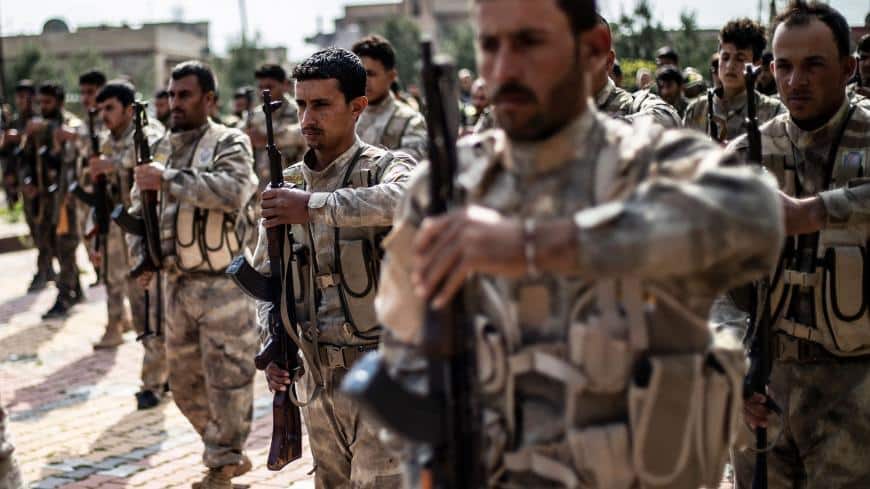
Over thirty people were killed in a battle between the Syrian Democratic Forces (SDF) and the Deir el-Zour Military Council (DEMC). Both the SDF and DEMC are supported by the US.
Fighting erupted between the two groups when the SDF captured the leader of the DEMC, Abu Khawla, during a meeting on Sunday. In total 32 people, including three civilians, were killed amid the clashes. Sources now report that fighting between the SDF and DEMC has ceased as Khawla has agreed to step down as the group’s leader.
On Wednesday, the SDF claimed Khawla’s detention is due to committing “multiple crimes,” including drug trafficking, and “coordination with external entities hostile to the revolution.” The statement suggests the SDF was unhappy with Khawla’s outreach to the Syrian government.
Worse, Washington’s boorish behavior is alienating countries whose support the United States may want or need with respect to other issues. The recent episodes provide further evidence of the administration’s intellectual bankruptcy regarding foreign affairs.
U.S. leaders rarely have been noted for being able to gauge changing sentiment in the international arena and adjusting their foreign policy accordingly. The Biden administration, however, may be setting new records for the tone-deaf quality of its policies. Three incidents in the past few weeks illustrate the problem.
There has been obvious movement in recent months on the part of leading Arab powers to temper their feud with Syrian leader Bashar al-Assad. Only a few years ago, Saudi Arabia, the United Arab Emirates, and other countries were in a partnership with Turkey and the United States to unseat Assad – largely because of his close alliance with Iran. Now, those same powers have changed course dramatically, seeking a rapprochement with both Damascus and Tehran. Important signals of the new political environment were Saudi Arabia’s restoration of diplomatic relations with Iran and Syria’s re-entry to the Arab League.
Instead of going along with the new diplomatic and geopolitical realities in the region, the Biden administration chose this moment to escalate its increasingly futile attempts to isolate Assad. On May 30, Washington imposed new economic sanctions on Syria. As Dave DeCamp noted, the businesses were targeted using the Caesar Act, a law the US has used to impose sanctions on Syria that are specifically designed to prevent the country’s reconstruction.” One could scarcely imagine a more ill-timed move, given the powerful, contrary diplomatic trends in the region.
We should therefore remember that it was US planners, with help from their regional allies, that first “pulled the trigger” in what became a ten-year imperialist dirty war on Syria that has claimed hundreds of thousands of lives, destroyed large segments of the country, created millions of refugees and internally displaced persons, and led to untold human suffering.
“I have been a refugee for 37 years due to my political engagement against the ruling Baath party. I cannot go back to Syria without being punished. But I see what the western countries, Turkey, and the Gulf states are now trying to do to my country. It has nothing to do with human rights or democracy. They want to divide the country and get rid of an opponent to the US´ plans for the region.”- Saliba Mourad
Introduction
Since the beginning of the Syrian crisis, President Bashar al-Assad has claimed that Syria was the victim of a plot by Western imperialist powers seeking to effect regime in the country. Such a view has been widely ridiculed by opponents of the Syrian government, who argue that US and allied intelligence agencies played no role in sparking the anti-government protests that erupted in Syria in March 2011 as part of the so-called Arab Spring. Instead, as described by the New York Times, “Syrians, like other peoples across the region, rose up peacefully against their authoritarian government. Mr. Assad cracked down violently. Communities took up arms to defend themselves, then fought back in what became a civil war. Some soldiers joined the rebels, but not enough to win.”
According to this view, those pointing to the role of US and allied intelligence agencies in sparking the protests are conspiracy theorists who deny the agency of Syrians to determine their own fate. For example, pro-opposition activists and authors Robbin Yassin-Kassab and Leila al-Shami argue that considering the role of US and allied intelligence agencies in sparking the protests necessarily “leads some ever deeper into conspiracism. For such people, not only the Syrian revolution but the whole Arab Spring was a foreign plot, the English-language slogans at Kafranbel are proof of a CIA presence,” while efforts to blame the conflict on the Western imperialist powers, “remove the agency of the peoples concerned,” casting Syrians, “as innocents pleased to suffer poverty, torture and humiliation until some devilishly clever Westerner whispers in their ears.”
Such a view suggests further that if the Western powers deserve any blame, it is not for manufacturing the conflict in Syria, but for their supposed inaction and refusal to intervene in the war against the Syrian government and on behalf of the Syrian people.
However, as I have shown elsewhere, claims of US inaction in the Syrian conflict that erupted in 2011 are a myth. The CIA did intervene massively in the conflict, by covertly pumping billions of dollars of weapons to Salafist armed groups, both directly and via allied regional intelligence agencies, in what is now acknowledged as the costliest covert program in the agency’s history.
More importantly, there is clear evidence that US planners not only intervened in the Syrian conflict after it erupted, but that they covertly sparked the conflict itself. US planners prepared for years to ignite a sectarian civil war in Syria resembling that in neighboring Iraq, and successfully engineered the anti-government protests that erupted in March 2011 for this purpose. They then used these protests as cover to simultaneously launch an al-Qaeda led insurgency that quickly enveloped the country. It was hoped that this would spark a sectarian civil war that would pave the way for the fall of the Baath-led Syrian government and possibly even direct US military occupation of the country.
Any honest effort to understand the origins of the Syrian conflict must take account of this covert role played by US planners. Suggesting that any discussion of the US role amounts to promoting conspiracy theories, or denies the agency of Syrians, is not meant to shed light on the origins of the conflict but is meant to deliberately obscure them. For this reason, it is unsurprising that Robin Yassin-Kassab has been a vocal advocate of Western-backed regime change not only in Syria, but everywhere the Western powers have sought to intervene in recent years. As author Nu’man Abd al-Wahid observes, “Robin Yassin-Kassab has distinguished himself as one of Britain’s leading regime-change propagandists. Whether it’s Libya, Syria or Venezuela, Mr. Yassin-Kassab can be handsomely relied upon to supply the clever and poetic armoury to push forward narratives to facilitate Western imperialism militarily overhauling a nation-state not to its predisposition. For most of the last decade, Syria was his favoured target for spewing regime-change propaganda.”
Sadly, propaganda of the sort peddled by Yassin-Kassab and others in the service of Western imperialism is to be expected, as such propaganda accompanies every war. As Arthur Ponsonby observed in the wake of World War I, “Falsehood is a recognized and extremely useful weapon in warfare, and every country uses it quite deliberately to deceive its own people, to attract neutrals, and to mislead the enemy. The ignorant and innocent masses in each country are unaware at the time that they are being misled, and when it is all over only here and there are the falsehoods discovered and exposed.”
Almost a decade after the start of the Syria war, the role played by U.S. planners in launching it is still rarely recognized. In the remainder of this essay, I detail the efforts of U.S. planners to engineer the anti-government demonstrations that erupted in Syria in March 2011 as part of the so-called Arab Spring.
Early Experiments in Covert Action
The role of US planners in sparking the conflict in Syria in March 2011 was not immediately apparent to outside observers because it was covert and deliberately hidden. As philosopher and cultural critic Gabriel Rockhill observes, intelligence services such as the CIA “want to remain beneath the radar of history. They do not want to participate in or be identified as the heroes of history. But in a very paradoxical and quite pernicious way, they are often precisely those that are most powerful in the constitution of the visible histories we have and in the legacies that have been left.”
Covert US efforts to destabilize Syria in 2011 should not be surprising, as such efforts stretch back over 70 years. Attorney and international law expert Ernesto Sanchez observed that “During the Cold War’s early years, the United States tried to overthrow the Syrian government in one of the most sustained covert-operations campaigns ever conducted,” while historian Douglas Little explained that “This newly independent Arab republic was an important staging ground for the CIA’s earliest experiments in covert action.”
It is important to emphasize what motivated US planners to intervene in Syria during this early period. Historian William Blum notes that according to declassified National Security Council (NSC) documents, US planners were responding to the “popular leftward trend” in the Syrian government, which was allowing “continuous and increasing Communist activities,” while rejecting US military aid, which would have obligated Syria to support US efforts to “encourage the efforts of other free nations … to foster private initiative and competition [i.e., capitalism].”
As Robert F. Kennedy Jr. details, “The CIA began its active meddling in Syria in 1949—barely a year after the agency’s creation,” in a coup directed against Syria’s democratically elected president, Shukri al-Quwatli, after he “hesitated to approve the Trans-Arabian Pipeline, an American project intended to connect the oil fields of Saudi Arabia to the ports of Lebanon via Syria.”
The coup installed General Husni al-Za’im in power, who US officials viewed as a “Banana Republic dictator type” with a “strong anti-Soviet attitude.” This led a State Department political officer in Damascus, Deane Hinton, to admit that the successful 1949 coup was, “the stupidest, most irresponsible action a diplomatic mission like ours could get itself involved in, and that we’ve started a series of these things that will never end.”
The American Project
The roots of the most recent US intervention in Syrian affairs can be traced to the George W. Bush administration. In his 2005 book, “Inheriting Syria,” Flynt Leverett, former senior Middle East analyst at the CIA and senior director for Middle East affairs at the National Security Council explained why US planners wished to effect regime change in Syria during this period. Leverett noted that Syria is a “swing state” in the Middle East, and that since Hafez al-Assad came to power in 1970, US policy toward Syria has been motivated by an interest in bringing Syria into the pro-US camp and therefore “tipping the regional balance of power against more radical or revisionist actors,” in particular against Iran. Leverett complained that the US has “had to cope with Syrian resistance on a variety of fronts” since 1970, which resistance includes opposition to US support for Israel’s annexation of the Syrian Golan Heights, Syria’s “largely successful campaign to repulse Israel’s 1982 invasion of Lebanon,” and Syria’s “inauguration of a strategic alliance with Iran” which “ran against American moves throughout the 1980’s to bolster [Saddam’s] Iraq as a bulwark against the Islamic Republic’s revolutionary influence.” Leverett noted further that “As the Bush administration launched its military campaign against Saddam’s regime in 2003, Bashar [al-Assad] not only opposed the war but authorized actions that worked against the US pursuit of its objectives in Iraq.” Leverett also discusses Syrian support for Palestinian resistance groups (PFLP-GC, Hamas, and Islamic Jihad) and the fact that Syria “has for many years been the principal conduit for Iranian military supplies going to Hezbollah fighters in southern Lebanon.” Leverett then wondered whether the best course for “changing problematic Syrian behaviors” should entail US efforts to “ratchet up economic, political, rhetorical pressure on Damascus,” on the one hand, or “coercive regime change” on the other.
In short, as Syria expert David Lesch observed, Syria “did not give in to what, in the region during the Bush years, was often called the ‘American project.’”
Cleaning up the Middle East
Such threats were not new. According to former NATO supreme military commander Wesley Clark, then US Under Secretary of Defense for Policy, Paul Wolfowitz, told him after the First Gulf War in 1991 that “We didn’t get rid of Saddam Hussein and we should have. . . We’ve only got five or ten years to clean up the middle east. These old soviet surrogate regimes like Syria and Iraq, get rid of them before the next superpower comes along to challenge us.” According to Clark, the efforts of Wolfowitz and other neoconservatives in the Bush administration to aggressively use force to change regimes “appeared full blown after 9-11.”
As Samer Arabi observes, neoconservatives from the Project for the New American Century (PNAC) demanded at this time that “Iran and Syria immediately cease all military, financial, and political support for Hezbollah and its operations.” They threatened that, “Should Iran and Syria refuse to comply, the [Bush] administration should consider appropriate measures of retaliation against these known state sponsors of terrorism,” even though none of these countries played any role in the 9/11 attacks.
In March 2003, US planners launched the illegal US invasion and occupation of Iraq, a country which also played no role in the 9/11 attacks. Wesley Clark famously revealed as well that the Iraq invasion was part of a larger plan developed by US Secretary of Defense Donald Rumsfeld’s office “to take out seven countries in five years,” including Iran, Libya, and Syria. As academic Piers Robinson notes, Clark’s claims were confirmed by then Secretary of Defense Colin Powell’s Chief of Staff Lawrence Wilkerson, as well as by documents released by the UK Chilcot Inquiry showing British Prime Minister Tony Blair and US President George Bush planning a possible attack on Syria in the same context.
Syrian planners understood this threat well. David Lesch notes that “in the fresh glow of the Bush administration’s ‘mission accomplished’ in 2003, several implicit threats were directed at Damascus – threats that Syrian officials took very seriously: Syria could be next on the Bush doctrine’s hit list. [emphasis in the original].”
Not only Syrian planners, but also average Syrians were aware of these threats. Journalist and former US Marine Brad Hoff notes that during a lengthy stay in Damascus in 2005, many of his Syrian acquaintances expressed the view that “A war on Syria is coming. The Americans are coming here – whether in a few years or more, they will target Damascus.”
A Clean Break
The threat of regime change was reinforced in October 2005 by CNN reporter Christiane Amanpour during an interview with Syrian president Bashar al-Assad. She warned Assad that US planners were actively seeking to depose him, stating that, “Mr. President, you know the rhetoric of regime change is headed towards you from the United States. They are actively looking for a new Syrian leader. They’re granting visas and visits to Syrian opposition politicians. They’re talking about isolating you diplomatically and, perhaps, a coup d’etat or your regime crumbling. What are you thinking about that?” As Brad Hoff observed, Amanpour was married to former US Assistant Secretary of State James Rubin, who later advised both President Obama and Secretary of State Hillary Clinton. Amanpour was therefore not likely speculating, but instead appeared to be delivering a direct threat on behalf of US planners.
In December 2005, the Wall Street Journalreported that within US government circles, the “Pressure for regime change in Damascus is rising,” and that according to prominent neoconservative and architect of the US invasion of Iraq, Richard Perle, “Assad has never been weaker, and we should take advantage of that.” Perle, a member of the US Defense Policy Board, made his comments in the context of a US-sponsored effort to blame the Syrian government for the assassination of Lebanese Prime Minister Rafiq Hariri.
Perle’s advocacy for regime change in Syria stretched back at least a decade and was articulated in a 1996 policy document produced by a study group he led. Entitled, “A Clean Break: A New Strategy for Securing the Realm,” the document recommended to then incoming Israeli Prime Minister Benjamin Netanyahu that Israel “shape its strategic environment, in cooperation with Turkey and Jordan, by weakening, containing, and even rolling back Syria. This effort can focus on removing Saddam Hussein from power in Iraq, an important Israeli strategic objective in its own right, as a means of foiling Syria’s regional ambitions [emphasis mine].”
The text of the document was primarily authored by David Wurmser, a colleague of Perle’s at the American Enterprise Institute (AEI). Wurmser elsewhere argued that the US and Israel should “expedite the demise of Baathism in Syria,” and of secular Arab nationalism generally, to create new states in the region on based instead on “tribal/clan/familial alliances.”
Wurmser’s views were themselves reminiscent of the 1982 “Yinon Plan,” which viewed the break-up of the Baathist-led Syrian and Iraqi governments into weak, sectarian mini-states as beneficial for Israeli interests. In an article titled “A Strategy for Israel in the Nineteen Eighties,” former Israeli foreign ministry official Oded Yinon wrote that, “The dissolution of Syria and Iraq later on into ethnically or religiously unique areas such as in Lebanon, is Israel’s primary target on the Eastern front in the long run, while the dissolution of the military power of those states serves as the primary short term target. Syria will fall apart, in accordance with its ethnic and religious structure, into several states such as in present day Lebanon, so that there will be a Shi’ite Alawi state along its coast, a Sunni state in the Aleppo area, another Sunni state in Damascus hostile to its northern neighbor, and the Druzes who will set up a state, maybe even in our Golan, and certainly in the Hauran and in northern Jordan. This state of affairs will be the guarantee for peace and security in the area in the long run, and that aim is already within our reach today.”
CIA and NSC official Flynt Leverett notes that because both Perle and Wurmser obtained influential positions in the Bush administration (with Wurmser becoming Middle East advisor to Vice President Cheney’s staff) it was, “thus not surprising that the Office of the Secretary of Defense became the principal agent advocating coercive regime change strategy toward Damascus, supported by the office of the Office of the Vice President.”
Creative Chaos
Part of the neoconservative effort to impose regime change in Syria was the creation of the Syria Reform Party (SRF), led by Farid Ghadry, shortly after the 2003 invasion of Iraq. Ghadry had left Syria with his family for Lebanon at a young age before emigrating to the United States. He attended the American University in Washington DC and became a successful businessman. Ghadry enjoyed support from Richard Perle and other neoconservatives centered around then Vice President Dick Cheney’s office. Ghadry viewed Iraqi exile Ahmed Chalabi’s role in promoting the neoconservative-planned US invasion of Iraq as a positive model. Ghadry told the Wall Street Journal that “Ahmed paved the way in Iraq for what we want to do in Syria.” In an indication of how deeply Ghadry reflected the interests of his neoconservative US sponsors, and how little popularity he would ever enjoy among Syrians, Ghadry became a member of the American Israeli Public Affairs Committee (AIPAC), the most powerful Israel lobby in Washington, and wrote a column on his website titled “Why I Admire Israel.”
According to Syrian journalist Salim Abraham, Ghadry claimed to want “regime change by any means,” including a direct US invasion and occupation of the country. Ghadry also hoped to dismantle Syria’s largely socialist economy and replace it with a completely free market system. Abraham reports further that in November 2005, Ghadry met with both Perle and Chalabi in Washington where they discussed “the next steps in Syria” for regime change. Ghadry later described his plan to gather all Syrian opposition groups to create a government in exile, and “Then, take people to [the] streets. Some people get killed. The international community gets further angry at the regime. Then, have NATO forces protect a safe zone in northern Syria,” on the border with Turkey, after which “we will move right away into Syria.” Ghadry explained further that, “There will be some revenge killings, unfortunately. There will be a fight among opposition groups. . . . But the U.S. and France will be like traffic cops, who would organize and ensure” a peaceful transition.
The regime-change desired by Ghadry and his American handlers depended not only on an Iraq-style invasion and occupation, but also on inciting a sectarian civil war of the sort also raging in Iraq at the time. In reviewing an essay written by Ghadry, Syria expert and academic Joshua Landis observed, “Ghadry stipulates that by opening up a sectarian war inside Syria, the regime will fall. He encourages Washington to facilitate this and to — ‘stir trouble amongst the Sunnis of Syria’ — with the goal of causing the collapse of the Asad regime, preferably by a coup.” Landis notes further that Ghadry “takes the neocon policy of ‘creative chaos’ to its logical conclusion, which is to fan the flames of the sectarian war being waged in Iraq to bring down the neighboring regimes and break the Middle East wide open. He presumes that Washington will end up siding with the Sunnis in Iraq against the Shiites and harness Saudi Arabia to this task.”
Ghadry’s strategy to use sectarianism to destabilize the Syrian government likely did not originate with him, but with his American handlers such as Richard Perle. US planners had long viewed inciting sectarian tensions in Syria that would culminate in civil war as beneficial. This strategy was articulated in a 1986 CIA memo entitled, “Syria: Scenarios of Dramatic Political Change,” and is worth quoting at length due to the emphasis the document places on inciting anti-government protests in Syria of the kind seen in 2011. The memo explains that, “We believe that a renewal of communal violence between Alawis and Sunnis could inspire Sunnis in the military to turn against the regime. . . . disgruntlement over price hikes, altercations between citizens and security forces, or anger at privileges accorded to Alawis at the expense of Sunnis could foster small-scale protests. Excessive government force in quelling such disturbances might be seen by Sunnis as evidence of a government vendetta against all Sunnis, precipitating even larger protests by other Sunni groups. . . . Regime efforts to restore order would founder if government violence against protestors inspired broad-based communal violence between Alawis and Sunnis. A general campaign of Alawi violence against Sunnis might push even moderate Sunnis to join the opposition. Remnants of the Muslim Brotherhood, some returning from exile in Iraq, could provide a core of leadership for the movement. Although the regime has the resources to crush such a venture, we believe brutal attacks on Sunni civilians might prompt large numbers of Sunni officers and conscripts to desert or stage mutinies in support of dissidents, and Iraq might supply them with sufficient weapons to launch a civil war.”
Watching the Carnage in Iraq
According to a December 2006 US State Department cable leaked by Wikileaks, US embassy officials in Damascus similarly suggested that the US should use sectarianism to destabilize the Syrian government, in this case by playing “on Sunni fears of Iranian influence.” The cable explains that “There are fears in Syria that the Iranians are active in both Shia proselytizing and conversion of, mostly poor, Sunnis. Though often exaggerated, such fears reflect an element of the Sunni community in Syria that is increasingly upset by and focused on the spread of Iranian influence in their country through activities ranging from mosque construction to business. Both the local Egyptian and Saudi missions here, (as well as prominent Syrian Sunni religious leaders), are giving increasing attention to the matter and we should coordinate more closely with their governments on ways to better publicize and focus regional attention on the issue.”
As Robert Naiman observed, “This [December 2006 State Department] cable was written at the height of the sectarian Sunni-Shia civil war in Iraq. . . . No one working for the US government on foreign policy at the time could have been unaware of the implications of promoting Sunni-Shia sectarianism.”
US planners realized that the anti-Shia sectarianism of al-Qaeda in Iraq (AQI) leader Abu Musab al-Zarqawi (who was killed by US forces in June 2006) could be beneficial for US and Israeli interests in neighboring Syria. A leaked email to Hillary Clinton from her advisor Sidney Blumenthal explained that “the fall of the House of Assad could well ignite a sectarian war between the Shiites and the majority Sunnis of the region drawing in Iran, which, in the view of Israeli commanders would not be a bad thing for Israel and its Western allies,” because it “would distract and might obstruct Iran from its nuclear activities for a good deal of time,” and possibly “even prove to be a factor in the eventual fall of the current government of Iran.”
As noted in the State department cable above, US planners sought to coordinate closely with the Saudi government to publicize the alleged threat of Shiite and Iranian influence in Syria. In his book, “The last decade in the history of Syria: the dialectic of stagnation and reform,” Syrian sociologist Muhammad Jamal Barout, notes as a result that during early anti-government demonstrations in Syria in 2011, the slogan, “No to Iran! No to Hezbollah!” became common. Barout writes that, “The merging of hostility for the [Syrian] regime and Hezbollah was the result of the Salafi propaganda campaign originating from the Gulf countries which targeted Shiites generally, and which focused on the concept of the Shiite-Nusayri [Alawite] alliance, as expressed in the writings of Muhammad Sarour Zein al-Abbedine.” Muhammad Sarour was a prominent Syrian Salafi cleric living in exile who was famous for writing a book (under a pseudonym), titled “Then Came the Turn of the Majus,” which inspired al-Zarqawi to call for genocide against Iraq’s Shia population. As I have discussed elsewhere, Sarour and his followers later played a prominent, though often unacknowledged, role in the early protest movement that erupted in Syria in 2011, including in Deraa.
Al-Jazeera, the Qatari-owned satellite news channel, played a key role in promoting the Salafi propaganda campaign originating from the Gulf countries as well, in accordance with US interests. As Iraqi-British author Sami Ramadani notes, Qatar’s rulers “saw in Al Jazeera a vehicle for spreading their political influence,” just as “Qatar became the headquarters of US military operations throughout the Middle East. Al Jazeera remains one of the root sources of constant scares about a supposed sectarian threat from Iranian and ‘Shia’ influence in the region.”
It should further be noted that US planners were not promoting this Salafist propaganda campaign to topple Assad because he was unpopular with Syrians. As Syria analyst Camille Otrakji observed, “Had President Assad been so unpopular with ‘the Sunnis’ … why did America’s embassy need to manufacture Sunni anger?” US planners were aware that although President Assad did not come to power via democratic elections, he was nevertheless extremely popular. Washington Post reporter David Ignatius, who enjoys access to many US military and intelligence sources, wrote in November 2005 for example that, “It’s hard to find a Syrian who doesn’t want Assad to remain at least as a figurehead. He’s a symbol of stability for a country nervously watching the carnage in Iraq. Sami Moubayed, a Syrian analyst, is probably right when he tells me that ‘the president would win in a landslide if there was an election.’” Nevertheless, US planners were willing to spark a sectarian war in the country to depose Assad’s government.
In the first years of his presidency, Assad was warmly welcomed in London and even met the Queen. The British Syrian Society brought dozens of MPs to Syria before the war, and beyond official British visits, a glance at the society’s events page shows a who’s who of the UK’s top business, political and social elite.
When the war began, however, the government was not interested in talking or listening, as Cameron appeared to be driven by a Blair-esque desire for righteous wars. Yet, MPs historically defeated Cameron and the Foreign Office’s push in 2013 to launch attacks on Syria, seeing a lack of strategy in the endgame.
A 2017 BBC Panorama investigation showed how UK aid money was being diverted to terrorist funding in Syria without basic checks and balances. Jonathan Foreman’s book Aiding and Abetting previously argued that British aid in general has proved counterproductive because of a lack of proper research and application.
The recent MEE revelations about British propaganda efforts in Syria further undermine the UK’s rationale for its divisive policy, casting a grim light on its supposed neutrality in foreign conflicts.
Questioning UK policy
Several former British ambassadors to Syria were opposed to the UK’s foreign manoeuvring during the early days of the war, before all hell broke loose and Syria spiralled into a regional conflict. So what was the UK’s endgame? Was it to oust Syrian President Bashar al-Assad, or just weaken him – or was it complete regime change?
The UK’s actions certainly have not contributed to stability. This is all the more alarming, as more than any other Western country, the UK had forged close ties with the Syrian government, with dozens of MPs visiting Syria before the war broke out. Many diplomats and military officials with knowledge, experience and insights into Syria have questioned the UK’s policy.
The UK has been obsessed with the ‘Assad must go’ notion, which has inhibited rational policy
Joshua Landis, a leading Syria expert in the US, wrote in 2011 that the Syrian government would likely survive, and that there would have to be a negotiated way out of the conflict.
Similarly, the late Patrick Seale, whose books on prewar Syria top the reading list on the Levant, argued that the opposition was not united and regime change would fail, citing the need for a negotiated path.
Former UK Prime Minister Tony Blair’s adviser, Ed Husain, argued the same narrative in 2011. But these warnings were not heeded. Instead, the UK took an exceptionally hostile approach to Syria, without looking to the consequences.
Confused and hostile
The UK arguably led the US into going headstrong into Syria, even as Libya had begun to unravel. Former US President Barack Obama, in an Atlantic interview, launched an astonishing attack on former UK Prime Minister David Cameron, arguing that he took his eye off the ball without finishing the job in Libya, and then moved on to Syria, urging war there.
David Lesch, author of The New Lion of Damascus, has told me several times that after his meetings with both the UK and US leaderships in the early days of the war, it was the British who seemed confused and more hostile towards Damascus.
Former British Prime Minister David Cameron speaks at a Syria donors’ conference in central London in 2016 (AFP)
In the first years of his presidency, Assad was warmly welcomed in London and even met the Queen. The British Syrian Society brought dozens of MPs to Syria before the war, and beyond official British visits, a glance at the society’s events page shows a who’s who of the UK’s top business, political and social elite.
When the war began, however, the government was not interested in talking or listening, as Cameron appeared to be driven by a Blair-esque desire for righteous wars. Yet, MPs historically defeated Cameron and the Foreign Office’s push in 2013 to launch attacks on Syria, seeing a lack of strategy in the endgame.
Then and since, the UK has been obsessed with the “Assad must go” notion, which has inhibited rational policy. Anyone who suggests the opposite is declared an “Assadist” or regime supporter. The then chairman of the UK Parliament’s Foreign Affairs Committee, Crispin Blunt, had written in The Telegraph that removing Assad was not the solution. The chairman of the Defence Committee, Julian Lewis, also argued similarly on the BBC and the Guardian.
They clearly did not see an overall policy or strategy in Syria. If the two most fundamental oversight committees in Parliament were not convinced that says a lot.
‘Politics by other means’
Military leaders studying Clausewitz are taught that “war is a continuation of politics by other means”. Once the war had peaked, the UK’s former defence chief told CNN that it would be better to let Assad win and negotiate.
REVEALED: The British government’s covert propaganda campaign in Syria
Other leading generals, including Sir Simon Mayall, a former UK top military adviser in the Middle East, have suggested that UK policy was hampered by “wishful thinking” and ignorance. Former army chief General Richard Dannatt said the solution lay in working with Assad to talk and end the war.
Two decorated former heads of British special forces, Jonathan Shaw and John Holmes, both told me previously how wrong the UK had been with regards to Syria. Former British ambassador Sir Roger Tomkys also told me that the UK was wrong in jumping the gun to oust Assad, and three former ambassadors have voiced publicly their opposition as well.
The UK’s support of clandestine groups that were terrorists, coupled with propaganda support to spread divisions and hatred, inflamed the war in Syria. There has never been a proper strategy; far from it.
An exclusive Grayzone investigative documentary rips the cover off of the most sophisticated and expensive campaign of humanitarian interventionist propaganda in modern history.
By Dan Cohen
For decades, Western governments, corporate media, and Hollywood have engaged in a project of mass deception to manufacture consent for military interventions. Waged in the name of lofty ideals like freedom, human rights, and democracy, US-led wars in Iraq, Afghanistan and Libya wound up bringing death, destruction and even the return of slavery to the African continent.
As the wounds from those catastrophes festered, Washington embarked on its most ambitious project yet, marketing another war of regime change, this time in Syria.
The following investigative mini-documentary exposes the cynical deceptions and faux humanitarianism behind the campaign to sell the dirty war on Syria.
It also demonstrates the lengths that the US and its allies have gone to develop new ploys to tug at Western heartstrings and convince even liberal minded skeptics of war that a US intervention was necessary — even if it meant empowering Al Qaeda’s largest franchise since 9/11 and its theocratic allies among the insurgency.
Big lies and little children have formed the heart of what is perhaps the most expensive, sophisticated, and shameless propaganda blitz ever conducted. Welcome to The Syria Deception.
Hollywood’s role in promoting war is nothing new. The American film industry has collaborated over the years with the State Department, the Pentagon, and the intelligence services to produce an array of films burnishing the military’s image, revising controversial US actions, and propagating official accounts of critical events through action blockbusters.
However, Turkey’s army is not executing the mission on the ground, instead outsourcing the job to mercenaries. While rebranded from the Free Syrian Army (FSA) to the Syrian National Army (SNA) in late 2017, the Turkish-backed force now condemned for its brutal assault on the Kurds is the very same “moderate” Sunni Arab opposition supported and armed by the Obama administration earlier in the conflict. Indeed, the SNA fights under the same “revolutionary flag” flown by the FSA when it served at the pleasure of the United States.
Washington’s former opposition quislings in Syria have been cast in the role of villainous thugs in the corporate press as they take part in Turkey’s cross-border incursion against Kurdish fighters, despite years of fanfare from the Beltway Blob, which hailed the rebels as heroic “moderates.”
Meet the new rebels, same as the old rebels
Initially a crusade to oust President Bashar al-Assad, the American mission in Syria has seen a number of radical revisions over the years, shifting between regime change, defeating the Islamic State, protecting Israel, stopping Iranian arms shipments to Lebanon and now – the pundits say in unison – protecting Kurdish proxies from a Turkish onslaught.
Ankara’s “Operation Peace Spring,” launched October 9 to clear US-backed Kurdish groups from the Syrian-Turkish border, appears to have triggered a partial reshuffling on the battlefield, forcing Washington to vacate Kurdish areas in the northeast which long served as a bastion for US forces and, in some towns, allow the Syrian Arab Army to take its place.
However, Turkey’s army is not executing the mission on the ground, instead outsourcing the job to mercenaries. While rebranded from the Free Syrian Army (FSA) to the Syrian National Army (SNA) in late 2017, the Turkish-backed force now condemned for its brutal assault on the Kurds is the very same “moderate” Sunni Arab opposition supported and armed by the Obama administration earlier in the conflict. Indeed, the SNA fights under the same “revolutionary flag” flown by the FSA when it served at the pleasure of the United States.
The SNA raises a giant Syrian revolutionary flag on the flagpole in the center of Tal Abyad.
The flag hasn’t flown in Tal Abyad in at least 5 years, since ISIS captured the city from the Free Syrian Army in 2014.pic.twitter.com/hEOqLQC8R0
To the tune of hundreds of millions of dollars – much of that provided by the Saudis – Obama’s CIA carried out operation “Timber Sycamore,” training up rebel fighters and flooding the battlefield with weapons and gear. Turkey, Jordan, the UAE, Qatar, France and the UK also had a hand in the project, transforming the conflict from an internal civil war to a multinational proxy bonanza.
The CIA mission was conducted despite clear signs that the Syrian opposition was lacking in democracy-loving moderates, and lousy with radicals and head-chopping war criminals. A 2012 memo produced by the Defense Intelligence Agency (DIA) sternly warned that a “Salafist principality” – a term synonymous with “Islamic state” – could emerge from the jihadist-dominated opposition in Eastern Syria. Astonishingly, the document deemed that a desirable outcome in terms of the Obama administration’s policy goals, as it might help to “isolate” the Syrian government.
Here is DIA memo from 2012 predicting / explaining rise of ISIS.. Who was our Sec of State at that time?… #Clintonpic.twitter.com/4dA4xZbIKv
The United States watched as the rebels plunged deeper into insurgency, stoking a conflict in which hundreds of thousands of civilians and combatants were killed on all sides, yet the weapons kept flowing. The most radical factions – including the DIA’s “Salafist Principality,” the Islamic State – were soon awash in American arms, too, as FSA units defected and joined their ranks, or sold their weapons on the black market.
Writing on the wall
Though some analysts in the DIA, not to mention in the alternative media, could see that extremist elements dominated the Syrian opposition from early in the conflict, with the benefit of hindsight that fact is even clearer now to anyone who cares to look.
In the spring of 2013, a video surfaced online underscoring the “moderate” essence of the US-backed opposition. In the clip, rebel commander Abu Sakkar, then with a FSA break-off faction, the al-Farouq Brigades, is seen consuming the heart of a dead Syrian soldier. He then calls on his cohorts to follow his example to strike fear into the apostate Alawites. Farouq, like many of the FSA’s subgroupings, later merged with even more radical factions, and for a time fought alongside the Syrian al-Qaeda affiliate, Hayat Tahrir al-Sham (formerly Jabhat al-Nusra).
The War Party is scrambling to keep the game going, clinging to oil fields in Syria’s north and a base in the south, but the US occupation project is suffering convulsions and the conflict is entering an increasingly post-Washington phase…
it becomes clearer by the day that the United States cannot remain in Syria forever, and now simply has no productive role to play there. It never did.
Having endured a deadly, drawn-out civil war which is gradually drawing to a close, Syrian President Bashar al-Assad is facing the daunting task of reuniting and reconstructing a devastated nation, filling in the power vacuum in newly-liberated parts of the country and overcoming a Western-imposed economic blockade.
The Presidential Palace in Damascus overlooks the Syrian capital, but the most troubled parts of the war-ravaged country are out of sight.
The future of those lands, as well as the broader question of how to solve the ongoing political imbroglio and rebuild Syria, are on Bashar al-Assad’s mind as he speaks in his first interview to foreign media in over a year.
The president talks to RT’s Afshin Rattansi about the origins of the conflict that engulfed his country and the role of Western governments in it, and gives his take on the recent and future developments in Syria and elsewhere.
On the interview embargo
Bashar al-Assad, who turned 54 in September, last gave an interview to a foreign news outlet in June 2018. He says he had stopped speaking to Western media completely because of their hunt for a “scoop”, but feels now that “public opinion in the world, and especially in the West, has been shifting during the past few years”.
“They know that their officials have told them so many lies about what’s going on in the region, in the Middle East, in Syria, in Yemen,” he says of the Western public. “They know there is a lie, but they don’t know the truth; so, I think, it’s time to talk about this truth.”…
On chemical attacks
As the fighting intensified, a series of alleged chemical attacks occurred in opposition-held areas in 2013. Damascus and Moscow both suggested that the March attack in Khan al-Assal was a false flag operation by the opposition-aligned militias, which blamed the government in turn.
When UN investigators arrived on the ground to investigate the incident, their visit coincided with an even larger-scale sarin attack in Ghouta on 21 August, which reportedly led to hundreds of casualties. The United States was quick to accuse the Syrian government and was on the brink of a military intervention, averted only when Damascus agreed to surrender all of its chemical weapons…
On the US’ role in terrorist insurgence
The president reiterates a widespread assumption that those terror groups emerged as a direct consequence of the CIA arming the mujahedeen in Afghanistan in the 1980s as a counterbalance to the Soviet Union.
He says of the American policy: “They invaded Afghanistan, they got nothing. They invaded Iraq, they got nothing, and they started to invade other countries but in different ways.
“The problem with the Unites States now is that they fight a survival war from their point of view because they are losing their hegemony…
On the ‘looting’ of Syria’s oil
During the war, terrorists have captured large swathes of oil-rich territories in northeast Syria; they have since been ousted from there by US-backed Kurdish militias which apparently continue extracting and smuggling out Syria’s oil.
US President Donald Trump has made it clear in recent weeks that “securing” Syria’s oil (i.e. keeping it in the hands of Kurds and away from the Damascus government) is his major priority in Syria. Moscow has recently exposed Washington’s efforts to keep the oil fields under its military control, describing them as “banditry.”…
On Turkey’s invasion
Fighting is still going on in some parts of the country, particularly in the rebel-held north-west province of Idlib and in the north-east, where Turkey recently launched an offensive against Kurdish fighters who it designates as terrorists.
It drove the Syrian Democratic Forces – a Kurdish-led alliance of militias that includes Arab groups – to seek protection from Damascus, whose forces have moved into the areas vacated by American troops and Kurds.
Al-Assad views the Turkish encroachment as a violation of Syria’s sovereignty but refuses to lay the blame on the Turks altogether.
“The Turkish people are our neighbours, and we have a common history, and we cannot make them the enemy,” he says. “The enemy is Erdogan and his policy and his coteries. So, being against those [terrorist] groups in Turkey and in Syria does not mean that we see eye to eye in another aspect, especially after he invaded Syria, publicly and formally.”
On the Kurdish deal
Al-Assad, now probably in a much stronger military position than ever in the past nine years, has ruled out a power-sharing agreement with Kurds. He says the deal with the SDF is intended for the Syrian government to restore “full sovereignty” over the previously Kurdish-held territories and pull the Kurds from the Turkey border in order to “remove the pretext for the Turks to invade Syria.”
He adds he has also invited Kurds to join the government forces; some heeded the call and some did not…
On attacks by Israel
Tel Aviv, which is at loggerheads with Damascus over the Golan Heights, has on many occasions bombed targets in Syria throughout the war that it believes are signs of Iran’s military presence in the country.
Asked if Israel provides a direct support to terrorists, al-Assad says: “Every time the Syrian army advanced against those Al-Nusra terrorists in the south, Israel used to bombard our troops, and whenever we advance somewhere else in Syria, their airplanes started committing air strikes against our army.”
In his opinion, this indicates that there was a “correlation” between the operations of Israel’s army and Syria-based terrorists.
On Iranian tanker arrest
Al-Assad took a back seat over the summer when headlines from the Middle East were mostly dominated by Iran’s stand-off with the US and the UK.
The president strikes a tone similar to that of his allies in Iran, calling Britain’s actions an act of “piracy.” He suggested that the UK “wanted to affect the people in Syria” in “the last-ditch attempt” to turn them against his government…
On rebuilding Syria
Cornered by Syrian troops and Russian airstrikes, the Idlib terrorists are posed to surrender sooner or later. And however preoccupied President al-Assad may be with the restive province, a transition from war to peace will be needed next.
That transition is complicated by international sanctions, but al-Assad is adamant that Syria will be able to overcome it – with a little help from its friends.
“We have the human resources enough to build our country,” the president reassures, “so I would not worry about this embargo, but definitely, the friendly countries like China, Russia and Iran, will have priority in this rebuilding.”
When asked whether the EU member states would be allowed to participate, he answeres flatly: “Every country which stood against Syria will not have a chance to be part of this reconstruction.”
What about Britain?
“Definitely not.”
*Daesh is a terror group banned by Russia, the US, and numerous other states.
Compared to other brutal Mideast leaders, Assad is pretty weak tea. The US/British propaganda effort to paint Assad in blackest colors is having a difficult time.
You have to know how to take the money and do what you are told, or at least make it look that way. That being said, not everyone has the skillset of Pakistan’s Hamid Kharzai.
Butcher of Damascus. Gasser of children. Baby Killer of Syria. Tool of Moscow. Cruel despot. Monster.
These are all names the western media and politicians routinely heap on Syria’s president, Bashar al-Assad. He has now become the top Mideast villain, the man we love to hate.
As a veteran Mideast watcher, I find all this hard to swallow. Compared to other brutal Mideast leaders, Assad is pretty weak tea. The US/British propaganda effort to paint Assad in blackest colors is having a difficult time. Read the rest of this entry »
We turned Al Qaeda-less Iraq into an Al Qaeda haven (with Al Qaeda financier SA help). We made a low level Afghan faction Taliban into a national powerhouse. The same with Boko Haram. Libya is now a slave trade/illegal immigration center. The Balkans is the place to go for trade in human organs and drugs.
All now Christian-less of course. The Syrian population should be very afraid.
(ANTIMEDIA Op-ed)— After over a year of flip-flopping and reversing its position on Syria and its president, Bashar al-Assad, the U.S has finally admitted the real reason its military continues to violate Syria’s sovereignty. From the Washington Post:
“After months of incoherence, the Trump administration has taken a step toward a clear policy on Syria and its civil war. In a speech last week, Secretary of State Rex Tillerson bluntly recognized a truth that both President Trump and President Barack Obama attempted to dodge: that ‘it is crucial to our national defense to maintain a military and diplomatic presence in Syria, to help bring an end to that conflict, and assist the Syrian people . . . to achieve a new political future.’ To do that, the United States will continue to deploy several thousand personnel in the country and help allied Syrian forces maintain control over enclaves in the southwest, near Israel and Jordan, and the northeast, on the border with Iraq and Turkey.” [emphasis added]
The great lie told by the Washington Post editorial board, however, is its attempt to paint Washington’s regime change operation in Syria as crucial to America’s national defense and a “truth that both President Trump and President Barack Obama attempted to dodge.” In doing so, the Post is suggesting that regime change in Syria is the only realistic path for the U.S. to pursue, even when it has become increasingly clear that the longer the U.S. prolongs the war in Syria, the greater the suffering of ordinary Syrians will be.
Considering that the U.S. military’s recent strategy in Syria allegedly involves a 30,000-strong Kurdish and Arab border force that in less than a week prompted a Turkish invasion, it should be clear that the U.S. has no intention of putting Syria on the long-awaited road to peace.
However, according to the Washington Post, the U.S.’ new proposal is justified.
“Critics predictably charge that Mr. Trump is launching another ‘endless war’ in Syria,” the WaPo Editorial Board writes. “In fact, the administration has simply recognized reality: The United States cannot prevent a resurgence of al-Qaeda and the Islamic State, prevent Iran from building bases across Syria, or end a civil war that has sent millions of refugees toward Europe without maintaining control over forces inside the country, just as Russia and Iran do.”
If you ever needed proof that the corporate media actively promotes the U.S. war machine, this is it. None of the above is true. At best, it is purposely disingenuous.
It is widely accepted that it was the U.S.-led invasion of Iraq in 2003 that not only paved the way for al-Qaeda to take root in Iraq but also laid the foundation for what would later become ISIS (ISIS evolved out of what was previously referred to as al-Qaeda in Iraq (AQI).
ISIS was then able to grow from strength to strength in Syria, primarily by taking advantage of U.S. weapons transfers. Further, U.S.-led foreign policy actively weakened the Syrian state since 2011, creating a vacuum for these terrorists to take root.
The Washington Post’s attempt to absolve American foreign policy of its role in the refugee crisis ignores the fact that after the Syrian government was able to retake Syria’s major cities, hundreds of thousands of refugees began returning to their homes.
The references to Iran also raise some issues. If Syria opts to allow Iran to build bases inside its country, international law dictates that no other country should be allowed to interfere with this proposal. The U.S. is suspected of having close to 1,000 bases worldwide, and many of them have encircled Iran. If the U.S. can have bases, so can any other country.
Further, it is not clear under which legal principle the Washington Post is suggesting the U.S. has the right to invade someone else’s country just to oppose Iran.
If the U.S. wants to counter Iran and al-Qaeda and bring peace to Syria, logic dictates that the U.S needs to try a brand new strategy altogether and respect international law for once. Of course, if recent history is any indicator, this is just as far-fetched an idea as the notion that the Trump administration will ever bring peace to this war-torn nation.





 MCViewPoint