


As a result, credit is centralized in the system of credit-expanding banks and investment decisions are dictated by the short-term logic of said system. Changing diets is just one consequence of the distortions engendered, albeit one that no one, pace Selgin, has investigated until now.
https://mises.org/wire/how-fiat-money-made-beef-more-expensive
In my article on the gold standard published in the Journal of Libertarian Studies back in May, I suggested that the destruction of the gold standard led to changing consumption patterns, specifically to a drop in the consumption of beef. The eminent economist George Selgin was kind enough to suggest that this was a novel argument, although in truth, in that essay I did no more than hint en passant at a possible connection between fiat money and changing consumption patterns, without explaining what the causal factors at work are. Therefore, I think the thesis bears restating and expanding upon.
Changing Food Consumption Patterns in the Twentieth Century
The change in meat consumption was a global phenomenon, but for present purposes, I will focus on the American case, although the same causal factors are at work, and probably to a greater extent, in the rest of the world. The US Department of Agriculture’s Economic Research Service (ERS) compiles and publishes copious data on food availability, that is, how much of various foods are available to the American consumer. Various kinds of meat are partial substitutes for each other, as are, of course, other foodstuffs; however, it seems a fair assumption to say that, in general, people would consider beef, pork, and poultry (the top three meats) the closest substitutes. Only in extreme cases would one consider, say, soy a substitute for tasty beef.
The ERS dataset for meats covers the period 1909–2019 and measures availability in pounds per capita. In 1909, there were 51.1 pounds of beef, 41.2 pounds of pork, and 10.4 pounds of chicken available per capita, for a total of 102.7 pounds of all meats per capita. In 2019 the figures were, respectively, 55.4, 48.8, and 67.0 per capita, for a total of 171.2 pounds of all meats per capita. While meat consumption had gone up, the composition of the diet had changed drastically. If we add the fact that veal and delicious lamb, minor components in 1909 at 5 and 4.4 pounds per capita, respectively, had virtually disappeared from the diet in 2019, the change becomes even more noticeable.
The following graph indexes the changing composition of meat availability over the century (1971=100). As we see, there is a steady and drastic rise in chicken availability from about the early 1950s, while the expansion of beef availability peaks in 1976 and then drops steadily back toward the 1909 level. While availability of all meats expands until about 1970, it stagnates thereafter.
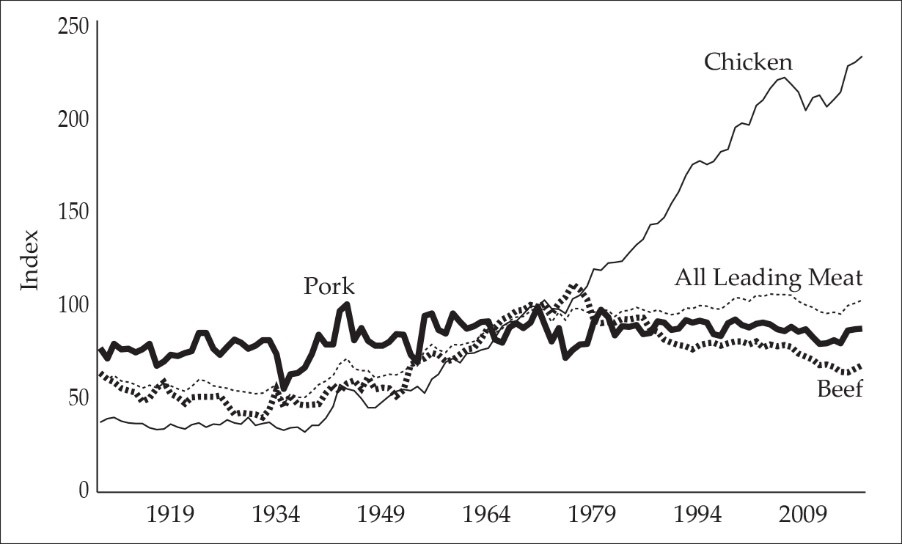
Source: Kristoffer Mousten Hansen, “The Populist Case for the Gold Standard,” Journal of Libertarian Studies 24, no. 2 (2020): figure 6. Data from ERS Food Availability (Per Capita) Data System.
If we look at changes in the relative prices of the various foodstuffs over the long run, a similar picture emerges. Beef prices have increased since the middle of the twentieth century, while other prices have fallen.

Source: Data from David S. Jacks, “From Boom to Bust: A Typology of Real Commodity Prices in the Long Run,” Cliometrica 13, no. 2 (2019): 202–20, Data on Real Commodity Prices, 1850–present online dataset.
Unfortunately, poultry prices are not listed in the dataset. However, we can approximate them by looking at grain prices, as this is a main input in the raising of chicken.

Source: Jacks, Data on Real Commodity Prices, 1850–present.
I have here chosen barley and corn prices, but it does not matter much, since the trend is similar for the prices of all grains. Prices have decreased since midcentury despite some fluctuations in the seventies and are now far below the level that prevailed for decades. Beef prices, on the contrary, have trended much higher and were in 2020 about double the level in 1900 or 1850. If we consider the relative price of beef, it is much, much higher, so we should not be surprised that meat consumption has shifted to cheaper substitutes: pork and especially chicken. It is clear that a fundamental change has happened in modern food production.
The Monetary Causes of Changing Food Production1
Author:
Kristoffer Mousten Hansen is a research assistant at the Institute for Economic Policy at Leipzig University and a PhD candidate at the University of Angers. He is also a Mises Institute research fellow.
Be seeing you

 MCViewPoint