MCViewPoint

Opinion from a Libertarian ViewPoint

Posts Tagged ‘Bill of Rights’

Opinion | The Supreme Court has abdicated its duty to the Bill of Rights – The Washington Post

Posted by M. C. on November 7, 2021

https://www.washingtonpost.com/opinions/2021/11/04/supreme-court-qualified-immunity-frasier-evans/

Image without a caption

By Radley Balko

The Supreme Court, having created the problem of qualified immunity to shield police from being held liable for their misconduct, keeps refusing to fix it.

This week, the court declined to review an especially outrageous ruling by the U.S. Court of Appeals for the 10th Circuit involving a Denver man who was detained for recording a traffic stop, then had his computer confiscated and searched.Opinions to start the day, in your inbox. Sign up.

No one doubts the man, Levi Frasier, had the right to record the stop. To date, six federal appeals courts have ruled there is a constitutional right to record police officers in public, a sentiment shared by the overwhelming majority of constitutional scholars. No federal appeals court has ruled the other way. In fact, the law is so well established that the officers in Denver were trained that citizens have such a right, and to respect it.

Yet the 10th Circuit ruled that because that circuit had yet to rule on the matter, the right was not yet “clearly established.” In a truly remarkable sentence, the court added, “It is therefore ‘irrelevant’ whether each officer defendant actually believed — or even in some sense knew — that his conduct violated . . . the First Amendment.”

In my last column, I looked at the origins of qualified immunity, the court-created doctrine that makes it extremely difficult to sue police officers for abuse and other constitutional violations. As I previously pointed out, legal scholars generally point to 1967′s Pierson v. Ray as the court’s first major decision affording protection to law enforcement (and other government officials) from civil liability for constitutional violations, so long as the violations were in good faith.

But that decision required courts (or juries) to determine the state of mind of the officers accused, always a difficult thing to discern. So in 1982, the court revised the policy and created qualified immunity as we know it today. To successfully sue a police officer, a plaintiff must pass a two-prong test, showing that: (A) the police violated the plaintiff’s constitutional rights, and (B) a reasonable person should have known the officers’ actions were unconstitutional under “clearly established” law.

See the rest here

Be seeing you

Posted in Uncategorized | Tagged: , , | Leave a Comment »

Buying a New Mind « Jon Rappoport’s Blog

Posted by M. C. on September 23, 2021

At the perimeter of your new mind is the Cattle Farm. Slow moving, meaningless, and random tautologies circulate there, efficiently blocking exit from the overall programmed space of consciousness.

https://blog.nomorefakenews.com/2021/09/22/buying-a-new-mind/

by Jon Rappoport

“Sign up now and get on the list for a new mind!”

The technical description of the surgery is over your head, but the basics are thrilling.

Two solid post-op improvements are speed and accuracy. You will think 20 times faster, and your rate of mistakes will drop to .01%. Your IQ will rise by a minimum of 50 points.

There is also an automatic signal when a problem you’re working on won’t resolve. Your left ear lobe burns. This informs you that, no matter how hard you try, you won’t be able to come to a useful conclusion.

You’ll save a great deal of time.

The new mind you’re getting contains several basic elements:

157,893 subconscious generalizations (or premises) deemed to be truthful;

a subconscious deductive logic program;

an instantly accessible technical library adjusted to your job.

The library automatically generates, collates, and summarizes the best available information re the problem you’re working on, in line with the previously installed generalizations (premises) and the logic program.

It produces an answer, a solution. Your solution.

For an additional fee, you can opt for a social program that will enable you to shift out of work-mode and communicate effectively with colleagues, friends, and family.

The left-ear-lobe burn signal will go live whenever social conversations touch on controversial issues. This is your cue to back away and seek other company.

Your new mind will be monitored 24/7 from a combined NSA-DHS node that ensures proper functioning. If repairs are needed, a partial shutdown will deploy. Corrections will normally take less than three hours.

There is also a bullpen function. Persistent questions for which there is no available answer; personal reflections and contemplations; and any instance of social, political, financial, or existential claustrophobia will all be funneled to a dead space where they will linger and progressively fade.

A tiny but important Grand Slam Package will translate any thoughts once deemed to be creative into a sludge-mesh, where the velocity of transmission will slow to one synaptic flash per hour. In other words, you’ll achieve close to a zero rate on imagination.

At the perimeter of your new mind is the Cattle Farm. Slow moving, meaningless, and random tautologies circulate there, efficiently blocking exit from the overall programmed space of consciousness.

You’re centered where you’re most needed, where you can perform usefully and swiftly.

Throughout the day, you’ll think thoughts that trigger a carefully groomed and modulated pleasure-quotient. The overall effect will stimulate you to conclude you are satisfied.

Thought-forms called Border Collies will continuously roam the space of your mind and organize stray electrical effects, bringing them into symmetrical, simplistic, geometric wholes. These wholes will automatically constitute your “aesthetic sense.”

At night, while you sleep, regions of mind unreachable by the surgery will naturally expend extraordinary energies of outrage, resentment, resistance, and pure hatred. This is quite normal.

Scooper Drones will siphon off those energies and their attendant emotional wildfires, and beam them directly into the minds of our soldiers on the battlefield, to help them wreak destruction on the enemy.

It’s estimated that, with your new mind in tow, you’ll require full overhauls every three years. During these periods, you’ll experience total shutdown.

Your families, friends, and co-workers will be notified in advance.

As an historical note of interest, you recall, I’m sure, the so-called spying, the so-called Surveillance State, back in the old days. Yes?

Most people didn’t realize the program was the first attempt to create a single Universal Mind.

The Surveillance State was really the first crude new-mind surgery.

But now we can guarantee the result. The science has advanced majestically. The surgery is extremely specific and comprehensive.

Central Planning for Planet Earth must restructure brains so they perform, in various ways, to produce what we call The Whole X.

What is The Whole X? It’s the meshing of all human thought and function that will indeed produce the greatest good for the greatest number.

Whole X is the plan from above.

It calculates every move and every thought-pattern the billions of Earth inhabitants undertake, during every hour of every day.

Whole X dispenses justice and goods and services and sustainability and shared thoughts from Nome to Tierra Del Fuego.

How can these elements be parceled out unless, at the level of mind, the rational processes of every human are coordinated?

Yes, we’ve come a long way from Spy Headquarters. That was then; this is now.

We’ve walked the path from the Bill of Rights to the Bill of the Mind.

Use your gifts wisely.

To those who lament the loss of freedom, privacy, and imagination, consider that those qualities led us to the brink of extinction. We turned the corner and found enduring peace in our time.

For more information, log on to The Church of Absolute Inescapable Unity.

Be seeing you

Posted in Uncategorized | Tagged: , , , | Leave a Comment »

Australia Has No Bill Of Rights, And It Shows – by Caitlin Johnstone – Caitlin’s Newsletter

Posted by M. C. on September 10, 2021

One of the most controversial recent developments in Australia’s escalating government overreach (and potentially the most consequential in the long term) has been the hasty passing of a new law greatly expanding government surveillance powers which allows law enforcement to hack into people’s devices and collect, delete, or even add to and alter the data therein, as well as take control of their social media accounts, supposedly “in order to frustrate the commission of serious offences online.”

Australia is not a free country. Westerners are trained to believe that that’s what you call any wealthy English-speaking nation with liberal cultural values, but really it’s just a continent-sized US military base with kangaroos. Human rights are only allowed where they are convenient, which is why they are continually disintegrating.”

https://caitlinjohnstone.substack.com/p/australia-has-no-bill-of-rights-and

Caitlin Johnstone

The Australian government has been on the receiving end of more and more criticism for its Covid response lately, not just domestically but from overseas.

There’s a lot to criticize, from soldiers patrolling state borders and policing the streets of Sydney, to people being arrested for merely posting about lockdown protests on social media, to police accessing QR tracing information and firing projectile weapons at lockdown protesters, to news broadcasters naming and shaming Covid patients who violate isolation orders, to the frequently ineffective hotel quarantine system for travellers being replaced with purpose-built quarantine facilities and Orwellian surveillance apps. The states of both Victoria and New South Wales have begun moving toward reopening after the Delta variant proved zero-Covid goals unattainable even amid strict lockdowns, but will do so by adding Australia to the growing list of nations that have implemented the dangerously authoritarian policy of vaccine passports.

And there are other aspects of this trend which have nothing to do with Covid. One of the most controversial recent developments in Australia’s escalating government overreach (and potentially the most consequential in the long term) has been the hasty passing of a new law greatly expanding government surveillance powers which allows law enforcement to hack into people’s devices and collect, delete, or even add to and alter the data therein, as well as take control of their social media accounts, supposedly “in order to frustrate the commission of serious offences online.”

Critics tend to lump this sweeping surveillance state escalation in with authoritarian policies related to the pandemic, but the bill makes no mention of Covid; its proponents cite its utility in fighting terrorism and child exploitation. Indeed this bill, which will certainly lead to myriad abuses, is just the latest in a continuing expansion of government surveillance powers in Australia that has been going on for years. This video from The Juice for example was made in 2018 criticizing Canberra’s assault on encryption:https://www.youtube-nocookie.com/embed/eW-OMR-iWOE?rel=0&autoplay=0&showinfo=0&enablejsapi=0

In reality, while the pandemic has certainly been a major factor in exacerbating civil rights erosion, Australia’s Covid response has simply added to a problem that had already existed and was already getting worse. The 2019 CIVICUS Monitor, a global research group that tracks fundamental freedoms in 196 countries, downgraded Australia from an “open” country to one where civil space has “narrowed”, citing new laws to expand government surveillance, prosecution of whistleblowers, and raids on media organizations

And this ongoing trend can be largely traced back to the fact that Australia is the only so-called democracy in the world which has no national charter or bill of rights of any kind. A tremendous amount of faith has been placed in state and federal legislators to simply do the right thing, which has proved foolish and ineffective. Professor George Williams wrote for the Melbourne University Law Review in 2006:

Australia is now the only democratic nation in the world without a national bill of rights. Some comprehensive form of legal protection for basic rights is otherwise seen as an essential check and balance in democratic governance around the world. Indeed, I can find no example of a democratic nation that has gained a new Constitution or legal system in recent decades that has not included some form of a bill of rights, nor am I aware of any such nation that has done away with a bill of rights once it has been put in place.

Why then is Australia the exception? The answer lies in our history. Although many think of Australia as a young country, constitutionally speaking, it is one of the oldest in the world. The Australian Constitution remains almost completely as it was when enacted in 1901, while the Constitutions of the Australian states can go back as far as the 1850s. The legal systems and Constitutions of the nation and the Australian colonies (and then states) were conceived at a time when human rights, with the prominent exception of the 1791 United States Bill of Rights, tended not to be protected through a single legal instrument. Certainly, there was then no such law in the United Kingdom, upon whose legal system ours is substantially based. This has changed, especially after World War II and the passage of the Universal Declaration of Human Rights, but by then Australia’s system of government had been operating for decades.

Caitlin Johnstone ⏳ @caitozFriendly reminder that while 61 percent of Australians believe they have a bill of rights, Australia remains the only developed western democracy without one. There’s literally nothing in place to stop our government from abusing these measures. #auspol World Socialist Web Site @WSWS_UpdatesAustralian governments are aggressively promoting #COVIDSafe, a mobile phone application that will supposedly assist in monitoring and containing the spread of the coronavirus, despite unanswered questions about privacy. https://t.co/JLd0iPTdIb https://t.co/JLd0iPTdIbMay 9th 202074 Retweets163 Likes

The state of Victoria has a Charter of Human Rights and Responsibilities, which supposedly includes rights like freedom of movement and peaceful assembly, but such protections have been unceremoniously dismissed as state premiers harnessed sweeping powers hardly anyone was even aware they possessed and began imposing strict laws to get the virus under control.

Officials have been rewarded for these drastic actions with thunderous public support, and until a few months ago the Australian government enjoyed soaring levels of approval from a very collectivist-minded population who overwhelmingly desired the elimination of the virus even if it meant trading some freedoms. Approval of those strict measures has dipped significantly since the Delta outbreak, but a majority of Australians still believe lockdowns and other restrictions are at appropriate levels for the time being. The absence of any federal restrictions on state governments’ ability to limit personal freedoms has allowed premiers to chase this public support regardless of potential long-term consequences.

Australia is not a free country. Westerners are trained to believe that that’s what you call any wealthy English-speaking nation with liberal cultural values, but really it’s just a continent-sized US military base with kangaroos. Human rights are only allowed where they are convenient, which is why they are continually disintegrating.

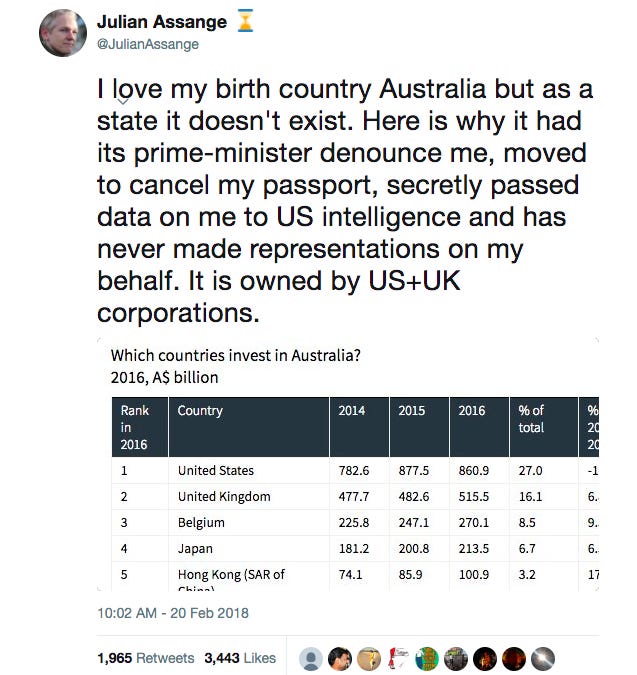
The first mistake in believing that Australia is a free country is believing that it is free. The second is believing that it’s an actual country. As Julian Assange put it shortly before the Australian government allowed him to be silenced and then imprisoned for journalism exposing US war crimes:

“I love my birth country Australia but as a state it doesn’t exist. Here is why it had its prime-minister denounce me, moved to cancel my passport, secretly passed data on me to US intelligence and has never made representations on my behalf. It is owned by US+UK corporations. Before WWII Australia was dominated by the UK–of which it was a colony. After the war it subordinated itself U.S. hegemony. A brief attempt at an independent Australian foreign policy in 1975 resulted in a US+UK backed constitutional coup.”

Anyway, it’s a mess.

So what to do about all this? If you listen to social media comments from people in the northern hemisphere the answer is that Australians should wage a civil war against their government, which from where I’m standing is hilarious partly because they’re talking about a populace whose entire cultural values system is built around being laid back and unbothered, and partly because most of those commenters are Americans living directly under the single most tyrannical regime on earth who have yet to put their much-touted Second Amendment toward practicing what they preach.

There’s a lot that’s going to have to shift before Australians gain stable protections for their civil liberties, which will necessarily have to include not just some kind of bill of rights but becoming an actual republic and finally getting that ugly old woman off our coins and ending the illegitimate US military occupation here once and for all. This will not happen until there’s an expansion in public consciousness of the need to do this, which may or may not be born out of conditions getting a lot worse before they get better. It may also be born out of a critical mass of Australians deciding they’re fed up and beginning a real push toward becoming a free country.

Bottom line the answer to the question of what needs to happen for Australia to move toward health is the same as the answer everywhere else: we’re just going to have to wake up. Human consciousness wants to awaken, and it will shake us in whatever ways we need to be shaken in order to make that happen. This is a hell of a time to be alive.

_________________________

My work is entirely reader-supported, so if you enjoyed this piece please consider sharing it around, following me on FacebookTwitterSoundcloud or YouTube, or throwing some money into my tip jar on Ko-fiPatreon or Paypal. If you want to read more you can buy my books. The best way to make sure you see the stuff I publish is to subscribe to the mailing list for at my website or on Substack, which will get you an email notification for everything I publish. Everyone, racist platforms excluded, has my permission to republish, use or translate any part of this work (or anything else I’ve written) in any way they like free of charge. For more info on who I am, where I stand, and what I’m trying to do with this platform, click here

Be seeing you

Posted in Uncategorized | Tagged: , , | 1 Comment »

Judicial Review? No. Nullification | Abbeville Institute

Posted by M. C. on February 24, 2021

https://www.abbevilleinstitute.org/blog/judicial-review-no-nullification/

By Earl Starbuck

“Acts of congress, to be binding, must be made pursuant to the constitution; otherwise they are not laws, but a mere nullity.” -St. George Tucker

“There is no danger I apprehend so much as the consolidation of our government by the noiseless, and therefore unalarming instrumentality of the Supreme Court.” -Thomas Jefferson

As a pro-life Jeffersonian, I am constantly frustrated by the endless line of pro-life activists who talk about the Supreme Court overturning Roe v. Wade.[1] There are multiple reasons this irks me. For one thing, the Supreme Court will never overturn Roe because its members are dedicated to the preservation of precedent. Add on top of that the absurd kangaroo courts that Senate confirmation hearings have become, with their character assassinations and incessant prattling about the vital importance of Roe, and it’s clear that the potential Justices are being reminded not to tread on that particular landmine if they wish to be confirmed. The brutal character assassination of Robert Bork is ample evidence of this, as are the farcical witch-hunts against Clarence Thomas and Brett Kavanaugh.

My other objections to this pro-life reliance on Federal Courts are constitutional and practical. To begin with, accepting the Incorporation Doctrine (the legal justification for Roe and its descendants) means accepting the idea that the 14th Amendment incorporates the Bill of Rights against the State governments, including the implied right to privacy and the subsequent right to obtain an abortion. The legal and historical problem with this is that the Bill of Rights was never intended by the Founding Fathers to be applied to the States.[2] There were two primary arguments against the Bill of Rights. The first of these (advanced by men like Roger Sherman, Hugh Williamson, and Theophilus Parsons) was that, since the States already had their declarations/bills of Rights, and since Congress had been given no authority to infringe upon them, a Federal Bill of Rights would be redundant and unnecessary, and might even undermine the sovereignty and authority of the States. 

The second reason for objecting to the Bill of Rights had to do with its length and scope. Enumerating all of the rights protected would be impossible, and therefore would result in an implied surrender of whichever rights they forgot to explicitly protect in the Bill of Rights. Moreover, why say that the government can’t do something (like restrict freedom of speech or the press) if the government hasn’t been granted that power to begin with? (James Wilson and Alexander Hamilton presented these arguments; Hamilton’s is easily found in Federalist Essay #84).

See the rest here

About Earl Starbuck

A native of East Tennessee, Jake Starbuck is an independent historian and a descendant of soldiers on both sides of The Late Unpleasantness and of Governor John Sevier. His father, who was a member of the Sons of Confederate Veterans, taught him to love history and the South. Starbuck holds a BA in History and Political Science from Carson-Newman University and an MA in History from Liberty University. He has no connection to the coffee company. More from Earl Starbuck

Be seeing you

Posted in Uncategorized | Tagged: , , , , | Leave a Comment »

The Constitution Is Not Your Friend | The Libertarian Institute

Posted by M. C. on August 22, 2020

By strictly limiting the authority of the general government, the founding generation hoped it would never possess enough the power to intrude on our rights.

But there isn’t any provision in the Constitution that actually empowers the federal government to protect our liberty. In fact, the founding generation would have almost certainly considered that too much power for a general government to wield.

https://libertarianinstitute.org/articles/the-constitution-is-not-your-friend/

by

One of the biggest misconceptions I hear about the Constitution is that it was written to “protect our liberty.”

It wasn’t. At least not in a direct sense.

The confusion likely arises from the words of the Declaration of Independence:

“We hold these truths to be self-evident, that all men are created equal, that they are endowed by their Creator with certain unalienable Rights, that among these are Life, Liberty and the pursuit of Happiness.–That to secure these rights, Governments are instituted among Men, deriving their just powers from the consent of the governed.”

It’s true that the Constitution was written during a time when protecting unalienable rights was widely viewed as the primary role of government. But the Constitution is not a philosophical document. It is a legal document that formed a political union and created a central government.

That’s all it does. Asking it to “protect your rights” is really asking too much. That wasn’t why it was written or ratified.

Now the Constitution does reflect the philosophy espoused in the Declaration in that it established a general government of limited, enumerated powers. The decentralized nature of the political system it created was intended to encourage liberty.

By strictly limiting the authority of the general government, the founding generation hoped it would never possess enough the power to intrude on our rights.

But there isn’t any provision in the Constitution that actually empowers the federal government to protect our liberty. In fact, the founding generation would have almost certainly considered that too much power for a general government to wield.

In practice, this means the federal government really doesn’t have any responsibility to “protect your rights” beyond staying within its constitutionally delegated powers. Its obligation isn’t to act in order to protect liberty, it is to not act outside of its legitimate authority.

In the same way, the Bill of Rights was never intended to empower the federal government to protect your rights. As the preamble to the Bill of Rights makes clear, it was intended to add “further declaratory and restrictive clauses” to the Constitution “in order to prevent misconstruction or abuse of its powers.” I have often said it would be better named “The Bill of Restrictions.”

A lot of people want the Constitution to deliver something it never promised. They want the government to serve as a liberty enforcement squad. This is a dangerous proposition. In order to protect your liberty, the government must define your liberty. The best thing the government can do is stay out of the way. The Constitution created a limited federal government for that purpose.

But it’s ultimately up to us to hold it within its limits. Unfortunately, by insisting that the government “protect their rights” they are doing the exact opposite.

This article was originally featured at the Tenth Amendment Center

About Michael Maharrey

Michael Maharrey [send him email] is the communications director for the Tenth Amendment Center. He also runs GodArchy.org, a site exploring the intersection of Christianity and politics. Michael is the author of the book, Constitution Owner’s Manual: The Real Constitution the Politicians Don’t Want You to Know About. You can visit his personal website at MichaelMaharrey.com, like him on Facebook HERE and follow him on Twitter @MMaharrey10th.
Be seeing you

Posted in Uncategorized | Tagged: , , , , , | Leave a Comment »

Colonialism 2.0: US assault on TikTok is latest step in building monopoly on hearts & minds of internet-connected world — RT Op-ed

Posted by M. C. on August 10, 2020

Government always has your best interests at heart.

https://www.rt.com/op-ed/497410-microsoft-tiktok-information-colonialism-monopoly/

Helen Buyniski
Helen Buyniski

is an American journalist and political commentator at RT. Follow her on Twitter @velocirapture23


The Trump administration’s bid to seize Chinese platform TikTok and hand it over to already-monopolistic Microsoft is part of a huge power grab, as the deteriorating quality of US propaganda puts its narrative dominance at risk.

The US government has made clear the fact it won’t rest until the user-facing portion of the internet is under its control. It is no longer enough for Twitter, Facebook, and YouTube/Google to merely eject hundreds of anti-establishment accounts on command, accompanied by stated rationales that would be laughable if they didn’t trample on the fundamental freedoms of the account owners.

TikTok – hardly a bastion of subversive political thought – must nevertheless be wrested from its Chinese owners ByteDance and handed to Microsoft, a convicted antitrust violator, lest Beijing be permitted to challenge Washington for control over the hearts and minds of online youth.

Also on rt.com Twitter censoring tweets containing links to BitChute video service, flags posts as ‘potentially harmful’


It’s ironic that, with western culture in the grip of a reckoning with its colonial past, the US is so intent on subjugating the world’s peoples with a lighter-touch, tech-enabled version of colonialism that doesn’t require the deployment of ships to foreign shores (though those 800+ military bases around the world don’t hurt). A direct line to the eyes and ears of targeted peoples is sufficient to maintain Hegemony 2.0.

But the quality of US propaganda has deteriorated noticeably over the years, to the point where four out of five Americans believe their media is biased. Rather than step up their propaganda game, Washington’s response has always been to stifle competition, either using censorship enacted through its private-sector partners, or by buying competitors’ silence. Interlopers like TikTok are crushed – or bought out by the likes of Microsoft, massive companies intertwined with state intelligence agencies.

Like Amazon, whose servers host the secrets of the US security state. Or Facebook, which skyrocketed past the billion-user mark with the alleged backing of CIA venture capital fund In-Q-Tel. Microsoft, meanwhile, is for all intents and purposes a private-sector extension of the US empire. It was the first to sign on to the NSA’s wildly unconstitutional PRISM surveillance program back in 2007. It left exploitable backdoors in its operating systems open for two decades until another government-collaborating tech company complained. Even in the privacy-averse 21st century, its intrusive practices – from keystroke logging to chiding users for politically incorrect language – have raised red flags for years. It’s also the only tech monopoly ever to be prosecuted for its monopolistic behavior.

The Big Tech apparatus serves as an ideal conduit for the US government to circumvent the Bill of Rights. Private corporations are not legally prohibited from imposing restrictions on users’ free speech or (digital) assembly, no matter how arbitrary. Section 230 protections have fallen by the wayside as Facebook, YouTube and Twitter became increasingly emboldened to knock troublesome dissenters off their platforms. Slurping up user information is child’s play too, with the kind of backdoors Microsoft and Apple have lovingly constructed for their government partners – never mind the protections against unreasonable search and seizure that would hamstring government agencies attempting to do the same thing. Big Tech and Big Brother are two arms on the same octopus.

TikTok, however, spoils US narrative dominance and doesn’t share its data with the bosses. Sure, right now it’s only insipid dance videos and teenagers lip-synching, but what about when those teens grow up? American propaganda is so sloppy that the State Department feels threatened by a handful of “Russian proxy” websites getting a few thousand hits per month, and it appears to have spammed thousands of Russians and Iranians with offers of $10 million for tall tales about election hacking.

Also on rt.com Takes one to know one? New ‘Russian disinformation’ scare-sheet by State Department’s propaganda arm is full of projection


Facebook, Twitter, and YouTube are constantly being urged to censor an ever-larger range of opinions as the mainstream media struggles not to trip over its own falsehoods  and hemorrhages cash to the victims of its lies.

At the heart of the TikTok seizure – which expanded on Friday to an assault on Chinese platform WeChat – is a hatred of competition. As Facebook, Twitter, Google, and YouTube become little more than mainstream media mouthpieces, users will naturally flock to other platforms, especially those with massive user bases like their Chinese competitors. Washington’s pet platforms can hardly roll back their censorship regimes – not with an election just a few months away. So, in the grand tradition of organized crime, they’ve made ByteDance an offer they can’t refuse. Climb in bed with Microsoft – the most corrupt of the bunch – or get banned.

Freedom isn’t free, as the saying goes. Neither are America’s celebrated “free markets.”

Think your friends would be interested? Share this story!

Be seeing you


Posted in Uncategorized | Tagged: , , , , , | Leave a Comment »

Keep Those Federal Troops out of American Cities | Mises Institute

Posted by M. C. on August 1, 2020

As a legal matter, of course, I have no doubt that federal judges and supporters of federal meddling could find a way to slice and dice the Constitution so as to make it say whatever they want. As a moral and historical question, however, it is clear that sending in federal troops without an invitation from local leaders is blatantly contrary to the provisions of the Declaration of Independence and is contrary to the Tenth Amendment.

It’s a safe bet that the authors of the Declaration of Independence would say that a scuffle in Denver clearly lies within the authority of the government in Colorado.

https://mises.org/power-market/keep-those-federal-troops-out-american-cities?utm_source=Mises+Institute+Subscriptions&utm_campaign=19800a2cd3-EMAIL_CAMPAIGN_2020_07_31_04_05&utm_medium=email&utm_term=0_8b52b2e1c0-19800a2cd3-228343965

Ryan McMaken

The violence and the utter disregard for basic human rights displayed by the Left in recent years—combined with its support for war crimes when a Democrat is president—have made me inclined to play nice with conservatives these days. At least conservatives aren’t planning to torch my neighborhood any time soon, and at the moment they’re no worse than the Left on foreign policy.

On the other hand, sometimes even the relatively less bad guys (for now) come to some very dangerous conclusions.

[RELATED: About Those Spooky Federal Cops in Portland” by Jeff Deist]

Specifically, some authors at conservative publications are now demanding that the president send in federal agents and troops to make arrests and intervene in local law enforcement to pacify rioters in Portland and other American cities. These pundits are claiming that since local officials allegedly aren’t responding with sufficient alacrity to rioters, it’s time to send in federal troops.

It is questionable that the president has the legal authority to do this. But even if he does have this power—legally speaking—basic commonsense principles of subsidiarity and decentralization inveigh against federal intervention. In other words, a basic respect for the principles behind the Bill of Rights and the Declaration of Independence ought to cause one to reject the notion that it’s a good idea to send in federal troops to “solve” the crime problems experienced in American cities.

Here’s one example: in an article titled “It’s Time to Crush the New Rebellion against Constitution” at Real Clear Politics, author Frank Miele claims “the president is designated as the commander in chief” and therefore “shall be expected to act during a crisis of ‘rebellion or invasion’ to restore public safety.”

Miele addresses two legal questions. The first is whether or not federal troops or agents can act independently when protecting federal property—such as a federal courthouse. The second question is whether or not federal troops can intervene even when no federal property is under threat.

Arguably, in the former case federal agents would be well within their prerogatives to protect federal property as a security guard might do. This, however, does not necessarily empower them to make arrests or assault citizens outside the federal property itself, on the streets of a city well outside the federal compound. The so-called constitutional sheriffs movement—which the Left hates—has it right on this. Local law enforcement ought to be the final authority when it comes to making arrests.

Clearly, however, Miele will not brook such limitations, and he supports the idea that federal troops can intervene “where no federal property is involved.”

And what are the limitations on this federal power? Basically, there are none, in Miele’s view. So long as we define our adversaries as people fomenting a “rebellion” nothing is off the table. Not surprisingly, Miele strikes a worshipful pose toward Abraham Lincoln’s scorched-earth campaign against the Southern states of the US in the 1860s. Those people were “rebels,” you see, so the president was right to “tak[e] bold action” even if it meant “skirting the Constitution.” Because “there was never any doubt where [Lincoln’s] allegiance lay,” it was perfectly fine when he abolished the basic legal rights of Americans, such as the right of habeas corpus.

The use of the word “rebellion” is central to understanding the profederal position here. Authors like Miele (and Andrew McCarthy at National Review) have routinely used words like “insurrection” or “rebellion” in order to support their claim the current unrest requires a Lincoln-like response, including a Lincolnesque abolition of half the Bill of Rights.

The Moral Case for Local Control, Made by American Revolutionaries

As a legal matter, of course, I have no doubt that federal judges and supporters of federal meddling could find a way to slice and dice the Constitution so as to make it say whatever they want. As a moral and historical question, however, it is clear that sending in federal troops without an invitation from local leaders is blatantly contrary to the provisions of the Declaration of Independence and is contrary to the Tenth Amendment.

As I explained here, the Declaration lists that the misuse of the executive’s (i.e., the king’s) troops was a reason for the American rebellion of 1776. These troops must receive the permission of local lawmakers:

The American revolutionaries and those who ratified the US constitution…thought they were creating a political system in which the bulk of land-based military power would rest in the hands of the state governments. Standing armies were to be strenuously opposed, and the Declaration of Independence specifically condemned the king’s use of military deployments to enforce English law in the colonies and “to render the Military independent of and superior to the Civil Power.” These principles go back at least as far as the English Civil War (1642–51), when opposition to standing armies became widespread.

Thus, any attempt to send in British troops without the approval of the colonial legislatures was an abuse. This same principle was later applied to the state legislatures in relation to federal power.

Sending in federal troops to override local officials is in direct opposition to the moral underpinnings of the American Revolution. But this doesn’t stop Miele, who then insists that Article IV of the Constitution authorizes federal invasions because the text says “The United States shall guarantee to every State in this Union a Republican Form of Government.” According to Miele, the “republican form of government” here “means government of the people, by the people and for the people—not the mob.”

This definition of a republic is something Miele apparently just made up. This is hardly a standard definition of “republic,” especially in the eighteenth century—the context most relevant for our purposes here. In those days, “republic” mostly meant “not a monarchy” and something like a decentralized state ruled by a commercial elite.

The idea that the president can send in troops anywhere whenever we decide that a local government is not guaranteeing a “republic”—based on whatever idiosyncratic definition of “republic” we might choose—is dangerous indeed.

In another example, we find authors “Because state and local Democrat officials refuse to restore order, the federal government must….Enough is enough. Those responsible for this new wave of insurrection must face the full force of federal law. ”

Note the language about “insurrection”—as if a minuscule clash between some left-wing and right-wing demonstrators in Denver—an example the authors use to justify their position—requires a federal invasion.

Presumably governments are expected to intervene to prevent this sort of thing from happening.

But which government shall do that? It’s a safe bet that the authors of the Declaration of Independence would say that a scuffle in Denver clearly lies within the authority of the government in Colorado. After all, the American patriots fought a war—and many died in it—to ensure local control outside the hands of a powerful executive in command of a standing army thousands of miles away.

It is indeed true that the rights of those who wished to see Malkin speak were violated. But here’s the thing: the rights of Americans are violated every single day in every city of America. Murders, rapes, thefts, and even gang warfare are not unheard of across this nation, year in and year out. Moreover, the data is clear that police agencies are really quite bad at bringing these criminals to justice.

So, should we call in the feds to solve these problems? There were more than fifty homicides just in the city of Denver last year. There were many more assaults and attempted murders. Doesn’t this level of bloodshed constitute a sort of “insurrection” against the decent people of the city? Certainly if we’re going to be free and loose with terms like these, as is now apparently the MO of advocates for federal intervention, our conclusion could easily be yes. We might conclude the local police are unwilling to do what it takes to “establish order” and do something about these terrorists and thugs. Will sending in the FBI or the Department of Homeland Security solve this problem?

Fortunately, cooler heads have somehow prevailed, and “sending in the feds” is not a run-of-the-mill policy option. This makes even more sense when we remember that there is zero reason to assume federal cops are better at bringing peace to a city than the state or local officials. These feds are the same people and organizations that have been running a failed and disastrous war on drugs for decades. These are the people who daily spy on law-abiding Americans, in blatant violation of the Bill of Rights. These are the people who were blindsided by 9/11 in spite of decades of receiving fat paychecks to “keep us safe.” These are the people (i.e., especially the FBI) who have conspired against Americans in order to unseat a democratically elected president.

Unfortunately, old habits die hard and the myth prevails on both the left and the right that if we’re not getting the result we want from politicians, then the answer lies in calling in other politicians from somewhere else to “solve” the problem. But just as it would be contrary to basic notions of self-government and self-determination to call in the UN or the Chinese government to “protect rights” in the United States, the same is true of calling in federal bureaucrats to “fix” the shortcomings and incompetence of state and local bureaucrats. The American revolutionaries created a decentralized, locally controlled polity for a reason. Abolishing federalism to achieve short-term political ends is a reckless way to go.


Be seeing you


Posted in Uncategorized | Tagged: , , , , , | Leave a Comment »

Some Conservatives Want Americans to Abandon Classical Liberalism. Don’t Listen to Them. | Mises Wire

Posted by M. C. on June 23, 2020

But Deneen’s new attack on libertarians helpfully serves as yet another example of some conservatives’ deeply misguided enthusiasm for attacking classical liberals and even attempting to condemn them as “un-American.” But just as Carlson and Bannon have employed bad economics to attack classical liberals in the past, Deneen now indulges in bad history.

Let’s consider some evidence…

https://mises.org/wire/some-conservatives-want-americans-abandon-classical-liberalism-dont-listen-them?utm_source=Mises+Institute+Subscriptions&utm_campaign=97d1b61b70-EMAIL_CAMPAIGN_9_21_2018_9_59_COPY_01&utm_medium=email&utm_term=0_8b52b2e1c0-97d1b61b70-228343965

Donald Trump’s economic populism, and his break with the established postwar conservative movement, has created an opening for new types of conservatism. Among these is the antimarket wing of the movement characterized by a renewed enthusiasm for trade controls, more spending on welfare programs, and more government regulation in the everyday lives of ordinary Americans.

The economic agenda has been voiced perhaps most enthusiastically by pundit Tucker Carlson and former Trump advisor Steve Bannon. Both have attacked what they apparently see as “excessive” freedom. This freedom—especially when exercised in the marketplace—has led, they believe, to the decline of the middle class for consumers and businesses which Bannon and Carlson blame for creating economic hardship in the United States. As a “solution” both have pushed for the state to seize and control even more of the economy than it already has.

The fact that the United States has only become consistently less free, both in terms of markets and in everything else, is strenuously ignored. These attacks on markets are, frankly, based on poor economics and a poor understanding of economic history, as I’ve noted here and here.

Not surprisingly, this way of thinking has led to new attacks on those who most support freedom in the marketplace (and everywhere else): classical liberals, also known as libertarians.

[RELATED: “‘Libertarian’ Is Just Another Word for (Classical) Liberal” by Ryan McMaken]

Carlson has specifically denounced libertarians for their free market views, as has Bannon. Both have even singled out “Austrian economists” as especially worthy of denunciation. Attacks on the laissez-faire liberals have proliferated, including unprovoked attacks from conservatives in First Things, the American Conservative, and The Spectator.

Is Classical Liberalism Un-American?

But perhaps the most aggressive attack on classical liberalism comes from Patrick Deneen, who has attempted to claim that classical liberalism has no place in American history at all.

In a new column this week, Deneen attacks libertarians and the entire liberal tradition in general. Not content with merely criticizing the liberals/libertarians as too extreme, as Bannon and Carlson do, Deneen seeks to recast classical liberalism altogether as a pernicious, foreign, and dangerous ideology. According to Deneen, this ideology—the ideology of Thomas Jefferson, Lord Acton, and Frederic Bastiat, among many other defenders of freedom and natural rights—has nothing at all to do with “the American tradition.”

This general thesis of Deneen goes well beyond his article this week, and his odd and ahistorical view of classical liberalism has already been explained here at mises.org by both David Gordon and Allen Mendenhall. But Deneen’s new attack on libertarians helpfully serves as yet another example of some conservatives’ deeply misguided enthusiasm for attacking classical liberals and even attempting to condemn them as “un-American.” But just as Carlson and Bannon have employed bad economics to attack classical liberals in the past, Deneen now indulges in bad history.

Let’s consider some evidence.

Yes, the American Revolutionaries Were Classical Liberals

Deneen’s first mistake in this week’s column is claiming that liberalism was not a central factor in the American Revolution. This rather unbelievable claim is derived from Deneen’s belief that liberalism of all types “requires liberation from all forms of associations and relationships, from family to church, from schools to village and community.”

As Mendenhall notes, this is not at all a sound definition of classical liberalism. But from this rather questionable premise, Deneen then concludes that the only real liberals in America at the time were the few disciples of John Locke (i.e., the Jeffersonians and their allies). After all, in Deneen’s view, it was only the Lockeans who embraced the atheism, hedonism, and the mania for the accumulation of material possessions that Deneen thinks characterize the classical liberals. Thus, those Americans who still embraced institutions like church and family were not liberals at all. Deneen thus contrasts “a small number of Lockeans” during the Revolution to the “larger population of Christians” to illustrate that the classical liberals were at odds with the main nonliberal part of the population.

The real founding ideology of America, we are told, was a Christian “common good conservatism” which valued community above individual conscience and above individual rights. This claim is central to Deneen’s basic thesis here, which is that any American revolutionary who was a Christian was necessarily not a liberal.

But the Lockean view and Christianity are not mutually exclusive. As David Gordon points out, there is significant evidence that Locke “defended divine and natural law and argued for the existence of God.” Moreover, in his history of economic thought, Rothbard shows that Locke, for all his deviations, was well within the natural law tradition handed down from medieval Christian Europe. It was easy for Americans to adopt the basic classical liberal and Lockean framework without abandoning Christianity. Indeed, Deneen’s idea that anyone embracing Locke’s ideas of “life, liberty, and property” must be some sort of avaricious atheist strains the bounds of plausibility. Yet Deneen treats this idea as if it were unassailable.

Moreover, a look at the actual historical record shows widespread adoption of liberal ideals during the Revolution. As Rothbard illustrates in the fourth volume of Conceived in Liberty, liberal ideals spread rapidly during the period, and in quite a radical way. Opposition to slavery spread, and indentured servitude declined precipitously. Old feudal laws were overturned. The system of land sales and distribution was democratized. Religious freedom was far more widely embraced. Rothbard notes that the Revolution was a civil war conducted by “fanatics” and zealots who rejected “the siren call of compromise.”

Rothbard maintains that these legal, social, and military upheavals were animated by liberalism/libertarianism. After all, if slavery, indentured servitude, and feudal land grants were all perfectly acceptable to “the common good” by Americans conservative Christian one minute, how did these things become unacceptable just a few years later? The answer lies in the spread of liberalism among Americans during the revolutionary period. The very idea of “the common good” changed as the public embraced liberalism.

State-Sponsored Churches Declined Because America Embraced Classical Liberalism

Deneen also claims that the post-Revolutionary period was little affected by liberalism. Specifically, he asserts that the First Amendment of the Bill of Rights was designed not to increase religious freedom, but to increase the power of the established churches in the states:

The Bill of Rights was in fact proposed and ratified in order not merely to forbid the government from establishing a religion, butprevent the federal government from interfering in the existing State establishments. (emphasis in original)

In Deneen’s view, the First Amendment’s “original intention” was to help the state governments in “protecting these establishments.” He insists that the American revolutionaries understood that the state governments must have state-supported churches or society would descend into “war of all against all.”

Once again, the historical record is not on Deneen’s side.

While there is not doubt that some revolutionaries were in favor in maintaining state-favored established churches, that fact is that most Americans—animated by individualistic classical liberal ideals—saw religion more as a matter of personal choice and conscience. This was already in play by the late eighteenth century, when, as Rothbard notes, “the previously hysterical-anti-Catholicism that had permeated the colonies” was abandoned in favor of toleration. During the Revolution no fewer than eight states moved to allow Roman Catholics to hold public office. These were hardly the actions of populations clinging to the idea of empowering the local state-supported churches.

At the same time, the established churches, those churches Deneen claims were so dear to Americans at the time of the Bill of Rights, went into steep decline and had disappeared by the 1830s. State governments ceased to support their established churches, and, as historian Ann Douglas has described it, “between the Revolution and the Civil War, the [formerly established] sects which were disestablished lost ground in every sense while the largest ‘dissenting’ groups, which had never received state support, flourished.”

That is, the old established churches—the Congregational and Presbyterian churches, for example—were abandoned in droves by Americans who embraced the idea that religious faith was a matter of individual choice. In Deneen’s mind, this seemingly illustrates a disgraceful march toward chaos. But most Americans were apparently unconcerned. Americans didn’t abandon Christianity, of course. Their newfound liberalism required no such thing. But Americans did embrace a religious order based on purely voluntary, private institutions far from the old mindset of those who supported the established churches of old.

The American Political Tradition Is Liberal and Libertarian

These are just two examples of Deneen’s rewriting of history, but they serve to show how he appears to have become convinced that classical liberalism is incompatible with the sorts of institutions that any social conservative would value. Consequently, he seeks to read classical liberalism out of American history almost in its entirety.

In actual practice, however, classical liberalism has never been a danger to the Christian civilization that Deneen defends. On the contrary, as Mendenhall concludes:

The classical liberalism or libertarianism to which Christian individualists adhere promotes peace, cooperation, coordination, collaboration, community, stewardship, ingenuity, prosperity, dignity, knowledge, understanding, humility, virtuousness, creativity, justice, ingenuity, and more, taking as its starting point the dignity of every human person before both God and humanity. This individualism prospers in fundamentally conservative cultures and does not square with Deneen’s caricature of a caricature of a caricature of “liberal” individualism.

Indeed, liberalism has historically been a key component in providing the freedom necessary to allow institutions of civil society to flourish. A strong private sector protects churches and communities from the power of the state. A robust economy allows families to establish independence without a reliance on state largesse or on a small number of state-favored monopolistic firms. Without these freedoms, all of civil society becomes a hostage to the ruling junta or regime. That sort of dependence may seem fine so long as those who favor our social views are in power. But what happens when our friends are no longer in charge?

Today, we see precisely what happens. After decades of empowering the state with an ever longer list of prerogatives and prohibitions, those who control the state can now easily turn on those institutions that are so central to the kind of society Deneen would like to see. The solution lies in scaling back the power of the state and insisting that large sectors of civil society are simply off limits from the state’s coercive power. The solution lies in allowing free association, free contracting, freedom in religious practices, and freedom to use our property as we like.

Throwing classical liberalism under the bus won’t help.

 

Be seeing you


Posted in Uncategorized | Tagged: , , , , , | Leave a Comment »

The Incorporation Doctrine Broke the Constitutional System | | Tenth Amendment Center

Posted by M. C. on June 11, 2020

The BIll of Rights Was Never Intended to Apply to State or Local Governments

The application of the Bill of Rights to state and local governments was not a feature of the original constitution. It came about through a series of federal court cases based on the 14th Amendment.

https://tenthamendmentcenter.com/2020/05/30/the-incorporation-doctrine-broke-the-constitutional-system/?fbclid=IwAR3PT549ncYVFvDfJDANg-V9mVTx4USDc2WyM0r3kX-RkVbDRHcjO2CZxPA

By:

I think centralizing power is always a net loss for liberty. So did the founding generation. This is why the framers of the Constitution emphatically rejected a proposal to give the federal government veto-power over state laws. It’s also why the first Congress rejected applying some provisions of the Bill of Rights to the states.

When I say this, it tends to confuse people because, in today’s political system, the federal government vetoes state laws all the time through federal courts. And virtually every time somebody perceives that a state government has violated their rights, they run straight to federal courts to stop the offending state action.

Despite my protests, the application of the federal Bill of Rights to the states has become a key feature of the American political system.

As I said, I believe this will ultimately prove to be a net loss for liberty. When you turn to federal courts to protect your liberty from state actions, you’re playing a game of Russian roulette with five bullets loaded into your six-shooter. Despite a few minor victories here and there, federal courts almost always come out with opinions that expand government power, not protect individual liberty. And these expansions of government power become the law of the land across the entire United States. In a decentralized system, bad state court decisions only impact the people in that one state.

The risk isn’t worth the reward.

And yet here we are.

Among friends of liberty, you will find a great deal of support for using federal courts to stop states from violating individual rights. Despite my misgivings, I can understand the impulse. When we see state governments trampling rights, we want somebody to step in. The feds are more than happy to step. Why not take advantage of their service. But if you’re going to support the enforcement of the federal Bill of Rights on state and local governments, you need to understand where this purported power comes from and its implications on the American constitutional system.

The BIll of Rights Was Never Intended to Apply to State or Local Governments

The application of the Bill of Rights to state and local governments was not a feature of the original constitution. It came about through a series of federal court cases based on the 14th Amendment.

A lot of people believe that the Bill of Rights always applied to state governments. This is simply not true. The Bill of Rights was never intended to bind the actions of state governments.

The preamble to the Bill of Rights makes its purpose absolutely clear: to further restrict federal government power.

THE Conventions of a number of the States, having at the time of their adopting the Constitution, expressed a desire, in order to prevent misconstruction or abuse of its powers, that further declaratory and restrictive clauses should be added: And as extending the ground of public confidence in the Government, will best ensure the beneficent ends of its institution. [Emphasis added]

The words “its powers” clearly refer back to the Constitution. The Bill of Rights was intended to “prevent misconstruction or abuse” of the Constitution’s powers as exercised through “the government” – the federal government. Notice the word “government” is not plural.

The preamble of the Bill of Rights makes no mention of limiting the power of state governments. The state ratifying conventions had no intention of restricting their state’s own powers. They already had state constitutions to do that job.

This is an undebatable fact  — no founding-era evidence exists that Congress or the state ratifiers intended for the protections included in the Bill of Rights to bind state governments. None.

Doing so would have essentially created a federal veto over state laws. As I’ve already said, this idea was rejected during the framing of the Constitution. It would have allowed for a massive expansion of central government authority – the exact opposite of the stated purpose of including a bill of rights.

The Incorporation Doctrine

The federal courts enforce the Bill of Rights on the states today through a legal framework known as the incorporation doctrine.

In a nutshell, the Supreme Court invented the incorporation doctrine through the 14th Amendment. It relies on a dubious legal principle called “substantive due process,” invented out of thin air by the court more than 50 years after the ratification of the amendment.

There is some basis to argue that the 14th Amendment was intended to incorporate the Bill of Rights onto the states. The operative clause of the amendment reads, “No state shall make or enforce any law which shall abridge the privileges or immunities of citizens of the United States.” The question is: are the provisions of the Bill of Rights included in the 14th Amendment’s “privileges and immunities?”

In my educated opinion, the answer is no. The 14th Amendment was intended to constitutionalize the Civil Rights Act of 1866. This was asserted over and over again both in the congressional debates and as supporters presented the amendment to the states. The civil rights act specifically enumerates the privileges and immunities that were to be protected. (The privileges and immunities listed in the Supreme Court case Corfield v Coryell were also mentioned in debates.) They include the right to enter into contracts, own property, inherit property, travel freely and access to the courts. The act made no mention of the Bill of Rights.

In fact, in the 1873 Slaughterhouse case, the U.S. Supreme Court rejected the idea that the privileges and immunities clause in the 14th Amendment applied the Bill of Rights to the states.

Was it the purpose of the fourteenth amendment, by the simple declaration that no State should make or enforce any law which shall abridge the privileges and immunities of citizens of the United States, to transfer the security and protection of all the civil rights which we have mentioned, from the States to the Federal government? And where it is declared that Congress Shall have the power to enforce that article, was it intended to bring within the power of Congress the entire domain of civil rights heretofore belonging exclusively to the States?

We are convinced that no such results were intended by the Congress which proposed these amendments, nor by the legislatures of the States which ratified them.

This is why the Court later made up the concept of “substantive due process” to justify incorporation. The previous Court had closed the door on basing it on the more logical privileges and immunities clause.

I admit there exists some evidence that undermines my view on incorporation through the privileges and immunities clause. But the concept of substantive due process is every bit a product of “living breathing” constitutional interpretation as any progressive Court opinion conjured up during the New Deal.

Regardless, incorporation is now the law of the land and is ensconced in the legal system. You can try to use the federal courts to protect your rights from state governments if you choose. But you should at least understand how the idea evolved and what it has done to the constitutional system.

Incorporation Breaks the Original Constitutional System

The founding generation warned us over and over again about consolidating the states into a single national government. It was the greatest fear voiced by opponents of the Constitution during ratification and was a prime reason for the inclusion of the Bill of Rights.

During the Massachusetts ratifying convention, delegate Fisher Ames asserted that “a consolidation of the States would subvert the new Constitution.” And during the Virginia ratifying convention, Patrick Henry warned, “Consolidation must end in the destruction of our liberties.”

“When he asks my opinion of consolidation, of one power to reign over America with a strong hand, I will tell him I am persuaded of the rectitude of my honorable friend’s opinion, (Mr. Mason,) that one government cannot reign over so extensive a country as this is, without absolute despotism. Compared to such a consolidation, small confederacies are little evils; though they ought to be recurred to but in case of necessity.”

Supporters of the Constitution didn’t defend consolidation. They acknowledged its danger and swore it would never happen. In Federalist #32, Alexander Hamilton wrote:

“An entire consolidation of the States into one complete national sovereignty would imply an entire subordination of the parts; and whatever powers might remain in them, would be altogether dependent on the general will. But the plan of the convention aims only at a partial union or consolidation, the State governments would clearly retain all rights of sovereignty which they before had, and which were not, by that act, exclusively delegated to the United States.”

The incorporation doctrine did what Hamilton promised wouldn’t happen. It effectively obliterated state sovereignty and consolidated the state into a single national government.

Whether legitimate or not, the incorporation doctrine made real the founders’ worst fears. Using federal courts to police the states and enforce the Bill of Rights fractured the original constitutional structure, broke the Tenth Amendment and effectively consolidated the states to be ruled by an oligarchy of federal judges.

You can’t simultaneously support incorporation and the original Constitution. They are hopelessly at odds.

Be seeing you


Posted in Uncategorized | Tagged: , , , | Leave a Comment »

Follow The Money

Posted by M. C. on May 1, 2020

In Florida, the State receives $132,000 for each reported case of corona.
In Nebraska, Minnesota and Montana, the State receives over $300,000 for
each reported case of corona. The difference in the amounts received is
based on some weird government bureaucrat-created voodoo Medicare
formula. The point is, hospitals are being financially rewarded for
identifying people as contracting or dying from corona—whether they
actually contracted the virus or not.

https://chuckbaldwinlive.com/Articles/tabid/109/ID/4001/Follow-The-Money.aspx

Chuck Baldwin

By now, most thinking people realize that the numbers being circulated by the Medical/Pharmaceutical/Industrial Complex and their Big Government hacks in the media of people being infected and killed by the coronavirus are grossly exaggerated.

Watch this medical doctor’s report.

And also watch this medical doctor’s report.

Now we learn that medical professionals, most of whom are employed by hospital monopolies, have a personally vested reason to participate in the dishonest practice of fudging corona numbers upward. States are being given government (read: taxpayer) stimulus dollars for each corona case reported.

In Florida, the State receives $132,000 for each reported case of corona. In Nebraska, Minnesota and Montana, the State receives over $300,000 for each reported case of corona. The difference in the amounts received is based on some weird government bureaucrat-created voodoo Medicare formula. The point is, hospitals are being financially rewarded for identifying people as contracting or dying from corona—whether they actually contracted the virus or not.

In the meantime, however, most hospitals are literally sitting empty. There is no mad rush of corona patients lining up for treatment. For example, in one of the so-called COVID-19 hot spots, Seattle, Washington, an army field hospital on loan to the city was returned after only nine days, because it never saw a patient:

Gov. Jay Inslee’s office on Wednesday announced that the state will be returning a field hospital deployed to CenturyLink Field Event Center to the U.S. Department of Defense.

The 250-bed facility, for which setup began on March 30, was intended to help Washington state’s health care system tend to non Covid-19 patients in the event of a hospital surge.

But just three days after announcing the facility was ready to receive patients, officials say they’re returning the hospital to the federal government.

The action is aimed at helping another state with a more significant need for hospital capacity at this time, according to the Governor’s Office. The facility did not see any patients during the time it was slated to operate in Seattle.

A local hometown newspaper where I live published this story a few days ago:

Kalispell Regional Healthcare announced today that it will furlough roughly 600 employees beginning April 15 due to steep revenue declines resulting from the COVID-19 pandemic.

Hospital executives, physicians and executive directors will also take reductions in their salaries, effective immediately.

KRH officials say the actions are necessary because revenue losses are projected to exceed $16 million per month, “which could jeopardize the organization’s ability to serve the long-term health needs of our community.”

The hospital didn’t immediately specify what types of employees or departments will be impacted by the furloughs.

An April 13 press release noted that KRH, like other health-care organizations across the country, has strengthened COVID-19 clinical teams, support staff and resources “needed to deliver life-saving care and ensure patient and staff safety as a result of the pandemic.” But the pandemic response has also led to the halting of many services “for the health and safety of our community,” the hospital stated.

In other words, people who need all sorts of medical care unrelated to corona are deliberately being denied treatment, as hospitals gear their entire operations to treat a mad rush of nonexistent corona cases. This is called medical rationing, by the way. But instead of admitting this pandemic was a complete and total exercise in government-created manipulation and hysteria—and allowing hospitals to reopen to the REAL medical needs of their communities—they continue to parrot the Fauci/CDC-authorized fear and paranoia over corona, while hospitals sit empty and must layoff untold numbers of employees in order to stay solvent.

Say it yet another way: The only thing keeping hospitals financially afloat right now is government corona money—and it’s not enough, as the numbers of corona cases just aren’t there. So, doctors and hospitals are diagnosing everyone they can as being infected or killed by COVID-19 just to keep government dollars flowing into their coffers. And still, untold numbers of medical workers are losing their jobs.

Besides the obvious usurpation of our Natural liberties enshrined in the Bill of Rights, we can expect an all-out push from the mad scientist Anthony Fauci and his billionaire Frankenstein Bill Gates to coerce the federal and State governments to mandate forced vaccinations. Go ahead: Take a quick guess who will profit from this little act of government tyranny.

From the very beginning, this has never been about OUR health and safety; it has been all about THEIR money and power. That’s what manufactured crises like this are always about.

Speaking of money: You and I both know that our economy cannot withstand this massive explosion of national debt without dire consequences. It seems almost certain that this corona scam is the perfect storm for recession and hyperinflation.

After talking with my friend Ron Paul several years ago, I converted my personal IRA into a precious metals-backed IRA as a hedge against hyperinflation. And the company I am able to recommend is one of the finest precious metals companies in the country. They have been in business since 1976 with a solid reputation and track record, offering the option of easy online ordering as well as the safe, secure storage of metals if needed.

I am, therefore, proud to partner with this fine company and recommend them to my readers. I know these fellows personally. They are genuine Christian patriots who truly understand what’s going on and have a heart to help their fellow Americans affordably obtain precious metals.

Whether you are looking to convert your traditional IRA to a precious metals-backed IRA (as I did) or are simply wanting to purchase gold and silver coins, I urge you to contact my friend of many years, David Hart. He is the National Sales Director. Dave is extremely friendly, helpful and trustworthy.

I promise you that Dave will not try and pressure you into doing anything you don’t want to do. He will simply answer your questions, help you determine whether adding precious metals to your financial portfolio is something you want to do and guide you through the process—if you decide to proceed. Believe me, Dave will take the anxiety out of transferring your IRA or even purchasing a few gold and silver coins. I urge you to contact Dave and see whether investing in precious metals is right for you.

Contact Dave here.

As with almost every government “emergency,” follow the money—and keep an eye on yours, because those miscreants in Washington, D.C., will take every penny they can, by hook or by crook.

Be seeing you

Posted in Uncategorized | Tagged: , , , , , | Leave a Comment »